Mostrando entradas con la etiqueta caligrafía. Mostrar todas las entradas

miércoles, 14 de septiembre de 2016

Rinocerontes (LXXVII)

Jorge Pérez Rodríguez

Jorge Pérez Rodríguez es un artista nacido en La Laguna (Tenerife, Islas Canarias), donde reside actualmente. Ya hemos disfrutado de una selección de sus obras en el blog, aquí uno de sus trabajos recientes con un pintoresco rinoceronte.

"Kalima y su rinoceronte de camuflaje / Kalima and her Camouflage Rhino"
Óleo sobre papel / oil on paper, 70 x 50 cms., 2016

Jorge Pérez Rodríguez is an artist born in La Laguna (Tenerife, Canary Islands), where he currently resides. We have already enjoyed a selection of his works in this blog, here one of his recent work with a picturesque rhino.

Jorge Pérez Rodríguez en "El Hurgador" / in this blog: [Jorge Pérez Rodríguez (Dibujo, Pintura)], [Asonancias (XV)]
____________________________________________________________

Caligrafía árabe / Arabic Calligraphy

Imagen de un rinoceronte creada usando sólo caligrafía árabe en escritura Diwani Jali. El texto es la famosa cita de Eugene Ionesco de la obra 'Rinoceronte': "Hay cosas que les vienen a la cabeza hasta a aquellos que no la tienen." La frase está escrita dos veces. Dimensiones: 20 x 29 cm 


The image of a rhinoceros created using only Arabig calligraphy in the Diwani Jali script. The text is the famous Eugene Inoesco quote from the play 'Rhinoceros': "There are certain things which enter the minds of even people without one". The quote is writed twice.

Eugene Ionesco en "El Hurgador" / in this blog: [Rinocerontes (LIX)], [Libros de artista (XV)]
____________________________________________________________

Dušan Polakovič

Dušan Polakovič es un pintor, grabador e ilustrador eslovaco nacido en 1950 en Bratislava, donde vive y trabaja. Recientemente publiqué una selección de sus exlibris. Aquí les dejo este curioso rinoceronte descubierto por Olga.

"Nosorozec / Rinoceronte / Rhinoceros", 2008

Dušan Polakovič is an Slovak painter and illustrator born in 1950 in Bratislava, where lives and works. I published recently a selection of his bookplates. Here this curious rhino discovered by my friend Olga.

Dušan Polakovič en "El Hurgador" / in this blog: [Recolección (LIX)], [Asonancias (I)]
____________________________________________________________

Tahiche Díaz

"Los cinco ensueños del paseante, a propósito de los Mass Media / 
The Five Daydreams of the Walker, apropos of Mass Media"
Cerámica, acero, bronce y óleo / ceramic, steel, bronze and oil, 165 x 28 x 42 cm., 2014
TEA (Tenerife Espacio de las Artes / Space of Arts), 5/2015. Foto / Photo: Javier Fuentes

Tahiche Díaz es un prolífico artista nacido en Tenerife, Islas Canarias, en 1997. Lleva trabajando y exponiendo desde 1995. Su labor artística comprende la escultura, la pintura, el dibujo y el vídeo y su búsqueda es la de comprender -pero sobre todo contar- la realidad en sus múltiples aspectos: filosófico, político, social, poético. 
Recibió su Licenciatura en Bellas Artes por la Universidad de La Laguna (2000) y realizó cursos de doctorado en la Facultad de Bellas Artes.

TEA (Tenerife Espacio de las Artes / Space of Arts), 5/2015. Foto / Photo: Esther Frías

Tahiche Díaz is a prolific artist born in Tenerife, Canary Islands, in 1997. He has been working and exhibiting since 1995. His artistic work includes sculpture, painting, drawing and video and his search is to understand - but especially to tell - reality in its many aspects: philosophical, political, social, poetic.
He received his Bachelor of Fine Arts from the University of La Laguna (2000) and attended doctorate courses at the Faculty of Fine Arts.

TEA (Tenerife Espacio de las Artes / Space of Arts), 5/2015. Foto / Photo: Javier Fuentes

Las fotografías de esta escultura con rinoceronte fueron tomadas en el TEA (Tenerife Espacio de las Artes), en la muestra "Arqueología del astronauta desmemoriado y sonidos del Paraíso", que tuvo lugar entre abril y junio de 2015.

The pictures of this sculpture with rhino were taken at the TEA (Tenerife Espacio de las Artes), in the show "Archeology of the Forgetful Astronaut and Sounds of Paradise", April-June 2015

Foto / Photo: sitio web del artista / artist's website. Link
____________________________________________________________

Todd Wills Lockwood

Todd Wills Lockwood es un artista estadounidense nacido en 1957, especializado en ilustración de fantasía y ciencia ficción. 
Es conocido por su trabajo en el juego de rol Dungeons & Dragons, y por sus portadas para los libros de R. A. Salvatore. Su arte también ha aparecido en los libros de Tor Books, DAW Books y en portadas de revistas, incluyendo la revista Satellite Orbit en 1984-1985, Asimov's Science Fiction, Analog Science Fiction y Science Fact, Realms of Fantasy, Dragon Magazine y la revista Dungeon.

"Rhinojets", acrílico y óleos / acrylic and oils, 24 x 30, 1990 © B.F. Goodrich

Todd Wills Lockwood, is an American artist born in 1957, specializing in fantasy and science fiction illustration.
He is best known for his work on the role-playing game Dungeons & Dragons, and for his covers for the books of R.A. Salvatore. His art has also appeared in books from Tor Books, DAW Books, and on magazine covers, including Satellite Orbit magazine in 1984-1985, Asimov's Science Fiction, Analog Science Fiction and Science Fact, Realms of Fantasy, Dragon Magazine, and Dungeon Magazine.
____________________________________________________________

Carol Carter

Carol Carter es una pintora de St. Louis que trabaja principalmente en acuarelas y acrílicos figurativos a gran escala. Hace un par de días repasé su obra en un post monográfico. Aquí un rinoceronte a la acuarela.

"Rinoceronte / Rhino", acuarela / watercolor, 9" x 9", 2016. Colección privada / Private Collection

Carol Carter is a St. Louis painter working primarily in large-scale figurative watercolors and acrylics. A couple of day ago I reviewed her body of work in a monographic post. Here a watercolor with a Rhino.

Carol Carter en "El Hurgador" / in this blog: [Carol Carter (Acuarelas)], [Asonancias (XX)]
____________________________________________________________

Nadim Karam

Nadim Karam es un artista multidisciplinar y arquitecto nacido en Senegal en 1957. Vive y trabaja en Beirut, Líbano.
Su trabajo incorpora pintura, dibujo, escultura y escritura en la creación de obras de arte audaces, estimulantes y extrañas que desafían los prejuicios comunes. Con un background que fusiona las teorías orientales y japonesas de espacio, Karam ha creado sus propios conceptos y un vocabulario artístico distinto que aborda la universalidad de la condición humana, trabajando hacia la reconfiguración de los ambientes. Su investigación se centra en la convicción de que las ciudades necesitan soñar, y es el papel de los artistas provocar este sueño, inyectando arte en las estructuras fijas estableciendo silenciosas, aunque palpables motores culturales con el poder de actuar como imanes que influyan en las trayectorias de la gente. Por lo tanto, las ciudades son a menudo los sitios de inspiración y destino de sus propuestas conceptuales e iniciativas innovadoras.

"Diva sobre un rinoceronte / Diva on a Rhino", Ed. 3
Acero inoxidable con terminación super brillante y acero corten /
stainless steel super shiny finish and corten steel, 201 x 169 x 27 cm., 2014

Nadim Karam is a multidisciplinary artist and architect born in Senegal in 1957. He lives and works in Beirut, Lebanon.
His work incorporates painting, drawing, sculpture, and writing in the creation of bold and inspiring, uncanny artworks that challenge common preconceptions. With a background that fuses Oriental and Japanese theories of space, Karam has created his own concepts and a distinct artistic vocabulary that tackles the universality of the human condition, working towards the reconfiguration of environments. His research focuses on the conviction that cities need to dream, and it is the role of artists to provoke this dream, injecting art into still structures by setting up silent, yet palpable, cultural movers with the power to act as magnets that influence the paths of people. Thus, cities are often the inspiration and target sites of his groundbreaking conceptual proposals and initiatives.
____________________________________________________________

João Guapo

João Guapo es un ilustrador y diseñador portugués.
«Mi estilo artístico se deriva principalmente de mi interés en los cómics, de los que añado nuevos elementos con el fin de explorar nuevas formas y alternativas de expresarme. Siempre trato de innovar y mantenerme al día en mis ilustraciones, por lo tanto, estoy en un proceso de aprendizaje continuo. »

"Ser un rinoceronte como un señor / Being a Rhino Like a Sir", ilustración / illustration

João Guapo is an Illustrator/Designer from Portugal.
«My artistic style derives mostly from my interest in comics, from which I add new elements in order to explore fresh and alternative ways to express myself. I always try to innovate and stay current in my illustrations, I am therefore in a continuous learning process.»
____________________________________________________________

Martin Düfert

"El rinoceronte loco / The Crazy Rhino", obra en proceso / work in process

Martin Düfert es un artista gráfico alemán.
He descubierto este gracioso rinoceronte creado por Martin, junto con los dibujos que muestran el proceso desde el boceto inicial hasta la obra terminada.
Más imágenes e información sobre Martin en deviantART, Behance

"El rinoceronte loco / The Crazy Rhino", obra en proceso / work in process

"El rinoceronte loco / The Crazy Rhino", obra en proceso / work in process

Martin Düfert is a graphic artist from Germany.
I discovered this funny rhino created by Martin, along with drawings showing the process from the initial sketch to the finished work.

"El rinoceronte loco / The Crazy Rhino"
____________________________________________________________

Chris Van Allsburg

Chris Van Allsburg es un escritor e ilustrador  de libros para niños estadounidense nacido en 1949 en East Grand Rapids, Míchigan.
Ganó dos veces la Medalla Caldecott, por Jumanji (1982) y El Expreso Polar (1985). Precisamente una de sus ilustraciones Jumanji es la que vemos aquí, la de la estampida de los rinocerontes que muchos de ustedes recordarán muy bien de la película de Joe Johnston de 1995, y que ya publiqué en el post LXII de esta serie.

Jumanji. Houghton Mifflin, USA, 1981

Chris Van Allsburg is an American writer and illustrator of books for children born in 1949 in East Grand Rapids, Michigan.
He won twice Caldecott Medal for Jumanji (1982) and The Polar Express (1985). Precisely one of his illustrations for Jumanji is what we see here, that of the stampede of rhinos that many of you will remember for the film by Joe Johnston (1995), and I already published in the post LXII of this series.

Chris Van Allsburg en "El Hurgador" / in this blog: [Paolo Domeniconi (Ilustración)]
____________________________________________________________

Jorge Zambrano Núñez

Jorge Zambrano Nuñez es un pintor chileno nacido en Valdivia, en 1971. Desde 1998 reside en Barcelona, España.
Estudió Arquitectura en la Universidad del Bio Bio, Concepción, Chile. Se Licenció en Artes Plásticas en la Universidad de Concepción.
Ha presentado su obra en varias exposiciones individuales y colectivas en España, Alemania, Italia, Estados Unidos e Inglaterra.
Entrevista de Agustín Benelli en Flashback (audio)

"Bloqueo del interes / Lock of Interest", óleo sobre lienzo / oil on canvas, 2000

Jorge Zambrano Nuñez is a Chilean painter born in Valdivia in 1971. Since 1998 he lives in Barcelona, Spain.
He studied architecture at the University of Bio Bio, Concepción, Chile. He graduated in Fine Arts at the University of Concepción.
He has presented his work in several solo and group exhibitions in Spain, Germany, Italy, United States and England.
Interview by Agustín Benelli in Flashback (audio in Spanish)
____________________________________________________________

Sarah Moon

Sarah Moon, anteriormente conocida como Marielle Warin, es una fotógrafa francesa nacida en 1941. Inicialmente modelo, se volvió a la fotografía de moda en la década de 1970. Desde 1985 se ha concentrado en las galerías y las películas.
Su familia judía se vio obligado a abandonar la Francia ocupada y emigraron a Inglaterra. En su adolescencia estudió dibujo antes de trabajar como modelo en Londres y París (1960-1966) bajo el nombre Marielle Hadengue. También se interesó por la fotografía, tomando fotos de amigas modelos. En 1970 finalmente se decidió pasarse a la fotografía a tiempo completo dejando el modelado, adoptando Sarah Moon como su nuevo nombre. Capturó con éxito la atmósfera elegante de Londres después de los "años sesenta", en estrecha colaboración con Barbara Hulanicki, que había puesto en marcha la popular tienda de ropa de Biba.
En 1972 fotografió el calendario Pirelli; la primera mujer en hacerlo. Después de trabajar durante mucho tiempo con Cacharel, su reputación creció y también recibió encargos de Chanel, Dior, Comme des Garçons y Vogue. En 1985 se pasó al trabajo de galería y películas, haciendo incluso un video pop, el tema "Aicha" por Khaled.

"Histoires naturelles, Rhinocéros / Historias naturales, rinocerontes"
Impresión a la gelatina de plata / silver gelatin print, 45,3 x 55,5 cm., 1995

Sarah Moon, previously known as Marielle Warin, is a French photographer born in 1941. Initially a model, she turned to fashion photography in the 1970s. Since 1985, she has concentrated on gallery and film work.
Her Jewish family was forced to leave occupied France for England. As a teenager she studied drawing before working as a model in London and Paris (1960-1966) under the name Marielle Hadengue. She also became interested in photography, taking shots of her model colleagues. In 1970, she finally decided to spend all her time on photography rather than modelling, adopting Sarah Moon as her new name. She successfully captured the fashionable atmosphere of London after the "swinging sixties", working closely with Barbara Hulanicki, who had launched the popular clothes store Biba.
In 1972, she shot the Pirelli calendar, the first woman to do so. After working for a long time with Cacharel, her reputation grew and she also received commissions from Chanel, Dior, Comme des Garçons and Vogue. In 1985, she moved into gallery and film work, even making a pop video, Aicha by Khaled.

Sarah Moon en "El Hurgador" / in this blog: [Aniversarios Fotografía (CL)], [Asonancias (X)]
____________________________________________________________

Dimitar Neshev

"Camiseta Rinoceronte 3D / T-Shirt Rhino 3D"

Hace poco encontré una camiseta hiperrealista con una bella imagen de un rinoceronte negro que los interesados pueden adquirir aquí.
La pintura fue creada por el artista búlgaro Dimitar Neshev.
La colección de arte NeshevArtStudio.com cuenta con el trabajo de Antonia Neshev y Dimitar Neshev. Ambos artistas se graduaron de la Academia Nacional de las Artes, Bulgaria, y trabajaban en el campo del arte comercial como ilustradores de vida silvestre. Actualmente Antonia y Dimitar crean obras de arte digitales de animales salvajes en un intento de revelar un mundo oculto de almas bellas y espíritus fuertes. El estilo de sus obras se asemeja a las técnicas tradicionales de pintura al óleo y refleja una influencia de pintores clásicos europeos.

"Rinoceronte negro / Black Rhinoceros", pintura digital / digital painting

Not long ago I found this hyperrealistic T-shirt with a beautiful image of a black rhinoceros. If you are interested, you can buy it here.
The painting was created by Dimitar Neshev, Bulgarian artist.
The NeshevArtStudio.com art collection features the work of Antonia Neshev and Dimitar Neshev. Both artists graduated from the National Academy of Arts, Bulgaria and worked in the field of commercial art as wildlife illustrators. Presently Antonia and Dimitar create fine art digital images of wild animals in an attempt to reveal a hidden world of beautiful souls and strong spirits. The images' art style resembles traditional oil painting techniques and an influence from classical European painters is present.

"Rinoceronte blanco / White Rhinoceros", pintura digital / digital painting
____________________________________________________________

Por último, durante nuestras recientes vacaciones, algunos rinocerontes se nos han cruzado en el camino... /
Finally, during our recent holidays, some rhinos crossed our path...

Decoración en la vidriera de una tienda de ropa /
Decoration of a clothing store showcase, Cuenca, España / Spain
Foto / Photo: Javier Fuentes

Decoración en la vidriera de una tienda de ropa /
Decoration of a clothing store showcase, Cuenca, España / Spain
Foto / Photo: Javier Fuentes
___________________________________________________

Ilustración de un asentamiento del Paleolítico Medio / Middle Palaeolithic settlement illustration
Museo Provincial / Provincial Museum, Teruel, España / Spain
Foto / Photo: Javier Fuentes

Ilustración de un asentamiento del Paleolítico Medio / Middle Palaeolithic settlement illustration
Museo Provincial / Provincial Museum, Teruel, España / Spain
Foto / Photo: Javier Fuentes
___________________________________________________

Rinoceronte lanudo / Wooly Rhinoceros

Reproducción de un esqueleto de rinoceronte lanudo / Reproduction of the skeleton of a Wooly Rhinoceros.
Museo Paleontológico / Paleontological Museum, Cuenca, España / Spain
Foto / Photo: Javier Fuentes

Reproducción de un esqueleto de rinoceronte lanudo / Reproduction of the skeleton of a Wooly Rhinoceros.
Museo Paleontológico / Paleontological Museum, Cuenca, España / Spain
Foto / Photo: Javier Fuentes

Reproducción de un esqueleto de rinoceronte lanudo / Reproduction of the skeleton of a Wooly Rhinoceros.
Museo Paleontológico / Paleontological Museum, Cuenca, España / Spain
Foto / Photo: Javier Fuentes

Reproducción de un esqueleto de rinoceronte lanudo / Reproduction of the skeleton of a Wooly Rhinoceros.
Museo Paleontológico / Paleontological Museum, Cuenca, España / Spain
Foto / Photo: Esther Frías
_________________________________________________

Como siempre, muchas gracias Shirley y Olga por vuestras frecuentes contribuciones./
As always, thanks a lot Shirley and Olga for your frequent contributions

lunes, 14 de julio de 2014

Lalla Essaydi [Fotografía]

Lalla Essaydi


Lalla Essaydi nació en Marrakech, Marruecos, en 1956. 
Vivió varios años en Oriente Medio, en Arabia Saudí, y luego viajó a París para estudiar pintura formalmente. En Estados Unidos obtuvo un Master de Bellas Artes en pintura y fotografía. Fue premiada en 2003 en la Escuela de Bellas Artes de Boston. La artista ahora se mueve entre sus estudios de Nueva York y Boston, y sitios históricos en Marruecos para llevar adelante su trabajo. Las experiencias de la mujer árabe están en el foco de su práctica creativa.

"Harén Nº 1 / Harem # 1", 2009 [click en la imagen para ampliar / click on the image to enlarge]

"Harén Nº 8 / Harem # 8", 2009

«En mi arte deseo presentarme a través de múltiples ópticas: como artista, como marroquí, como saudí, como tradicionalista, como liberal, como musulmana. En resumen, yo invito a mis espectadores a resistirse a los estereotipos.»

"Harén revisitado Nº 32/ Harem Revisited # 32"

"Bala revisitado Nº 22 / Bullet Revisited # 22", 2013

Los estereotipos que Essaydi cuestiona, responden a los desarrollados por los europeos, especialmente los franceses, que comenzaron a conquistar el norte de África alrededor de 1800 y luego establecieron colonias en las costas. Las fantasías de los varones europeos sobre las exóticas y seductoras mujeres nativas en las colonias, aparecen abundantemente en la literatura, pintura y fotografía europeas. Estos temas son conocidos hoy en día como "Orientalismo", como perteneciente a distantes tierras conquistadas que así eran imaginadas por los europeos consumidores de cultura.

"Territorios convergentes Nº 7 / Converging Territories # 7", 2003

"Bullet Nº 8 / Bala # 8"

Las detalladas e intrincadamente escenificadas fotografías de Essaydi reflejan los estilos realistas de los artistas orientalistas europeos. Pero la artista a menudo lleva a sus modelos al extremo. Las miradas directas de muchas de ellas desafían los supuestos de que las mujeres árabes con pasivas. Los rostros con o sin velos de esas mujeres, sus cabezas y cuerpos, cuestionan la fantasía europea de la sensualidad y disponibilidad de la mujer árabe tras su velo. Las mujeres se reclinan en espacios íntimos de la casa (el harén) invitando al espectador a reconsiderar las experiencias actuales de la mujer árabe. Cuestiona las fantasías de los varones occidentales, tradicionalmente excluídos de esos espacios como forasteros.

Les Femmes du Maroc / Las mujeres de Marruecos / Women of Morocco
"Bailarina / Dancer"

La artista dedica varios años a planificar cada una de sus series fotográficas, y para el montaje de los textiles y temas. La instalación le lleva varios días o semanas para completarse. Como registro final del proceso, fotografía sus composiciones.
«Trabajo con grandes formatos. No hay manipulación alguna en mi obra. Tomo las fotografías y las imprimo en cuarto oscuro, a la manera tradicional»

"Bala Nº 18 / Bullet # 18" [click en la imagen para ampliar / click on the image to enlarge]

Les Femmes du Maroc / Las mujeres de Marruecos / Women of Morocco
"Después del baño / After the Bath", 2008

«Escribo con henna y los textos son míos, y están basados en la historia de esas mujeres y también en la mía propia. Es autobiográfica, pero también está escrita de manera poética, porque la poesía y la caligrafía se consideran artes elevadas.»

"Territorios convergentes Nº 10 / Converging Territories # 10", 2003

«El harén físico es la peligrosa frontera donde colisionan las leyes sagradas y el placer. Este no es el harén de la imaginación orientalista occidental, un lugar de euforia libre de ansiedad y carente de limitaciones, en la cual la palabra "harén" ha perdido su aspecto peligroso. Mi harén está basado en la realidad histórica, a diferencia de las imágenes artísticas de occidente: un idílico y lujurioso sueño de mujeres disponibles sexualmente, desinhibidas de las limitaciones morales de la Europa del s. XIX.»
Lalla Essaydi, 2010

"Territorios convergentes Nº 24 / Converging Territories # 24"

"Territorios convergentes Nº 24b / Converging Territories # 24b"

Lalla Essaydi was born in 1956 in Marakkech, Morocco, in North Africa. Essaydi lived for several years in the Middle East, in Saudi Arabia, and then she traveled to Paris, France, to first formally study painting. In America she earned her Master’s of Fine Arts degree in Painting and Photography, awarded in 2003, at the School of the Museum of Fine Arts, Boston. The artist now travels between studios in New York and Boston, and historic sites in Morocco to carry out her work. The experiences of Arab women are the focus of her creative practice.

"Territorios convergentes Nº 26 / Converging Territories # 26", 2004

Les Femmes du Maroc / Las mujeres de Marruecos / Women of Morocco
"Odalisca reclinada / Reclined Odalisque" 
[click en la imagen para ampliar / click on the image to enlarge]

«In my art I wish to present myself through multiple lenses—as artist, as Moroccan, as Saudi, as traditionalist, as liberal, as Muslim. In short I invite the viewer to resist stereotypes.»

"Bala Nº 6 / Bullet # 6"

"Harén Nº 2 / Harem # 2", 2009

The stereotypes that Essaydi responds to were first developed by Europeans, especially the French, who had begun their conquest of North Africa c. 1800 and thereafter established French colonies along Africa’s northern shores. European male fantasies about exotic and alluring native women in the colonies appear widely in European literature, painting, and photography. These subjects are today referred to as “Orientalist,” or belonging to distant, conquered lands that were imagined by European consumers of culture.

"Harén revisitado Nº 34 / Harem Revisited # 34", 2012
 [click en la imagen para ampliar / click on the image to enlarge]

«I write with the henna and the text is mine, and is based on the story if these women and my story as well. It is autobiographical but it is also written in a poetic way because poetry and calligraphy is considered high art.»

"Harén revisitado Nº 38 / Harem Revisited # 38", 2012

Essaydi’s detailed and intricately staged photographs mirror the realistic styles of European Orientalist artists. But Essaydi often turns their passive subjects on end. The direct gazes of many of Essaydi’s subjects challenge assumptions that these Arab women are passive. The veiling and unveiling of women’s faces, heads, and upper bodies question the European fantasy of the sensuous, available Arab woman behind the veil. Women reclining in the intimate spaces of the home—the harem—invite the viewer to reconsider the actual experiences of Arab women. They also question the fantasies of Western male viewers traditionally excluded from these spaces as outsiders.

The artist dedicates several years to planning each one of her photographic series, and to assembling the textiles and subjects for them. Site installation then takes a number of days or weeks to complete. As the final record of Essaydi’s process she photographs her compositions.
«I work with large format. There is absolutely no manipulation whatsoever with my work. I shoot the film and we print in a darkroom the traditional way.»

Les Femmes du Maroc / Las mujeres de Marruecos / Women of Morocco
"Belleza del harén / Harem Beauty", 2008
[click en la imagen para ampliar / click on the image to enlarge]

«The physical harem is the dangerous frontier where sacred law and pleasure collide. This is not the harem of the Western Orientalist imagination, an anxiety-free place of euphoria and the absence of constraints, where the word “harem” has lost its dangerous edge. My harem is based on the historical reality; rather then the artistic images of the West – an idyllic, lustful dream of sexually available women, uninhibited by the moral constraints of 19th Century Europe.» 
Lalla Essaydi, 2010

Les Femmes du Maroc / Las mujeres de Marruecos / Women of Morocco
"LFDM revisitado Nº 1 / LFDM Revisited # 1"
_________________________________________________________________________

Los textos y comentarios de diversas fuentes, la mayoría disponibles a través del sitio web de la artista y los videos al final del post.
Texts and comments from various sources, most available through the website of the artist and the videos at the end of this post.

Más obras e información en / More information and works in
Website, Facebook

Imágenes publicadas con autorización de la artista (¡Muchas gracias, Lalla!)
Gracias también a Shirley Rebuffo por el descubrimiento.
Images published here with artist's permission (Thanks a lot, Lalla!)
Thanks also to Shirley Rebuffo for the discovery.


Les Femmes du Maroc
Mujeres de Marruecos / Women of Morocco

Eugène Delacroix
"Femmes d’Alger dans leur appartement / Mujeres de Argel en su apartamento / 
The Women of Algiers (In Their Apartment)", óleo sobre lienzo / oil on canvas, 180 x 229 cm., 1834.
Museo del Louvre (Paris, Francia / France)

Les Femmes du Maroc / Las mujeres de Marruecos / Women of Morocco
"Nº 1 / # 1", 2005

Esta serie de obras "Las mujeres de Marruecos", es una serie de fotografías... Una de las cosas realmente maravillosas al respecto, es que es la obra de una mujer árabe contemporánea, y que mira a las pinturas que se hicieron en el siglo XIX, en su mayoría por artistas masculinos europeos que fueron a Marruecos y Oriente Medio (...) y tenían una comprensión muy diferente de lo que era esta cultura. Así que Lalla Essaydi ha buscado lo que los artistas europeos habían visto como ejemplo de la cultura marroquí, de Oriente Medio, y ha adaptado sus propias ideas acerca de lo que, según su propio conocimiento, son en realidad estas culturas. Ella toma a sus contemporáneos; amigas suyas, amigss de la familia, mujeres marroquíes que viven en Estados Unidos (...) colabora con ellas y las utiliza para recrear estas imágenes que fueron hechas por estos pintores tempranos, y representa una nueva visión de lo que ha sido una interpretación equivocada de la cultura árabe.
Donna Gustafson, curadora del Zimmerly Art Museum.

John Singer Sargent
"Fumée d'Amber Gris / Humo de ámbar gris / Grey Amber Smoke"
Óleo sobre lienzo / oil on canvas, 139,1 x 90,6 cm., 1880.
Sterling and Francine Clark Art Institute at Williamstown (MA, Estados Unidos / USA)

Les Femmes du Maroc / Las mujeres de Marruecos / Women of Morocco
"Fumée d'Amber Gris / Humo de ámbar gris / Grey Amber Smoke", 2008

This series of works "Les Femmes du Maroc", is a series of photographs... One of the things that is really wonderful about it is that is a work by a contemporary Arab woman, and she's looking at paintings that were done by nineteen century mostly male artists who were from Europe who had come to Morocco and the Midde Eastm (...) and they had very different understandings of what the culture was. And so Lalla Essaydi has looked at what these European artists have seen as been exemplary of Moroccan Middle Eastern culture, and she has adapted her own ideas of what on her own knowledge of what Moroccan culture and Middle Eastern culture is like. And she takes contemporaries, friends of her, friends of the family, women form Morocco who are in the United States (...) she collaborated with them, and she uses them to recreate this images that were done by this earlier painters, and she represents now a brand new vision of what has been a misunderstanding of Arabic culture.
Donna Gustafson, Zimmerly Art Museum, Curator 

Léon François Comerre
"L'Odalisque / Odalisca", óleo sobre cartón / oil on cardboard. Colección privada / Private Collection.

"Harén revisitado Nº 33 / Harem Revisited # 33", 2012

Rudolf Ernst 
"La lectora / The Reader"
Acuarela sobre papel / watercolor on paper, 31,8 x 48,9 cm. Colección privada / Private collection.

Les Femmes du Maroc / Las mujeres de Marruecos / Women of Morocco
"Nº 30 / # 30" 2006

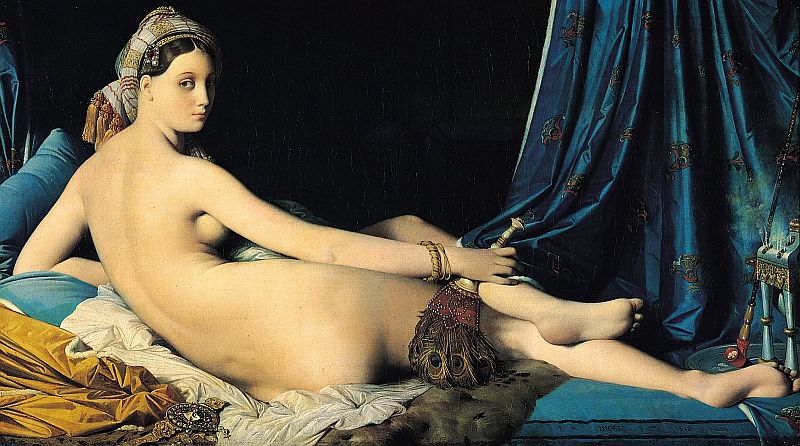
Dominique Ingres
"La Grande Odalisque / La gran odalisca", óleo sobre lienzo / oil on canvas, 91x 162 cm., 1814
Museo del Louvre (Paris, Francia / France)

Les Femmes du Maroc / Las mujeres de Marruecos / Women of Morocco
"La gran odalisca / La Grande Odalisque", 2008

Museo del Louvre / Louvre Museum

Delacroix en "El Hurgador" / in this blog: [Todos los enlaces / All links]
John Singer Sargent en "El Hurgador" / in this blog: [Todos los enlaces / All links]
Léon François Comerre en "El Hurgador" / in this blog: [Arte y Videos (III)], [Recolección (LXXIX)]
Rudolf Ernst en "El Hurgador" / in this blog: [Recolección (LXVII)], [Recolección (LXXXII)]
Dominique Ingres en "El Hurgador" / in this blog: [Todos los enlaces / All links]


Para la muestra "Lalla Essaydi: Revisiones", la artista habla acerca de por qué empezó a pintar y cuales son sus motivaciones.
For the exhibit "Lalla Essaydi: Revisions" the artist spoke about why she began to paint and what motivates her.

__________________________________________________________

Reporte de Carolyn Turner para VOA sobre la muestra de Lalla Essaydi en el Museo Nacional de Arte Africano en Washington.
Artist Lalla Essaydi's work is on display at the National Museum of African Art in Washington, D.C. VOA's Carolyn Turner reports.


Los artistas / The artists

Léon François Comerre, pintor académico francés nacido en 1850, famoso por sus retratos de mujeres hermosas.
Comerre nació en Trélon. Se mudó a Lille con su familia en 1853. Desde edad muy temprana mostró interés en el arte, y se hizo estudiante de Alphonse Colas en la Escuela de Bellas Artes de Lille, ganando una medalla de oro en 1867. Desde 1868, una beca del Département du Nord le permitió continuar sus estudios en París, en la famosa Escuela Nacional de Bellas Artes, en el estudio de Alexandre Cabanel. Allí recibió la influencia del orientalismo.
Comerre expuso por primera vez en París, en el Salón de 1871, y ganó otros dos premios en 1875 y 1881.
Murió en 1916.

Léon François Comerre, French academic painter born in 1850, famous for his portraits of beautiful women.
Comerre was born in Trélon. He moved to Lille with his family in 1853. From an early age he showed an interest in art and became a student of Alphonse Colas at the École des Beaux-Arts in Lille, winning a gold medal in 1867. From 1868 a grant from the Département du Nord allowed him to continue his studies in Paris at the famous École nationale supérieure des Beaux-Arts in the studio of Alexandre Cabanel. There he came under the influence of orientalism.
Comerre first exhibited at the Paris Salon in 1871 and went on to win prizes there in 1875 and 1881.
He died in 1916.
 _______________________________________________________________

Rudolf Ernst, pintor austro-francés nacido en 1854.
Era hijo de un arquitecto y, animado por su padre, comenzó a estudiar en la Academia de Bellas Artes de Viena a los 15 años. Pasó algún tiempo en Roma, copiando a los antiguos maestros, y continuó sus clases con August Eisenmenger y Anselm Feuerbach.
En 1876 se estableció en París. Al año siguiente participó en el primer salón de artistas. Luego viajó a España, Marruevos, Egipto y Estambul para estudiar y documentó lo que allí había visto.
En 1905 se mudó a Fontenay-aux-Roses donde montó un negocio para producir azulejos de loza con motivos orientales. Decoró su casa al estilo otomano y vivió una vida de reclusión. La fecha exacta de su muerte aparentemente no está registrada.
Comenzó como pintor de género, pero desde 1885 se dedicó exclusivamente a pintar con motivos orientalistas, especialmente escenas islámicas, como los interiores de las mezquitas. También pintó escenas de harenes y retrató la vida cotidiana en el norte de África, basándose en fotografías así como en sus propios recuerdos de sus viajes por aquellas regiones. Murió en 1932.

Rudolf Ernst, Austro-French painter, printmaker and ceramics painter born in 1854.
He was the son of an architect and, encouraged by his father, began studies at the Academy of Fine Arts Vienna at the age of fifteen. He spent some time in Rome, copying the old masters, and continued his lessons with August Eisenmenger and Anselm Feuerbach.
In 1876, he settled in Paris. The following year, he participated in his first artists' salon. He later made trips to Spain, Morocco, Egypt and Istanbul to study and document what he saw there.
In 1905, he moved to Fontenay-aux-Roses where he set up a shop to produce faience tiles with orientalist themes. He decorated his home in Ottoman style and lived a reclusive life. His exact date of death was apparently not recorded.
He began as genre painter but, from 1885, he devoted himself exclusively to paintings with orientialist motifs; especially Islamic scenes, such as the interiors of mosques. He also painted harem scenes and portrayals of everyday life in North Africa, based on photographs and prints as well as his own memories from his travels in those regions. He died in 1932.
 _______________________________________________________________

Jean-Auguste-Dominique Ingres, pintor francés neoclásico nacido en 1780. Aunque se consideraba a sí mismo como un pintor historicista en la tradición de Nicolas Poussin y Jacques-Louis David, al final de su vida fueron sus retratos, tanto pinturas como dibujos, los que se reconocen como su gran legado.
Hombre profundamente respetuoso del pasado, asumió el rol de guardián de la ortodoxia académica en contra del ascendente estilo romántico representado por su némesis Eugène Delacroix. Sus ejemplos, explicó una vez, fueron "los grandes maestros que florecieron en aquél siglo de glorioso recuerdo cuando Rafael estableció el marco eterno e incontestable de los sublime en el arte... y yo soy el conservador de la buena doctrina, y no un innovador." Sin embargo la opinión moderna tiende a ver a Ingres y otros neoclasicistas de esta época como imbuídos del espíritu romántico de su tiempo, a la vez que sus expresivas distorsiones de la forma y el espacio hacen de él un importante precursor del arte moderno.

Jean-Auguste-Dominique Ingres, French Neoclassical painter born in 1780. Although he considered himself to be a painter of history in the tradition of Nicolas Poussin and Jacques-Louis David, by the end of his life it was Ingres's portraits, both painted and drawn, that were recognized as his greatest legacy.
A man profoundly respectful of the past, he assumed the role of a guardian of academic orthodoxy against the ascendant Romantic style represented by his nemesis Eugène Delacroix. His exemplars, he once explained, were "the great masters which flourished in that century of glorious memory when Raphael set the eternal and incontestable bounds of the sublime in art ... I am thus a conservator of good doctrine, and not an innovator." Nevertheless, modern opinion has tended to regard Ingres and the other Neoclassicists of his era as embodying the Romantic spirit of his time, while his expressive distortions of form and space make him an important precursor of modern art.