Mostrando entradas con la etiqueta chess. Mostrar todas las entradas

viernes, 29 de julio de 2022

Warren King [Escultura / Sculpture]

Para realizar sus esculturas de cartón, el artista estadounidense Warren King se inspira en personajes relacionados con su patrimonio cultural: habitantes de la aldea china donde nacieron sus abuelos, viandantes de las calles de Chinatown, bailarines, jugadores de ajedrez... El resultado es una colección de figuras de exquisita factura (sobre todo teniendo en cuenta la modestia del material y los exiguos medios técnicos), muchas de ellas a tamaño natural, o incluso mayores, con una sorprendente vitalidad y expresividad. 

To create his cardboard sculptures, the American artist Warren King is inspired by characters related to his cultural heritage: inhabitants from the Chinese village where his grandparents were born, pedestrians from the streets of Chinatown, dancers, chess players... The result is a collection of figures of exquisite workmanship (especially considering the modesty of the material and the meager technical means), many of them life-size, or even bigger, with a surprising vitality and expressiveness. 
_________________________________________________________

Warren King
(Madison, Wisconsin, EE.UU./ WI, USA, 1970-)
en Nueva York / at New York

Warren en su estudio / at his Studio

Warren King es un artista estadounidense, que se crió en los suburbios de Wisconsin, donde nació en 1970.
Hijo de inmigrantes muy trabajadores y disciplinados, no hay antecedentes artísticos en su familia, y en principio hizo lo que se esperaba tanto de él como de sus hermanos: estudiar una carrera universitaria (ingeniero de estructuras), con la idea de convertirse de mayor en sustento del hogar continuando con el negocio familiar.
El arte hizo su aparición bastante más tarde en su vida. Los primeros años de ejercicio de su profesión coincidieron con el boom de las tecnologías de Internet, y muchas compañías de software buscaban gente sin experiencia, que aprendieran rápido y pudieran dedicarle un buen número de horas semanales. Tras varios años de viajes de negocios en plena burbuja de Internet, llegó a la gerencia brindando sus servicios a varias start-ups, hasta que decició dejarlo por un tiempo. Por ese entonces, su familia decidió aprovechar una oportunidad que se presentó para mudarse a Suecia, lo cual abrió la mente de Warren a nuevas posibilidades, y fue allí donde realizó la primera de sus figuras de los aldeanos de Shaoxing.

"Xuanzang", cartón y tinta / board and ink © Warren King
Foto / Photo: Jón Prospero

El estoico personaje está basado en el monje del siglo VII del mismo nombre que recorrió 16.000 kilómetros en la India para recuperar textos budistas y que inspiró la novela clásica "Viaje al Oeste". "Yo mismo fui un ávido mochilero y realicé algunos viajes que definieron mi vida", explica el artista. "Y también soy un empollón de los libros, así que Xuanzang es naturalmente una especie de ídolo para mí". (4)

The stoic character is based on the 7th Century monk by the same name who trekked 10,000 miles into India to recover Buddhist texts and inspired the classic novel, Journey to the West. "I used to be an avid backpacker and made a few life-defining treks myself," the artist shares. "And I’m a book nerd too, so Xuanzang is naturally kind of an idol for me." (4)

Instalación en el Museo Alma Löv / Installation at Alma Löv Museum
(Östra Ämtervik, Suecia / Sweden) © Warren King

"Esposo de Shaoxing 2 / Shaoxing Husband 2", cartón / cardboard, 2016 © Warren King

«Tengo dos hijos, y cuando eran más pequeños les hacía juguetes y disfraces utilizando cualquier material disponible y gratuito.  Todo el mundo tiene cajas viejas en sus armarios, así que utilicé una para hacer mi primera pieza, un casco de Darth Vader para mi hijo. Luego, para Halloween, hice unas cuantas máscaras más, y rápidamente se convirtió en una actividad habitual en nuestra casa. Un gran paso fue cuando me ofrecí para hacer máscaras para una producción teatral del colegio. Se aprende rápido cuando hay que hacer 30 máscaras que soporten el abuso de niños de seis años. Después de unos cuantos años haciendo máscaras, armaduras y juguetes para mis hijos, me volví bastante hábil con el cartón. Entonces, un día mi hijo me retó a hacer algo "más realista, como una cara". Hasta entonces no había hecho ningún proyecto para mí, y me pareció un reto interesante, así que lo intenté. Capturar la expresión humana es cuestión de pequeños matices, por supuesto; un milímetro de ajuste en un rasgo facial puede dar lugar a una sensación completamente diferente. Si no tuviera años de práctica haciendo máscaras de cartón, no creo que tuviera el control sobre el material necesario para hacer figuras humanas.» (2)
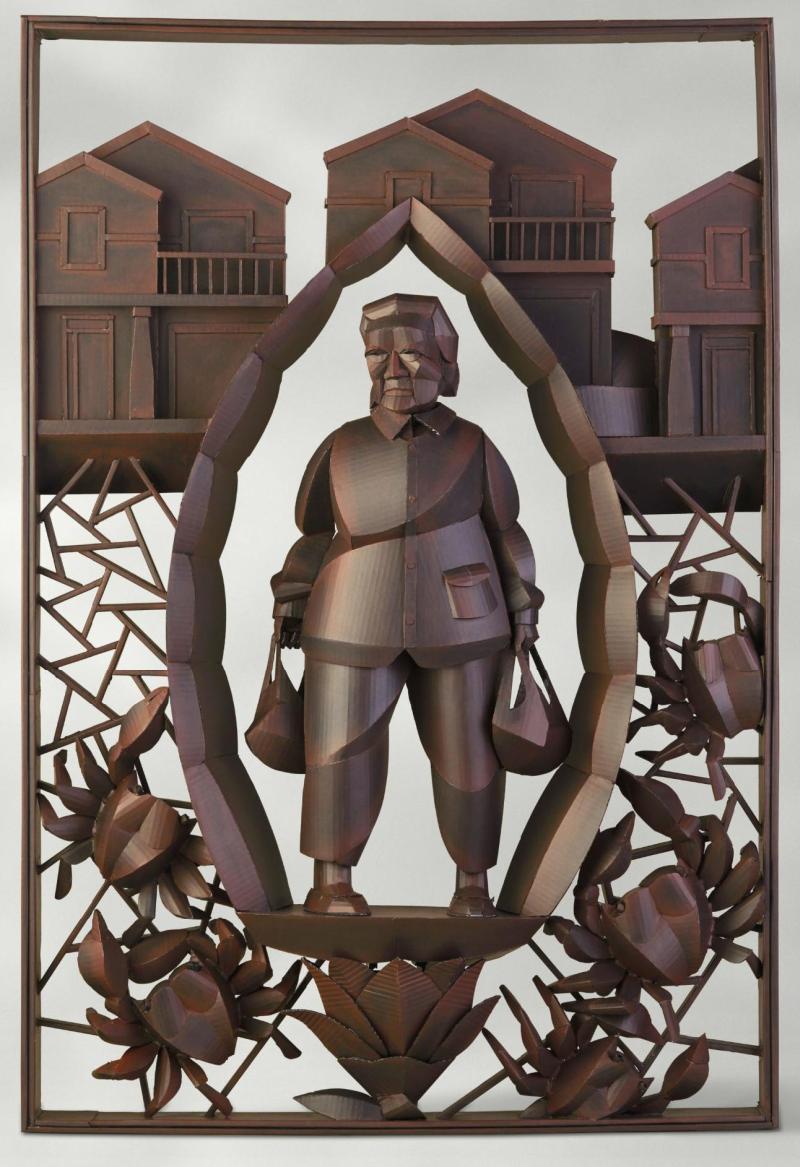
"Cordón para zapatos / String for Shoes"
Cartón corrugado y tinta / corrugated cardboard and ink, 127 × 86 × 10 cm., 2018 © Warren King

"Hombre de Shaoxing, Sonriendo / Shaoxing Man, Smiling", cartón / cardboard, 2015 © Warren King

«En todas mis obras recientes, intento contar una historia. Algunas de estas historias proceden de la experiencia personal, pero muchas se basan en narraciones sobre personajes de la historia o cuentos populares. Y otras son puramente imaginarias, inspiradas en una foto o quizá en un artefacto u objeto. Así que miro muchas fotos documentales, hablo con los miembros de la familia, leo sobre acontecimientos de la historia. Lo que busco es algo que arroje luz o plantee una pregunta sobre mi conexión con mi cultura y mis antepasados. Y luego trato de desarrollar formas de expresar visualmente estas conexiones. Sinceramente, esta es la parte que más me cuesta. Viniendo de una formación de ingeniería y análisis, en la que las cosas tienen que ser explícitas, me ha costado aprender a usar imágenes, metáforas e iconografía para evocar una respuesta emocional. Pero por eso estoy tan agradecido por la oportunidad de hacer arte en este momento de mi vida; me está dando la oportunidad de explorar una forma de pensar totalmente nueva. Me sigue fascinando la reacción de la gente ante mi obra cuando la muestro en público, ver que la gente conecta de forma poderosa y personal con estas figuras que he hecho con mis manos. Y las reacciones no siempre son positivas. Me costó un tiempo aceptar que cada persona tendrá una respuesta diferente a mi trabajo, y que está bien que así sea.» (2)

"Sentado en un banco del Parque Columbus / Columbus Park Bench Sitter", cartón / cardboard © Warren King

"400 manzanas al día y otras mentiras / 400 Apples a Day and Other Lies"
Cartón, tinta acrílica / cardboard, acrylic ink, altura / height: 40", 2018 © Warren King

La Emperatriz viuda Cixi (慈禧太后), del clan manchú Yehe Nara, fue una noble china, concubina y posteriormente regente que controló eficazmente el gobierno chino a finales de la dinastía Qing durante 47 años, desde 1861 hasta su muerte en 1908.
Esta obra, inspirada en la controvertida vida de la emperatriz, trata de reivindicar la historia auténtica, frente a quienes pretenden empañarla.

Empress Dowager Cixi (慈禧太后), of the Manchu Yehe Nara clan, was a Chinese noblewoman, concubine and later regent who effectively controlled the Chinese government in the late Qing dynasty for 47 years, from 1861 until her death in 1908.
This work, inspired by the controversial life of the Empress, is about reclaiming one's own story from those who seek to tarnish you.

"Tang Sanzang", cartón / cardboard, 2019 © Warren King
Maestro del Rey Mono, caminante épico. Compasivo, idealista, totalmente indefenso ante los males del mundo /
Monkey King’s teacher, epic trekker. Compassionate, idealistic, utterly defenseless against the evils of the world.

"Esposo de Shaoxing / Shaoxing Husband"
Cartón corrugado y tinta / corrugated cardboard and ink, 165 × 74 × 46 cm., 2019 © Warren King

"Durante mi primer viaje a China visité el pueblo y hablé con los residentes que recordaban a mis abuelos de hace más de 50 años", cuenta King. "Fue una experiencia fundamental para mí, que me inspiró a convertirme en artista. A través de mi trabajo, intento comprender las frágiles conexiones con la gente y la cultura, y examinar si esas conexiones, una vez rotas, pueden restaurarse". (3)

"En la recreación de los habitantes del pueblo natal de sus abuelos, un individuo a la vez, los lugares comunes son materiales desechados que utiliza en relación con la naturaleza de las conexiones que intenta reconstruir. Las formas se abstraen, y las espaldas de las figuras quedan inacabadas, revelando la oquedad y la meticulosa construcción del artista. Su obra no trata tanto de los individuos representados como de sus propios intentos de comprenderlos, y también de las limitaciones de estos esfuerzos". (1)

Warren se inspira en "músicos callejeros, jugadores de ajedrez en Columbus Park, vendedores de verduras, vendedores de bolsos de imitación en Canal Street, bailarines de leones durante las celebraciones del Año Nuevo chino", cuenta a Colossal. "Me ha fascinado durante mis viajes semanales a la tienda de comestibles la vibrante y diversa comunidad de Chinatown (Nueva York), que es tan diferente de los suburbios relativamente homogéneos donde crecí". (4)

"Abuela, enmascarada / Grandmother, Masked" (frontal y trasera / front and back)
Cartón y tinta / cardboard and ink, 2016 © Warren King

"El Wu Dan responde al llamado / The Wu Dan Answers the Call" © Warren King
Cartón ondulado de archivo y tinta / Corrugated board and ink, 127 × 64 × 51 cm., 2019
Foto / Photo: Satoshi Kobayashi

Con este personaje, dice Warren, "quería contar la historia de mi aguerrida abuela, que de joven intentó alistarse en la sangrienta lucha contra los japoneses. Pero la obra es una mezcla de un personaje de la ópera china y la famosa escultura del David de Donatello, que refleja las dos lentes a través de las que veo la historia" (2)

With this character “I wanted to tell the story of my feisty grandmother, who as a young woman tried to enlist in the bloody fight against the Japanese. But the piece is a mashup of a character from Chinese opera and Donatello’s famous sculpture of David, which reflects the two lenses through which I view the story,” he says. (2)

Warren trabajando en "Hombre en cuclillas Nº 1" / at work with "Squatting Man #1"

Warren King is an American artist, who grew up in the suburbs of Wisconsin, where he was born in 1970.
The son of hard-working and disciplined immigrants, there is no artistic background in his family, and he initially did what was expected of him and his siblings: study a university degree (structural engineer), with the idea of becoming a breadwinner by continuing the family business when he grew up.
Art made its appearance much later in his life. The first years of his career coincided with the boom of Internet technologies, and many software companies were looking for inexperienced people who could learn quickly and dedicate a good number of hours per week. After several years of business travel in the middle of the Internet bubble, he became a manager providing his services to several start-ups, until he decided to leave for a while. Around that time, his family decided to take advantage of an opportunity to move to Sweden, which opened Warren's mind to new possibilities, and it was there that he made the first of his Shaoxing villagers figures.

"Hombre en cuclillas Nº 1 / Squatting Man #1"
Cartón / cardboard, 180 x 140 x 120 cm., 2015 © Warren King

"Invasores y nietos / Invaders and Grandsons"
Cartón corrugado y tinta / corrugated cardboard and ink, 79 × 53 × 53 cm., 2019 © Warren King

«I have two kids, and when they were younger I would make toys and costumes for them using whatever materials were available and free.  Everyone has old boxes in their closets, so I used one to make my first piece, a Darth Vader helmet for my son. Then for Halloween, I made a few more masks, and then it quickly became a regular activity in our house. A big step was when I volunteered to provide masks for a school theater production. You learn quickly when you have to make 30 masks that can withstand abuse from six year olds. After a few years of making masks, armor and toys for my kids, I got pretty proficient with cardboard. Then one day my son challenged me to make something “more realistic, like a face”. I hadn’t really done any projects for myself up until then, and this seemed like an intriguing challenge, so I gave it a shot. Capturing human expression is all about tiny nuances, of course; a millimeter of adjustment to a facial feature can result in a completely different feeling. If I didn’t have years of practice making masks out of cardboard, I don’t think I would have the control over the material necessary to make human figures.» (2)

"Esposa de Shaoxing / Shaoxing Wife"
Cartón corrugado y tinta / corrugated cardboard and ink, 160 × 71 × 41 cm., 2019 © Warren King

 © Warren King

«In all of my recent works, I’m trying to tell a story. Some of these stories come from personal experience, but many are based on narratives about figures in history or folk tales. And some are purely imagined, inspired by a photo or maybe an artifact or object. So I look at a lot of documentary photos, I talk to family members, I read about events in history. What I’m looking for is something that sheds light on or raises a question about my connection to my culture and ancestors. And then I try to develop ways to visually express these connections. Honestly, this is the part that I struggle with the most. Coming from an engineering and analytical background, where things have to be explicitly stated, I’ve been struggling to learn how to use imagery, metaphor and iconography to evoke an emotional response. But this is why I’m so grateful for the opportunity to make art at this point in my life; it’s giving me a chance to explore a totally new way of thinking. I am still fascinated by people’s reactions to my work when I show it publicly, to see people connecting in a powerful and personal way to these figures that I’ve made with my hands. And the reactions are not always positive. It took me a while to accept that different people will have different responses to my work, and that it’s totally fine if they do.» (2)

"Mujer de Shaoxing Nº 19 / Shaoxing Woman #19", cartón / cardboard, 2016 © Warren King

"Hombre de Shaoxing Nº 18 / Shaoxing Man #18", cartón / cardboard © Warren King

"Hombre de Shaoxing Nº 18 / Shaoxing Man #18" (detalle / detail) © Warren King

"During my first visit to China about 7 years ago, I visited the village and spoke with residents who actually remembered my grandparents from over 50 years ago," said King. "It was a pivotal experience for me, one that inspired me to become an artist. Through my work, I am attempting to understand the fragile connections to people and culture, and examine whether those connections, once broken, can be restored." (3)

"In the recreation of the residents of his grandparents’ home village, one individual at a time, the commonplace are discarded materials that he uses relate to the nature of the connections he is attempting to reconstruct. The forms are abstracted, and the backs of the figures are left unfinished, revealing hollowness and the artist’s meticulous construction. His work is not so much about the individuals that are represented as it is about his own attempts to understand them, and also the limitations of these efforts." (1)

"Bailarín del león / Lion Dancer", cartón / cardboard, 2020 © Warren King

"Bailarín del león / Lion Dancer" (detalle / detail) © Warren King

"Jugadores de ajedrez / Chess Players", cartón / cardboard, 2020. Foto / Photo: Jón Prospero © Warren King

Warren draws inspiration from "street musicians, chess players in Columbus Park, vegetable sellers, knockoff handbag vendors on Canal Street, lion dancers during Chinese New Year celebrations,” he tells Colossal. "I’ve been fascinated during my weekly grocery shopping trips by the vibrant, diverse community there, which is so different from the relatively homogenous suburbs where I grew up." (4)

"Mujer de Shaoxing, Sentada / Shaoxing Woman, Seated", cartón / cardboard, 2015 © Warren King

"El emperador se toma un descanso / The Emperor Takes Five"
Cartón / cardboard, altura / height: 30", 2018 © Warren King

Fuentes / Sources:
* (1) Sobre / About Warren King. Website
* (2) Entrevista de / Interview by Y-Jean Mun-Delsalle
"Preguntas y respuestas, con Warren King, que convierte el cartón en arte" /
"Q&A With Warren King Who Turns Cardboard Into Art", Forbes, 1/4/2020
* (3) Artículo de / Article by Grace Ebert. Colossal, 7/2022
"Las esculturas de cartón del artista Warren King son un homenaje a su herencia china /
The Cardboard Sculptures of Artist Warren King Are an Homage to His Chinese Heritage"
* (4) Artículo de / Article by Kate Sierzputowski. Colossal, 12//2017
"Las esculturas de cartón a tamaño natural de aldeanos chinos sacan partido de la herencia ancestral del artista Warren King /
Life-Size Cardboard Sculptures of Chinese Villagers Tap Into Artist Warren King’s Ancestral Heritage"
_____________________________________________________________

Más sobre / More about Warren King: Website, Instagram, facebook

Imágenes publicadas con autorización del artista. ¡Muchas gracias, Warren!
Images published here with artist's permission. Thanks a lot, Warren!

miércoles, 9 de junio de 2021

Uruguayos / Uruguayans (LIV) - Fabián Mendoza [Pintura, Entrevista / Painting, Interview]

Con esta nueva entrevista de Shirley Rebuffo presentamos a Fabián Mendoza, pintor uruguayo con una obra extensa y personal plagada de singulares personajes e insólitas situaciones que incitan al observador al juego de construir su propia narrativa.
Texto en inglés al final del post.

With this new interview by Shirley Rebuffo we present Fabián Mendoza, Uruguayan painter with an extensive and personal work full of unique characters and unusual situations that encourage the observer to play the game of constructing his own narrative.
Text in English at the end of this post.
________________________________________________________

Fabián Mendoza Garciarena
(Mercedes, Soriano, Uruguay, 1966-)

Fabián Mendoza

Fabián Mendoza es un pintor uruguayo nacido en Mercedes, Departamento de Soriano, en 1966. Desde hace 15 años vive y trabaja en Montevideo.
Si bien su formación es esencialmente autodidacta, aprendió desde los 17 años con los que él consideró sus maestros: Jaime Parés y Fernando Cabezudo. En estos encuentros, que incluso podían ser fortuitos, en un café o en la plaza del pueblo, se hablaba de filosofía, de la libertad, del arte y la condición humana".
Ha presentado su obra en numerosas muestras colectivas, y varias exposiciones individuales en Montevideo (Centro Cultural Tractatus, 2015; Galería Doris Luecker, 2010; Centro Cultural Anyway Mdes, 2002) y Santiago de Chile (Instituto Cultural Banco del Estado, 1997)
Ha recibido varios premios desde 1993, y sus obras se encuentran en colecciones particulares de Argentina,  Alemania, Austria, Australia, Suiza, Portugal, México, EEUU, Canadá, Brasil, Chile, Paraguay y Uruguay.

Obra / Work # 449. "Jonás / Jonah", óleo sobre lienzo / oil on canvas, 125 x 150 cm., 2017

Obra / Work # 419. "Ícaro / Icarus", óleo sobre lienzo / oil on canvas, 125 x 158 cm., 2014

Entrevista de Shirley Rebuffo

Shirley Rebuffo: ¿Cómo nace tu inclinación por la pintura?
Fabián Mendoza: Sospecho que desde siempre. Los recuerdos más lejanos en el tiempo se remontan a la época en que iba al jardín de infantes; tenía entonces 3 años y me maravillaba ver cómo otro niño dibujaba las antenas de tv con un detalle que yo jamás había reparado en tales estructuras. Creo que ahí comencé a mirar distinto, de un modo que podríamos llamar consciente. Más adelante, en las penitencias que me imponía mi madre para evitar que corriera haciendo ruido por toda la casa sin dejar en paz a nadie (en la pequeña ciudad del interioir de donde provengo las siestas son algo así como un estadio sagrado de la gente) y en esa suerte de “medidas cautelares” para evitar tener un remolino en la casa, era cuando marchaba en penitencia a una habitación que hacía las veces de biblioteca (aunque nunca la llamábamos así, era simplemente la habitación de los libros), donde pasaba mis horas de penitente siestero. Revolviendo aquellos anaqueles me encontré con las enciclopedias que se llamaban ARTE/RAMA. Abrir aquellas páginas fue para aquel niño de 6 o 7 años algo así como un portal dimensional. Allí estaban Leonardo, Rafael, Botticelli, Caravaggio, el Bosco, Goya… Además de quedar fascinado sentí que aquellas personas me querían decir algo, que "me estaban hablando".

Obra / Work # 453. "Alquimia / Alchemy", óleo sobre lienzo / oil on canvas, 90 x 115 cm., 2018

Obra / Work # 405. "Quo Vadis XVI", óleo sobre lienzo / oil on canvas, 2012

SR: ¿Tu familia alentó el ejercicio de tus inclinaciones artísticas?
FM: Sí, absolutamente. Si bien era una familia de modesta condición económica, jamás me faltaron crayones y hojas de papel de estrasa. Tampoco mis padres ponían objeciones cuando comenzaba a cortar cartones de cajas de zapatos o de remedios para fabricar mis propios juguetes, salvo una vez que corté un pedazo de una de las cortinas (creo que se llamaba tul aquella tela) que a mí me parecieron ideales para fabricar una red de los arcos de fútbol de mis jugadores hechos con tapitas de refrescos a los que les dibujaba sus camisetas de colores. Salvo por estos inconvenientes de recortar los números del almanaque para las camisetas de los jugadores y la cortina para los arcos de fútbol, fui un niño bastante libre.

Obra / Work # 420. "Gambito de dama (Pentinente y gallo) / Queen's Gambit (Penitent and Rooster)"
Técnica mixta / mixed media, 130 x 150 cm., 2014

"Quo vadis XV", óleo sobre lienzo / oil on canvas, 108 x 130 cm., 2014

SR: ¿Quiénes te inspiraron?
FM: Todos, desde el arte clásico a los comics, la literatura, el cine. Cualquier manifestación trataba de absorberla casi con silenciosa voracidad.

SR: ¿Podrías referirte a las claves de tu trabajo?
FM: Precisamente eso. Trabajo, mucho trabajo, mucha observación y juego entre el ensayo y el error.

Obra / Work # 418. "Viaje en tercera mayor / Travel in Major Third"
Óleo sobre lienzo / oil on canvas, 116 x 154 cm., 2014

"El sueño del ángel / The Dream of The Angel", óleo sobre lienzo / oil on canvas, 100 x 120 cm., 2015

SR: ¿Cuál fue el momento en que sentiste mayor libertad en tu vida artística?
FM: Desde siempre. Quien fuera mi maestro, Jaime Pares, me dijo algo que me quedó grabado a fuego. Es un axioma cuasi sagrado para mí y lo he respetado a rajatabla. Me dijo: "muchacho, en esto de pintar hay dos caminos: o haces lo que esperan que hagas o haces lo que quieres hacer. Cualquiera de las dos opciones podrán ser válidas, pero cualquiera sea la opción que tomes te llevará por distintos caminos. En el primero es probable que al cabo de unos años no sepas ni quién eres, el segundo es el más difícil, porque habrás de saber que ese espacio de tela en blanco (señalando un bastidor) quizá sea el único espacio de libertad que tengas en tu vida, y evitar profanar ese espacio será tu tarea si quieres ser un verdadero artista".

Obra / Work # 422. "Sinfonía concertante / Concertante Symphony"
Óleo sobre lienzo / oil on canvas, 125 x 160 cm., 2014. Colección privada / Private Collection (Argentina)

"El sueño del pibe / The Boy's Dream", óleo sobre lienzo / oil on canvas, 130 x 150 cm., 2013

SR: ¿Alguna vez has tenido un conflicto al enfrentarte a una tela vacía? ¿Cómo se resolvió?
FM: No un conflicto como tal, pero sí he sentido el abismo del vacío, del espacio sagrado, como te decía antes, y lo he resuelto dibujando, a veces saliendo a caminar sin rumbo, a veces pensando qué vería el niño revoltoso que fui si se viera en silencio y sin saber por dónde comenzar frente a la tela en blanco. Pero básicamente lo que me trajo hasta aquí es la clave para sortear esos momentos, y es trabajar, pensar lo ya pensado, dibujar una y otra vez hasta que aparezca lo que quiero.

SR: ¿Cuál es tu técnica preferida? ¿Qué te es imprescindible para trabajar?
FM: Trabajo desde hace ya muchos años sólo con óleos y lo que resulta imprescindible para trabajar es algo que jamás me pregunté; si quieres hacer algo lo puedes hacer con un pedazo de ladrillo o con un tizón. Digamos que no tengo "exigencias" a priori para trabajar más que estar convencido que he alcanzado algo, un boceto o una idea que me agrade.

Obra / Work # 404. "Realidad Virtual / Virtual Reality", óleo sobre lienzo / oil on canvas, 130 x 150 cm., 2012

SR: ¿Eres metódico para trabajar?
FM: Sí. Desde la concepción del bastidor, que yo mismo elaboro, la elección del tipo de lienzo, la imprimación y hasta de la fabricación en algunos casos de mis propios óleos. Para todo esto se necesita método y aplicación.

Fabián Mendoza trabajando en su obra "De negras noches y blancos días" /
at work with "Of Black Nights and of White Days"

Inspirado en el poema de Jorge Luis Borges "Ajedrez

“También el jugador es prisionero
(la sentencia es de Omar) de otro tablero
de negras noches y de blancos días.

Dios mueve al jugador, y éste, la pieza.
¿Qué Dios detrás de Dios la trama empieza
de polvo y tiempo y sueño y agonía?”

Jorge Luis Borges en "El Hurgador" / in this blog: [Todos los enlaces / All Links]

"Obra / Work # 477". "De negras noches y blancos días / Of Black Nights and of White Days"
Óleo sobre lienzo / oil on canvas, 125 x 150 cm., 2021

Inspired by Jorge Luis Borges' poem "Chess"

The player also is a prisoner
(The saying is Omar's) of another board
Of black nights and of white days.
 
God moves the player, and he, the piece.
Which god behind God begets the plot
Of dust and time and dream and agonies?

"Crónica de un hombre solo / Chronicle of a Lonely Man"
Óleo sobre tela / oil on canvas, 130 x 160 cm., 2011

SR: Tu exacerbada imaginación hace a tus obras orbiten en un contexto amable, construido a través del realismo mágico y el surrealismo con un sentido lúdico y misterioso. ¿Qué hay detrás de tu lenguaje?
FM: No sé si estoy de acuerdo acerca de lo amable, creo sí que son aparentemente amables y creo también que hay en muchas de mis pinturas distintos niveles, capas de lecturas posibles. Algunas veces es solo un pequeño juego y otras un acertijo. Aquello qué hay detrás de mi lenguaje, es algo que prefiero no revelar porque le estaría quitando la posibilidad a quien se enfrente a una de estas telas, lo condicionaría (y no es la idea) coartando el juego de encontrar sus propias respuestas, quizás descubrir algo o arribar a lugares insospechados.

Obra / Work # 446. "Entre el Cielo y Maljut I / Between Heaven and Malkuth I"
Díptico, El Interior / Diptych, The Interior, óleo sobre lienzo / oil on canvas, 115 x 154 cm., 2017

Obra / Work # 447. "Entre el Cielo y Maljut II / Between Heaven and Malkuth II"
Díptico, El Exterior / Diptych, The Exterior, óleo sobre lienzo / oil on canvas, 115 x 154 cm., 2017

Obra / Work # 454. "Tocata y Fuga / Toccata and Fugue"
Óleo sobre lienzo / oil on canvas, 120 x 150 cm., 2018

Obra / Work # 421. "Aprendiz y Eclipse / Apprentice and Eclipse"
Óleo sobre lienzo / oil on canvas, 125 x 160 cm., 2014

SR: ¿Cómo es tu proceso de trabajo? ¿En qué orden eliges los espacios, los personajes...?
FM: Trato de encontrar una idea y luego pienso si esa idea se puede mejorar, y luego otra y otra; voy rayando hojas, y a veces aparece algo buscado y otras veces algo mejor de lo que buscaba, y sigo por ese camino. No hay un orden exacto; a veces a partir de un color, o una emoción casi abstracta, o una mirada en la calle, nunca se sabe cuál puede ser el disparador, pero sí importa en qué frecuencia estás mirando o viendo.

SR: ¿Con el paso de los años, te ha ido resultando más fácil plasmar lo que tienes en mente?
FM: Sí, es la ventaja que dan tantos años de tratar de conocer una técnica, pero es también un desafío cada vez.

Obra / Work # 444. "La mesa / The Table", óleo sobre lienzo / oil on canvas, 117 x 154 cm., 2017

Obra / Work # 417. "Tres Maestros Carpinteros / Three Master Carpenters"
Óleo sobre lienzo / oil on canvas, 130 x 150 cm., 2014

SR: ¿Cuáles son las cosas que te apasionan?
FM: La vida toda, la condición y tragedia humana, la historia, la música barroca, la mujer que es la prueba de la existencia de Dios ¿Quién sino una divinidad la habría creado?

SR: ¿Si te digo "jaque mate", a qué te lleva?
FM: A mirar el tablero. Procuro que mi rey esté siempre bien defendido. Los dameros o tableros no siempre representan el ajedrez, aunque el ajedrez es como un cuerpo simbólico de la condición humana. Evidentemente allí están simbolizadas sus pasiones y sus tragedias, la guerra y la paz.

"El día despúes / The Day After", óleo sobre lienzo / oil on canvas, 115 x 85 cm., 2020

SR: ¿Qué visión te han dado tus viajes?
FM: Que solo somos una partícula flotando en el espacio tiempo. Esta sola pregunta y mis probables respuestas, tal vez absurdas, podrían ocuparte demasiado espacio. Depende cuál sea el viaje; te puedes trasladar de continente y que no tenga efecto en ti. Todo depende qué viaje estés haciendo, y cada quien emprende el viaje para el que está preparado. 

SR: ¿Qué proyectos tienes ahora entre manos?
FM: El mismo que tuve cuando empecé a pintar: entender a cabalidad por qué esta necesidad de pintar y si es posible lograr hacer una obra maestra, pero esto último es un todo de poner el cielo lejos, para no cejar en el esfuerzo que tanto me gusta.

Obra / Work # 450. "Tycho Brahe", óleo sobre lienzo / oil on canvas, 120 x 120 cm., 2018
___________________________________________________________

Microcosmos imaginario

«Un primer punto insoslayable, es su autodefinición de "Pintor" por sobre la grandilocuente definición de "Artista", algo que nos sitúa en el centro de su visión y de sus trabajos. Asimismo y en un ejercicio fundamental de coherencia, Mendoza es un Pintor integral a tiempo completo.

El oficio tal cual lo concibe Mendoza implica resolver y preparar cada uno de los elementos que utiliza. Desde los caballetes, pasando por la elección del lienzo, ingletar, armar los bastidores, tensar, e imprimar. Pero va todavía más allá. Ya que también prepara sus pinturas, amalgamando aceites, tierras de colores, etc. Toda una odisea para recién llegar al desafío de la tela en blanco.

Basta examinar las obras de Mendoza para comprobar que conoce perfectamente todas las aristas y complejidades de la pintura al óleo: empastes, veladuras, raspados, collages, esgrafiados, el trabajo con capas, diluciones, rodillos tallados, etc. forman parte de un completo abanico de soluciones capaces de resolver conjugados con el gesto pictórico cualquier desafío creativo.

Normalmente las figuras, o el grupo de ellas, ocupan el centro de la tela, rodeados de accesorios, a veces tan intrincados como inútiles, pero capaces de contribuir a un relato, a una historia única. No veremos horizontes, si bien hay un cuidado uso de la perspectiva y de planos que se suceden para generar una idea de la espacialidad tan difusa como el concepto de lo temporal.

Su dibujo, que domina a la perfección es producto de lo que minuciosamente ha planeado, nada escapa al meticuloso proceso de la composición.

[Sus personajes son una] Mezcla de duendes o gnomos que nos miran a través de ojos entrecerrados, a veces en forma displicente, a veces desafiantes, otras veces ignorando al casual espectador, siempre serenos y en ocasiones, misteriosamente enmascarados.
Mayoritariamente masculinos, indefectiblemente vistiendo la más diversa colección de sombreros, desde un simple bombín hasta enormes galeras, incluso objetos como un embudo, o diversas cacerolas.
Mendoza es un maestro en el concepto del "no lugar".

Si bien se pueden reconocer interiores, espacios abiertos, fondos casi planos, en realidad nada hace referencia a un lugar real o reconocible. En esos espacios flotan nubes de cartón, nadan peces, se ubican muebles con infinidad de cajoncitos, donde generalmente el piso o alguna de las superficies es uno de sus infaltables dameros donde la perspectiva es perfecta y las líneas de fugas son a veces los ejes centrales de la composición.

Estos microcosmos están plagados de máquinas, instrumentos, herramientas, vehículos que me recuerdan a las invenciones e investigaciones de Leonardo Da Vinci así como el uso de la escritura espejo como travesura.

Extracto de "Microcosmos imaginarios". Claudio Del Pup - Durik, Enero de 2018. Texto completo aquí.

Obra / Work # 391. "El fin del juego / The End of the Game"
Óleo sobre lienzo / oil on canvas, 150 x 130 cm., 2011

Más sobre / More about Fabián Mendoza: facebook, Galería Ciudadela

Muchas gracias por la entrevista, Fabián!
Thanks a lot for the interview, Fabián!
__________________________________________________

Shirley Rebuffo es Licenciada en Bibliotecología y Archivología por la Escuela Universitaria de Bibliotecología y Ciencias Afines (Montevideo, Uruguay), Técnica en Museología por la Facultad de Humanidades y Ciencias (opción de Antropología), Objeto, símbolo y espacio en Curaduría. Museología Aplicada y Museología Social – Conceptos, técnicas y prácticas (Campo Grande, BR), Coaching (Campo Grande, BR), Planeamiento Estratégico (Campo Grande, BR) y estudiante de arte y pintura con el maestro Eduardo Espino.

Shirley Rebuffo has a Degree in Library Science and a Degree in Archivology by the Universitary School of Library and Related Sciences (Montevideo, Uruguay), Technician in Museology by the Faculty of Humanities and Sciences (Anthropology option), Object, Symbol and Spance in Curatorship Applied Museology and Social Museology - Concepts, Technics and Practice (Campo Grande, Brazil), Coaching (Campo Grande, Brazil), Strategic Planning (Campo Grande, Brazil), and Art and Painting student under Master Eduardo Espino.
________________________________________________________

Text in English

Fabián Mendoza. Foto / Photo: Celeste Carnevale. Revista Dossier

Fabián Mendoza is a Uruguayan painter born in Mercedes, Department of Soriano, in 1966. He has been living and working in Montevideo for 15 years.
Although his training is essentially self-taught, he learned from the age of 17 with what he considered his teachers: Jaime Parés and Fernando Cabezudo. In these meetings, which could even be fortuitous, in a café or in the town square, they talked about philosophy, freedom, art and the human condition".
He has presented his work in numerous group shows, and held several solo exhibitions in Montevideo (Tractatus Cultural Center, 2015; Doris Luecker Gallery, 2010; Anyway Mdes Cultural Center, 2002) and Santiago de Chile (Banco del Estado Cultural Institute, 1997).
He has received several awards since 1993, and his works are in private collections in Argentina, Germany, Austria, Australia, Switzerland, Portugal, Mexico, USA, Canada, Brazil, Chile, Paraguay and Uruguay.

Interview by Shirley Rebuffo

Shirley Rebuffo: How did your inclination for painting come about?
Fabián Mendoza: I suspect it has always been there. The most distant memories go back to the time when I was in kindergarten; I was then 3 years old and I was amazed to see how another child drew TV antennas with a detail that I had never noticed in such structures. I think that's when I began to look differently, in a way that we could call conscious. Later, when I was grounded by my mother to prevent me from running around the house making noise without leaving anyone alone (in the small town where I come from, naps are something like a sacred stage of the people) and in that kind of "precautionary measures" to avoid having a whirlwind in the house, was when I was grounded in a room that served as a library (although we never called it that, it was simply the room of books), where I spent my hours as a grounded during naptime. Flipping through those shelves I came across the encyclopedias called ARTE/RAMA. Opening those pages was for that 6 or 7 year old boy something like a dimensional portal. There were Leonardo, Raphael, Botticelli, Caravaggio, Bosch, Goya... Besides being fascinated I felt that those people wanted to tell me something, that they were "talking to me".

SR: Did your family encourage your artistic inclinations?
FM: Yes, absolutely. Although I was from a family of modest economic condition, I never lacked crayons and sheets of scrap paper. My parents didn't object when I started to cut cartons from shoeboxes or medicine boxes to make my own toys, except once when I cut a piece of one of the curtains (I think that fabric was called tulle) that I thought was ideal to make a net for my players' soccer goals out of soda caps, and I drew their colored jerseys on them. Except for these inconveniences of cutting out the almanac numbers for the players' jerseys and the curtain for the soccer goals, I was a pretty free child.

SR: Who inspired you?
FM: Everyone, from classical art to comics, literature, cinema. Any manifestation I tried to absorb almost with silent voracity.

SR: Could you talk about the keys to your work?
FM: Precisely that. Work, a lot of work, a lot of observation and play between trial and error.

SR: What was the moment when you felt the most freedom in your artistic life?
FM: Always. My teacher, Jaime Pares, told me something that was engraved in my heart. It is a quasi-sacred axiom for me and I have respected it to the letter. He told me: "boy, there are two ways in painting business: either you do what they expect you to do or you do what you want to do. Either of the two options may be valid, but whichever option you take will lead you down different paths. In the first one you probably won't even know who you are after a few years, the second one is the most difficult, because you will have to know that that blank canvas space (pointing to a canvas) may be the only space of freedom you have in your life, and avoiding profaning that space will be your task if you want to be a true artist".

SR: Have you ever had a conflict when facing an empty canvas? How did you resolve it?
FM: Not a conflict as such, but I have felt the abyss of emptiness, of sacred space, as I was telling you before, and I have solved it by drawing, sometimes going for a walk aimlessly, sometimes thinking what the unruly child I was would see if he saw himself in silence and not knowing where to start in front of the blank canvas. But basically what brought me here is the key to get around those moments, and that is to work, think what I have already thought, draw again and again until what I want appears.

SR: What is your favorite technique and what is essential for you to work with?
FM: I've been working for many years only with oils and what is essential to work with is something I've never asked myself; if you want to do something you can do it with a piece of brick or a piece of charred stick. Let's say that I have no a priori "demands" to work with other than being convinced that I have achieved something, a sketch or an idea that pleases me.

SR: Are you methodical in your work?
FM: Yes, from the conception of the stretcher, which I make myself, the choice of the type of canvas, the priming and even in some cases the making of my own oil paintings. All of this requires method and application.

SR: Your exacerbated imagination makes your works orbit in a friendly context, built through magical realism and surrealism with a playful and mysterious sense. What is behind your language?
FM: I don't know if I agree about "friendly", I think they are apparently kind and I also think that there are in many of my paintings different levels, layers of possible readings. Sometimes it's just a little game and sometimes it's a riddle. What is behind my language is something I prefer not to reveal because I would be taking away the possibility of those who face one of these canvases, I would condition them (and this is not the idea), restricting the game of finding their own answers, perhaps discovering something or arriving to unsuspected places.

SR: What is your work process like? In what order do you choose the spaces, the characters...?
FM: I try to find an idea and then I think if that idea can be improved, and then another and another; I keep scratching sheets, and sometimes something I was looking for appears and sometimes something better than what I was looking for, and I follow that path. There is no exact order; sometimes from a color, or an almost abstract emotion, or a look in the street, you never know what the trigger might be, but it does matter how often you are looking or seeing.

SR: Over the years, have you found it easier to capture what you have in mind?
FM: Yes, that's the advantage of so many years of trying to get to know a technique, but it's also a challenge every time.

SR: What are the things you are passionate about?
FM: All of life, the human condition and tragedy, history, baroque music, the woman who is the proof of God's existence, who else but a divinity would have created her?

SR: If I tell you "checkmate", what does it lead you to?
FM: To look at the board. I try to make sure my king is always well defended. The checkerboards do not always represent chess, although chess is like a symbolic body of the human condition. Evidently, its passions and tragedies, war and peace, are symbolized there.

SR: What insights have your travels given you?
FM: That we are just a particle floating in spacetime. This question alone and my probable answers, perhaps absurd, might take up too much space. It depends on what the journey is; you can move continents and have no effect on you. It all depends on what journey you are taking, and everyone takes the journey they are prepared for. 

SR: What projects are you working on now?
FM: The same I had when I started painting: to fully understand why this need to paint and if it is possible to achieve a masterpiece, but the latter is a whole to put the sky far away, to not give up in the effort that I like so much.
_____________________________________________________

Imaginary Microcosms

A first unavoidable point is his self-definition of "Painter" over the grandiloquent definition of "Artist", something that places us in the center of his vision and his works. Likewise, and in a fundamental exercise of coherence, Mendoza is a full-time integral painter.

The craft as Mendoza conceives it implies solving and preparing each of the elements he uses. From the easels, through the choice of canvas, mitering, assemble the frames, tensioning, and priming. But he goes even further. He also prepares his paints, amalgamating oils, colored earths, etc. Quite an odyssey to reach the challenge of the blank canvas.

It is enough to examine Mendoza's works to see that he knows perfectly all the edges and complexities of oil painting: impasto, glazes, scratches, collages, sgraffito, working with layers, dilutions, carved rollers, etc. are part of a complete range of solutions capable of solving any creative challenge combined with the pictorial gesture.

Normally the figures, or a group of them, occupy the center of the canvas, surrounded by accessories, sometimes as intricate as useless, but capable of contributing to a story, to a unique history. We will not see horizons, although there is a careful use of perspective and planes that follow one after the other to generate an idea of spatiality as diffuse as the concept of time.

His drawing, which he masters to perfection, is the product of what he has carefully planned, nothing escapes the meticulous process of composition.

[His characters are a] Mixture of elves or gnomes that look at us through narrowed eyes, sometimes dismissively, sometimes defiantly, sometimes ignoring the casual spectator, always serene and sometimes mysteriously masked.
Mostly male, unfailingly wearing the most diverse collection of hats, from a simple bowler hat to huge galleys, even objects such as a funnel, or various pans.

Mendoza is a master of the concept of "non-place".
While you can recognize interiors, open spaces, almost flat backgrounds, nothing actually refers to a real or recognizable place. In these spaces cardboard clouds float, fish swim, furniture is placed with an infinity of little drawers, where generally the floor or one of the surfaces is one of his infallible checkerboards where the perspective is perfect and the vanishing lines are sometimes the central axes of the composition.

These microcosms are full of machines, instruments, tools, vehicles that remind me of Leonardo Da Vinci's inventions and investigations as well as the use of mirror writing as a prank.

Excerpt from "Imaginary Microcosms". Claudio Del Pup - Durik, January 2018. Full text here.