Nueva entrevista de Shirley Rebuffo, esta vez a Ivonne Jacob, artista plástica uruguaya residente en Argentina. Con una intensa actividad cultural en el mundo del arte, tanto en la creación como a nivel institucional, su obra se desarrolla en base a una variedad de técnicas y recursos con los que compone y construye diversas estructuras. El juego con los materiales, la geometría, las texturas y las superficies, se concreta en formas tridimensionales, cajas-objeto en las que busca generar una experiencia sensorial que proporcione un máximo de intensidad con un mínimo de materiales.
Texto en inglés al final del post.
New interview by Shirley Rebuffo, this time with Ivonne Jacob. Uruguayan visual artist based in Argentina. With an intense cultural activity in the art world, both in creation and at an institutional level, her work is developed based on a variety of techniques and resources with which she composes and builds various structures. The play with materials, geometry, textures and surfaces, takes shape in three-dimensional forms, box-objects in which she seeks to generate a sensory experience that provides a maximum of intensity with a minimum of materials.
Text in English at the end of the post.
_________________________________________________________
Ivonne Jacob
(Young, Río Negro, Uruguay, 1952-)
en / at Buenos Aires, Argentina

Ivonne Jacob en su taller / at her Studio
Nace en septiembre de 1952 en Young, departamento de Rio Negro, Uruguay. Desde niña ha estado involucrada en diversas actividades artísticas tales como la música y la danza.
En 1974 se radica en Buenos Aires donde vive, dicta clases y trabaja en su Taller de Plástica en el barrio de Belgrano. Desde 1985 expone en forma individual y colectiva a nivel oficial, en museos y galerías privadas, destacándose su participación en Uruguay (Montevideo y Punta del Este), Estados Unidos (New York y Washington), Bélgica (Bruselas), España (Barcelona y Lugo), Inglaterra (Londres) y Suecia (Estocolmo).
Desde 2013 integra el grupo de artistas Poéticas Divergentes. Es secretaria de SAVA, Sociedad de Gestión Colectiva de Derechos de Autor, desde el 2016. A partir de 2017 integra la comisión directiva de AAVRA (Asociación Artistas Visuales de la República Argentina). También ha creado el colectivo de artistas uruguayos residentes en Buenos Aires “Río de los pájaros”.

Técnica mixta / mixed media, 82 x 64 x 6 cm., 2001
Museo Provincial de Bellas Arte Timoteo Navarro (Tucumán, Argentina), 2014


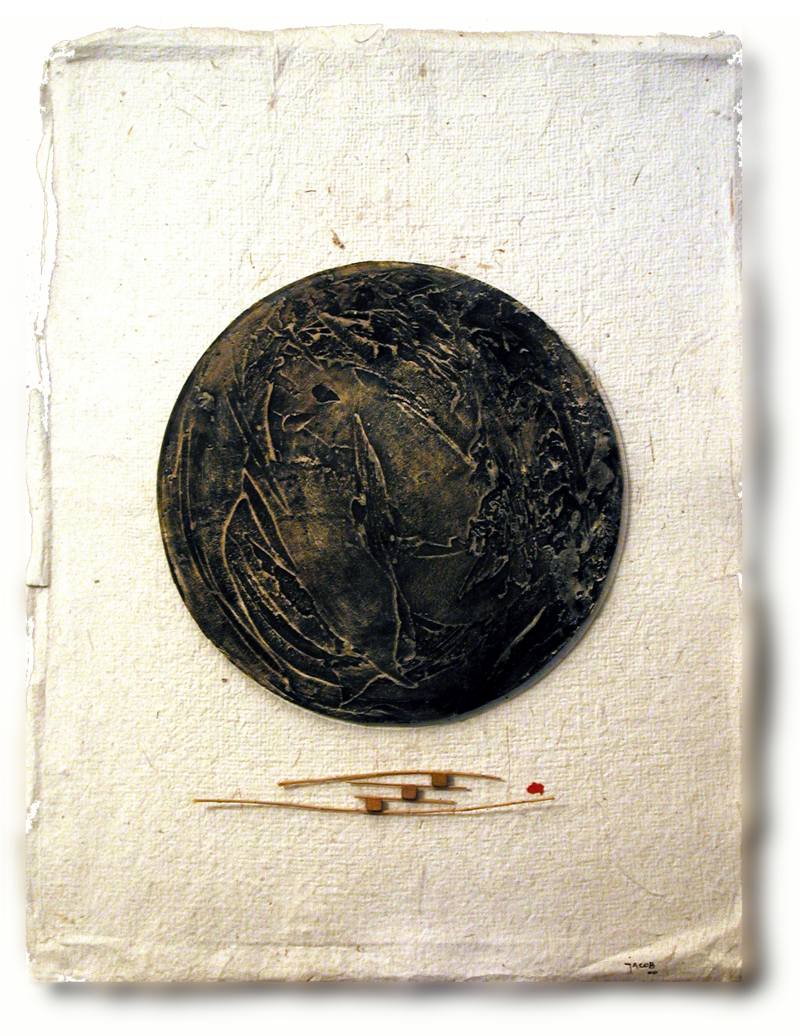

"La danza de las líneas III / Dance of the Lines III"
Técnica mixta / mixed media, 21,5 x 14,5 x 3,5 cm., 2014
Expuesta en / Exhibited at Museo Municipal Bellas Artes (Tandil, Buenos Aires, Argentina), 2016
Entrevista de Shirley Rebuffo
Shirley Rebuffo: ¿Cuándo comenzó tu interés por las artes plásticas?
Ivonne Jacob: De manera no consciente. Podría decir que todo comenzó a la hora de la siesta, cuando en mi niñez jugaba horas y horas en el jardín de mi casa con barro, hojas, ramas, flores, etc.
Coleccionaba todo tipo de cajas, papeles, hilos de colores, telas. Desde muy chica estuve ligada a distintas expresiones artísticas: la danza y la música ocuparon un lugar importante hasta mi adolescencia.
Con el transcurso del tiempo todas estas actividades empiezan a convertirse en una unidad transformándose en lo que posteriormente plasmaría en mis trabajos.
Pasé por varias etapas. En 1985 pintaba naif; me detenía a mirar adoquines y tejas para luego reproducirlos en mis trabajos de una manera obsesiva. Sentí una necesidad imperiosa de pintar con libertad sin tener referencias. Transité por el expresionismo abstracto, cubismo, hasta 1992 que comencé a tomar clases en el taller de Adolfo Nigro.
Para mi asombro, se abrió un mundo fascinante que me llevó a una conexión con mis raíces y el Taller de Torres-García. Los moldes culturales hacen a nuestras subjetividades, a las memorias de nuestros cuerpos.

"Diálogos / Dialogues", acrílico / acrylic, 80 x 100 cm., 1992.
Tercer Premio / Third Prize. Salón Alba. 1992

"Soneto a palabras olvidadas / Sonnet to Forgotten Words"
Técnica mixta / mixed media, 20,5 x 23,5 x 3 cm., 2009
Expuesta en / Exhibited at Museo de Arte Latinoamericano (La Plata, Buenos Aires, Argentina), 2016
SR: ¿Cómo definirías el trabajo que haces?
IJ: Es difícil definirlo en una sola técnica, pues utilizo la pintura, dibujos, collage, ensamblajes, relieves, volumen, textiles. El juego de imágenes, conjuntos de signos, conforman una caja-objeto.
El Arte nos enseña nuevos caminos cambiando nuestra mirada todo el tiempo. Dejarse sorprender en ese preciso instante ante sutilezas inesperadas.
El juego de las formas en el espacio justo. Fragmentos que forman un todo y un todo que se fragmenta para transformarse en nuevos brotes tratando de cambiar la realidad en algo bello o como expresión de dolor. Trabajar en la incertidumbre, ignorando hacia dónde vamos, como la vida misma.

"Portal del alma / Doorway of the Soul", técnica mixta / mixed media, 35 x 16 x 2,5 cm., 2017.
Expuesta en la Embajada de Uruguay / Exhibited at the Uruguayan Embassy (Buenos Aires, Argentina)

"Diálogo de las formas II / Dialog of Shapes II"
Técnica mixta / mixed media, 23 x 14,5 x 4 cm., 2009
Expuesta en / Exhibited at Museo Casa de Yrurtia (Buenos Aires, Argentina), 2010
SR: ¿Crees que has conseguido encontrar un estilo con el que realmente te sientes cómoda?
IJ: Siempre estoy en una búsqueda constante. Lo importante es que la continua producción de imágenes sea con mucha autenticidad y ser sincero con uno mismo. Trato de superarme siempre. Nunca estoy conforme con lo que hago, busco generar una experiencia sensorial.
SR: ¿Cómo es el proceso de trabajar diversos materiales y conseguir la combinación justa?
IJ: Continuamente estoy haciendo formas, estructuras, bases con texturas irregulares, superficies austeras. Me interesa mucha la construcción y deconstrucción, así como también la transformación de los materiales. Trabajo mucho con el azar hasta que se produzca un hecho estético. Los detalles definen una imagen en ese preciso instante.

"Tesoros del silencio / Treasures of Silence", 2015

"Océanos de papel / Oceans of Paper", técnica mixta / mixed media, 33 x 59 x 3 cm., 2015
Expuesta en / Exhibited at Centro Cultural Borges (Buenos Aires, Argentina), 2018
SR: ¿Cuánto te preocupa la mirada de los demás a tu obra?
IJ: Pienso que nuestro trabajo se termina con la mirada y un reencuentro con el otro. Es muy importante la comunicación con el público. Se producen experiencias enriquecedoras en un intercambio de miradas y sensaciones diferentes a la nuestra de maneras tanto físicas, emocionales, conceptuales y objetuales.
En el ARTE se pone de manifiesto el PENSAMIENTO. El mundo se percibe de otra forma.

"Océanos de papel / Oceans of Paper", técnica mixta / mixed media, 33 x 33 x 3 cm., 2016
Expuesta en / Exhibited at Museo AreaTEC (Buenos Aires, Argentina), 2019

"Océanos de papel (políptico) / Oceans of Paper (polyptych)"
SR: ¿Cuál es el momento que consideras más interesante en la ejecución una obra?
IJ: La materia original que luego es embellecida por la elaboración de la forma: rescatar el valor de la textura con sus rugosidades, sus hendiduras, su aspereza, su irregularidad; el de una piedra, una rama; la sensibilidad de un papel rasgado, de los hilos con sus respectivas tramas, que al igual que la vida nos remiten a un pasado, a lo primitivo, al origen.
Los elementos que utilizo producen en mí una especial atracción, sensación, vibración. Es ese el momento del punto de partida. Lo real se transforma en otra realidad. Darle importancia al vacío, al silencio, a lo simple. Alcanzar un máximo de intensidad con un mínimo de materiales.

"Océanos de papel / Oceans of Paper", técnica mixta / mixed media

"Océanos de papel / Oceans of Paper", técnica mixta / mixed media, 33 x 33 x 3 cm., 2016
Expuesta en / Exhibited at Museo AreaTEC (Buenos Aires, Argentina), 2019
SR: ¿Cuánto hay de pensado y cuánto de espontáneo en tus obras?
IJ: Trabajo sin un eje proyectual la mayoría de las veces, guiada por mi intuición y hago una reflexión posterior.
Cuando lo hago con un eje temático siento que los trabajos no tienen la misma factura. El juego plástico es más forzado. Quizá sea una sensación de fragilidad, vulnerabilidad en la cual se produce la experiencia estética o mis sensores internos que cuestionan la obra real o aparente. No hay mejor estimulante que la duda.

"Entre negras y corcheas / Between Quarter Notes and Eighth Notes"
Técnica mixta / mixed media, 46 x 33 cm., 2002
Expuesta en / Exhibited at ARTEBA 2004. Collegium Musicum

"Profundas fluctuaciones / Deep Fluctuations"
Técnica mixta / mixed media, 140 x 120 cm., 1992
Expuesta en / Exhibited at LXXXIV Salón Nacional, 1995
SR: ¿Cuánta relevancia tiene la naturaleza en tu trabajo?
IJ: Mis trabajos son un canto a la Naturaleza, la preservación del medio ambiente, su equilibrio y los seres vivientes que habitan en conexión con la Madre Tierra formando una unidad. El nexo con ella se hace visible. Es primordial. Esa visión inconmensurable que se asemeja al contacto más íntimo con nuestro yo interior para dejar fluir nuestra esencia.
Formas ondulantes, simétricas, asimétricas, orgánicas que se mezclan con texturas y estructuras recordatorias a la creatividad armónica, respetando todas las formas de vida.

"Sonidos del viento / Sounds of the Wind"
Técnica mixta / mixed media, 50 x 15,5 x 1,5 cm., 2009
2° Premio / 2nd. Prize Salón Arte Textil. Museo de Arte Popular José Hernández (Buenos Aires, Argentina)

"Oda a lo efímero / Ode to the Ephemeral", técnica mixta / mixed media, 49 x 33,5x 3,5 cm., 2017
Expuesta en / Exhibited at Centro Cultural de Cooperación "Floreal Gorini" (Buenos Aires, Argentina), 2018
SR: ¿Con qué herramientas, materiales y temáticas trabajas más? ¿Por qué eliges esos materiales para trabajar?
IJ: Utilizo maderas, metales, cartón, papel hecho a mano, textiles realizados con hilo de algodón, cáñamo y alambres. Trabajo mucho con el juego de las formas, elementos encontrados, resignificación del objeto y estetización de los elementos cotidianos.
La caja es un elemento importante que se repite desde hace años. En mi obra actual representa la CASA, que nos separa y protege del mundo exterior. Nuestro hábitat vibrando con la geometría de la creación del individuo en lo referente al continente y contenido.

"El hilo continuo de la revelación / The Continuous Thread of Revelation"
Técnica mixta / mixed media, 40 x 12 x 6 cm. Galería Van Riel (Buenos Aires, Argentina)

"Expectante por emerger / Expecting to Emerge", técnica mixta / mixed media, 45 x 25 x 1 cm., 2016.
Expuesta en / Exhibited at Museo de Artes Plásticas Eduardo Sivori (Buenos Aires, Argentina), 2016
SR: ¿Te ha ido resultando más fácil plasmar lo que tienes en mente con el paso de los años?
IJ: Vas adquiriendo una gimnasia visual y creativa, que la da el trabajo constante en nuestra soledad. Siento que refleja ese sorprendente y inmutable diálogo con uno mismo, despojándose en lo posible de las creencias. Percibir belleza, tocando las fibras sensibles que provoquen un hecho estético, una emoción de aceptación o rechazo siendo un camino inagotable de constante superación y crecimiento.
Todo es un gran descubrimiento, encuentros y desencuentros, asombro, búsqueda, entrega, juego, dudas, conflictos, sufrimiento. Trabajar desde y para la imaginación con un profundo sentimiento, autenticidad y libertad. Un gran desafío.

"Himno a una estrella desconocida II / Hymn to a Unknown Star"
Técnica mixta / mixed media, 19, 5 x 14,5 x 3 cm., 2017
Expuesta en / Exhibited at Asociación Cultural Pestalozzi (Buenos Aires, Argentina), 2017
SR: ¿Por qué tu traslado a Buenos Aires? ¿Se te ha hecho más fácil mostrar tus trabajos?
IJ: En 1974 me casé con un argentino. Mi formación artística la realicé en Buenos Aires.
Mantengo que la vida se sostiene en comunidad y la interacción es muy importante en cualquier lugar del planeta.
No puedo dejar de mencionar la importancia y necesidad del Arte en esta nueva modalidad por la cual estamos transitando durante la pandemia.
La Cultura contribuye en mantener la salud social y la necesidad de cuidar la vida. El ARTE es una necesidad como experiencia sensorial, emotiva y reflexiva. El PRESENTE, el verdadero protagonista del tiempo.

"Poder del Universo / Power of the Universe"
Técnica mixta / mixed media, 50 x 40 cm., 2000
Expuesta en / Exhibited at Galería Alfredo Cataldo (Buenos Aires, Argentina)

Muchas gracias por la entrevista, Ivonne!
Thanks a lot for the interview, Ivonne!
__________________________________________________
Shirley Rebuffo es Licenciada en Bibliotecología y Archivología por la Escuela Universitaria de Bibliotecología y Ciencias Afines (Montevideo, Uruguay), Técnica en Museología por la Facultad de Humanidades y Ciencias (opción de Antropología), Objeto, símbolo y espacio en Curaduría. Museología Aplicada y Museología Social – Conceptos, técnicas y prácticas (Campo Grande, BR), Coaching (Campo Grande, BR), Planeamiento Estratégico (Campo Grande, BR) y estudiante de arte y pintura con el maestro Eduardo Espino.
Shirley Rebuffo has a Degree in Library Science and a Degree in Archivology by the Universitary School of Library and Related Sciences (Montevideo, Uruguay), Technician in Museology by the Faculty of Humanities and Sciences (Anthropology option), Object, Symbol and Spance in Curatorship Applied Museology and Social Museology - Concepts, Technics and Practice (Campo Grande, Brazil), Coaching (Campo Grande, Brazil), Strategic Planning (Campo Grande, Brazil), and Art and Painting student under Master Eduardo Espino.
________________________________________________________
Text in English
She was born in September 1952 in Young, Rio Negro, Uruguay. Since she was a child she has been involved in various artistic activities such as music and dance.
In 1974 she moved to Buenos Aires where she lives, teaches and works in her Plastic Workshop in the neighborhood of Belgrano. Since 1985 she exhibits individually and collectively at the official level, in museums and private galleries, highlighting her participation in Uruguay (Montevideo and Punta del Este), United States (New York and Washington), Belgium (Brussels), Spain (Barcelona and Lugo), England (London), and Sweden (Stockholm).
Since 2013 she has been a member of the group of artists Poéticas Divergentes. She is secretary of SAVA, Sociedad de Gestión Colectiva de Derechos de Autor (Copyright Collective Management Society), since 2016. As of 2017 she is a member of the board of directors of AAVRA (Asociación Artistas Visuales de la República Argentina). She has also created the collective of Uruguayan artists living in Buenos Aires "Río de los pájaros".
Interview by Shirley Rebuffo
Shirley Rebuffo: When did your interest in the visual arts begin?
Ivonne Jacob: Not consciously. I could say that it all started at nap time, when in my childhood I used to play for hours and hours in the garden of my house with mud, leaves, branches, flowers, etc.
I collected all kinds of boxes, papers, colored threads, fabrics. Since I was very young I was linked to different artistic expressions: dance and music occupied an important place until my adolescence.
As time went by, all these activities began to become a unit, transforming into what I would later express in my work.
I went through several stages. In 1985 I painted naïf; I would stop to look at cobblestones and roof tiles and then reproduce them in my work in an obsessive way. I felt an imperious need to paint freely without references. I went through abstract expressionism, cubism, until 1992 when I started taking classes at Adolfo Nigro's workshop.
To my amazement, a fascinating world opened up that led me to a connection with my roots and the Torres-García workshop. Cultural molds make our subjectivities, the memories of our bodies.
SR: How would you define the work you do?
IJ: It is difficult to define it in a single technique, since I use painting, drawings, collage, assemblages, reliefs, volume, textiles. The play of images, sets of signs, make up a box-object.
Art teaches us new ways by changing our gaze all the time. To let oneself be surprised at that precise moment by unexpected subtleties.
The play of shapes in the right space. Fragments that form a whole, and a whole that fragments to become new sprouts trying to change reality into something beautiful or as an expression of pain. Working in uncertainty, ignoring where we are going, like life itself.
SR: Do you think you've managed to find a style that you really feel comfortable with?
IJ: I am always in a constant search. The important thing is that the continuous production of images is with a lot of authenticity and being honest with oneself. I always try to improve myself. I am never satisfied with what I do, I seek to generate a sensory experience.
SR: How is the process of working with different materials and getting the right combination?
IJ: I am constantly making shapes, structures, bases with irregular textures, austere surfaces. I am very interested in construction and deconstruction, as well as the transformation of materials. I work a lot with chance until an aesthetic fact is produced. The details define an image at that precise moment.
SR: How much do you worry about how others look at your work?
IJ: I think that our work ends with the look and a reencounter with the other. Communication with the public is very important. Enriching experiences are produced in an exchange of looks and sensations different from our own in physical, emotional, conceptual and objectual ways.
In ART, THOUGHT is revealed. The world is perceived in a different way.
SR: What do you consider to be the most interesting moment in the execution of a work?
IJ: The original material that is then embellished by the elaboration of the form: to rescue the value of the texture with its roughness, its cracks, its irregularity; that of a stone, a branch; the sensitivity of a torn paper, of the threads with their respective wefts, which, like life, take us back to the past, to the primitive, to the origin.
The elements I use produce in me a special attraction, sensation, vibration. That is the moment of the starting point. The real is transformed into another reality. Giving importance to emptiness, to silence, to simplicity. To reach a maximum of intensity with a minimum of materials.
SR: How much is thought and how much is spontaneous in your work?
IJ: I work without a projective axis most of the time, guided by my intuition and I make a later reflection.
When I do it with a thematic axis, I feel that the works don't have the same craft. The plastic game is more forced. Perhaps it is a sense of fragility, vulnerability in which the aesthetic experience is produced or my internal sensors that question the real or apparent work. There is no better stimulant than doubt.
SR: How relevant is nature in your work?
IJ: My works are a hymn to Nature, the preservation of the environment, its balance and the living beings that inhabit in connection with Mother Earth forming a unity. The nexus with her becomes visible. It is primordial. That immeasurable vision that resembles the most intimate contact with our inner self to let our essence flow.
Undulating, symmetrical, asymmetrical, organic forms that blend with textures and structures reminiscent of harmonic creativity, respecting all forms of life.
SR: What tools, materials and themes do you work with most? Why do you choose those materials to work with?
IJ: I use wood, metals, cardboard, handmade paper, textiles made with cotton thread, hemp and wires. I work a lot with the play of shapes, found elements, resignification of the object and aestheticization of everyday elements.
The box is an important element that has been repeated for years. In my current work it represents the HOUSE, which separates and protects us from the outside world. Our habitat vibrating with the geometry of the creation of the individual in terms of container and content.
SR: Have you found it easier to express what you have in mind over the years?
IJ: You acquire a visual and creative gymnastics, which comes from working constantly in our solitude. I feel that it reflects that surprising and unchanging dialogue with oneself, stripping as much as possible of beliefs. To perceive beauty, touching the sensitive fibers that provoke an aesthetic fact, an emotion of acceptance or rejection being an inexhaustible path of constant overcoming. inexhaustible path of constant improvement and growth.
Everything is a great discovery, encounters and misencounters, astonishment, search, surrender, play, doubts, conflicts, suffering. Working from and for the imagination with deep feeling, authenticity and freedom. A great challenge.
SR: Why did you move to Buenos Aires? Has it become easier for you to show your work?
IJ: In 1974 I married an Argentinean. I did my artistic training in Buenos Aires.
I maintain that life is sustained in community and interaction is very important anywhere on the planet.
I cannot fail to mention the importance and necessity of Art in this new modality we are going through during the pandemic.
Culture contributes in maintaining social health and the need to take care of life. ART is a necessity as a sensorial, emotional and reflective experience. The PRESENT, the true protagonist of time.


