lunes, 9 de diciembre de 2013

Peter Gric [Pintura]

Peter Gric


Peter Gric es un artista nacido en Brno, antigua Checoslovaquia, en 1968. Desde pequeño contó con el apoyo de sus padres que reconocieron y apoyaron su talento para el dibujo y la pintura. En 1980 sus padres emigraron a Austria a través de Hungría y Yugoslavia.
En Linz completó la primaria y estudió en un colegio técnico de diseño gráfico. En 1988 llegó a Viena y comenzó a estudiar en la Academia de Bellas Artes con el profesor Arik Brauer. Ya durante sus estudios participó en numerosas exposiciones colectivas y comenzó a vender con éxito sus pinturas. Terminó de estudiar en 1993 con un Master en Bellas Artes.

Obsevando su obra, es difícil no evocar los biomecanoides y paisajes de H.R. Giger, pero hay notables diferencias entre ambos. En la obra de Peter puede apreciarse una presencia más significativa de estructuras arquitectónicas, un tratamiento diferente de los espacios y, desde luego, menos oscuridad.

"Ginoide-Monumento II / Gynoid-Monument II"
Acrílico sobre panel / acrylic on board, 40 x 50 cm., 2012-2013

"Cortex", acrílico y óleo sobre panel / acrylic & oil on board, 69 x 137 cm., 2005-2013

A principios de los '90, Peter comenzó a descubrir las posibilidades de los gráficos por ordenador para sus pinturas. De ahí en adelante su imageniería visual orgánico-surrealista se enriqueció con complejas estructuras arquitectónicas y artefactos. En lugar de utilizar el lápiz y el cuaderno de bocetos, comenzó a diseñar sus composiciones con software de visualización en 3D, comenzando a transferir la realidad virtual a sus pinturas y consecuentemente encontró en esta fusión un estilo único y distintivo.

"Artefakt XI / Artefacto XI / Artefact XI", acrílico sobre lienzo / acrylic on canvas, 100 x 120 cm., 2013

"Rekonfiguration VI / Reconfiguración VI / Reconfiguration VI"
Acrílico sobre panel de fibra / acrylic on fiberboard, 60 x 70 cm., 2009

"La escuela fue un desastre. Su principal objetivo parecía no ser apoyar los talentos tanto como fuera posible, sino exactamente lo contrario. Me resultaba frustrante dibujar conos de madera y cuencos o fichas de colores en un cartón para estudiar como debería ser una "composición". Terminé harto y cansado de todo aquello y mi interés por la pintura y el dibujo se desvaneció por completo. Por aquél entonces, sin embargo, descubrí una nueva pasión: el ordenador. Fue un trabajo duro convencer a mis padres de que me compraran una (una Atari 800XL), pero no les entusiasmaba la idea de verme durante todo mi tiempo libre presionando teclas en la computadora y mirando aquellas cosas extrañas que aparecían en la pantalla. Obsesionado, aprendí casi todo sobre aquél aparato, hasta incluso programar sofisticados juegos de ordenador en lenguaje máquina. En el tercer año de mi educación como diseñador gráfico descubrí el aerógrafo. Esta técnica resucitó mi pasión por las artes gráficas."
De una entrevista concedida por Peter a Gil Pinkas, HDL Magazine que puede leerse completa aquí.

"Raumkrümmungsmaschine / Máquina deformadora del espacio / Space-Warp Machine"
Acrílico sobre panel de fibra / arcylic on fiberboard, 25 x 50 cm., 2010

"Netzwerk VI / Red VI / Network VI", acrílico sobre lienzo / acrylic on canvas, 120 x 100 cm., 2013

¿Cuáles son tus artistas favoritos?

¿Cuándo sabes exactamente cómo se verá una imagen cuando esté terminada?
Depende de una serie de cuestiones técnicas. A veces no tengo ni idea hasta el último momento. Otras, por el contrario, la arquitectura se construye en programas hasta que todos los detalles de iluminación están a punto, y luego se transfiere al lienzo.
De una entrevista a Peter en su sitio web en ruso.

"Androide II / Android II", acrílico sobre panel de fibra / acrylic on fiberboard, 25 x 50 cm., 2011

Izq./ Left: "Ereignis / Evento / Event"
Acrílico y óleo sobre lienzo / acrylic & oil on canvas, 120 x 100 cm., 2006
Der./ Right: "Mittelschiff II / Nave central II / Central Nave II"
Acrílico y óleo sobre lienzo / acrylic & oil on canvas, 120 x 100 cm., 2006

"El lienzo (o panel) es para mí un vehículo, una especie de nave espacial con la cual viajar a espacios y realidades desconocidos. Si el origen de mi viaje está en el mundo de lo que puede ser explicado o descrito, entonces intento abandonar esa órbita. Sin embargo, la gravedad de las palabras tira de mí hacia atrás; por eso no me hago preguntas durante el viaje y, consecuentemente, no espero respuestas. Sólo quiero maravillarme con las cosas que veo ahí fuera. Quieron entrar y experimentar nuevas realidades, nuevos espacios, formas y dimensiones. No es una cuestión de palabras, pensamientos o mensajes, sino de visiones silenciosas."
De una entrevista concedida por Peter a Gil Pinkas, HDL Magazine que puede leerse completa aquí.

Se puede disfrutar del trabajo de Peter en su sitio web y también en su facebook.

"Ginoide IX / Gynoid IX", acrílico sobre panel de fibra / acrylic on fiberboard, 25 x 50 cm., 2013

Peter was born in Brno, former Czechoslovakia in 1968. Already in his early childhood his parents recognized and supported his talent for drawing and painting. In the year 1980 his parents decided to emigrate and via Hungary and Yugoslavia they arrived to Austria. 
He finished the primary school and a technical college for graphic-design in Linz. In 1988 he came to Vienna and started to study at the Academy of Fine Arts in the master class of Prof. Arik Brauer. Already during the study he participated in numerous group exhibitions and started to successfully sell his paintings. He finished the study in 1993 and earned a Masters degree in Fine Arts.

Noting his work, it's hard not evoke HR Giger's landscapes and biomechanoids, but there are notable differences between the two. In Peter's work can be seen a more significant presence of architectural structures, a different treatment of spaces and, of course, less darkness.

"Neuordnung II / Realineamiento II / Realignment II"
Acrílico sobre lienzo / acrylic on canvas, 120 x 100 cm., 2013

"Mente de androide / Android-Mind"
Acrílico sobre panel de fibra / arcylic on fiberboard, 120 x 100 cm., 2006

In the early nineties Peter Gric started to discover the possibilities of computer graphics for his paintings. From then on his organic-surreal visual imagery was enriched by complex architectural structures and artefacts. In place of using pencil and sketchbook he began to design his compositions with a 3D visualization software, he started to transfer the virtual reality into painting and consequently found within this fusion to his very unique and distinctive style.

"Raumkrümmungsmaschine II / Máquina deformadora del espacio II / Space-Warp Machine II"
Acrílico y óleo sobre lienzo / acrylic & oil on canvas, 360 x 120 cm., 2012-13

"Synchronisation / Sincronización / Synchronization"
Acrílico sobre panel de fibra / acrylic on fiberboard, 32 x 40 cm., 2011

"The school, however, was a disaster. The main goal of the school seemed not to be supporting talents as effectively as possible, but the exact opposite. I was very frustrated drawing wooden cones and bowls or sticking colourful paper chips on a cardboard in order to study what a "composition" should be. I got sick and tired of all this and my interest for drawing and painting was completely gone. At this time, however, I found a new passion: the computer. I had a hard job to convince my parents to buy me one (an Atari 800XL), but they were not delighted seeing me all my free time pressing buttons on a computer keyboard and staring on weird stuff popping up on a screen. In my obsession I learned almost everything about this machine, up to programming a sophisticated computer game in machine language. In the third year of my education as graphic designer I came in touch with the air-brush. This technique actually revived my passion for graphic art."
From an interview by Gil Pinkas from HDL Magazine you can fully read here.

"Periferia / Periphery"
Acrílico y óleo sobre panel de fibra / acrylic & oil on fiberboard, 22 x 35 cm., 1990

"Künstlicher Schlaf V / Sueño artificial V / Artificial Sleep V"
Acrílico sobre panel de fibra / acrylic on fiberboard, 70 x 60 cm., 2012

¿Who are your favorite artists?

¿When you know exactly how an image will look when finished?
It depends on a number of technical issues. Sometimes I have no idea until the last moment. In other cases, however, the architecture is built using programs until all lighting details are defined, and then transferred to the canvas.
From an interview to Peter in his Russian website.

Izq./ Left: "Sphäre II / Esfera II / Sphere II"
Acrílico y óleo sobre lienzo / acrylic & oil on canvas, 120 x 100 cm., 2006
Der./ Right: "Künstlicher Raum II / Espacio artificial II / Artificial Space II"
Acrílico sobre panel de fibra / acrylic on fiberboard, 25 x 20 cm., 2007

"Gynoid Engel / Ángel Ginoide / Gynoid Angel"
Acrílico sobre panel de fibra / acrylic on fiberboard, 40 x 32 cm., 2012

"The canvas (or board) is for me a vehicle, a kind of a space craft, to journey to unknown places in unknown realities. If the origin of my journey is in the world of the explainable and the describable, then I attempt to leave its orbit. However, the gravity of words pulls me back, that's why I am not taking any questions along on my trip, and consequently I do not expect any answers either. I just want to marvel about the things I see out there. I want to enter and experience new realities, new spaces, forms and dimensions. It's not about words, thoughts and messages, but rather about silent visions."
From an interview by Gil Pinkas from HDL Magazine you can fully read here.

Izq./ Left: "Interferenzzone / Zona de interferencia / Interference Zone"
Acrílico sobre panel de fibra / acrylic on fiberboard, 50 x 25 cm., 2009-2010
Der./ Right: "Transluzide Muse II / Musa traslúcida II / Translucid Muse II"
Acrílico sobre panel de fibra / acrylic on fiberboard, 40 x 32 cm., 2010

You can enjoy Peter's work in his website and also in his facebook.

"Ginoide III / Gynoid III", acrílico sobre panel de fibra / acrylic on fiberboard, 32 x 40 cm., 2011

Artistas de referencia en "El Hurgador" / Reference artists in this blog:
Max Ernst: [Yousuf Karsh (Fotografía)]
H.R. Giger: [H.R.Giger (Pintura, Escultura, Diseño, Cine)], [Te Recomiendo (IV)]
Rudolf Hausner: [Los Austríacos (IV)]

Imágenes publicadas con autorización del artista (¡Muchas gracias, Peter!)
Images published here with artist's permission (Thanks a lot, Peter!)


Una charla/entrevista entre Robert Venosa y Peter Gric en Viena, verano de 2008.
A conversation/interview between Robert Venosa and Peter Gric in Vienna, Summer of 2008.


Venosa meets Gric from Veno on Vimeo.

viernes, 6 de diciembre de 2013

Kunstalker entrevista a El Hurgador

Kunstalker (Kust = arte en alemán, talk = hablar en inglés, stalker = acechador, merodeador) es un blog en el que, como su nombre indica, se habla de arte. De hecho, según apunta su autora, la historiadora del arte Elena Richter:

"El término arte puede encontrarse en múltiples contextos, pero ¿Qué es el arte en realidad? El propósito de este blog es intentar encontrar la respuesta examinando todo lo que pueda ser considerado una obra de arte, por remoto que pueda ser."


Elena ha publicado el 4/12 una entrevista realizada a "El Hurgador" (o sea, yo mismo) que espero resulte de vuestro interés. En Kunstalker puede leerse también en alemán. Recomiendo el blog de Elena (en inglés y alemán) a los interesados en cuestiones artísticas.
_______________________________________________

"El Hurgador" es un blog que trata sobre arte, artistas y cuestiones generales relativas al arte. Nos gusta mucho su contenido y la forma como presenta sus textos. Por ello sentimos que queríamos saber un poco más sobre el creador de este blog, Javier Fuentes, su forma de trabajar y sus pensamientos sobre el arte.

¿Podrías darnos algo de información sobre tí?

Nací en Montevideo, Uruguay, en 1963. He estado viviendo en Tenerife, Islas Canarias, España, los últimos 14 años.
Trabajo en un hospital público en Tenerife, en el Servicio de Información de Urgencias, desde hace 8 años.
Soy simplemente un amante del arte desde que recuerdo. Cuando era joven estaba más interesado en la ciencia (matemáticas, física...), pero a partir de los 35 más o menos, decidí aprender más acerca de temas humanísticos; comencé una Licenciatura en Bibliotecología. Estudié un par de años en la Universidad. No terminé mis estudios porque debido a ciertas circunstancias de mi vida me mudé a España.

¿Cómo trabajas? La información en tu blog hace parecer que eres el único que aporta y mantiene el blog. Pero como publicas nuevos artículos casi a diario, me pregunto si no hay además otra gente involucrada en el proceso.

Trabajo solo y soy el único que aporta y mantiene el blog. Actualmente trato de publicar cada día de lunes a viernes. Cuando comencé posteaba incluso más, pero a medida que el blog se ha ido desarrollando, los artículos se han vuelto más expansivos y ahora necesito más tiempo para publicar algo con más "sustancia", información relevante y eso... Siempre he tenido la idea de colaborar con expertos para desarrollar posts más técnicos sobre cierto tópicos, pero no es fácil encontrar gente con ganas de trabajar gratis, tiempo suficiente y buenas ideas.

Tu blog es muy informativo y abundante en imágenes, lo cual en mi opinión es algo muy importante cuando se trata de hablar de arte. El lector debe ver el arte y no sólo leer sobre él. Por ello admiro mucho la forma como presentas tus textos.

Yo veo mi blog sólo como un proyecto personal para recopilar y organizar imágenes e información sobre el arte que disfruto.
Estoy de acuerdo contigo: el arte es algo para ver (oir, tocar), no sólo algo acerca de lo cual leer. Normalmente tengo grandes problemas para seleccionar un conjunto razonable de imágenes para publicar de artistas que realmente me gustan. A veces no es muy sencillo para mí construir un post con un buen equilibrio entre texto e imágenes, y debo reconocer que muchas veces los posts que publico tienen un tamaño algo excesivo. Pero... ¿qué puedo hacer? Disfruto mucho haciéndolo así.

¿Por qué decidiste comenzar este blog? En la sección de información dice: “Blog dedicado a difundir imágenes e información sobre arte, artistas, eventos y material en general relacionado con cuestiones artísticas.” Es una explicación muy clara. Pero me pregunto por qué empezaste exactamente. ¿Querías simplemente compartir tu amor por el arte con todo el mundo? ¿O es que conoces personalmente artistas que buscas apoyar con tu blog?

A través de los años descubrí ciertos blogs interesantes sobre temas relativos al arte. Pero como casi siempre ocurre, ninguno de ellos satisfacía plenamente mis intereses y expectativas. Algunos ofrecen buenas imágenes pero poca información. Otros mejor información, pero imágenes pobres. Muchos están escritos en inglés, pero mi lengua es el español. Algunos otros son muy específicios y otros demasiado amplios. Y así sucesivamente. Así que algún día pensé que probablemente podría hacer mi propia selección de artistas y obras de arte e intentar crear algo que encajara con mi propio criterio acerca de lo que considero interesante y cómo presentarlo.
Así que empecé con algunas ideas generales, pero básicamente quería crear una selección personal, aprovechando el hecho de que publicar un blog no es algo muy complicado hoy en día. Si miras mis primeros posts hace dos años, puedes ver tan sólo una colección de imágenes que me gustan sobre diversos temas (artes, imágenes científicas, música, curiosidades...) En el curso de estos dos años las cosas han evolucionado y ahora el blog tiene un perfil más o menos definido con cuatro o cinco elementos clave que intento preservar para dar una cierta "personalidad" a "El Hurgador".
Personalmente conozco y he conocido a algunos artistas, pero no demasiados. Incluso viví con artistas hace mucho tiempo. Soy un gran admirador de la gente capaz de crear cosas que me gustan, que me hacen sentir algo y me enriquecen. Para mí es estupendo poder diseminar información acerca de los artistas que me gustan y contribuir a que su trabajo se conozca. Como no tengo dinero para comprar arte, es lo mejor que puedo hacer por ellos para que sigan creando esas cosas de las que tanto disfruto. Por eso es que siempre intento estar en contacto con los artistas y pedirles permiso para publicar, y en dos años sólo 4 artistas me han negado su autorización: dos por sus contratos, uno por cuestiones ideológicas y otro porque no quería que se difundiera información sobre él.

¿Crees que aún no hay bastante información en la Red? ¿Por qué escogiste hacer un blog y no una revista o algo parecido?

La información nunca es suficiente, pero el problema no es la falta de información, sino su calidad. A veces paso mucho tiempo intentando verificar información de varias fuentes porque en sitios diferentes encuentras diferentes datos. Incluso en sitios presumiblemente fiables puedes encontrar información incorrecta. Quiero publicar algo que resulte una fuente razonablemente fiable para gente interesada en profundizar sus conocimientos. Desafortunadamente la mayoría de la gente sólo mira las imágenes, no el texto. Me encanta cuando los visitantes leen, dejan sus comentarios y me ayudan a corregir errores e información incorrecta.
Escogí un blog porque considero que trabajando solo es la mejor manera de hacer algo con la libertad suficiente como para ir definiendo poco a poco lo que me gusta y lo que quiero mostrar. Es algo que hago libremente, sin otros condicionamientos que los que yo mismo me impongo.

Tus textos son muy informativos, bien investigados, limpiamente vinculados y bellamente presentados. Esto es mucho trabajo. ¿Cuánto tiempo dedicas como media a investigar y escribir?

Gracias. Una de las cosas más importantes para mí es ofrecer información precisa y bien presentada.
Paso bastante tiempo buscando imágenes tan buenas como sea posible, información acerca de artistas y hechos artísticos. Adoro hurgar en los temas que me interesan y la red me ofrece infinitas posibilidades. No podría decirte exactamente cuánto tiempo, porque depende de muchos factores, pero son varias horas al día.

¿Cómo escoges los temas? ¿Hay algún patrón?

No tengo patrones predefinidos para seleccionar temas, pero después de todo este tiempo tengo algunos métodos más o menos definidos. Cuando busco información sobre un artista u obra específica, por lo general encuentro imágenes relacionadas o información acerca de otros artistas en blogs, revistas online, sitios web de galerías, museos, colecciones, en facebook... Una vez que encuentro algo interesante, comienzo una nueva línea de investigación acerca de ese tema. No siempre encuentro algo que me satisfaga lo suficiente, pero si ocurre, tengo un nuevo punto desde donde volver a empezar. Es un ciclo interminable de investigación y descubrimientos.

Los artista que presentas viven y trabajan por todo el mundo. No pareces tener favoritos en cuanto a países, épocas o estilos artísticos. ¿Es correcto? ¿O hay algo que prefieras especialmente? ¿Tienes algún artista o arte favoritos?

Bueno... creo que si lo que quiero es hacer algo interesante para mí y para otros amantes del arte, la presentación e información acerca de artistas conocidos es muy importante, pero no suficiente. Para mí es más interesante encontrar nuevos artistas, nuevas formas de expresión, diferentes puntos de vista, otros lenguajes artísticos y propuestas. Como amante del arte, no tengo restricciones, aún cuando los más publicados en el blog son pintores, escultores y fotógrafos. Si una obra de arte tiene el poder de hacerme sentir algo, tengo algo con lo que comenzar. Como te decía, sólo soy un amante del arte. No soy un crítico, ni un sabio o erudito. El arte me gusta o no, me hace sentir algo o no, despierta mi curiosidad o no. Tan simple como eso.
En función de esto, puedo encontrar arte que me guste en cualquier época o país, en cualquier estilo o género artístico. Hay muchos artistas que considero esenciales, la mayoría pintores figurativos, pero no todos: Picasso, Dalí, Rembrandt, Caravaggio, Kokoschka, Kandinsky, Michelangelo... Tengo ciertas preferencias, pero siempre estoy abierto. Prefiero el arte figurativo, pero adoro a Kandinsky. Prefiero la pintura, pero adoro las esculturas de Michelangelo, los grabados de Durero y Piranesi, docenas de grandes fotógrafos, artistas de técnicas mixtas, cineastas, artistas de performances...

¿Hay algún arte que no te guste?

No, pero hay muchas obras de arte que no me gustan.

Para tí, ¿qué es el arte?

Como comprenderás, no puedo darte una definición porque creo que el arte es algo indefinible. Pero puedo decir que podría ser algo como la realización de la necesidad individual de transmitir algo personal (sentimientos, experiencias, estados de ánimo, ideas) a otros individuos a través de la representación. El arte está en todos y en todas partes. Es una parte inseparable de la vida.
Resumiendo, es una forma de expresar algo, crear o hacer algo, para que sea recibido y disfrutado por alguien.
Además, creo que puedes incluso crear arte para que no sea visto por nadie más que tú misma, pero un arte sin destinatario es un arte cojo.

¿Cuál es la tarea de un artista?

Expresar algo que necesita ser expresado, mediante cualquier medio o técnica que domine, que pueda hacer sentir algo a otras personas.

¿Cuál es la tarea de alguien que escribe sobre arte?

Depende. Si eres un crítico de arte, probablemente quieras hacer dinero con el trabajo de otros, intentando explicar algo que no necesita ser explicado (es una broma... aunque no demasiado).
Si eres un amante del arte, probablemente intentar que otra gente conozca lo que a tí te gusta, o hacer que comprendan algo acerca de lo que te gusta, o hacer que comprendan por qué te gusta algo.
Si eres un artista, probablemente intentar ayudar a la gente a comprender lo que tu arte no puede explicar por sí mismo, o dar claves a la gente para que comprendan mejor tu arte.

¿Cuál es la tarea del destinatario del arte?

Sentirlo y disfrutarlo. Y, si es posible, ayudar a los artistas a que sigan creando.


Kunstalker [Kunst (German for art) merges with the words talk and stalk] is a blog in which, as the name suggests, talking about art. Its author, art historian Elena Richter, wrote:

"The term art may be found in a lot of contexts, but what is art really? The purpose of this blog is to try and find out the answer by looking at everything that could be considered a work of art, even as remote as it is."

Elena has published on December 4 an interview to "El Hurgador" (ie myself) which I hope you find interesting. German translation in Kunstalker. I recommend Elena's blog (both in English and German) to all of you interested in artistic facts.

_______________________________________________

http://elhurgador.blogspot.ch/ is a blog, which deals with art, artists and general arts oriented questions. We like its content and the way it presents its texts very much. Therefore we felt that we wanted to know a little more about the creator of this blog, Javier Fuentes, his way of working and his thoughts about art.

Could you give us a little information about yourself?

I was born in Montevideo, Uruguay, in 1963. I’ve been living in Tenerife, Canary Islands, Spain, for the past 14 years.
I’ve been working in a public hospital here in Tenerife, in the Information Service, Emergency Area, for the past 8 years.
I’m just an art lover since I can remember. When I was young I was more interested in science (maths, physics…) but when I was around 35 I decided to learn more about humanistic subjects; I started a Bachelor in Bibliothecology. I studied a couple of years at the University. I didn’t finish my studies because due to certain circumstances in my life I moved to Spain.

How do you work? The information on your blog seems to list you as the only contributor and maintainer of the blog. But since you post new articles almost every day I was wondering whether other people were involved in the work process as well.

I work alone and I’m the only contributor and maintainer. Nowadays I try to publish every day from Monday to Friday. When I started I posted even more, but as the blog developed the articles became more expansive and now I need more time to publish something with more “substance”, relevant information and so on… I always had the idea of collaborating with experts to develop more technical posts on certain topics, but it is not easy to find people willing to work for free, with time enough and good ideas.

Your blog is very informative and abundant in pictures, which in my opinion is a very important thing when it comes to talking about art. The reader should see the art and not only read about it. Therefore I highly admire the way you present your texts.

I see my blog just as a personal project to compile and organize images and information about art which I enjoy.
I agree with you: art is something to see (to hear, to touch) not only something to read about. I usually have a big problem to select a reasonable set of images by posted artists I really like. It is sometimes not so very easy for me to construct a post with a good balance between text and images and I must recognize that many times the posts I publish are probably a little bit oversized. But… what can I do? I enjoy a lot doing it that way.

Why did you choose to start this blog? In the information section it says “Blog dedicado a difundir imágenes e información sobre arte, artistas, eventos y material en general relacionado con cuestiones artísticas.” (translation: Blog dedicated to share pictures and information about art, artists, events and general issues related to artistic questions.) That is a very clear explanation. I still wonder why you started exactly. Did you simply want to share your love for art with the world? Or do you personally know artists you wanted to support through your blog?

Through the years I discovered certain interesting blogs about art facts. But as it almost always happens, none of them fully satisfied my interests and expectations. Some offer good images of artworks but little information. Other offer better information, but poor images. Many are written in English, but my language is Spanish. Some others are very specific and others too broad. And so on. So some day I thought that I probably could make my own selection of artists and artworks and try to create something matching my own criteria about what I consider interesting and how to present it.
So I started with some general ideas, but basically I wanted to create a personal selection taking advantage of the fact that publishing a blog is not a very complicated thing nowadays. If you take a look at my first posts two years ago, you can see just a collection of pictures about several topics I like (arts, scientific images, music, curiosities…) In the course of these two years things have evolved and now the blog has a more or less defined profile with four or five key elements which I try to preserve in order to offer a certain “personality” to “El Hurgador”.
I personally know and knew a few artists, but not a lot of them. I even lived with artists a long time ago. I’m really a fan of people who are able to create things that I like, that make me feel something and enrich me. It is a great feeling for me to be able to spread information about the artists I like and help their work to be known. As I have no money to buy art, this is the best I can do for them to keep creating those things I enjoy so much. That’s why I always try to stay in touch with the artists and ask for permission to publish, and in two years only 4 artists have denied authorization; two because of their contracts, one because of ideology and one because he didn’t want to spread information about himself.

Do you feel there is still too little information on the web? Why did you choose to do a blog and not a magazine or the like?

Information is never enough, but the problem is not the lack of information but its quality. I sometimes spend a lot of time trying to verify information from many sources because in different places you find different data. Even in places presumably reliable you can find wrong information. I want to publish something that can be a reasonably reliable source for people interested in deepening their knowledge. Unfortunately most of the people only check the images, not the text. I really like when visitors read, leave comments and help me fix mistakes and incorrect information.
I chose a blog because I consider that working alone is the best way of doing something having the freedom to define little by little what I like and what I want to show. It is something I can do for free with no other constraints than those I impose upon myself.

Your texts are very informative, well researched, cleanly linked and nicely presented. That is a lot of work. How much time do you spend on research and writing on average?

Thank you. One of the most important things for me is to offer accurate and well presented information.
I spend a lot of time looking for as good as possible images, information about artists and artistic facts. I love to delve into topics that interest me, and the net offers me endless possibilities. I can’t tell you exactly how much time because it depends on many factors, but many hours a day.

How do you pick your subjects? Is there any pattern to it?

I have no predefined patterns to select subjects, but after all this time I have more or less defined methods. When I’m looking for information about an artist or a specific artwork, I usually find related images or information about other artists in blogs, online magazines, websites of galleries, museums, collections, in facebook… Once I find something interesting, I start a new line of investigation about that subject. I don’t always find something that satisfies me well enough, but if it happens, I have a new point to start again. It is a never-ending cycle of research and discoveries.

The featured artists live and work all over the world. You don’t seem to have any special favourite when it comes to a country, epoch or art style. Is that correct? Or is there anything you prefer over the rest? Do you have any favourite art or artist?

Well… I think that if I want to do something interesting for myself and other art lovers, presentation and information about known artists and artworks is very important, but not enough. For me it is very interesting to find new artists, new ways of expression, different points of view, other artistic languages and purposes. As an art lover, I have no restrictions, even when the most featured artists in the blog are painters, sculptors and photographers. If an artwork I see has the power to make me feel something, I have something to start with. As I told you, I’m just an art lover. I’m not a critic, scholar or erudite. Art likes me or not, makes me feel something or not, awakes my curiosity or not. As simple as that.
Given this, I can find art I like in any epoch or country, in any style or artistic genre. There are many artists I consider essential, most of them figurative painters, but not all of them: Picasso, Dalí, Rembrandt, Caravaggio, Kokoschka, Kandinsky, Michelangelo… I have certain preferences, but I’m always open. I prefer the figurative art, but I love Kandinsky. I prefer painting, but I love Michelangelo’s sculptures, Dürer and Piranesi engravings, dozens of great photographers, mixed media artists, film makers, performers…

Is there any art you don’t like?

No, but there are a lot of artworks I don’t like.

To you, what is art?

As you may understand, I can’t give you a definition because I think art is something indefinable. But I can say that it could be something like the realization of the individual’s need to convey something personal – feelings, experiences, moods, ideas – to other individuals through representation. Art is in everyone and everywhere. It is an inseparable part of life.
In short, it is a way of expressing something, creating or doing something, to be received and enjoyed by anyone.
Furthermore, I think that you can even create art to be seen by nobody but yourself, but art without recipient is a sort of lame art.

What’s the job of an artist?

Express something needed to be expressed by any media or technique he masters, that can make other people feel something.

What’s the job of someone writing about art?

It depends. If you’re an art critic, probably you want to make money with the work of other people trying to explain something that doesn’t need to be explained (it is a joke… but not too much).
If you’re an art lover, probably you try to make other people know what you like, or make them understand something about what you like, or make them understand why you like something.
If you’re an artist, probably you try to help people understand what your art can’t explain by itself, or give clues to the people to better understand your art.

What’s the job of the recipient of art?

Feel it and enjoy it. And, if possible, help artists to keep creating.

jueves, 5 de diciembre de 2013

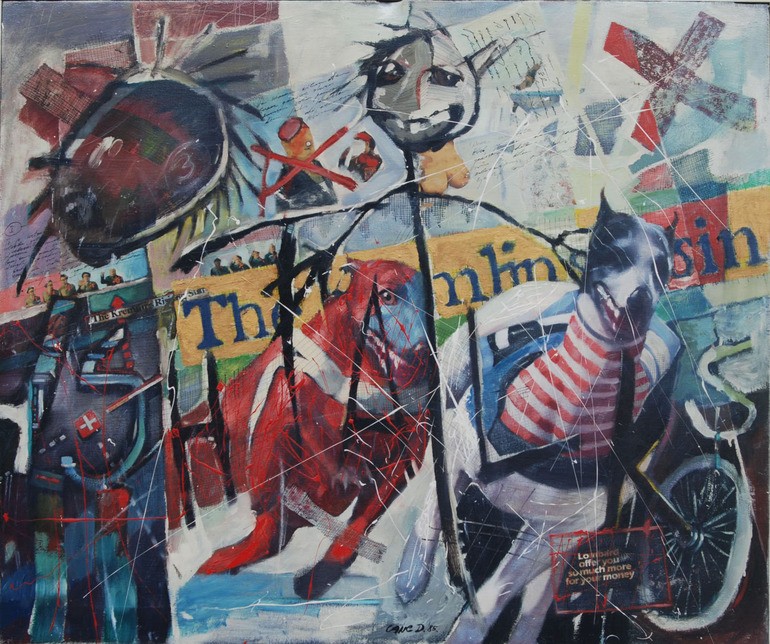
Cane Dojcilovic [Dibujo, Pintura]

Me ha llamado la atención el trabajo de éste artista. Les invito a conocer sus intrincados dibujos y curiosas pinturas, así como sus interesantes reflexiones sobre su propia obra y el arte en general.

I was struck by the work of this artist. I invite you to know his intricate drawings and curious paintings, and also his interesting reflections on his own work and art in general.

Cane Dojcilovic


Cane Dojcilovic es un pintor y dibujante nacido en Sabac, Serbia, que actualmente vive y trabaja en New York City.
Se graduó en Bellas Artes en departamento de Pintura de la Universidad de Artes de Belgrado, ha participado en cerca de 100 exposiciones colectivas con jurado en Europa y Estados Unidos, y varias muestras independientes. 

"Dibujo Nº 27 / Drawing # 27", grafito / graphite, 16,9" x 14,2"  © Cane Dojcilovic

"Sedimentos eólicos Nº2 / Eolian Sediments #2", pintura al óleo / oil painting © Cane Dojcilovic

Selecciono y traduzco algunos párrafos de sus escritos que bajo el título de "Fragmentos del bloc de notas", pueden leerse completos (en inglés) aquí.

«...La inspiración es un rostro humano o un cuerpo, pero el tema es intrascendente, puede ser cualquier cosa. La fase inicial de la pintura o dibujo es calculada, calma y simple, con un tema claro. Le siguen la fragmentación y el caos, a veces tan sólo para retornar a ese cálculo y calma del principio, que podría ser, inevitablemente, vuelto a fragmentar. Durante el proceso se desarrollan diferentes "poéticas" que dependen, intencionada o inintencionadamente, del proceso de pintura en sí mismo. Algunas horas pintando hoy podrían derivar en cualquier dirección mañana, incluso en más fragmentación y complicación, o limpiando y simplificando la fragmentación pintada ayer. Extremos de opuestos, simbiosis de las formas y suavidad, quietud y movimiento, brillo y oscuridad y una escala de diferentes temperaturas de gris entre medio se están originando y volviéndose visibles. Todos estos opuestos pueden encontrar el equilibrio sólo en el proceso de la pintura, y no pueden ser concebidos, formulados o planteados de antemano. En ese proceso, ritmos distintos, "juegos", y las fragmentaciones de las formas, luces, sombras y estructuras se están desarrollando y comenzando a evolucionar y desviarse en diferentes direcciones, algo que se vuelve independiente del tema inicial.

Me parece que éste proceso nunca termina y en él encuentro el regocijo de la pintura que me impide declarar un cuadro "terminado". Por eso mis pinturas están tan sólo en diferentes etapas, dependiendo de dónde y cuándo decido parar de pintar. Soy consciente de que ésta decisión debe ser tomada tarde o temprano: ¿Cuándo parar? Pero mis pinturas nunca están "terminadas".»

"La vida en tiempos de guerra Nº 3/ Life During Wartime #3"
Óleo sobre lienzo / oil on canvas, 102 x 76 cm., 2002 © Cane Dojcilovic

"Dibujo Nº 2 / Drawing # 2", lápiz sobre papel / pencil on paper, 34 x 47 cm., 1997 © Cane Dojcilovic

«...¿Cómo explicas cómo, qué y por qué pintas? ¿Cómo condensar eso en palabras, frases y párrafos? ¿Es posible enclaustrar todo el amor, tranquilidad, pasión, ingenio, absurdidad, decepción, miedo, simpatía, afecto, inventiva, estupidez, sentimentalismo, idiotez, maquinación, ingenuidad, locura, empatía y duplicidad en unos cientos o millones de pinceladas y trazos de grafito a lo largo de la vida... en unas pocas frases?»

«...Tal vez sea posible, si eres un buen escritor. Las palabras son como el agua, y como ella pasan de boca en boca, pero nunca sacian el mismo tipo de sed. Hemingway escribió una historia corta utilizando sólo seis palabras y estoy seguro de que yo podría hacer un dibujo empleando una sóla línea. ¿O tal vez sólo un pequeño punto con el lápiz en medio de un folio en blanco? ¿Pero de qué valdría? ¿Por qué querría yo hacer eso? Yo quiero dibujar con sescientas mil líneas.»

"Día y noche: Omega 2 / Day & Night: Omega 2"
Óleo sobre lienzo / oil on canvas, 102 x 76 cm., 2001 © Cane Dojcilovic

«...Cuánto más se convierte el arte visual en una imitación sintética y simulada de lo bello, culto, creativo e imaginativo, más palabras y explicaciones vacías e instrucciones se necesitan. Hoy en día hay todo un hábil negocio montado en torno a esta comedia. Profetas de este monumental engaño del "Gran Arte" y sus acólitos cojos han etiquetado prácticamente todas y cada una de las cosas que tienen que ver con el Arte de hoy en día, como un producto: por tipos, contenidos, valores, ingredientes, mes, año y fecha de caducidad. La escena del Arte Contemporáneo es como un enorme supermercado global: rentable, predecible, explicado, esperado, definido, institucionalizado, establecido, arraigado y completamente sin sentido. Sin embargo, cuando llegan al Arte, los gestores de éste Supermercado de Arte global, son como maridos cornudos: siempre los últimos en enterarse.»

Izq./ Left: "Bodegón con sangre / Still Life With Blood", pintura al óleo / oil painting 
Der./ Right: "Terra incognita", óleo sobre lienzo / oil on canvas, 102 x 76 cm., 1995
© Cane Dojcilovic

Se puede disfrutar del trabajo de Cane en Saatchi Online y también en ArtSlant.

"Dibujo Nº 12 / Drawing # 12", lápiz sobre papel / pencil on paper, 40 x 31 cm., 2001 © Cane Dojcilovic

Cane Dojcilovic is a Serbian drawer and painter born in Sabac, currently based in New York City.
Graduated at Belgrade University of Arts (Academy of Fine Arts, Painting Department). Participated in over hundred juried group exhibitions in Europe and United States (mostly in New York City) and several independent exhibitions.

"Caballero Nº 2 / Knight #2", pintura al óleo / oil painting © Cane Dojcilovic

Izq./ Left: "Dibujo Nº 5 / Drawing # 5", lápiz sobre papel / pencil on paper, 34 x 27 cm., 1998
Der./ Right: "Dibujo Nº 9 / Drawing # 9", lápiz sobre papel / pencil on paper, 39 x 29 cm., 2000
© Cane Dojcilovic

I select some paragraphs from his writings entitled "Fragments from the notebook" you can fully read here.

«...Inspiration is a human face or a body, but subject matter is inconsequential, it could be anything. Initial stage of the painting or drawing is calculated, calm and simple, with a clear subject matter. Fragmentation and chaos follows, sometimes only to lead right back to the calculated and calm beginning which would be, inevitably, fragmented again. Different “poetics” are developing in the process, intentionally or unintentionally dependent to the painting process itself. Few hours of painting today could take any direction tomorrow, either to more fragmentation and complication or to clearing and simplification of the fragmentation painted yesterday. Extremes of opposites, symbiosis of sharp and soft, stillness and motion, bright and dark and a range of different temperature grays in between are originating and becoming visible. All those opposites can find the balance only in the process of painting and they cannot be devised, formulated or arranged in advance. In that process, separate rhythms, “plays” and fragmentations of the forms, lights, shadows and structures are developing and starting to evolve and deviate to different directions, somehow becoming independent from the initial “subject” matter.

It seems to me that there is never end to that process and in it I find the joy of painting that prevents me from declaring a painting “finished”. That is why my paintings are only in different stages, depending on where and when I decided to stop painting them. I am aware that rational decision must be made sooner or later: when to stop? But my paintings are never “finished…»

"Vida de un cuerpo celeste / Life of a Celestial Body", pintura al óleo / oil painting © Cane Dojcilovic

"Los recuerdos no esperan Nº 2 / Memories Can't Wait # 2"
Óleo sobre lienzo / oil on canvas, 102 x 99 cm., 2002 © Cane Dojcilovic

«…How do you explain how, what and why do you paint? How do you squeeze that into words, sentences and paragraphs? Is it possible to box in all the love, silliness, passion, artfulness, absurdity, deception, fear, sympathy, affection, inventiveness, stupidity, sentimentality, idiocy, machination, ingenuity, lunacy, empathy and duplicity in a hundreds of millions of brush strokes and graphite treads over a lifetime… in a few sentences?...»

"Requiem", pintura al óleo / oil painting © Cane Dojcilovic

Izq./ Left: "Perdón por una mirada tan larga (inconcluso, detalle central) / 
Sorry for such a long staring gaze (unfinished, detail center)"
Óleo sobre lienzo / oil on canvas, 127 x 102 cm.
Der./ Right: "Gravedad salvaje / Wild Gravity", óleo sobre lienzo / oil on canvas, 72 x 56 cm., 2003
© Cane Dojcilovic

«…Perhaps it is possible, if you are a good writer. Words are like water, and like water they pass from mouth to mouth but they never quench the same kind of thirst. Hemingway wrote a short story using only six words and I am sure I could make a drawing using only one line. Or just one, small pencil dot in the middle of the white paper? But what would be the point? Why would I ever want to do that? I want a drawing with six hundred thousand lines…» 

"Día y noche: Omega / Day & Night: Omega"
Óleo sobre lienzo / oil on canvas, 102 x 76 cm., 2000 © Cane Dojcilovic

"Sic Transit Gloria Mundi", pintura al óleo / oil painting © Cane Dojcilovic

«… The more visual art becomes a synthetic and simulated mimicry of the beautiful, cultured, creative and imaginative, the more worded and hollow explanations and instructions are required. Today, there is a whole new adroit business made out of that comedy. Prophets of this monumental High Art hoax and their lamed acolytes have had labeled just about anything and everything in Art today, like a produce:  by type, content, value, ingredients, month, year and expiration date.  Contemporary Art scene today is like a huge, global supermarket: profitable, predictable, explained, expected, defined, institutionalized, established, entrenched and totally meaningless.  However, when it comes to Art, managers of this global Art Supermarket are like cuckolded husbands: always last to find out…»

"La vida en tiempos de guerra Nº 1 y 2 / Life During Wartime # 1 & # 2"
Óleo sobre lienzo / oil on canvas, 71 x 56 c/u / each, 1999 © Cane Dojcilovic

You can enjoy Cane's work in Saatchi Online and also in ArtSlant.

"Cabeza / Head", pintura al óleo / oil painting © Cane Dojcilovic

Imágenes publicadas con autorización del artista (¡Muchas gracias, Cane!)
Images published here with artist's permission (Thanks a lot, Cane!)

miércoles, 4 de diciembre de 2013

Moore al aire libre (II) [Escultura]

En este segundo post, una selección de buenas imágenes de obras públicas de Moore rescatadas de la red. Para más información sobre el artista, véase el post anterior.

In this second post, a selection of good images with public artworks by Moore founded on the net. You can ckeck the previous posts for more artworks and information.
___________________________________________________

Henry Moore

Henry Moore fotografiado por / photographed by Allan Warren (1975). Imagen / Image: Wiki

Allan Warren en "El Hurgador" / in this blog[Aniversarios Fotografía (CXLVII)]

"Figura reclinada en dos piezas Nº 5 / Two Piece Reclining Figure No. 5", bronce / bronze, 1963-64.
(Kenwood House, London, UK).
Imagen / Image: Wikimedia Commons

"Gran Huso / Large Spindle Piece", bronce / bronze, 1974-2. (West Bretton, Reino Unido)
Imagen / Image: Lesley Rigby, Panoramio

"Dos formas grandes / Large Two Forms", bronce / bronze, 1966 
(Instalación en Perry Green, Hertfordshire, Reino Unido) Imagen / Image: LFA

"Grupo familiar / Family Group", bronce / bronze, 1950. 
A la entrada de / Entrance to Barclay School, Stevenage, Hertfordshire, England. 
Imagen / Image: Wikimedia Commons

La estatua fue el primer encargo a gran escala que recibió Moore, y el primero después de la Segunda Guerra Mundial. Fue originalmente diseñada para el Impington Village College ya que encajaba con la filosofía del colegio de una educación a lo largo de toda la vida. Sin embargo, cuando Moore tenía ya diseñada la maqueta, Impington canceló el encargo por falta de fondos.
El proyecto fue reflotado años después cuando se diseñó el nuevo pueblo de Stevenage. El director de educación John Newsom, persuadió al ayuntamiento de que aportara fondos para obras de arte público destinadas a las nuevas escuelas que se estaban construyendo, permitiendo a Moore completar su obra para la Escuela Barclay en 1950.

This statue was Moore's first large scale commission for a bronze and his first commission following the Second World war. It was originaly intended for Impington Village College in Cambridge and the Family Group subject fits in with the village college philosophy of life-long education. However, after Moore had designed the maquette, Impington cancel the sculpture due to lack of funds.
The project was revived a few years later when the new town of Stevenage was being designed. The Chief Education Officer, John Newsom, persuaded the coucil to allocate funds for public art works at each of the new schools being built, allowing Moore to complete Family Group for the Barclay School in 1950.

"Óvalo doble / Double Oval", bronce / bronze, 1977. Jardín / Garden Connaught, Hong Kong
Imagen / Image: Wikimedia Commons

"Figura reclinada / Reclining Figure", bronce / bronze, 1951. Imagen / Image: Wikimedia Commons.
Galería Nacional de Arte Moderno, Edinburgo, Escocia / 
Scottish National Gallery of Modern Art, Edinburgh, Scotland.

"Pieza en tres sentidos Nº 2, 'El Arquero' / Three-Way Piece Nº 2, 'The Archer'", bronce / bronze, 1966.
Plaza Nathan Philips, Ayuntamiento / Nathan Philips Square, City Hall, Toronto, Canada
Imagen / Image: Wikimedia Commons

El arquitecto Viljo Revell pidió al escultor británico Henry Moore que diseñara y creara una estatua que complementara la fluidez de líneas del Ayuntamiento.
"El Arquero" es un forma libre en bronce de 2,5 toneladas que descansa sobre una base de hormigón, rodeada por un piso de hormigón con piedras incrustadas. Información traducida de aquí.

Architect Viljo Revell asked British sculptor, Henry Moore, to design and create a statue that would complement the flowing lines of City Hall.
"The Archer" is a 2.5 tonne bronze free-form statue that rests on a concrete base, surrounded by a floor of concrete embedded with stones. Info from here.

"Pieza en tres sentidos Nº 2, 'El Arquero' / Three-Way Piece Nº 2, 'The Archer'"
Vista norte / North view. Imagen / Image: Wikipedia

"Filo de cuchillo - Dos piezas / Knife Edge - Two Piece", bronce / bronze, 1962.
Imagen e información / Image and info: Wikimedia Commons

"Cuando se me propuso este sitio cerca de la Cámara de los Lores (...) me gustó tanto el lugar que no me molesté en ver un sitio alternativo en Hyde Park. Una escultura solitaria puede quedar perdida en un parque grande. La Cámara de los Lores es bastante diferente. Está cerca de un sendero por donde camina la gente, y hay algunos asientos donde pueden sentarse a contemplarla." H.M.

"When I was offered the site near the House of Lords... I liked the place so much that I didn't bother to go and see an alternative site in Hyde Park — one lonely sculpture can be lost in a large park. The House of Lords site is quite different. It is next to a path where people walk and it has a few seats where they can sit and contemplate it." H.M.

"Mujer reclinada / Reclining woman", bronce / bronze, 19??.
Jardín de Esculturas Donald M. Kendall, Sede mundial de Pepsico, Purcahse, New York
Donald M. Kendall Sculpture Gardens, Pepsico world headquarters, Purcahse, NY
Imagen / Image: Wikimedia Commons

"Relieve de pared Nº 1 / Wall Relief Nº 1", ladrillo / bricks, 1955. Imagen / ImageWikimedia Commons
Antiguo Centro de Construcción, Calle Weena, Rotterdam, Holanda / 
Former Bouwcentrum (Building Centre), Weena Street, Rotterdam, Netherlands

Esta pieza fue encargada al artista después de su exposición en el museo Boijmans Van Beuningen en 1953. Es su única obra en ladrillo.

This piece was commissioned to the artist after his exhibition in Museum Boijmans Van Beuningen in 1953. It is his first and only work in brick. 

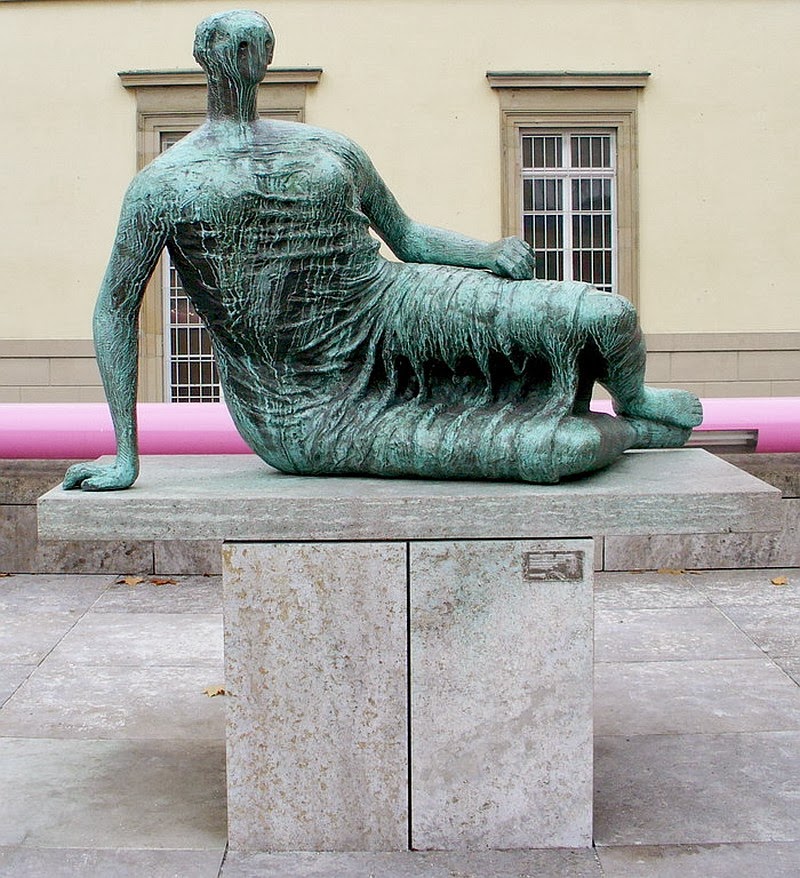
"Mujer reclinada vestida / Draped Reclining Woman", bronce / bronze, 1961.
Neue Staatsgalerie, Stuttgart, Alemania / Germany. Imagen / Image: Wikimedia Commons

“Figura reclinada en dos piezas / Two Pieces Reclining Figure Cut”, bronce / bronze, 1979-81
Rijksmuseum, Amsterdam, Holanda / Netherlands

"Escultura en tres piezas: Vértebras / Three piece sculpture: Vertebrae", bronce / bronze, 1968-69
Museo de la Palestina Ocupada, Jerusalén / Occupied Palestine Museum, Jerusalem
Imagen / Image: Wikimedia Commons

"Gran forma interna/externa vertical en primavera / 
Large Upright Internal/External Form in Spring", bronce / bronze, 1981-82
Exposición de 2007 en los Jardines Kew, Londres, Inglaterra / 
Exhibition at Kew Gardens (2007), London, England
Imagen / Image: Wikipedia

"Dos formas grandes / Two Large Forms", bronce / bronze, 1966-1969.
Galería Nacional de / Nationa Gallery of Ontario, Canada. Imagen / Imagetravellingflip

"Gran forma cuadrada con corte / Large Square Form with Cut"
Mármol de Rio Serra / Rio Serra marble, 1969-71
Plaza de San Marcos / Piazza San Marco, Prato, Toscana, Italia
Imagen / Image: Wikipedia

Henry Moore en "El Hurgador" / in this blog: [Todos los enlaces / All Links]