domingo, 17 de agosto de 2014

Aniversarios / Anniversaries (XXIX) [Agosto / August 10-16]

Textos en inglés al final del post / English translation at the end of this post.
Todos los aniversarios de Agosto aquí / All anniversaries for August here.
_________________________________________________________

El 10 de Agosto es el cumple de

Sheikh Mohammed "SM" Sultan (শেখ মোহাম্মাদ সুলতান ),pintor de Bangladesh nacido en 1923, declarado "Hombre de Asia" en 1982 por la Universidad de Cambridge. Comenzó dibujando los edificios en los que trabajaba con su padre como albañil. No pudo ir a estudiar a Calcuta por falta de medios, pero eventualmente llegó allí en 1938 con apoyo de un terrateniente local. No pudo entrar en la Escuela de Arte de Calcuta, y nunca completó su educación.
Viajó por la India como artista freelance, ganándose la vida pintando retratos de los soldados que acampaban en los lugares que visitaba. Su primera exposición tuvo lugar en Simla. Por fin se estableció en Narail, con vistas al río Chitra, donde vivió rodeado de animales. Su primera exposición en Dhaka fue en 1976. Murió en 1994.

_________________________________________________________

Anton Pavlovich Losenko (Антон Павлович Лосенко), pintor neoclásico y académico ucraniano nacido en 1737, que vivió en la Rusia Imperial y se especializó en temas históricos y retratos. Fue uno de los fundadores del movimiento pictórico histórico de la Rusia Imperial.
Fue admitido en la Academia de las Artes en 1759. Entre sus pinturas se cuentan los retratos de Ivan Shuvalov (1760) y de Alexander Sumarokov (1760).
En 1760 la academia lo envió a París para estudiar arte con el pintor francés neoclásico Jean II Restout.
En 1769, Losenko regresó a San Petersburgo. Recibió una oferta para presentar una pintura histórica como forma de recibir el status de Académico en la Academia Imperial de las Artes. De un episodio de la historia de Rus de Kiev, pintó su clásico lienzo de Olodymyr y Rohnida. Gracias a esta pintura no sólo obtuvo el título de Académico, sino también un profesorado.
Murió en 1773.

"Fyodor Volkov", 1763. Galería Tretyakov (Moscú, Rusia / Moscow, Russia)


El 11 de Agosto es el cumple de

Pavel 183, misterioso artista callejero ruso nacido en 1983. 
Su trabajo abarcó desde murales pintados con spray hasta combinaciones de audio y video, acompañados con mensajes políticos. Su trabajo se ha comparado con el del británico Banksy y el estadounidense Keith Haring.
A pesar de su graduado en diseño, solía atacar la publicidad por privar a la gente de su libre albedrío. También describía a los diseñadores como máquinas de hacer dinero, comparándolos con los verdaderos artistas, cuya obra respetaba más. Fue reconocido por sus instalaciones socialmente críticas y murales fotorrealistas a gran escala. Con el tiempo exploró técnicas de creación diferentes, como dibujar en la oscuridad con luz e incorporar estructuras existentes en el entorno, como las canalizaciones de Moscú y espacios de hormigón. Aunque su obra incorporaba elementos políticos, reivindicaba no ser considerado un "artista político".
Murió en 2013

Intervención en la vía pública / Intervention in the streets
_________________________________________________________

Martin Johnson Heade, prolífico pintor estadounidense nacido en 1819, conocido por sus paisajes de marismas, marinas y representaciones de aves tropicales (como colibríes), así como flores de loto y otras naturalezas muertas. Su estilo pictórico y temática, aunque derivado del romanticismo de la época, fue visto por los historiadores del arte como significativamente apartado del de sus colegas.
Sus obras tempranas (principalmente retratos) fueron producidas durante la década de 1840. De joven viajó varias veces por Europa, convirtiéndose en una artista itinerante en las costas estadounidenses y exhibiendo en Filadelfia en 1841 y en Nueva York en 1843. Su amistad con los artistas de la Escuela del Río Hudson condujo a su interés en el arte del paisaje. Desde entonces viajó varias veces a los trópicos, y continuó pintando aves y flores.
Heade no fue un artista ampliamente conocido durante su vida, pero su obra atrajo la atención de estudiosos, historiadores del arte y coleccionistas durante la década de 1940.
Murió en 1904.

"Orquídea y colibrí cerca de una cascada / Orchid and Hummingbird close to a Cascade"
Óleo sobre lienzo / oil on canvas, 38,2 x 51,5 cm., 1902. 
Colección Carmen Thyssen, en el Museo Thyssen-Bornemisza (Madrid, España / Spain)


El 12 de Agosto es el cumple de

Lino Enea Spilimbergo, pintor y grabador argentino nacido en Buenos Aires en 1896, considerado uno de los grandes maestros del arte de su país.
En 1917 se recibe de profesor nacional de Dibujo de la Academia Nacional de Bellas Artes Prilidiano Pueyrredón, entre sus profesores se encuentran artistas de la talla de Pío Collivadino, Ernesto de la Cárcova y Carlos Pablo Ripamonte.
Al ser asmático crónico los médicos le aconsejan trasladarse a un lugar de clima seco. Se muda a Desamparados, provincia de San Juan, donde realiza su primera exposición individual. En 1925 viaja a Europa y en Italia estudia a los clásicos con atención especial a los frescos.
Entre 1926 y 1928 (año de retorno a Argentina) sigue los cursos en la Académie de la Grande Chaumière por las mañanas y concurre por las tardes al taller de André Lhote en París, logrando una síntesis muy personal de estilos entre lo clásico y lo moderno. Murió en 1964.

"Paisaje de San Juan / Lanscape of San Juan", 1939.
_________________________________________________________

Tamás Lossonczy, pintor abstracto húngaro nacido en Budapest en 1904. Es considerado por  muchos críticos como una de las figuras líderes del arte moderno en Hungría durante el s.XX.
Tras finalizar la secundaria, comenzó a estudiar leyes, pero poco después hizo el examen de ingreso a la Academia de Bellas Artes de Hungría, y fue aceptado. Durante los años '20 viajó frecuentemente a París, donde se hizo amigo de varios prominentes artistas de la época. Tras su regreso a Hungría, estudió diseño de interiores en la Academia Húngara de Artes Aplicadas, donde sus intereses cambiaron temporalmente de la pintura a la arquitectura.
Lossonczy fue miembro de la Escuela Europea, los Artistas de Vanguardia del Valle del Danubio, y el Grupo Húngaro de Arte Concreto.
Entre sus obras más conocidas está el gran mosaico de la estación de metro EUR-Magliana en Roma, que fue inaugurado en 1998.
Murió en 2009.

"Gran tormenta purificadora / Great Purifying Storm", 1962. Foto / Photo: Kieselbach Gallery


El 13 de Agosto es el cumple de

Miklós Borsos, escultor y medallista húngaro nacido en 1906, cuyo estilo integró elementos del arte arcaico y el clasicismo con aportes modernos.
Se interesó en el arte, especialmente en la escultura, a fines de los años '20, iniciándose en la pintura y volcándose en la escultura durante la década de los '30.
Hizo uso de todos los géneros escultóricos, enriqueciéndolos con varias soluciones novedosas. Desarrolló el estampado en placas de cobre (una técnica rara en ese momento histórico), y produjo varias esculturas para lugares públicos y monumentos funerarios, centrándose en una cultura ambiental moderna que a menudo llevaba un mensaje personal profundo reflejando una gran intimidad (combinando motivos simbólicos de la vida natural, así como valores culturales). También se dedicó al retrato durante los '50 y los '60.
En 1979 abrió la Miklós Borsos Art Gallery in Győr. Murió en 1990.

"Tumba de / Tomb of Béla Bártok" (Budapest, Hungría / Hungary)
_________________________________________________________

Takahiro Hara, brillante pintor realista japonés nacido en Fukuyama, prefectura de Hiroshima, en 1971.
Más imágenes e información en el post previo.

"Espejo y notas / Mirror and Notes", 2013

Takahiro Hara en "El Hurgador" / in this blog:


El 14 de Agosto es el cumple de

Yannoulis Chalepas, escultor y figura significativa del arte moderno griego, nacido en 1851 en Pyrgos (isla de Tinos), en una familia de artesanos del mármol. Estudió en la Escuela de Artes de Atenas como alumno del escultor neoclásico Leonidas Drossis. En 1873 llegó a Münich gracias a una beca para continuar sus estudios en la Academia de Bellas Artes de la ciudad como alumno de Max von Widnmann. Regresó a Atenas en 1876, abriendo un taller donde comenzó a trabajar por su cuenta.
En 1878 sufrió una crisis nerviosa, destruyó algunas de sus esculturas y pasó por varios intentos de suicidio. Su condición empeoró y entre 1888 y 1902 estuvo recluido en el Hospital Mental de Corfu. Tras la muerte de su padre, vivió en Tinos con su madre que, culpando a la escultura de su enfermedad, le impidió trabajar y destruyó todo lo que había creado. Tras la muerte de ella, Chalepas retomó su trabajo ganándose la atención de los círculos intelectuales atenienses y en 1927 recibió el premio de la Excelencia en Artes y Letras de la Academia de Atenas. Murió en 1938.

"Figura de mujer durmiente / Figure of a Sleeping Woman", 1877
Tumba de Sofia Afentaki, Primer Cementerio de Atenas, Grecia /
Tomb of Sofia Afentaki, First Cemetery of Athens, Greece
_________________________________________________________

Claude-Joseph Vernet, pintor francés nacido en 1789. 
Con sólo catorce años de edad, ayudaba a su padre, Antoine Vernet (1689-1753), un experto pintor decorativo, en las partes más importantes de su trabajo. Los paneles de sillas de manos, sin embargo, no podían satisfacer su ambición, y Vernet comenzó por Roma. La vista del mar en Marsella y su viaje desde allí a Civitavecchia (puerto principal de los Estados Pontificios en el mar Tirreno) causó una profunda impresión en él, e inmediatamente después de su llegada, entró en el estudio de un pintor de marinas, Bernardino Fergioni. 
Durante veinte años Vernet vivió en Roma, produciendo vistas de los puertos de mar, tormentas, calmas, luz de luna, haciéndose especialmente popular entre los aristócratas ingleses.
Murió en 1789.

"Una bahía a la luz de la luna / A Harbor in Moonlight"
Óleo sobre lienzo / oil on canvas, 61 × 81,3 cm., 1787. 
Saint Louis Art Museum (San Luis, Missouri, EE.UU./ MO, USA)

Claude-Joseph Vernet en "El Hurgador" / in this blog: [Kate Bergin (Pintura)]


El 15 de Agosto es el cumple de

Ivan Meštrović, escultor y arquitecto croata nacido en 1883. Se le considera posiblemente el más grande de los escultores de temática religiosa desde el Renacimiento, y fue la primera persona viva de quien se hizo una exposición individual en el Metropolitan Museum de New York City. 
A los 16 años, un maestro cantero de Split notó su talento y lo tomó como aprendiz. Sus habilidades fueron mejorando con el estudio de los edificios monumentales de la ciudad. En 1905 hizo su primera exposición junto al grupo de la Secesión de Viena, notablemente influido por el Art Nouveau. Pronto su estilo se hizo popular. 
Durante la Primera Guerra viajó y expuso en París, Cannes, Londres y Suiza. Fue uno de los miembros del Comité para la ex-Yugoslavia.
Después de la Segunda Guerra se le ofreció un profesorado en la Universidad de Siracusa y se mudó a Estados Unidos. Murió en 1962.

"Fuente de la Vida / Fountain of Life", 1905. 
Frente al Teatro Nacional de Croacia / In front of the Croatian National Theater, Zagreb
_________________________________________________________

Kolë Idromeno, pintor, escultor, fotógrafo, arquitecto e ingeniero albanés nacido en 1860. 
Aprendió los primeros elementos de la fotografía de Pietro Marubi. En 1876 permaneció durante algunos meses en la Accademia di Belle Arti di Venezia (Academia de Bellas Artes de Venecia), y luego trabajó en el estudio de un pintor italiano. Cuando regresó a Albania (1878), se dedicó a una serie de actividades, trabajando como arquitecto, escultor, fotógrafo, escenógrafo, ingeniero y pintor. Realizó la primera exposición de arte en Shkodër (1923) y estuvo representado en la primera exposición nacional de arte en Tirana (1931). 
Idromeno fue el primer pintor en mostrar imágenes en movimiento en Albania en 1912, había mantenido una correspondencia con los hermanos Lumière en París. 
Fue también el primer pintor de paisajes en la escuela de pintura albanesa moderna (Patio de una casa en Shkodra) y fue pionero en la pintura secular realista. 
Murió en 1939.

"Dasma shkodrane / Boda en / Wedding in Shkodra", 1924. National Art Gallery (Tirana, Albania / Albany)


Ayer, 16 de Agosto, fue el cumple de

Agostino Carracci, pintor y grabador italiano de transición entre el Manierismo y el naciente Barroco, nacido en Bolonia en 1557.
Seguía como ideal la naturaleza, y fue, junto con sus parientes Annibale y Ludovico, el fundador de una escuela que buscaba una visión más particularizada de ésta, y en cierto modo rival al estilo preconizado por Caravaggio.
Agostino se formó en el ambiente manierista de Bolonia, especialmente con el arquitecto y tallista Domenico Tibaldi. Hizo viajes de estudios a Venecia en 1582, y a Parma entre 1586 y 1587, volviendo a Venecia entre 1587 y 1589; su vida y actividad posteriores se centraron no obstante en su ciudad natal.
Sus modelos pictóricos fueron, entre otros, Federico Barocci, Tintoretto, Antonio Campi y Correggio, de cuyas obras famosas hizo copias.
Murió en 1602.

"El Diluvio / The Flood", óleo sobre lienzo / oil on canvas, 166 x 247 cm., 1616-18. 
Musée du Louvre (París, Francia / France)

Agostino Carracci en "El Hurgador" / in this blog: [Recolección (CLXIX-2)]


Textos en inglés / English translation

On August 10 is the birthday of

Sheikh Mohammed "SM" Sultan (শেখ মোহাম্মাদ সুলতান), painter born in Bangladesh in 1923, declared "Man of Asia" in 1982 by the University of Cambridge. He began drawing the buildings where his father worked as a mason. He could not go to study in Calcutta for lack of means, but eventually got there in 1938 with support from a local landowner. He could not enter the School of Art in Calcutta, and never completed his education. 
He traveled to India as a freelance artist, making a living painting portraits of soldiers camped in the places he visited. His first exhibition was held in Simla. Finally he settled in Narail overlooking the river Chitra, where he lived surrounded by animals. His first exhibition was in Dhaka in 1976 and died in 1994.

Anton Pavlovich Losenko (Антон Павлович Лосенко), Ukrainian neoclassical painter and academician born in 1737, who lived in Imperial Russia and who specialized in historical subjects and portraits. He was one of the founders of the Imperial Russian historical movement in painting.
He was admitted to the Imperial Academy of Arts in 1759. Among the paintings he created there was the Portrait of Ivan Shuvalov (1760) and the Portrait of Alexander Sumarokov (1760).
In 1760, the Academy sent him to Paris to study art under the French neoclassical painter Jean II Restout.
In 1769, Losenko returned to Saint-Petersburg. He received an offer to present a historical painting as a way of receiving Academician status in the Imperial Academy of Arts. From an episode of Kievan Rus' history, he painted his classical canvas of Volodymyr and Rohnida. This painting not only brought him the title of Academician but also a professorship.
He died in 1773.

On August 11 is the birthday of

Pavel 183, mysterious Russian street artist born in 1983-
The works of Pavel 183 range from murals spray-painted on public structures to combinations of audio and video, at times accompanied by a political message. His works have been compared with those of the British street artist Banksy, and U.S. artist Keith Haring.
Despite his degree in design, he used to attack advertising for its power to deprive people of free will. He also describes designers as money makers and compares them to real artists, whose work he respects most. He was best known for his socially critical installations and grey-scale photorealistic murals. Later in his career, Pukhov explored different techniques of creation, eventually learning to draw in the dark with lights and to incorporate existing environmental aides, such as Moscow's waterways and concrete spaces.
While his works addressed political issues, he claimed not to consider himself a "political artist"

Martin Johnson Heade, prolific American painter born in 1819, known for his salt marsh landscapes, seascapes, and depictions of tropical birds (such as hummingbirds), as well as lotus blossoms and other still lifes. His painting style and subject matter, while derived from the romanticism of the time, are regarded by art historians as a significant departure from those of his peers.
His earliest works were produced during the 1840s and were chiefly portraits. He travelled to Europe several times as a young man, became an itinerant artist on American shores, and exhibited in Philadelphia in 1841 and New York in 1843. Friendships with artists of the Hudson River School led to an interest in landscape art. He travelled to the tropics several times thereafter, and continued to paint birds and flowers. 
Heade was not a widely known artist during his lifetime, but his work attracted the notice of scholars, art historians, and collectors during the 1940s.
He died in 1904.

On August 12 is the birthday of

Lino Enea Spilimbergo, Argentine painter and engraver born in Buenos Aires in 1896, considered one of the great masters of his country. 
In 1917 he became professor of drawing in the National Academy of Fine Arts Prilidiano Pueyrredon. Among his teachers had artists like Pius Collivadino, Ernesto and Carlos Cárcova Paul Ripamonte. 
Being asthmatic chronic medical advise moving to a place of dry weather. He moved to Desamparados in the province of San Juan, where he had his first solo exhibition. In 1925 he traveled to Europe and Italy studying the classics with a focus on frescoes. 
Between 1926 and 1928 (the year of his return to Argentina) follows the courses at the Academie de la Grande Chaumiere in the mornings, and evenings attends the workshop of André Lhote in Paris, achieving a very personal synthesis of styles of classic and modern . He died in 1964.

Tamás Lossonczy, Hungarian abstract painter born in Budapest in 1904. He is considered by many critics to be one of the leading figures of modern art in Hungary of the 20th century.
After graduation from secondary school, Lossonczy began law studies, but soon afterward took an entrance examination to the Hungarian Academy of Fine Arts and was accepted. During the 1920s, he traveled frequently to Paris, where he befriended several prominent artists of the period. Upon his return to Hungary, he studied interior design at the Hungarian Academy of Applied Arts, where his interests temporarily shifted from painting to architecture.
Lossonczy was a member of the European School, the Avant-garde Artists of the Danube Valley, and the Hungarian Group of Concrete Art.
Among his best known works is his large-scale mosaic at the EUR-Magliana metro station in Rome, Italy, which was inaugurated in 1998.
He died in 2009.

On August 13 is the birthday of

Miklós Borsos, Hungarian sculptor and medalist born in 1906, whose style integrated elements of archaic art and classicism with modern inputs. 
He became interested in art, especially in sculpture, in the late 20s, beginning in painting and focusing in sculpture during the decade of the 30s. 
He used all sorts of sculptures genders, endowing them with several innovative solutions. He developed the stamped copper plates (a rare technique in that historical moment), and produced several sculptures for public places and funerary monuments, focusing on modern environmental culture that often took a deep personal message reflecting great intimacy (combining symbolic motifs of natural life and cultural values​​). He also devoted himself to portraiture during the 50s and 60s. 
In 1979 he opened the Miklós Borsos Art Gallery in Győr. He died in 1990.

Takahiro Hara, brilliant Japanese realist painter born in Fukuyama, Hiroshima Prefecture, in 1971.
More images and information in the previous post.
In "El Hurgador": 

On August 14 is the birthday of

Yannoulis Chalepas, sculptor and significant figure of Modern Greek art, born in 1851 in Pyrgos (Tinos), into a family of craftsmen of the marble.
He studied at the Athens School of Arts as a student of neoclassical sculptor Leonidas Drossis. In 1873 he arrived in Munich on a scholarship to continue his studies at the Academy of Fine Arts in the city as a student of Max von Widnmann. He returned to Athens in 1876, opening a workshop where he began working on his own. 
In 1878 he suffered a nervous breakdown, destroyed some of his sculptures and went through several suicide attempts. Her condition worsened between 1888 and 1902 and was confined in the Mental Hospital of Corfu. After the death of his father, he lived in Tinos with his mother. She blamed sculpture of his illness prevented him from working and destroyed everything he had created. After her death, Chalepas resumed his work gaining the attention of Athenian intellectual circles and in 1927 received the Award of Excellence in Arts and Letters from the Academy of Athens. He died in 1938.

Claude-Joseph Vernet, French painter born in 1789.
When only fourteen years of age he aided his father, Antoine Vernet (1689–1753), a skilled decorative painter, in the most important parts of his work. The panels of sedan chairs, however, could not satisfy his ambition, and Vernet started for Rome. The sight of the sea at Marseilles and his voyage thence to Civitavecchia (Papal States' main port on the Tyrrhenian Sea) made a deep impression on him, and immediately after his arrival he entered the studio of a marine painter, Bernardino Fergioni.
For twenty years Vernet lived in Rome, producing views of seaports, storms, calms, moonlights, becoming especially popular with English aristocrats
He died in 1789.

On August 15 is the birthday of

Ivan Meštrović, Croatian sculptor and architect born in 1883. He is considered possibly the greatest sculptor of religious subject matter since the Renaissance, and was the first living person who made ​​a solo exhibition at the Metropolitan Museum in New York City. 
At age 16, a Split stonemason teacher noticed his talent and took him as an apprentice. His skills were improved by studying the monumental buildings of the city. In 1905 he made his first exhibition with the group of the Vienna Secession, greatly influenced by the Art Nouveau. Soon his style became popular. 
During World War I he traveled and exhibited in Paris, Cannes, London and Switzerland. He was one of the members of the Committee for the former Yugoslavia. 
After World War II he was offered a professorship at Syracuse University and moved to the United States. He died in 1962.

Kolë Idromeno, Albanian painter, sculptor, photographer, architect and engineer born in 1860.
He learned the first elements of photography from Pietro Marubi. In 1876 he stayed for some months at the Accademia di Belle Arti di Venezia, the academy of fine arts of Venice, and then worked in the studio of an Italian painter. When back in Albania (1878), he engaged himself in a number of different activities, working as an architect, sculptor, photographer, scene-painter, engineer and painter. He was the initiator of the first art exhibition in Shkodër (1923) and was represented in the first national art exhibition in Tirana (1931).
Idromeno was the first painter to show motion pictures in Albania in 1912. He had kept up a correspondence with the Lumière brothers in Paris.
He was the first landscape painter in the modern Albanian painting school (Courtyard of a House in Shkodra) and pioneered realistic secular painting. 
He died in 1939.

Yesterday, August 16, was the birthday of

Agostino Carracci, Italian painter and engraver in the transition between Mannerism and the nascent Baroque, born in Bologna in 1557. 
His ideal was nature, and with his relatives Annibale and Ludovico was the founder of a school that was looking for a more particularized view of nature, and in an style in certain way rival of the advocated by Caravaggio. 
Agostino was trained in the Mannerist environment of Bologna, especially with the architect and carver Domenico Tibaldi. He made trips to Venice in 1582, and Parma between 1586 and 1587, returning to Venice in 1587 and 1589; his life and subsequent activity is however focused on his hometown. 
His pictorial models were, among others, Federico Barocci, Tintoretto, Antonio Campi and Correggio, whose famous works made ​​copies. 
He died in 1602.

Aniversarios, Fotografía (XXIX) [Agosto / August 11-17]

Textos en inglés al final del post / English translation at the end of this post.
Todos los aniversarios de Agosto aquí / All anniversaries for August here.
_________________________________________________________

El 11 de Agosto es el cumple de

Reid Turner Blackburn, fotógrafo estadounidense nacido en 1952, que murió durante la erupción volcánica del Monte Santa Elena en 1980. Cubría la erupción como fotoperiodista de un periódico local (Vancouver, Washington Columbian), así como para para el la revista del National Geographic y el Observatorio Geológico de los Estados Unidos, cuando su coche fue atrapado en Coldwater Camp por la erupción.
El coche de Blackburn y su cuerpo fueron encontrados cuatro días después de la erupción. Su cámara, enterrada bajo los escombros, se encontró casi una semana después.
En diciembre de 2013, un rollo de película sin revelar que contenía tomas anteriores a la erupción del Monte Santa Elena, fue descubierto y revelado más de 30 años después de la muerte de Blackburn, y permanece como un importante registro periodístico del paisaje anterior a la erupción.

"Vista aérea del Monte Santa Elena tomada a principios de abril de 1980 / 
Aerial view of Mount St. Helens shot in early April 1980"


El 12 de Agosto es el cumple de

Antoine François Jean Claudet, fotógrafo y artista nacido en 1797 en Lyon, que produjo daguerrotipos. Estuvo activo en Gran Bretaña y fue estudiante de Louis Daguerre.
Después de haber adquirido una participación en el invento de Daguerre, fue uno de los primeros en practicar la técnica del retrato de daguerrotipos en Inglaterra, y mejoro la sensibilidad del proceso utilizando clorina (en lugar de bromina) añadido a la iodina, ganando así una gran rapidez en la acción. También inventó la luz roja para cuarto oscuro y fue quien sugirió la idea de utilizar series de fotografías para crear la ilusión de movimiento. También se le atribuye la idea de utilizar telones de fondo pintados.
Claudet recibió muchos honores, entre los cuales está la designación, en 1853, como "Fotógrafo habitual" para la Reina Victoria, y el premio honor, diez años más tarde, otorgado por Napoleón III de Francia. Menos de un mes después de su muerte, su "Templo de la fotografía" ardió, y muchos de sus más valiosos tesoros fotográficos se perdieron.

"La lección de geografía / The Geography Lesson"
Daguerrotipo estereoscópico / stereoscopic daguerreotype, 1851


El 13 de Agosto es el cumple de

Herbert "Herb" Ritts, fotógrafo de modas estadounidense nacido en 1952, que se concentró en la fotografía en blanco y negro y retratos, a menudo en el estilo de la escultura clásica griega.
Comenzó su carrera trabajando en el negocio de muebles de la familia. Más tarde, mientras vivía en Los Ángeles, se interesó en la fotografía cuando él y su amigo Richard Gere, por aquél entonces aspirante a actor, decidieron tomar unas fotografías frente a un viejo Buick. La imagen le proporcionó cierta cobertura, y comenzó a tomarse más en serio la fotografía.
Durante los '80 y '90, Ritts fotografió celebridades, desnudos y top models.
También trabajó para revistas y dirigió videos.
Murió en 2002.

Tatjana Patitz, Rostro velado, toma ajustada / Veiled Head, Tight View, Joshua Tree, 1988

Herb Ritts en "El Hurgador" / in this blog:
[Asonancias (I)], [Asonancias (V)], [Asonancias (VII)], [Asonancias (VIII)]


El 14 de Agosto es el cumple de

Willy Ronis, fotógrafo francés nacido en 1910, conocido por una obra que muestra la vida en el París de la posguerra y la Provenza. 
Su padre abrió un estudio de fotografía en Montmartre, y su madre daba clases de piano. El interés inicial del niño fue la música y esperaba convertirse en compositor. A su regreso del servicio militar obligatorio en 1932, debió suspender sus estudios de violín ya que el cáncer de su padre requería que Ronis se hiciera cargo del negocio de retratos de la familia. La pasión de Ronis por la música está presente en sus fotografías. 
Tras la muerte de su padre en 1936, el negocio se vino abajo y Ronis se pasó a trabajar por su cuenta. Sus primeras fotografías se publicaron en Regards. En 1937 conoció a David Seymour y Robert Capa. 
Ronis se convirtió en el primer fotógrafo francés para trabajar para LIFE. En 1953, Edward Steichen incluyó Ronis, Henri Cartier-Bresson, Robert Doisneau, Izis y Brassaï en una exposición en el Museo de Arte Moderno titulada Cinco fotógrafos franceses. 
Murió en 2009.

“Nu provençal / Desnudo provenzal / Provencal nude”, 1936

Willy Ronis en "El Hurgador" / in this blog: [Recolección (LIV)]


El 15 de Agosto es el cumple de

Paul Outerbridge, Jr., fotógrafo estadounidense nacido en 1896, que destacó por su uso temprano y experimentos en la fotografía en color. Outerbridge fue un fotógrafo de moda y comercial, un pionero y maestro de la fotografía en color, y un creador de fotografías de desnudos eróticos que no pudieron ser exhibidos durante su vida. 
Siendo aún adolescente, Outerbridge trabajó como ilustrador y diseñador teatral creando escenografías y esquemas de iluminación. Después de un accidente que causó su baja de la Royal Canadian Naval Air Service, en 1917, se alistó en el Ejército de Estados Unidos, donde produjo su primer trabajo fotográfico. En 1921, se matriculó en la escuela Clarence H. White de fotografía en la Universidad de Columbia. En tan sólo un año, su obra comenzó a ser publicada en las revistas Vanity Fair y Vogue. 
En Londres, en 1925, la Real Sociedad Fotográfica invitó Outerbridge a exponer en una muestra individual. Luego viajó a París y se hizo amigo de los artistas y fotógrafos Man Ray, Marcel Duchamp y Berenice Abbott. 
Los vívidos colores de sus desnudos de estudio, incluían tempranas fotos fetichistas y eran demasiado indecente para los estándares contemporáneos, como para lograr la aceptación del público en general. 
Murió en 1958.

"Desnudo de pie con silla / Standing Nude with Chair", c. 1924


El 16 de Agosto es el cumple de

Wolfgang Tillmans, fotógrafo artístico alemán nacido en 1968. Su obra se distingue por la observación de su entorno y una investigación en curso de los cimientos del medio fotográfico. 
En 2000, Tillmans fue el primer fotógrafo - y también la primera persona no-inglesa - en recibir el Premio anual Turner de la Tate Gallery. En 2009 fue galardonado con el Kulturpreis der Deutschen Gesellschaft für Photographie (El Premio de Cultura de la Sociedad Alemana de Fotografía). Tillmans vive en Berlín y Londres. 
Tillmans fue considerado un "documentalista de su generación, especialmente la del club de Londres y escenas homosexuales." La mitad de su obra se escenifica, con el artista escogiendo la ropa y la ubicación, así como la posición de sus modelos. 
La práctica fotográfica Wolfgang Tillmans se ha desarrollado para abarcar una amplia gama de géneros. Sus retratos, bodegones, fotografías del cielo (la serie Concorde), astrofotografía, tomas aéreas y paisajes son motivados tanto por intereses estéticos y políticos, y por las formulaciones de la realidad y requerimientos de la verdad, sobre todo en relación a la homosexualidad y la identidad de género.

"No quiero terminar contigo / I don't want to get over you", 2000


Hoy, 17 de Agosto, es el cumple de

Tina Modotti (Assunta Adelaide Luigia Modotti Mondini), fotógrafa italiana, modelo, actriz y activista política revolucionaria nacida en 1886 (16 o 17 de agosto). 
Atraída por las artes escénicas apoyadas por la comunidad de emigrados italianos en el Área de la Bahía de San Francisco, Modotti experimentó con la actuación. Apareció en varias obras de teatro, óperas y películas de cine mudo en la década de 1910 y principios de 1920, y también trabajó como modelo de un artista. 
Estando en Los Angeles, conoció al fotógrafo Edward Weston y a su socia creativa Margrethe Mather. Fue a través de su relación con Edward Weston que Modotti se desarrolló como una importante fotógrafa artística y documentalista. En 1921 Modotti fue la modelo favorita de Weston. 
El fotógrafo mexicano Manuel Álvarez Bravo divide la carrera de Modotti como fotógrafa en dos categorías: "romántica" y "revolucionaria". En general, Weston fue movido por el arte del paisaje y la gente de México para crear obras abstractas, mientras que Modotti fue más cautivada por el pueblo de México y mezcló este interés humano con una estética modernista. 
Murió en 1942.

"Donna che porta la brocca / Mujer con olla / Woman with Pot", 1926


Textos en inglés / English translation

On August 11 is the birthday of

Reid Turner Blackburn, American photographer born in 1952, killed in the 1980 volcanic eruption of Mount St. Helens. A photojournalist covering the eruption for a local newspaper - the Vancouver, Washington Columbian - as well as National Geographic magazine and the United States Geological Survey, he was caught at Coldwater Camp in the blast.
Blackburn's car and body were found four days after the eruption. His camera, buried under the debris of the eruption, was found roughly one week later.
In December 2013, a roll of undeveloped film containing pre-eruption shots of Mount St. Helens was discovered in Blackburn's archives at The Columbian. The photos, taken by Blackburn during a helicopter photo shoot of the mountain the month before the eruption, were successfully developed over 30 years after Blackburn's death, and remain journalistically important as a record of the pre-eruption landscape.

On August 12 is the birthday of

Antoine François Jean Claudet, French photographer and artist born in 1797 in Lyon, who produced daguerreotypes. He was active in Great Britain and was a student of Louis Daguerre.
Having acquired a share in L. J. M. Daguerre's invention, he was one of the first to practice daguerreotype portraiture in England, and he improved the sensitizing process by using chlorine (instead of bromine) in addition to iodine, thus gaining greater rapidity of action. He also invented the red (safe) dark-room light, and it was he who suggested the idea of using a series of photographs to create the illusion of movement. The idea of using painted backdrops is also attributed to him.
Claudet received many honours, among which was the appointment, in 1853, as "Photographer-in-ordinary" to Queen Victoria, and the award, ten years later, of an honor from Napoleon III of France. Less than a month after his death, his "Temple to photography" was burnt down, and many of his most valuable photographic treasures were lost.
He died in 1867.

On August 13 is the birthday of

Herbert "Herb" Ritts, American fashion photographer born in 1952, who concentrated on black-and-white photography and portraits, often in the style of classical Greek sculpture.
Ritts began his career working in the family furniture business. Later, while living in Los Angeles, he became interested in photography when he and friend Richard Gere, then an aspiring actor, decided to shoot some photographs in front of an old jacked up Buick. The picture gained Ritts some coverage and he began to be more serious about photography. 
During the 1980s and 1990s, Ritts photographed celebrities and took many fashion and nude photographs of top fashion models.
He also worked for the magazines and directed videos.
He died in 2002.

On August 14 is the birthday of

Willy Ronis, French photographer born in 1910, the best-known of whose work shows life in post-war Paris and Provence.
His father opened a photography studio in Montmartre, and his mother gave piano lessons. The boy's early interest was music and he hoped to become a composer. Returning from compulsory military service in 1932, his violin studies were put on hold because his father's cancer required Ronis to take over the family portrait business; Ronis' passion for music has been observed in his photographs.
After the dead of his father in 1936, the business collapsed and Ronis went freelance, his first photographs being published in Regards. In 1937 he met David Seymour and Robert Capa.
Ronis became the first French photographer to work for Life. In 1953, Edward Steichen included Ronis, Henri Cartier-Bresson, Robert Doisneau, Izis, and Brassaï in an exhibition at the Museum of Modern Art titled Five French Photographers.
He died in 2009.

On August 15 is the birthday of

Paul Outerbridge, Jr., American photographer born in 1896, prominent for his early use and experiments in color photography. Outerbridge was a fashion and commercial photographer, an early pioneer and teacher of color photography, and a creator of erotic nude photographs that could not be exhibited in his lifetime.
While still in his teens, Outerbridge worked as an illustrator and theatrical designer creating stage settings and lighting schemes. After an accident caused his discharge from the Royal Canadian Naval Air Service, in 1917, he enlisted in the U.S. Army where he produced his first photographic work. In 1921, Outerbridge enrolled in the Clarence H. White school of photography at Columbia University. Within a year his work began being published in Vanity Fair and Vogue magazines.
In London, in 1925, the Royal Photographic Society invited Outerbridge to exhibit in a one-man show. Outerbridge then traveled to Paris and became friends with the artists and photographers Man Ray, Marcel Duchamp, and Berenice Abbott.
Outerbridge's vivid color nude studies included early fetish photos and were too indecent under contemporary standards to find general public acceptance.
He died in 1958.

On August 16 is the birthday of

Wolfgang Tillmans, German fine-art photographer born in 1968. His diverse body of work is distinguished by observation of his surroundings and an ongoing investigation of the photographic medium’s foundations.
In 2000, Tillmans was the first photographer - and also the first non-English person - to be awarded the Tate annual Turner Prize. In 2009, he was awarded the Kulturpreis der Deutschen Gesellschaft für Photographie (The Culture Prize of the German Society for Photography). Tillmans lives in Berlin and London.
Tillmans was considered the “documentarian of his generation, especially that of the London club and gay scenes.” Half of his work is staged, with the artist choosing the clothes and the location, as well as setting his models up in their positions.
Wolfgang Tillmans’ photographic practice has developed to encompass a wide array of genres. His portraits, still lifes, sky photographs (i.e. the Concorde series), astrophotography, aerial shots and landscapes were all motivated equally by aesthetic and political interests and in formulations of reality and truth claims – particularly in relation to homosexuality and gender identity.

Today, August 17, is the birthday of

Tina Modotti (Assunta Adelaide Luigia Modotti Mondini), Italian photographer, model, actress, and revolutionary political activist born in 1986  (August 16 or 17).
Attracted to the performing arts supported by the Italian émigré community in the San Francisco Bay Area, Modotti experimented with acting. She appeared in several plays, operas, and silent movies in the late 1910s and early 1920s, and also worked as an artist's model.
While in Los Angeles, she met the photographer Edward Weston and his creative partner Margrethe Mather. It was through her relationship with Edward Weston that Modotti developed as an important fine art photographer and documentarian. By 1921, Modotti was Weston's favorite model.
Mexican photographer Manuel Álvarez Bravo divided Modotti’s career as a photographer into two distinct categories: "Romantic" and "Revolutionary". In general, Weston was moved by the landscape and folk art of Mexico to create abstract works, while Modotti was more captivated by the people of Mexico and blended this human interest with a modernist aesthetic.
She died in 1942.

viernes, 15 de agosto de 2014

Hans Holbein el Joven, Retratos (II) [Pintura]

Volviendo un poco sobre los clásicos, segunda parte para completar una selección de retratos realizados por el genial Hans Holbein el Joven. Para más imágenes e información sobre el artista, me remito al post anterior.

Going back a bit on the classics, second part to complete a selection of portraits by the great Hans Holbein the Younger. For more images and information about the artist, I refer to the previous post.
___________________________________________________________________

Hans Holbein el Joven / The Younger

"El Mercader Georg Gisze / The Merchant Georg Gisze", óleo sobre roble / oil on oak, 86,2 x 97,5 cm., 1532.
Gemäldegalerie der Staatlichen Museen zu Berlin (Berlín, Alemania / Germany)

Hans Holbein el Joven (der Jüngere) (Augsburgo, 1497? - Londres, entre el 7 de octubre y el 29 de noviembre de 1543) fue un artista y grabador alemán que se enmarca en el estilo llamado Renacimiento nórdico.

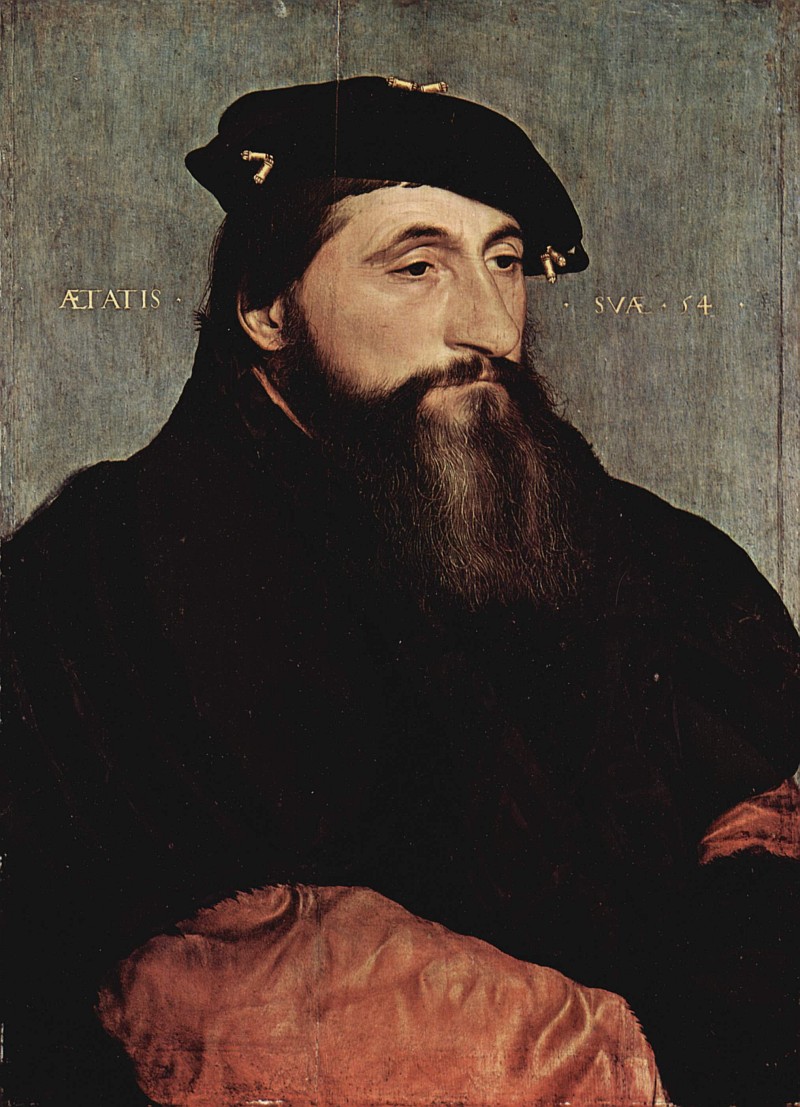
"Retrato de Antoine le Bon, Duque de Lorraine / Portrait of Antoine Le Bon, Duke of Lorraine"
Témpera sobre tabla / tempera on wood, 51 × 37 cm., 1543. 
Gemäldegalerie der Staatlichen Museen zu Berlin (Berlín, Alemania / Germany)

"Retrato de dama con ardilla y estornino / Portrait of a Lady with a Squirrel and a Starling"
Óleo sobre roble / oil on oak, 54 x 38,7 cm., 1527-28. National Gallery (Londres, Inglaterra / London / England)

Pintado probablemente durante la primera visita de Holbein a Inglaterra en 1526-28, se ha sugerido, bastante plausiblemente, que la modelo fuera Anne Lovell. El estornino al fondo y la ardilla mascota en su regazo, pueden tratarse de una alusión a su nombre: la familia Lovell llevaba ardillas en su escudo de armas, y tenían una casa en East Harling, en Norfolk. Es probable que el retrato fuera una vez parte de un par de marido y mujer.
Las ardillas eran mascotas muy populares en Inglaterra desde épocas tan tempranas como el s.XIV.
De la ficha de la obra en el sitio web de la National Gallery.

Probably painted during Holbein's first visit to England in 1526-8, it has been suggested, very plausibly, that the sitter is Anne Lovell. The starling in the background and the pet squirrel on a chain may have been intended to allude to her name: the Lovell family showed squirrels on their coat of arms and owned a house at East Harling in Norfolk. It is conceivable that the portrait was once part of a pair of husband and wife.
Squirrels were popular pets in England as early as the 14th century.
From the record on this arwork, National Gallery website.

"Retrato de / Portrait of Derich Born", óleo sobre tabla / oil on wood, 45 x 60 cm., 1533. 
Royal Collection, Windsor Castle (Londres, Inglaterra / London, England)

"Retrato de / Portrait of Dirk Tybis", óleo sobre tabla / oil on wood, 48 x 35 cm., 1533. 
Kunsthistorisches Museum (Viena, Austria)

"Retrato de esponsales de Ana de Cleves / Betrothal portrait of Anne of Cleves"
Acuarela sobre pergamino / watercolor on parchment, 65 x 48 cm., c.1539
Museo del Louvre (París, Francia / France)

Ana de Cleves (1515-17), una hija de Juan III, Duque de Cleves, fue la cuarta esposa de Enrique VIII. Holbein fue enviado a pintarla a Düren en el verano de 1539, para que Enrique pudeira evaluarla como posible esposa. Holbein la hizo posar de frente y con sus mejores galas. Enrique se decepcionó sobre la marcha, y se divorció de ella tras un matrimonio breve que no llegó a consumarse. Renombró a Ana como "Hermana del Rey", y ella permaneció en Inglaterra donde murió durante el reinado de la Reina María.
El uso de pergamino sugiere que Holbein pintó, o al menos comenzó el retrato en Düren. La versión en miniatura en el Victoria and Albert Museum fue probablemente pintada al mismo tiempo. Holbein también hizo el retrato de la hermana de Anna, Amelia, que está perdido. 
La idea de que Holbein cortejaba a Ana no está sustentada en evidencias.
Texto traducido de aquí.

Anne of Cleves (1515–57), a daughter of John III, Duke of Cleves, was the fourth wife of Henry VIII. Holbein was sent to paint her at Düren in summer 1539, so that Henry could appraise her as a possible wife. Holbein posed Anne square-on and in elaborate finery. Henry was disappointed with her in the flesh, and he divorced her after a brief, unconsummated marriage. He redesignated Anne as "King's Sister", and she remained in England, where she died during the reign of Queen Mary.
The use of parchment suggests that Holbein painted, or at least began, the portrait in Düren. A miniature version in the Victoria and Albert Museum was probably painted at the same time. Holbein also produced a portrait of Anne's sister, Amelia, which is now lost. Nicholas Wotton, the head of the English delegation, reported to Henry: "Your Grace's servant Hanze Albein hathe taken th'effigies of my lady Anne and the lady Amelye and hath expressed theyr images very lyvely". The tradition that Holbein flattered Anne is not borne out by the evidence.
Text from here.

"Retrato de Jane Seymour, Reina de Inglaterra / Portrait of Jane Seymour, Queen of England"
Témpera sobre panel / tempera on panel, 65,4 x 40,7 cm., 1536-37. 
Kunsthistorisches Museum (Wien / Viena / Vienna, Austria)

Jane Seymour en "El Hurgador" / in this blog: [Aniversarios (LXVII)]

"Retrato de / Portrait of Jane Seymour", boceto preliminar / preliminar sketch
Tizas negra y de colores, pluma y tinta india, sobre papel con imprimación rosada / 
black and coloured chalks, pen and Indian ink, on pink-primed paper, 50,3 × 28,7 cm., c.1536.
Royal Collection of Queen Elizabeth II, Castillo de Windsor (Berkshire, Reino Unido / UK)

Hans Holbein the Younger (c. 1497 - between 7 October and 29 November 1543) was a German artist and printmaker who worked in a Northern Renaissance style.

"Retrato de / Portrait of Lady Margaret Butts", óleo sobre panel / oil on panel, 47,2 x 36,9 cm., c.1543. 
Isabella Stewart Gardner Museum (Boston, Estados Unidos / USA)

"Retrato de / Portrait of Richard Southwell", témpera sobre panel / tempera on panel, 47,5 × 38 cm., 1536
Galeria degli Uffizi (Florencia, Italia / Florence, Italy)

"Retrato de / Portrait of Sir Henry Guildford", óleo sobre roble / oil on oak, 81,4 × 66 cm., 1527
Royal Collection of Queen Elizabeth II, Castillo de Windsor (Berkshire, Reino Unido / UK)

"Retrato de / Portrait of Sir Henry Wyatt", óleo sobre roble / oil on oak, 39 × 31 cm., c.1537
Museo del Louvre (París, Francia / France)

Retrato de / Portrait of  Sir William Butts", óleo sobre panel / oil on panel, 46 x 36 cm., 1543
Isabella Stewart Gardner Museum (Boston, Estados Unidos / USA)

"Retrato de un jóven comerciante / Portrait of a Young Merchant"
Óleo sobre roble / oil on oak, 46,5 × 34,8 cm., 1541. Kunsthistorisches Museum (Viena, Austria)

"Retrato de una Dama, probablemente de la familia Cromwell / 
Portrait of a Lady, probably a Member of the Cromwell Family"
Óleo sobre tabla / oil on wood, 71,9 x 49,5 cm., c.1535-40. Toledo Museum of Art (Ohio, Estados Unidos / USA)

"Retrato de uno de los mercaderes de la familia Wedigh en Colonia / 
Portrait of one of the Merchants of the Wedigh family, at Cologne"
Témpera y óleo sobre lienzo / tempera and oil on canvas, 39 × 30 cm., 1533
Gemäldegalerie der Staatlichen Museen zu Berlin (Berlín, Alemania / Germany)

"Retrato de William Warham, Arzobispo de Canterbury / Portrait of William Warham, Archbishop of Canterbury"
Témpera sobre madera / tempera on wood, 82 x 67 cm., 1527
Museo del Louvre (París, Francia / France)

"Retrato del astrónomo / Portrait of the Astronomer Nikolaus Kratzer"
Témpera sobre madera / tempera on wood, 83 × 67 cm., 1528
Museo del Louvre (París, Francia / France)

"Retrato de / Portrait of Robert Cheseman", óleo sobre panel / oil on panel, 58,8 x 62,8 cm., 1533
Royal Picture Gallery Mauritshuis (La Haya, Holanda / Netherlands)

La inscripción en latín nos cuenta la identidad de este noble: Robert Cheseman, 48 años en 1533. Cheseman era el halconero jefe del Rey Enrique VIII, una honorable posición. Sostiene al ave en su mano con gesto tierno. Esta pieza magistral fue pintada poco después de establecerse definitivamente en Inglaterra. Su asombrosa técnica pictórica se aprecia con claridad en la intensa mirada del hombre, el brillante satinado de las plumas y el pequeño brazalete de cobre.
De la ficha de la obra en el sitio web del Mauritshuis.

The Latin inscription tells us the identity of this nobleman: Robert Cheseman, 48 years old in 1533. Cheseman was the chief falconer to the English king Henry VIII, an honourable position. He is stroking the bird on his hand with a tender gesture. This masterpiece was painted shortly after he had settled for good in England. His amazing painting technique is shown to great advantage in the man’s intent gaze, in the shiny satin of his sleeves and in the little brass bell.
From the record on this painting in Mauritshuis website.

"Retrato del / Portrait of Dr John Chambers", témpera sobre tabla / tempera on wood, 51 × 54 cm., 1541-43
Kunsthistorisches Museum (Viena, Austria)

"Retrato del poeta Henry Howard, Conde de Surrey / Portrait of the Poet Henry Howard, Count of Surrey"
Témpera sobre madera / tempera on wood, 55,5 × 44 cm., 1541-43. 
Museu de Arte (São Paulo, Brasil / Brazil)

Más información e imágenes en / More images and information in: