miércoles, 6 de junio de 2018

Fernando Falcone [Dibujo, Ilustración / Drawing, Illustration]

Fernando Falcone es un artista argentino nacido en 1977, que desde hace ya varios años viene trabajando en el mundo editorial con ilustraciones para libros, utilizando una variedad de técnicas. Los personajes y circunstancias de las historias adquieren forma y color en imágenes en las que abundan los elementos surrealistas, los seres singulares y los ambientes oníricos.

Fernando Falcone is an Argentine artist born in 1977, who for several years has been working in the publishing world with illustrations for books, using a variety of techniques. The characters and circumstances of the stories acquire form and color in images that abound with surreal elements, singular beings and dream environments.
__________________________________________________

Fernando Falcone


«Nací en la ciudad de Buenos Aires. Hago dibujos desde que tengo memoria, o desde antes. Desde muy chico mi mente estuvo poblada de seres fantásticos y monstruos. Los libros, las películas y el trabajo de diferentes artistas, ayudaron a que esa población creciera y se desarrollara enormemente hasta el día de hoy. Siempre tuve la suerte de encontrar un camino para visitar otras realidades a través de la imaginación. Pero solo con la imaginación no era suficiente, y desde que recuerdo también me preocupe por mejorar mi técnica, estudiar y practicar continuamente para poder trasladar de la mejor manera posible esas ideas al papel.»

"Mientras estuviera dormido / While I Was Asleep", 2012 © Fernando Falcone

"Abrazo / Hug", 2006 © Fernando Falcone

"El fantasma de Canterville / Canterville Ghost" © Fernando Falcone
Ilustración para los Cuentos completos de Oscar Wilde, que serán publicados próximamente por /
Illustration for the Complet Short stories by Oscar Wilde, that will be published soon by
Editorial Alma, Barcelona

Oscar Wilde en "El Hurgador" / in this blog[Aniversarios Fotografía (CLXVII)]

Antiguos cuentos de brujas / Ancient Stories of Witches - Edhasa 2015 © Fernando Falcone

"Registré la habitación palmo a palmo. Tropecé con una cama hedionda hecha de pedazos de cuero. Al lado había una olla quemada y en el piso, cenizas y huesos de animal. Salí a respirar aire puro y tuve un escalofrío al enfrentarme en la intemperie bárbara de la pampa con una criatura horrible. Era una mujer, creo, y la dueña del rancho. Tenía un pelo tan
seco y grueso que formaba una sólida continuidad con el atado de leña que traía al hombro."
Adaptación de Jorge Accame de un episodio de "La Tierra Purpúrea", de Guillermo Hudson.

"I searched the room inch by inch. I stumbled over a stinking bed made of pieces of leather. Next to it there was a burned pot, and on the floor, ashes and animal bones. I went out to breathe fresh air and I had a chill when facing me, in the smashing outdoor of the pampas, with a horrible creature. She was a woman, I think, and the owner of the ranch.
She has a hair so dry and thick that formed a solid continuity with the bundle of firewood that she carried on her shoulder. "
Adaptation by Jorge Accame of an episode of "La Tierra Purpúrea / Purple Land", by Guillermo Hudson.

"Comerciante de Urk / Merchant from Urk", 2004 © Fernando Falcone

"Una y mil noches de Sherezada / One and a Thousand Nights of Scherezade"
Texto / Text: Ana María Shua. Alfaguara. 2014 © Fernando Falcone

"Insecto / Insect", 2003 © Fernando Falcone

«Estudié en la Escuela Nacional de Bellas Artes Prilidiano Pueyrredón, de Buenos Aires, y en el año 2006 comencé a colaborar como ilustrador profesional en diferentes Editoriales de Argentina y del mundo, en el desarrollo de libros ilustrados, para niños, jóvenes y adultos.  
En el año 2008 fui seleccionado como uno de los 32 ilustradores invitados, para representar a la Argentina en la feria internacional de libros infantiles de Bologna, Italia, una de las más importantes del mundo. 
Las técnicas que utilizo son variadas y abarcan desde el dibujo con lápices, pasteles, acuarelas, y en algunos casos, distintas combinaciones de esos materiales con edición digital.»

Antiguos cuentos de brujas / Ancient Stories of Witches
Texto de / Text by: Jorge Accame. Edhasa, 2015 © Fernando Falcone

"El tiempo de los árboles / Time of the Trees", 2013 © Fernando Falcone
Primer premio (compartido) en el Concurso latinoamericano de Ilustración IV edición, de la Universidad de Palermo (Argentina).
First prize (shared) in the Latin American contest of Illustration IV edition of the University of Palermo (Argentina).  

"Hades" © Fernando Falcone
Proyecto de libro-álbum Orfeo / Project Book Album Orpheus - Texto de / Text by: Jorge Accame

"Meroe, de / from Ípata" © Fernando Falcone
Antiguos cuentos de brujas / Ancient Stories of Witches - Texto de / Text by: Jorge Accame. Edhasa, 2015

"- Es una maga – respondió desesperado por mi audacia –, una adivina. Puede hacer cualquier cosa: convertir en piedra las aguas de la fuente, deshacer los montes, levantar las sombras de los muertos hacia el cielo, arrojar los dioses al infierno, apagar las estrellas, dar luz al Tártaro." 
Escrito por Jorge Accame. Basado en el cuento de Apuleyo. 

"She is a magician –he answered, desperate for my audacity– a fortune-teller. She can do anything: turn the waters of the fountain into stone, destroy the mountains, raise the shadows of the dead toward the heavens, throw the gods into hell, turn off the stars, give birth to Tartarus."
Written by Jorge Accame. Based on the story of Apuleius.

"Una y mil noches de SherezadaOne and a Thousand Nights of Scherezade"
Texto / Text: Ana María Shua. Alfaguara. 2014 © Fernando Falcone

Ilustración para "El señor Fuentes" de "Fantasía y terror en Cuerno Callado" /
Illustration for "Mr. Fuentes", from "Fantasy and Terror at Cuerno Callado".
Victoria Bayona, Gerbera, 2016 © Fernando Falcone

Cuerno Callado es un pueblo levantado por hechiceros de pies descalzos. Sus fundadores prometieron no recurrir a la magia, pero la magia no prometió nada. Y así irrumpe en cada uno de estos cuentos, a través de imágenes inolvidables: unos grandes y terribles muñecos hechos con trigo, marinos fantasmas que se cuentan sus muertes, velas que arden conectadas con los sueños, un niño al que las avispas siguen como si fuera su amo… goodreads

Cuerno Callado is a town built by wizards with bare feet. Its founders promised not to resort to magic, but magic promised nothing. And so it breaks into each of these stories, through unforgettable images: a great and terrible dolls made with wheat, marine ghosts that narrated their deaths, candles that burn connected with dreams, a child to which the wasps follow as if he were their master ... goodreads

"Caronte / Charon" © Fernando Falcone
Proyecto de libro-álbum Orfeo / Project Book Album Orpheus - Texto de / Text by: Jorge Accame.

"Dorcus Titanus Platymelus" © Fernando Falcone

Antiguos cuentos de brujas / Ancient Stories of Witches
Texto de / Text by: Jorge Accame. Edhasa, 2015 © Fernando Falcone


«I was born in Buenos Aires. I have been making drawings since I remeber, or from before. Since a very young age,  my mind was full of fantastic beings and monsters. Books, movies and the work of different artists helped me to make this population grew up and developed greatly until nowadays. I was always lucky to find a way to visit other realities through the imagination. But the imagination was not enough, and since I remember, I was interested in improving my technique, studying and practicing continuously to be able to express in the best way those ideas to paper.»

"Meroe y Pantia" © Fernando Falcone
Antiguos cuentos de brujas / Ancient Stories of Witches - Texto de / Text by: Jorge Accame. Edhasa, 2015

Medea invocando a Artemisa, de 'La Antorcha' / Medea invoking Artemis, from 'The Torch'
Antiguos cuentos de brujas / Ancient Stories of Witches
Texto de / Text by: Jorge Accame. Edhasa, 2015 © Fernando Falcone

"Hilos / Threads", 2001 © Fernando Falcone

"Telifrón" © Fernando Falcone
Antiguos cuentos de brujas / Ancient Stories of Witches - Texto de / Text by: Jorge Accame. Edhasa, 2015

"Otra metamorfosis / Another metamorphosis", 2014 © Fernando Falcone

«I studied at the National School of Fine Arts Prilidiano Pueyrredón, Buenos Aires, and in 2006 I began to work as a professional illustrator for different publishers in Argentina and the world, making illustrated books for children, youngs and adults.
In 2008, I was selected as one of the 32 illustrators to represent Argentina in the International fair of Children's books in Bologna, Italy, one of the most important in the world.
I use several techniques like drawing with pencils, pastels, watercolors, and in some cases, different combinations of these materials with digital edition.»

"Un largo, accidentado, insólito y maravilloso viaje /
A Long, Rugged, Unusual and Wonderful Journey" © Fernando Falcone
Convención Teatro (Córdoba, Argentina), 2015. vos
______________________________________________________

Sobre su trabajo en el libro Antiguos Cuentos de Brujas, Fernando cuenta:
«Con Jorge Accame ya habíamos trabajado juntos en un libro álbum, entonces él me propuso como ilustrador de este proyecto. La editorial me dio mucha libertad para trabajar, no es lo más común este tipo de proceso, realmente pude crear las imágenes de la manera que quise.
El trabajo a partir de un texto, no es siempre igual, depende de cómo te motiva lo que estás leyendo, de lo identificado que uno se sienta con las historias. No siempre es tan fácil como en este libro, porque son cuentos que me gustan mucho, el tema, y el estilo del escritor. Generalmente leo todo el texto, y mientras tanto voy imaginando las primeras escenas. Después lo releo y me documento con fotografías, según lo que el texto requiera. El trabajo concreto empieza al definir las partes a ilustrar (si la editorial no las definió antes, a veces es así) y al hacer bocetos de cada ilustración.»

«Las ilustraciones de este libro están hechas con lápices y pasteles, pero trabajé mucho tiempo con técnicas digitales, y me parece una herramienta muy útil. Trato de no hacer mucha diferencia ente herramientas digitales y las otras. Pienso que es una frontera que debería ir borrándose.»


About his work in the book Ancient Tales of Witches, Fernando tells:
"With Jorge Accame we had already worked together on a book album, so he proposed me as an illustrator of this project. The editorial gave me a lot of freedom to work, it is not the most usual in this kind of process, I could really create the images in the way I wanted.
Working from a text is not always the same, it depends on how you are motivated by what you are reading, how identified you feel with the stories. It is not always as easy as in this book, because they are stories that I like very much, the theme, and the style of the writer. I usually read the whole text, and meanwhile I'm imagining the first scenes. Then I reread it and I document with photographs, according to what the text requires. The concrete work begins by defining the parts to be illustrated (if the publisher did not define them before, sometimes it is like that) and by making sketches of each illustration.»


«The illustrations for this book are made with pencils and pastels, but I worked a lot with digital techniques, and I think it is a very useful tool. I try not to make much difference between digital tools and the others. I think it's a border that should be erased.»

Puedes comprar el libro en / You can buy the book inedhasa
______________________________________________________

Ilustración para la portada del libro "Una y mil noches de Scherezada" /
Illustration for the cover of the book "One and a Thousand Nights of Scherezade"
Texto / TextAna María Shua. Alfaguara. 2014 © Fernando Falcone

Puedes comprar el libro en / You can buy the book in Boutique del Libro
____________________________________________________

Fuentes / Sources:
* Website
* "Jorge Accame & Fernando Falcone: Brujerías en papel / Witchcraft on paper"
Entrevista de / Interview by Valeria Massimino. Revista Meta
* "Un largo, accidentado, insólito y maravilloso viaje / A Long, Rugged, Unusual and Wonderful Journey"
Artículo en / article in La Voz, vos, 10/2015

Más sobre / More about Fernando Falcone: Website, facebook

Imágenes publicadas con autorización del artista (¡Muchas gracias, Fernando!)
Images published here with artist's permission (Thanks a lot, Fernando!)

lunes, 4 de junio de 2018

Artem Rogowoi [Pintura / Painting]

Artem Rogowoi es un pintor figurativo ucraniano en cuya obra predomina la imagen femenina, aunque también encontramos una buena colección de paisajes (muchos de ellos con referencias orientales) y bodegones, pintados con un meticuloso tratamiento de las texturas y armonías cromáticas en tonos pastel. Artem trabaja normalmente en óleo sobre lienzo, incorporando ocasionalmente el pan de oro.

Artem Rogowoi is a Ukrainian figurative painter. In his work the feminine image predominates, although we also find a good collection of landscapes (many of them with oriental references) and still lifes, painted with a meticulous treatment of the textures and chromatic harmonies in pastel tones. Artem works normally in oil on canvas, occasionally incorporating gold leaf.
____________________________________________________

Artem Anatolyevich Rogowoi
Артем Анатольевич Роговой

Artem junto a su obra / with his work

Artem Anatolyevich Rogowoi es un artista ucraniano nacido en 1988 que vive y trabaja en la región de Járkov (Kharkov).
Sus primeros estudios artísticos tuvieron lugar en la escuela, luego se graduó en Colegio de Arte de Járkov en 2008, y más tarde estudió en la Academia de Diseño y Artes de Járkov, donde aprendió restauración de pinturas. "Fue muy importante en mi vida, porque aprendí la tecnología de la pintura y cuestiones técnicas como el fresco y otras. Así que este es mi fuerte, y amo lo que hago."

"Бабье лето / Verano indio / Indian Summer"
Óleo sobre lienzo / oil on canvas, 170 х 160 cm., 2017

Artem trabajando en "Verano indio" / at work in "Indian Summer"

"Вечерняя семечка / Semillas de girasol de la tarde / Evening Sunflower Seeds"
Óleo sobre lienzo / oil on canvas, 140 x 80 cm., 2017

«Yo mezclo varios estilos pictóricos e intento crear las más bellas imágenes artísticas basadas en la experiencia de generaciones previas de artistas, y mi observación de las texturas naturales y elementos. Pero es difícil para mí, quiero decir, hablar sobre mis pinturas, porque constantemente estoy insatisfecho con los resultados, y quiero mejorar.»

"Осенний двор в Qiantong / Patio de otoño en / Autumn Courtyard in Qiantong"
Óleo sobre lienzo / oil on canvas, 100 x 100 cm., 2017

"Тёплое солнце востока / El cálido sol oriental / The Warm Sun of the East"
Óleo sobre lienzo / oil on canvas, 140 x 90 cm., 2017

"Юдифь / Judith", óleo sobre lienzo / oil on canvas, 170 х 120 cm., 2015

"Мозаика груш / Mosaico de peras / Mosaic of Pears"
Óleo sobre lienzo / oil on canvas, 70 х 130 cm., 2016

"Ранняя весна / Principios de la primavera / Early Spring"
Óleo sobre lienzo / oil on canvas, 140 х 130 cm., 2018

Artem comenzó a participar en exposiciones en 2009, y en 2012 realizó su primera muestra individual. Sus obras se encuentarn en colecciones privadas de Ucrania, Rusia, Estados Unidos y China.

"La canción de las hayas / The Song of Beeches", óleo sobre lienzo / oil on canvas, 63" x 51"

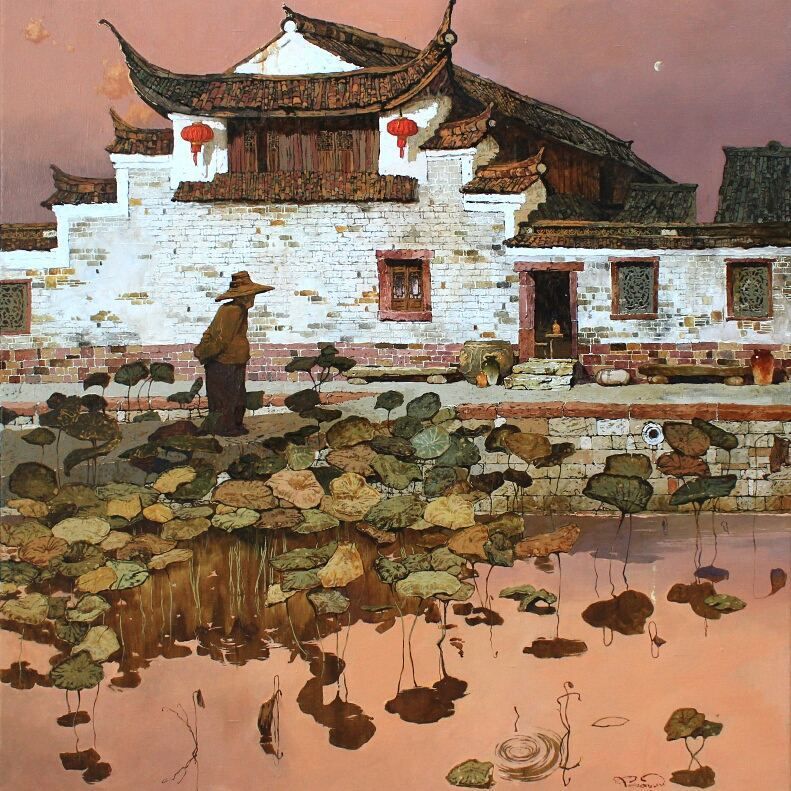
"Вечерний лотос в Zoumatang / Loto de tarde en / Evening lotus in Zoumatang"
Óleo sobre lienzo / oil on canvas, 100 x 100 cm., 2017

"Sol rojo / Red Sun", óleo sobre lienzo / oil on canvas, 150 x 140 cm., 2017

Artem trabajando en "En la taberna" / at work in "In the Tavern"

Artem Anatolyevich Rogowoi is an Ukrainian artist born in 1988, who lives and works in the region of Kharkov.
His first artistic training was at school, then he graduated at the Kharkov Art College in 2008, and after that he studied at the Kharkov Academy Design and Arts, where he learnt restoration of painting. «It was important for my life, because I learned painting technology and something technical like fresco and others. So, it’s my metier and I love what I do.»

"У шинку / En la taberna / In the Tavern"
Óleo sobre lienzo / oil on canvas, 80 х 160 cm., 2016

"У шинку / En la taberna / In the Tavern" (detalle / detail)

"Camomila / Chamomile", óleo y pan de oro sobre lienzo / oil and gold leaf on canvas, 39" x 39"

"После дождя / Después de la lluvia / After the Rain"
Óleo sobre lienzo / oil on canvas, 50 х 50 cm., 2017

«I mix few styles of painting and try to create the most beautiful artistic images based on the experience of previous generations of artists and my observations of natural textures and elements. But it’s hard for me, I mean to talk about my paintings because I’m constantly dissatisfied with the results and I want to improve.»

"Восточный вечер / Tarde oriental / Eastern Evening"
Óleo sobre lienzo / oil on canvas, 140 x 90 cm., 2017

"Охота на листик / Cazando una hoja / Hunting for a Leaf"
Óleo sobre lienzo / oil on canvas, 130 х 60 cm., 2014

"Ажурный перец / Pimiento calado / Openwork Pepper"
Óleo sobre lienzo / oil on canvas, 55 х 40 cm., 2014

"El chal de otoño / The Shawl of Autumn", óleo sobre lienzo / oil on canvas, 110 x 95 cm.

"Натюрморт с Юга / Bodegón desde el sur / Still Life From the South"
Óleo sobre lienzo / oil on canvas, 129,5 × 119,4 cm., 2017

Artem started participating in exhibitions in 2009, and his first solo show was in 2012. His works can be found in private collections in Ukraine, Russia, the United States and China.

"На печі / En la cocina / On the Stove", óleo sobre lienzo / oil on canvas, 120 х 110 cm., 2014

"Вогонь дівка / Vogon dyvka", óleo sobre lienzo / oil on canvas, 2015

"Бабушкин самогон / Abuela Luz de Luna / Grandma Moonshine"
Óleo sobre lienzo / oil on canvas, 100 х 110 cm., 2012

Más sobre / More about Artem Rogowoi: Arts in UA, Instagram, facebook, Vk

Imágenes publicadas con autorización del artista (¡Muchas gracias, Artem!)
Images published here with artist's permission (Thanks a lot, Artem!)

domingo, 3 de junio de 2018

Aniversarios (CCXXIX) [Mayo / May 28-31]

Todos los aniversarios de Mayo aquí / All anniversaries for May here.
_________________________________________________________

El 28 de Mayo es el cumple de

Fedot Ivanovich Shubin (Федот Иванович Шубин), nacido en una aldea de Pomor cerca de Kholmogory, ampliamente considerado como el mejor escultor de la Rusia del siglo XVIII.
Era hijo de un campesino, e inspirado por el ejemplo de su vecino Mikhail Lomonosov caminó hasta San Petersburgo a la edad de 18 años. Lomonosov se dio cuenta de su talento en el tallado de marfil de morsa (una artesanía popular tradicionalmente practicada en Kholmogory), y lo ayudó a unirse a la recientemente establecida Academia Imperial de las Artes, donde su instructor, Nicolas-François Gillet, quedó tan impresionado con sus habilidades que le hizo otorgar a Shubin una medalla de oro, lo que le abrió la posibilidad de continuar su educación en el extranjero.

"Екатерина II, законодательница / Catalina II, la Legisladora / Catherine II the Lawmaker"
Mármol / marble, 1790
Museo Estatal Ruso (San Petersburgo, Rusia / St. Petersbourg, Russia). Wikimedia Commons

Con la ayuda de Falconet, en 1767 se unió al atelier de París del gran Pigalle, antes de mudarse a Roma tres años más tarde. A su regreso a Rusia en 1772 se convirtió en el escultor más moderno y codiciado del país. En los años 1770 y 1780 ejecutó numerosas piezas para el Palacio de Mármol y el Alexandro-Nevsky Lavra, diseñó 58 medallones que representan a todos los soberanos rusos de Rurik en adelante, y fue admitido en la Academia de las Artes como académico. Sin embargo, las intrigas de sus rivales minaron su carrera. Permaneció en la indigencia hasta 1794, cuando la Academia finalmente le otorgó una cátedra.
Murió en 1805.

"Портрет Е.М. Чулкова / Retrato de / Portrait of E.M. Chulkova"
Mármol / marble, 1792. Wikimedia Commons
Museo Estatal Ruso (San Petersburgo, Rusia / St. Petersbourg, Russia). Wikimedia Commons

"Портрет Графини Марии Паниной / Retrato de la Condesa / Portrait of Countess Maria Panina"
Mármol / marble, c.1770
Galería Tretyakov (Moscú, Rusia / Moscow, Russia). Wikimedia Commons

On May 28 is the birthday of

Fedot Ivanovich Shubin (Федот Иванович Шубин)born in a Pomor village near Kholmogory, widely regarded as the greatest sculptor of 18th-century Russia.
He was a peasant's son, and inspired by the example of his neighbour Mikhail Lomonosov, he walked all the way to St Petersburg at the age of 18. Lomonosov took notice of his talent in walrus ivory carving (a folkcraft traditionally practised in Kholmogory) and helped him join the newly established Imperial Academy of Arts, where his instructor, Nicolas-François Gillet, was so impressed with his abilities that he had Shubin awarded with a gold medal, which opened to him the prospect of furthering his education abroad.

"Портрет А.М. Голицын / A.M. Golitsyn", mármol / marble, c.1773
Galería Tretyakov (Moscú, Rusia / Moscow, Russia). Wikimedia Commons

Through the help of Falconet, in 1767 he joined the Paris atelier of the great Pigalle, before moving to Rome three years later. Upon his return to Russia in 1772, Shubin became the most fashionable and sought-after sculptor in the country. In the 1770s and 1780s, he executed numerous pieces for the Marble Palace and the Alexandro-Nevsky Lavra, designed 58 medallions representing all the Russian sovereigns from Rurik onward, and was admitted into the Academy of Arts as an academician. The intrigues of his rivals undermined his career, however. He remained destitute until 1794, when the Academy eventually bestowed a professorship on him.
He died in 1805.

"Бюст Павла I / Busto de Pablo I / Bust of Paul I", bronce / bronze, 1798
Galería Tretyakov (Moscú, Rusia / Moscow, Russia). Wikimedia Commons


El 29 de Mayo es el cumple de

Edmé Bouchardon, escultor francés nacido en 1698 en Chaumont-en-Bassigny, estimado y valorado también como pintor y dibujante.
Bouchardon era el hijo del escultor y arquitecto Jean-Baptiste Bouchardon. Se convirtió en alumno del escultor Guillaume Coustou y recibió el Premio de Roma en 1722. Resistiendo las tendencias rococó de sus contemporáneos, era de estilo clásico. El notable anticuario Comte de Caylus dijo de Bouchardon que había comenzado a "apropiarse del talento de los Antiguos y encontrarlo de nuevo en la Naturaleza". Durante los diez años que permaneció en Roma se le asignó la tarea de crear el busto del Papa Benedicto XIII.
En 1746 produjo su primera obra maestra aclamada, "Cupido, modelando un arco a partir de la maza Hércules", ahora en el Museo del Louvre, que impresionó a los primeros espectadores por su naturalismo unidireccional. Su otra obra maestra es la "Fontaine des Quatre-Saisons / Fuente de las cuatro estaciones" en París, encargada en 1739, y completada seis años más tarde. Bouchardon recibió el encargo de diseñar una estatua ecuestre de Luis XV, para conmemorar la victoria de Francia en la Guerra de Sucesión de Austria. Lamentablemente no vivió para terminar este trabajo y su finalización quedó en manos de su contemporáneo Jean-Baptiste Pigalle. Finalmente la estatua fue destruida durante la Revolución Francesa.

"L'Amour se faisant un arc de la massue d'Hercule /
Cupido fabricando su arco con la maza de Hércules /
Cupid Fashioning a Bow out of the Club of Hercules", mármol / marble, 173 x 75 x 75 cm., 1750.
Musée du Louvre (París, Francia / France). Wikimedia Commons

Era un conocido diseñador de jetons o tokens / medallas, que fueron distribuidas por el Rey. Los temas y modelos fueron elegidos por la Académie des Inscriptions et Belles-Lettres y antes de su aprobación pasaron por un elaborado proceso de críticas que involucró al propio Rey. Los dibujos y pruebas de estos jetons ahora conservan en varios museos y colecciones de todo el mundo, incluidos el Institut de France, el Musée de la Monnaie y la Bibliothèque Nationale.
También ejecutó una serie de estudios "de los órdenes más bajos" (bas peuple) que sigue siendo un registro valioso de varios comercios callejeros del siglo XVIII.
Murió en 1762.

"Busto del Papa Clemente XII / Bust of Pope Clement XII", mármol / marble, 1730. Link

On May 29 is the birthday of

Edmé Bouchardon, French sculptor born in 1698 in Chaumont-en-Bassigny, esteemed and valued as well as a painter and draughtsman.
Bouchardon was the son of sculptor and architect, Jean-Baptiste Bouchardon. He became the pupil of sculptor Guillaume Coustou and was awarded the Prix de Rome in 1722. Resisting the rococo tendencies of his contemporaries, he was classical in style. The noted antiquarian Comte de Caylus said of Bouchardon that he had begun "to appropriate for himself the talent of the Ancients and find it again in Nature." During the ten years he remained in Rome, Bouchardon was given the task of creating the bust of Pope Benedict XIII.
In 1746, Bouchardon produced his first acclaimed masterpiece, "Cupid Fashioning a Bow out of the Club of Hercules," now in the Louvre Museum, which struck early viewers as shockingly crude in its unideal naturalism. His other masterpiece is the "Fontaine des Quatre-Saisons / Fount of the Four Seasons" in Paris, commissioned in 1739, and completed six years later. Bouchardon was commissioned to design an equestrian statue of Louis XV, to commemorate France's victory in the War of Austrian Succession. Unfortunately, he did not live to finish this work and its completion was left his contemporary Jean-Baptiste Pigalle. Ultimately, the statue was destroyed during the French Revolution.

"Charles Frédéric de La Tour du Pin, Marquis de / Marqués de Gouvernet"
Mármol / marble, 30 x 78,5 x 56 cm., 1736
Musée du Louvre (París, Francia / France). Aguttes

Bouchardon was a well-known designer of jetons or tokens/medals, which were distributed by the King. The subjects and themes were chosen by the Académie des Inscriptions et Belles-Lettres and passed through an elaborate process of critiques before approval, which involved the King himself. Drawings and counterproofs for these jetons are now held at various museums and collections around the world including the Institut de France, the Musée de la Monnaie, and the Bibliothèque nationale.
Bouchardon also executed a series of studies "of the lower orders" (bas peuple) which remains a valuable record of various eighteenth century street trades.
He died in 1762.

"Madame Vleughels", mármol / marble, 27,7 x 54,1 45,5 cm., 1732
Musée du Louvre (París, Francia / France)

Edmé Bouchardon en "El Hurgador" / in this blog[Léo Caillard (Fotografía)]


El 30 de Mayo es el cumple de

Kurt Emil Hugo Arentz, escultor alemán nacido en 1934 en Colonia.
Era el hijo de una antigua familia de artesanos de montaña. Primero aprendió a comerciar, y luego comenzó su propia actividad artística en 1979.
Al principio creó naturalezas muertas en óleo y pastel, y retratos de celebridades como Franz Josef Strauss y Herbert von Karajan en bronce. Más tarde se centró principalmente en motivos de animales, en los que hizo hincapié en las cualidades singulares de las diferentes especies. Mientras tanto, este fantástico artista autodidacta desarrolló su característico lenguaje expresivo. Más allá de los experimentos académicos, que estaban lejos de cualquier tópico naturalista, formó los símbolos de la naturaleza viva con sus manos. Sus ideales son el mundo intacto y la naturaleza salvaje libre. Logró hacer su trabajo eternamente tópico.

"Grupo escultórico 'Tres potros en primavera' / Sculpture group ‘Three Foals in Spring’"
Bronce / bronze, 42 x 14.5 x 6.5 cm., peso / weight: 3 kg., Ed.199. ars mundi

Para su obra utilizó un método especial de caucho de silicona, que le permitió la realización inmediata de sus ideas. De esta forma, las piezas fundidas de bronce tienen la firma específica del artista. En un paso final, las superficies del metal son pulidas, arrugadas o patinadas, obteniendo así las características típicas del motivo.
Presentó sus obras a un gran público en numerosas exposiciones en Alemania y Francia. En su cumpleaños número 70, el 30 de mayo de 2004, Kurt Arentz recibió felicitaciones del ex canciller Helmut Kohl y del ex presidente federal Roman Herzog. Recibió créditos y honores de personalidades destacadas: los funcionarios como Willy Brandt, Ronald Reagan o George Bush padre, así como Sir Peter Ustinov y Willy Millowitsch, que tienen sus retratos preparados por Kurt Arentz.
Arentz estuvo casado desde 1959 con Maria-Therese Klein, con quien tuvo un hijo y una hija. Murió en Munich unas semanas después de su 80º cumpleaños (2014) inesperadamente debido a un fallo cardíaco.

"Oso polar / Polar Bear", bronce / bronze, 28 x 13 x 8 cm., peso / weight: 2.5 kg. Ed.499. ars mundi

On May 30 is the birthday of

Kurt Emil Hugo Arentz, German sculptor born in 1934 in Cologne.
He was the son of an old-established mountain artisan family. First, he learned to trade, then started to his own artistic activity in 1979.
First he created still lifes in oil and pastel, portraits of celebrities such as Franz Josef Strauss and Herbert von Karajan in bronze. Later he turned mainly to animal motifs, in which he emphasized special qualities of different species. Meanwhile, this fantastic self-study artist developed his characteristic expressive language. Beyond academic experiments, which were far from any naturalistic platitudes, he formed the symbols of living nature with his hands. His ideals are intact world and free wild nature. He managed to make his work eternally topical. 

"Skulpturengruppe Windhunde / Grupo escultórico Galgos / Sculpture Group Greyhounds"
Bronce / bronze, 58 x 15 x 10 cm., pwso / weight 9 kg. ars mundi

For his work Kurt Arentz used a special silicone rubber method, which allowed him the immediate realization of his ideas. In this way the bronze castings obtain the specific handwriting of the artist. In a final step, the surfaces of the metal polished, roughened or patinated and get their motive-typical characteristics.
The sculptor presented his works to a large audience in numerous exhibitions in Germany and France. On his 70th birthday May 30, 2004 Kurt Arentz received congratulations from former Chancellor Helmut Kohl and former Federal President Roman Herzog. Arentz won credits and honors from prominent personalities: the officials like Willy Brandt, Ronald Reagan or George Bush senior, as well as Sir Peter Ustinov and Willy Millowitsch have their portraits prepared by Kurt Arentz.
Arentz was married since 1959 with Maria-Therese Klein, with whom he had a son and a daughter. He died in Munich a few weeks after his 80th birthday (2014) unexpectedly from heart failure.

"Angreifender Stier / Toro al ataque / Attacking Bull", bronce / bronze, 18 x 27 cm., Ed.299. ars mundi


Hoy, 31 de Mayo, es el cumple de

Jiří Kryštůfek, profesor y escultor checo nacido en 1932 en Praga, donde vive y trabaja.
Estudió en la Escuela Técnica de Cerámica de Praga (1947-1950), y en la Academia de Bellas Artes de Praga bajo la dirección del profesor Jan Lauda (1951-56)
Se ha desempeñado como asistente, asistente de profesor, profesor asociado y profesor en la Academia de Bellas Artes de Praga (1970-87), y como profesor en la Escuela Secundaria Privada de Diseño de Praga (1990-2004).

"Oddych / Descanso / Rest", piedra / stone, 1985
(Malešice, Praga, República Checa / Prague, Czech Republic) Link

"Ráno – Dospívání I / Mañana - Adolescencia 1 / Morning - Adolescence 1". Link

Ha recibido varios premios por sus obras, y muchas de ellas pueden verse al aire libre en diferentes puntos de la ciudad de Praga.

"Na slunci / Al sol / In the Sun", estaño / tin, largo / lenght: 22,5 cm. Link

"Péče o děti / Cuidado de los niños / Child Care", bronce / bronze, 1980
Nemocnice Motol / Hospital Motol (Praga, República Checa / Prague, Czech Republic)

Today, May 31, is the birthday of

Jiří Kryštůfek, Czech teacher and sculptor born in 1932 in Prague, where he lives and works.
He studied at the Technic School of Ceramics in Prague (1947-1950), and at the Academy of Fine Arts in Prague under the direction of Professor Jan Lauda (1951-56)
He has served as assistant, assistant professor, associate professor and professor at the Academy of Fine Arts in Prague (1970-87), and as a professor at the Private High School of Design in Prague (1990-2004).

"Před koupelí / Antes del baño / Before the Bath", bronce / bronze

He has received several awards for his work, and many of his works can be seen outdoors in different parts of the city of Prague.

"Alegorie Miru / Alegoría de la paz / Allegory of Peace", bronce / bronze, 1979
Plaza de la Paz / Namesti Miru (Praga, República Checa / Prague, Czech Republic). Wikimedia Commons