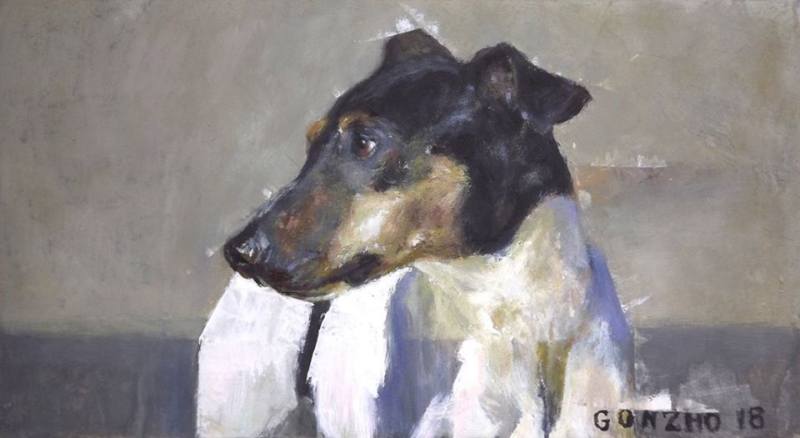
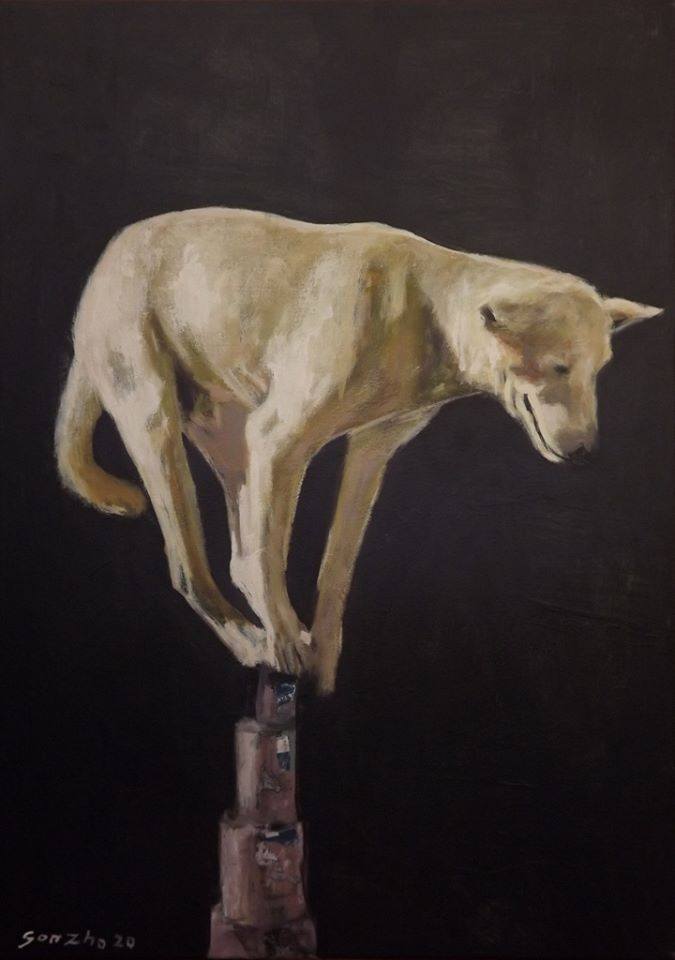
Si bien la obra del artista español Gonzho es mucho más amplia y diversa, tanto en lo temático como en lo estilístico, les presento aquí una selección de sus retratos de perros realizados entre 2018 y el presente año. Se trata de una colección de pinturas en las que el artista consigue captar con gran agudeza y sensibilidad la morfología, actitudes, comportamientos y expresividad de los canes. Acompaño las imágenes con algunas reflexiones de Gonzho y extractos de una entrevista que puede escucharse completa el final del post.
Although the work of the Spanish artist Gonzho is much more extensive and diverse, both in terms of subject matter and style, I present here a selection of his dog portraits taken between 2018 and this year. This is a collection of paintings in which the artist manages to capture with great acuity and sensitivity the morphology, attitudes, behaviors and expressiveness of the dogs. I accompany the images with some reflections of Gonzho and extracts of an interview that can be heard complete the end of the post.
_____________________________________________________
Gonzho
Francisco González Díez
(Marmolejo, Jaén, Andalucía, España / Andalusia, Spain, 1967-)
en / at Arjes, Toledo
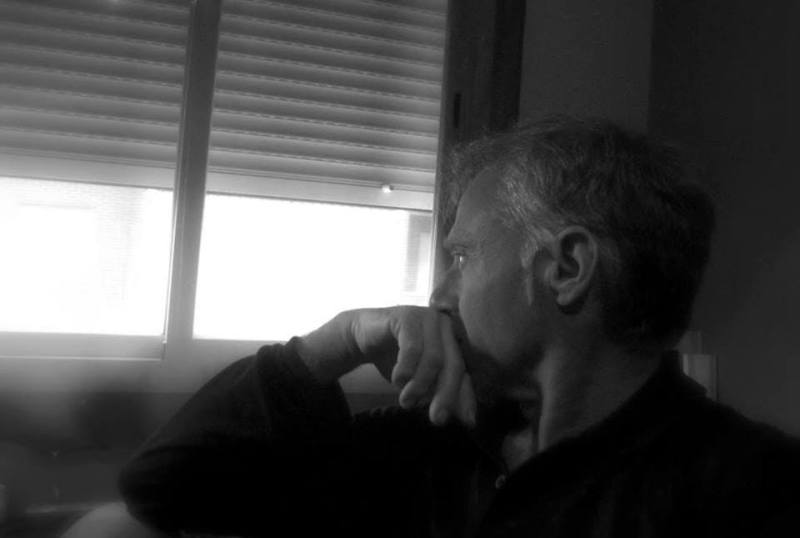
Francisco González Díez, más conocido como Gonzho, es un artista español nacido en 1967 en Marmolejo, Jaén, Andalucía.
Se formó en talleres de artistas (como el del pintor Matías Ruz, a cuyo taller acudió cuando tenía 17 años), y desempeñó diversas actividades relacionadas con el mundo del arte: animador de dibujos animados (series, largometrajes, publicidad para televisión), diseñador escaparatista, restaurador y técnico de arquitectura monumental, y profesor de dibujo en el Centro Cívico del Ayuntamiento de Cobisa (Toledo).
Tras asistir a talleres y clases en el Círculo de Bellas Artes de Madrid, comenzó a leer todo lo que caía en sus manos sobre pintura, y aprender de los artistas, "de la vida, de gestos, de todo". Gonzho piensa que el artista "debe formarse en la calle".
Desde el año 2003 ha presentado su obra regularmente en exposiciones individuales y colectivas en diversas ciudades españolas, y también en Hamburgo (Alemania), La Plata (Argentina) y París (Francia).
Hay pinturas suyas en el Museo de Arte Contemporáneo Mayte Spinola de Marmolejo (Jaén), y en colecciones privadas de un buen número de países.

"Cuando me espera / When It Waits For Me", acrílico sobre lienzo / acrylic on canvas, 2020
"La aparición' / The Appearance", acrílico sobre lienzo / acrylic on canvas, 2019
«Todas las personas, basicamente, nos enfrentamos a una obra plástica buscando respuestas o incluso formulando preguntas. Este diálogo entre la obra y el que la mira, es lo que intento producir. Para ello utilizo elementos conceptuales que, añadidos a una forma, más o menos figurativa, se apoyan en urdimbres comunes a todos pero difíciles de encontrar.
Por tanto, mi obra, la considero un ejercicio continuo de búsqueda de lo esencial y común a todos.»
«Utilizo la realidad como herramienta con la que construir una historia. No todo lo que es real me es útil.»
«Me inspira lo que veo y lo que me gustaría ver. Yo no quiero contar nada de mí porque mi vida es muy triste y muy simple. Yo lo que quiero es que quien vea mi obra reconozca algo, presente o futuro, que ha vivido o le gustaría vivir. Yo quiero que mis cuadros hablen del que los mira. En China, en Japón o en Francia. Esa es la universalidad del arte.»

"Despierta en la noche / Awake In The Night", acrílico sobre lienzo / acrylic on canvas, 2019
«Paradójicamente yo fui conocido a través de la abstracción. La gente me conoce como un pintor abstracto. Lo tienes que hacer relativamente bien. Tampoco se me dio mal. El problema es que hoy en día estamos en un período artístico en el que prima lo realista, y parece ser que hoy en día si no sabes hacer la gotita de rocío sobre el pétalo de una rosa perfectamente, como si fuera una fotografía, parece que no sabes pintar. Realmente pintar es saber hacer eso. Otra cosa es que entremos a analizar esa gotita, a ver si realmente se sabe pintar o simplemente creas una imagen aceptable para el común de los mortales. Los que pintamos y tratamos un poco el tema sabemos que esa gotita tiene que tener muchas cosas. Ahí tienen que estar todos los colores del mundo, los que existen y los que deben existir. Entonces a lo mejor para la gente esa gotita es aceptable, pero para los que vamos un poquito buscando cositas, vemos que esa gotita no tiene la expectativa que tendría que tener.»

"Ámbar", acrílico sobre lienzo pegado en tabla / acrylic on canvas glued on wood
Colección privada (Bélgica) / Private Collection (Belgium)
"Cuando me espera / When It Waits For Me", acrílico sobre lienzo / acrylic on canvas, 2018
«No toda la abstracción es válida; la abstracción es muy difícil. Qué pasa, que cuando estás empezando ya ves que tienes que ir cambiando porque lo que se está demandando es el hiperrealismo, el realismo, y la gente no te cree. La gente piensa que si tú pintas esa mancha o esa textura, es porque no sabes hacer esa gotita de rocío. Esa gotita de rocío la hacía yo con 17 años. Pero llega un momento en que ya te cansas de hacer gotitas, y piensas que el arte debe ser otra cosa. Porque si el arte es esa gotita, yo dejo esto. El arte tiene que ser más cosas, el arte nunca tiene fin. Abres una puerta y te das cuenta que tienes 40 más, y eso es lo que te apasiona del arte, que por mucho que llegues, nunca llegas. Eso te mantiene vivo. Y bueno, volví un poco al realismo, pero siempre con mi toque expresionista, porque me aburriría la pintura relamida.»
"Esperando / Waiting", acrílico sobre lienzo / acrylic on canvas, 60 x 60 cm., 2020
"Volver a empezar I / Starting Over I", acrílico sobre lienzo / acrylic on canvas, 70 x 50 cm., 2020
«Espero morir buscando. Yo tengo miedo a encontrar, y sí, hoy en día te demandan encontrar. Tú vas hoy en día a un sitio, y si no tienes una obra coherente, con el mismo estilo, piensan que estás perdido. Yo creo que estás perdido teniendo siempre el mismo estilo, porque muchas veces te coges a un estilo, y estás tan perdido que te tienes que agarrar a él, porque no sabes avanzar. Te sientes seguro ahí, en la zona de confort, y ahí te quedas. Pero eso para la gente es éxito. Yo creo que un artista es búsqueda, es equivocación, es duda...»
"Rozando el suelo / Grazing The Ground", acrílico sobre lienzo / acrylic on canvas, 2018
Colección privada (Germany) / Private Collection (Alemania)
«El arte es muy importante, porque te abre, te conecta a otro lado de tu cerebro que se va menguando con el tiempo, el lado derecho que es el emocional, el espacial, ese lado no interesa, porque es el intuitivo, el que te permite intuir que al otro lado del redil, al otro lado de la valla, hay más cosas, y lógicamente interesa mantenerte dentro del redil, y para mantenernos dentro del redil el lado izquierdo va muy bien, el pragmático. El lado derecho, por no utilizarlo, se va menguando, (...) se va atrofiando, como un músculo que no se usa, y yo intento que se conecten los dos. Porque cuando los dos funcionan a la par, el derecho, emocional intuitivo, y el práctico, que te conecta a la vida, las cosas tienen otra dimensión.»
"Aqui y ahora / Here And Now'', acrílico sobre lienzo / acrylic on canvas, 70 x 50 cm., 2018
"Cuestión de equilibrio / Question Of Balance'', acrílico sobre lienzo / acrylic on canvas, 70 x 50 cm., 2020
«Yo soy el primer sorprendido, y con mi mujer lo hablo mucho. ¿Cómo lo he hecho? Yo he vendido cuadros que he estado todo un día pintándolos por 20 euros, o los he regalado. Yo he hecho muchas cosas. Pero yo pensaba que un cuadro era una oportunidad. Ya para mí es un orgullo que alguien... ¡Aunque sean 20 euros!, que alguien dé 20 euros de un sueldo, como está la vida... si no lo hago ni yo. Que te de 20 euros por un cuadrito, y sobre todo que lo va a poner en su casa, lo va a colgar. El honor que es tener una cosa en otra casa, donde alguien lo va a poder ver, donde si hay niños, podrán levantarse cada mañana y verlos como yo veía los cuadros en mi casa, y yo ahora mismo tengo esos cuadros en mi casa que estarán siempre. Ya empiezas a formar parte de la vida de esas personas. Y que alguien pregunta a esas personas ¿ese cuadrito quién te lo ha hecho?.. Y vas viendo que esos 20 se convierten en 50...
Hay que ser humilde. Y conozco muchos colegas que dicen "yo es que este cuadro por menos de 200, 300 o 1000 no lo vendo". Pero es que a lo mejor tienes que venderlo por 20 para poder venderlo por 1000 algún día. Y hay gente que no se baja de ese burro. Y a mí me ha ido bien porque yo lo he aplicado en todas las cosas que he hecho en la vida. Lo que he aplicado es la humildad. Y que me reconozcan después de mi trabajo hecho, no al revés. Y me ha funcionado. Yo yo soy el primer sorprendido de esto, de que yo me levante por la mañana, con todo lo que he pasado en esta vida, y mi trabajo... me siento hasta culpable. Culpable de que algo que ha sido mi pasión, por lo que he luchado tanto, y algunas veces incluso hacer el ridículo, porque la gente te ve como alguien rarito (...) Yo no soy nadie, pero lo poquito que soy, lo soy. Y eso ya es mucho. Y hay que creer en eso, en que las cosas se pueden hacer. Hay que trabajar, hay que luchar, hay que creérselo también. Y saltar muchas vallas, caerte al saltarlas... Es que la vida es así.»

"La aparición III / The Appearance III", acrílico sobre lienzo / acrylic on canvas, 2020
Francisco González Díez, better known as Gonzho, is a Spanish artist born in 1967 in Marmolejo, Jaén, Andalusia.
He trained in artists' workshops (such as that of painter Matías Ruz, whose workshop he attended when he was 17 years old), and carried out various activities related to the world of art: cartoon animator (series, feature films, television advertising), window dresser designer, restorer and technician of monumental architecture, and drawing teacher at the Civic Centre of the Cobisa Town Hall (Toledo).
After attending workshops and classes at the Círculo de Bellas Artes in Madrid, he began to read everything he could about painting, and to learn from artists, "about life, gestures, everything". Gonzho thinks that the artist "must be trained in the street".
Since 2003 he has presented his work regularly in individual and collective exhibitions in various Spanish cities, and also in Hamburg (Germany), La Plata (Argentina) and Paris (France).
Paintings by Gonzho can be seen in the Museum of Contemporary Art Mayte Spinola in Marmolejo (Jaén), and in private collections in a good number of countries.

"Solo / Alone", acrílico sobre lienzo / acrylic on canvas
Colección privada / Private Collection (Portugal)

"Galga de perfil / Female Greyhound In Profile"
Acrílico sobre lienzo / acrylic on canvas, 2019
Colección privada (Netherlands) / Private Collection (Holanda)
«All people, basically, face an artwork looking for answers or even formulating questions. This dialogue between the work and the viewer is what I try to produce. For this I use conceptual elements that, added to a more or less figurative form, are supported by schemes common to all but difficult to find.
Therefore, I consider my work as a continuous exercise of search of the essential and what is common to all of us.»
«I use reality as a tool with which to build a story. Not everything that is real is useful to me.»
«I'm inspired by what I see and what I'd like to see. I don't want to tell anything about myself because my life is very sad and very simple. What I want is that whoever sees my work recognizes something, present or future, that they have lived or would like to live. I want my paintings to speak to the viewer. In China, in Japan or in France. That's the universality of art.»

"Cuando me espera / When It Waits For Me", crílico sobre lienzo / acrylic on canvas, 2020
«Paradoxically I was known through abstraction. People know me as an abstract painter. You have to do it relatively well. I wasn't bad at it. The problem is that today we are in an artistic period in which realism prevails, and it seems that today if you don't know how to make the dewdrop on a rose petal perfectly, as if it were a photograph, it seems that you don't know how to paint. Actually painting is knowing how to do that. Another thing is that we enter to analyze that little drop, to see if you really know how to paint or simply create an acceptable image for the common people. Those of us who paint and deal with the subject know that that little drop has to have many things. All the colours of the world have to be there, those that exist and those that should exist. So maybe for people that drop is acceptable, but for those of us who look for other things, we see that that drop doesn't have the expectation that it should have.»

"Mirada de miel / Honeyed Look", acrílico sobre lienzo / acrylic on canvas, 60 x 50 cm., 2020
«Not all abstraction is valid; abstraction is very difficult. What happens is that when you are starting out you see that you have to change because what is being demanded is hyperrealism, realism, and people do not believe you. People think that if you paint that stain or that texture, it's because you don't know how to make that dewdrop. That dewdrop was done by me when I was 17. But there comes a time when you get tired of making dewdrops, and you think that art should be something else. Because if art is that little drop, I'm leaving this. Art has to be more things, art never ends. You open a door and realize that you have 40 more, and that's what you love about art, that no matter how much you get there, you never get there. It keeps you alive. And, well, I went back to a little bit of realism, but always with my expressionist touch, because I'd get bored with pretentious painting.»

"Volver a empezar II / Starting Over II", acrílico sobre lienzo / acrylic on canvas, 70 x 50 cm., 2020
"Más que humana / More Than Human", acrílico sobre lienzo / acrylic on canvas, 2019
Colección privada (Italia) / Private Collection (Italy)
«I hope I die searching. I am afraid to find, and yes, these days they demand you to find. You go somewhere today, and if you don't have a coherent work, with the same style, they think you are lost. I think that you are lost if you always have the same style, because many times you cling to a style, and you are so lost that you have to hold on to it, because you don't know how to move forward. You feel safe there, in the comfort zone, and there you stay. But that's success for people. I think that an artist is search, it's mistake, it's doubt...»

"Cuando me hace reir / When It Makes Me Laugh", acrílico sobre lienzo / acrylic on canvas, 2018
Colección privada / Private Collection (Portugal)
«Art is very important, because it opens you up, it connects you to another side of your brain that is shrinking with time, the right side which is the emotional, the spatial side, that side does not interest, because it is the intuitive side, the one that allows you to intuit that on the other side of the pen, on the other side of the fence, there are more things, and logically it is interesting to stay within the pen, and to stay within the pen the left side goes very well, the pragmatic side. The right side, by not using it, is getting smaller, (...) it is getting atrophied, like a muscle that is not used, and I try to connect both of them. Because when both work together, the right side, the emotional intuitive side, and the practical side, which connects you to life, things have another dimension.»

"Cuando me oye / When It Hears Me", acrílico sobre lienzo / acrylic on canvas, 70 x 50 cm., 2020

"La aparición IV / The Appearance IV", acrílico sobre lienzo / acrylic on canvas, 2020
Colección privada (Suecia) / Private Collection (Switzerland)
«I'm the first one surprised, and I talk about it a lot with my wife. How did I do it? I have sold paintings that I have spent a whole day painting for 20 euros, or I have given them away. I have done many things. But I thought that a painting was an opportunity. I'm proud that someone... even if it's just 20 euros!, that someone gives 20 euros of a salary, with how difficult life is... I don't even do it myself. That he gives you 20 euros for a small painting, and above all that he's going to put it up in his house, he's going to hang it up. What an honour it is to have something in another house, where someone will be able to see it, where if there are children, they will be able to get up every morning and see them as I saw the paintings in my house, and right now I have those paintings in my house that will always be there. You're already beginning to be part of these people's lives. And that someone asks those people, that little painting, who did it to you?... And you see that those 20 euros become 50...
You have to be humble. And I know many colleagues who say: "I don't sell this painting for less than 200, 300 or 1000". But maybe you have to sell it for 20 to be able to sell it for 1000 one day. And there are people who don't back down. And I've done well because I've applied it to all the things I've done in life. What I've applied is humility. And to be recognized after my work is done, not the other way around. And it has worked for me. I am the first to be surprised by this, that I get up in the morning, with all that I have gone through in this life, and my work... I even feel guilty. Guilty that something that has been my passion, that I have fought so hard for, and sometimes even make a fool of myself, because people see you as a freak (...) I am nobody, but what little I am, I am. And that's already a lot. And you have to believe in that, that things can be done. You have to work, you have to fight, you have to believe it too. And you have to jump many fences, fall down when you jump them... That's how life is.»

"Solo un perro I / Just a Dog", acrílico sobre lienzo / acrylic on canvas
Colección privada (Alemania) / Private Collection (Germany)
___________________________________________________
Paqui Esteban entrevista a Gonzho en Radio Andújar, en el programa "Tertulia para Dos" /
Interview with Gonzho by Paqui Esteban in Radio Andújar, in the show "Tertulia para dos", 21/5/18
___________________________________________________
Fuentes / Sources:
* Perfil del artista /
Artist's profile.
Artelista* Perfil del artista y obras /
Artist's profile and works.
Flecha
Imágenes publicadas con autorización del artista (¡Muchas gracias, Gonzho!)
Images published here with artist's permission (Thanks a lot, Gonzho!)
___________________________________________________
Serie "Pintando perros" todos los enlaces aquí / Painting Dogs Series, all links here.