lunes, 25 de febrero de 2013

Ellen Kooi [Fotografía]

Ellen Kooi

Ellen Kooi en 2009

Ellen Kooi es una fotógrafa holandesa nacida en Leeuwarden en 1962. Obtuvo su graduado en la Art Academy ABK Minerva (Groningen) en 1987 y un Posgrado en artes de la Rijksacademy, Amsterdam. Ha expuesto regularmente desde hace más de una década una obra caracterizada por la pureza de las imágenes, cuidadosamente elaboradas y de una naturalidad sólo quebrada por la situación inverosímil de los personajes, que en todo caso están allí sin conflicto alguno con el entorno.

"Duinmeer - lissen", 2012 © Ellen Kooi

"Almere - Ophelia", 2006 © Ellen Kooi

"Velserbroek - de brug / el puente / The Bridge", 2000 © Ellen Kooi

El paisaje es el elemento clave en las fotografías de Ellen. En un artículo de Álvaro de Benito Fernández para la revista "Arte al Limite" en su edición Sep/Oct de 2008, comenta Ellen: "Lo que tiene de peculiar Holanda, respecto a otros países, es que la gente no sólo llega y se asienta, sino que tenemos que construir espacios alrededor para luchar contra el riesgo de inundación."
"Siempre he estado interesada en cómo determinados sitios afectan a la forma de ser de la gente y cómo viven. Estoy fascinada sobre la influencia de la geografía en las personas."
"A veces trato de recrear las impresiones que me transmiten los paisajes, y en otras ocasiones empleo el paisaje y cómo el sujeto se desenvuelve en él como una metáfora de cómo vive."  
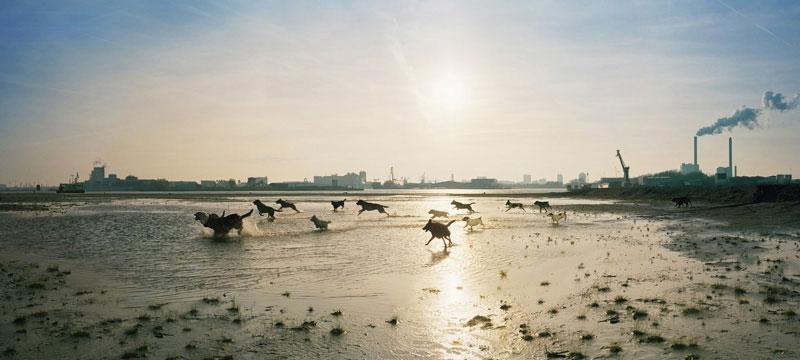
"Amsterdam - honden / perros / Dogs", 2005 © Ellen Kooi
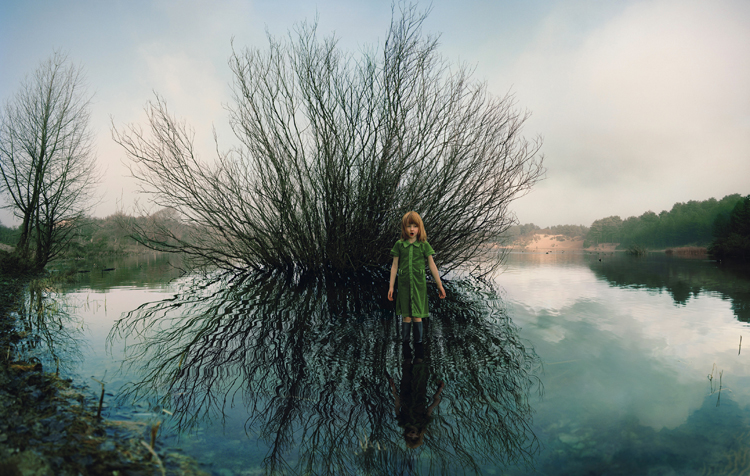
"Oosterplas - wilg / sauce / Willow", 2012 © Ellen Kooi

Las fotografías de Ellen son, en última instancia, un montaje teatral. Ensaya con los personajes su situación y actitud en el plano, logrando como resultado que lo que ocurre en la imágen parezca algo natural y espontáneo que la artista ha captado por pura casualidad.
"En la localización trabajo con iluminación añadida, basándome en los colores que ofrece la luz existente. Lo hago así para enfatizar la atmósfera que busco."
"En el ordenador puedo realizar la coloración y la atmósfera que deseo obtener. Pero lo que el espectador ve es una acción que ha tenido lugar y que ha ocurrido en el sitio que ve." 

"Lissabon - árbol / tree", 2007 © Ellen Kooi

"Nunca cambio el paisaje, sólo la luz."

"Spaarndam wolken", 2012 © Ellen Kooi

Se puede disfrutar del trabajo de Ellen en su sitio web. El artículo referido puede leerse completo aquí.

"Alpen aan de Rijn - pad", 2002-03 © Ellen Kooi

"Abbekerk - tweeling / gemelos / Twins", 2005 © Ellen Kooi

Ellen Kooi is a Dutch photographer born in Leeuwarden in 1962. She earned her degree from the Art Academy ABK Minerva (Groningen) in 1987 and a post Gratuate in Arts at the Rijksacademy, Amsterdam. She has exhibited regularly since more than a decade a work characterized by the purity of the images, carefully crafted and with a naturalness broken only by the strange situation of the characters, which in any case are there without any conflict with the environment.

"Alpen aan de Rijn - waterkant / ribera / Shore", 2002-03 © Ellen Kooi

"Beverwijk - berenklauw / heracleum", 2008 © Ellen Kooi

Landscape is the key element in Ellen's photographs. In an article by Álvaro de Benito Fernández in the "Arte al Limite" magazine, Sept/Oct. 2008, Ellen explains: "What is particular about Holland, and different from other countries, is that people not only came and settled, but we have had to create the spaces around us in order to fight against the risk of flooding.”
“I have always been interested in how certain places affect people’s behaviour and how they live. I am fascinated by the influence of geography in people.”
“Sometimes I try to recreate impressions that landscapes transmit to me and other times I use landscape and how the individual gets by in it; like a metaphor of how he 
lives.”

"De Houtwielen - ballonnen / globos / Balloons", 1997 © Ellen Kooi

"Dreischor - greppel / zanja / Trench", 2009 © Ellen Kooi

"Hindeloopen - IJsdame", 1997 © Ellen Kooi

Ellen's photographs are, at the end, a theater composition. She rehearses with the characters their situation and attitude in the space; as a results what is happening in the picture looks like a natural and spontaneous situation captured by chance.
“In the location I work with additional illumination, based in colours the existing light offers. I do it like that to emphasise the atmosphere I am looking for.”
“In the computer I can do the colouration and atmosphere I want to get. But what the spectator sees is an action that has taken place and that has occurred in the place where it is seen.”

"NO polder - ramanas", 2003 © Ellen Kooi

“I never change the landscape, only the light”

"Sibilini - Rim", 2006 © Ellen Kooi

You can enjoy Ellen's work in her website. The referred article can be checked here.

"Sirjansland - meeuwen / gaviotas / Seagulls", 2009 © Ellen Kooi

Imágenes publicadas con autorización de la artista (¡Muchas gracias, Ellen!)
Images published here with artist's permission (Thanks a lot, Ellen!)

viernes, 22 de febrero de 2013

Rinocerontes (XXXV) - Adonna y Onik

Adonna Khare

"Rinoceronte / Rhino"  © Adonna Khare

Adonna Khare es una excelente dibujante de quien publiqué un post no hace mucho. Dejé para ésta ocasión un repaso por sus rinocerontes, que aparecen salpicando toda su producción. Es raro encontrar alguno de sus trabajos grandes en los que no haya al menos uno. Curiosamente suelen ser pequeños, ínfimos incluso, como juguetitos...

"Elefante, León, Búfalo / Elephant, Lion Buffalo" (detalle / detail© Adonna Khare

"Elefante, León, Búfalo / Elephant, Lion Buffalo" (detalles / details© Adonna Khare

"Chimpancé y bebé / Chimp & Baby", 32 x 42 cm., 2008 © Adonna Khare

Adonna Khare is an excellent drawer. I published a post with her work not long ago. For this occasion I left a review of her rhinos, appearing here and there through her body of work. In her large works you can almost always find at least one. Curiously usually small rhinos, even tiny, like little toys ...

"Elefantes / Elephants" (detalle / detail) © Adonna Khare

"Elefantes / Elephants" (detalle / detail) © Adonna Khare

"Elefantes / Elephants" (detalles / details) © Adonna Khare

Acuarela / watercolor © Adonna Khare

"Pájaro caminante / Walking Bird" © Adonna Khare

"Gorila / Gorilla" (detalle / detail) y / and "Leona / Lioness" (detalle / detail© Adonna Khare

Adonna Khare en "El Hurgador" / in this blog:

Más trabajos e información sobre Adonna en / More works and info about Adonna in

Imágenes publicadas con autorización de la artista (¡Muchas gracias, Adonna!)
Images published here with artist's permission (Thanks a lot, Adonna!)


Onik Sahakian

"El rinoceronte de D. Manuel I / The Rhino of D. Manuel I", 40 x 50 cm., 2011

El pintor y bailarín armenio-iraní Onik Sahakyan nació en Teherán en 1936 y fue amigo de Dalí durante más de 20 años. De él dijo Salvador que era "El artista más Daliliano que conocía". Sahakian realizó 52 exposiciones en solitario en lugares tales como el Museum of World Culture en Gotheborg, el Grand Palais en París, el Museo de Arte Contemporáneo en Moscú, y el Museo de Arte Contemporáneo de Teherán.
Conocío a Dalí en 1958 y a través de los años fue su asistente con sus collages, pinturas y esculturas. También diseñó exquisita joyería para Dalí y su esposa. Dalí dijo una vez a Sahakian: "Tú estás loco, pero tienes una buena locura". Onik falleció en diciembre de 2012.


"El rinoceronte de D. Manuel I / The Rhino of D. Manuel I". (detalle / detail)

Muchos de los cuadros de Onik toman literalmente la iconografía daliniana y la reinterpretan sin mucho esfuerzo. En todo caso, el rinoceronte de Durero, uno de los fetiches pictóricos de Dalí, aparece por todas partes...
Más información y pinturas en su sitio web.

Izq./ Left: "Visión de Oriente / Vision of the Orient", técnicas mixtas / mixed media, 19¾" x 15¾", 2004
Der./ Right: "Llegado de Oriente / Arrived from Orient", técnica mixta / mixed media, 50 x 40 cm., 2011

The iranian-armenian painter and dancer Onik Sahakyan was born in Tehran in 1936 and was a friend of Dali during more than 20 years. About him told Salvador "Onik Sahakian is the Daliest man I know". Sahakian has had 52 solo exhibitions, in such places as the Museum of World Culture at Gotheborg, the Grand Palais in Paris, the Museum of Contemporary Art in Moscow, and the Contemporary Art Museum in Tehran, his home.
In 1958, he met Dali and over the years assisted him with his collages, paintings and sculptures. He also designed exquisite jewelry for Dali and his wife. Dali also once told Sahakian: "You are crazy; but a good kind of crazy". Onik died on December, 2012.

"Enigma 2", técnicas mixtas / mixed media, 80 x 30 cm., 2009

Many of the pictures taken literally Onik iconography reinterpreted Dalí and without much effort. In any case, the rhinoceros of Dürer, also part of Dali's pictorial fetishes, appears everywhere in Onik's body of work...

"Cuidado / Beware", técnica mixta / mixed media, 55 x 45 cm., 2011

More paintings and info in his website.

"Cuatro elementos de la Tierra / Four Elements of Earth", técnica mixta / mixed media, 120 x 80 cm., 2009

Dalí y / and Onik

Salvador Dalí en "El Hurgador" / in this blog: [Todos los enlaces / All links]

jueves, 21 de febrero de 2013

Jan Lebenstein [Pintura, Litografía]

Jan Lebenstein


Jan Lebenstein nació en Brest-Litovsk en 1930. Fue uno de los grandes pintores polacos de la segunda mitad del s.XX. Después de la guerra estudió pintura en la Academia de Bellas Artes de Varsovia, en el taller de Artur Nacht-Samborski [ver al final del post]. Desde mediados de la década de 1950, su Figura Axial (el auténtico emblema de su arte pictórico) fue cristalizando. En otoño de 1959, las Figuras Axiales fueron presentadas en la Primera Bienal de París, iniciada por el entonces Ministro de Cultura André Malraux. Lebenstein fue galardonado en la Bienal, y en 1961 una gran exhibición monográfica con sus trabajos se inauguró en el Museo de Arte Moderno de la Villa de París. 

"Jardiner", óleo sobre lienzo / oil on canvas, 1965.
Bogdan Jakubowski collection, Paris. Foto / Photo: Piotr Ligier

"Czterej jeźdźcy Apokalipsy / Los cuatro jinetes del Apocalipsis / 
The Four Horsemen of the Apocalypse", litografía a color sobre papel / color lithography on paper, 1985

Desde 1960 vivió permanentemente en París. Los '60, especialmente los primeros años de la década, fueron de un gran éxito internacional para el jóven pintor polaco. Sus pinturas se encontraban en las más prominentes exhibiciones europeas, colecciones privadas de Estados Unidos así como también en el Museum of Modern Art in New York. Por esa época, Lebenstein estableció estrechas relaciones de amistad con Konstanty A. Jeleński, Aleksander Wat, Mary McCarthy, Romain Gary, Jean Seber, y Jean Cassou

"Straż przyboczna / Guardaespaldas / Bodyguard"
Litografía a color sobre papel / color lithography on paper, 48 x 68,5 cm., 1973

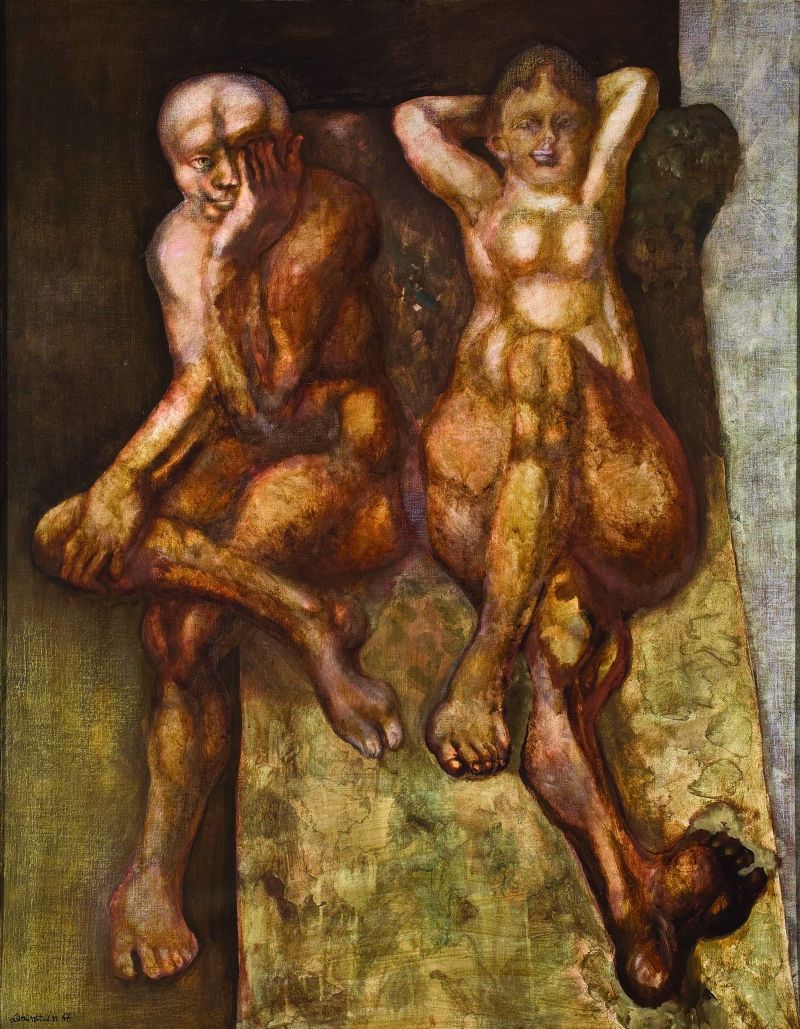
"Sentiments mixtes / Sentimientos mixtos / Mixed Feelings", óleo sobre lienzo / oil on canvas, 1967.
Colección privada / Private Collection. Foto / Photo: Piotr Ligier

"Apoteoza / Apoteosis / Apotheosis", tinta sobre papel / ink on paper, 20,3 x 13,4 cm.

El año 1968 fue un importante punto de inflexión, y sus consecuencias sociales y culturales condujeron al aislamiento del artista. En 1987 murió su amigo parisino más cercano, Konstanty A. Jeleński. En 1992 tuvo lugar una gran exposición monográfica de Jan Lebenstein en la Zachęta National Gallery of Arts, en Varsovia. Jan Lebenstein murió en Cracovia en 1999, cuando se presentó la exposición de sus trabajos "The Stages", en el International Cultural Centre.

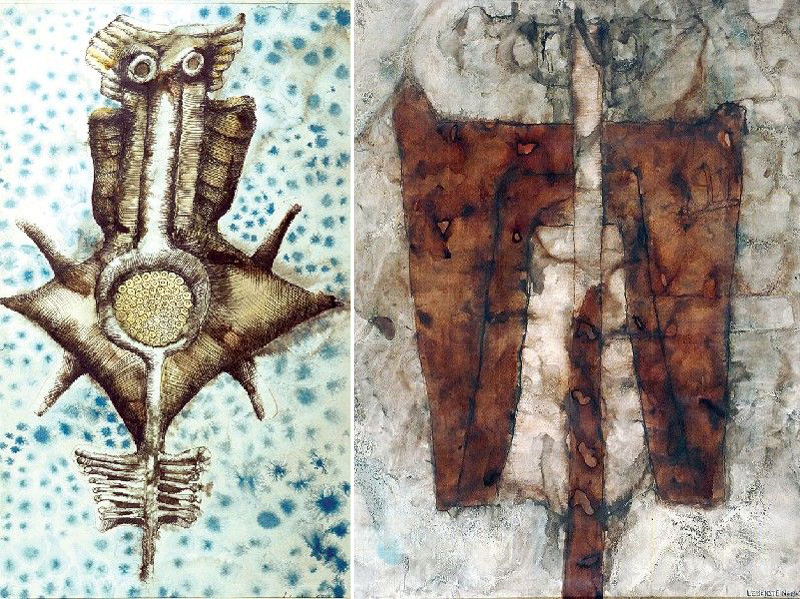
Izq./ Left: "Figura osiowa / Figura axial / Axial Figure", pluma, tinta y acuarela sobre papel hecho a mano /
pen, ink and watercolor on handmade paper, 53,5 x 32 cm., 1963
Der./ Rigth: "Figura", técnica mixta sobre papel cuadriculado / mixed media on graph paper, 49 x 43,5 cm., 1960

"Figura osiowa / Figura Axial / Axial Figure", acuarela, tinta india y pluma sobre papel /
watercolor, indian ink and pen on paper, 34 x 49 cm., 1959

Se puede disfrutar de muchos más trabajos de este artista aquí (de donde traduje el apunte biográfico) y aquí.

"Sin título / Untitled", óleo sobre lienzo / oil on canvas, 1963
Bogdan Jakubowski collection, Paris. Foto / Photo: Piotr Ligier

"Dimanche au Soleil / Domingo al Sol / Sunday in the Sun"
Pluma y tinta sobre papel / pen and ink on paper, 43,5 x 53 cm., 1969

Jan Lebenstein, was born in Brest-Litovsk in 1930. He was one of the greatest Polish painters of the second half of 20th century. After the war, he studied painting at the Academy of Fine Arts in Warsaw, in the atelier of Artur Nacht-Samborski [see at the end of the post]. Since the mid-1950s, his Axial Figure – the very emblem of his painting art, had been crystallising. In autumn 1959, Axial Figures were presented on the 1st Biennale de Paris, initiated by the then Minister of Culture, André Malraux. Lebenstein was granted the main award of Biennale and in 1961 there was great monographic exhibition of his works opened at Musée d’Art moderne de la Ville de Paris. 

"Ilustracja do 'Apokalipsy' / Ilustración de 'Apocalipsis' / Illustration form 'Apocalypse'"
Litografía color sobre papel / color lithography on paper, 50 x 30 cm., 1985

"Kąpiąca się i satyr / Baño y sátiro / Bath and Satyr"
Litografía color sobre papel / color lithograpy on paper, 43,5 x 33,9 cm.

"Les Siens", tinta, crayon y pastel sobre papel / ink, crayon and pastel on paper, 1969.
Bogdan Jakubowski collection, Paris. Foto / Photo: Piotr Ligier

Since 1960, he had been living in Paris permanently. The 1960s, and especially early years of the decade, were a great international success of the young Polish painter. His paintings were found at the most prominent European exhibitions, in private American collections as well as, inter alia, at the Museum of Modern Art in New York. During that time, Lebenstein built close friendships with Konstanty A. Jeleński, Aleksander Wat, Mary McCarthy, Romain Gary, Jean Seber, and Jean Cassou

Izq./ Left: "Rysownik / Dibujante / Draftsman"
Litografía color sobre papel / color lithography on paper, 42,5 x 33,5 cm.
Der./ Right: "Portret z ptakiem / Retrato de un pájaro / Portrait of a Bird"
Litografía a color sobre papel / color lithography on paper, 32,7 x 22,8 cm.

"Z cyklu 'Folwark zwierzęcy' / De la serie 'Granja animal' / From 'Animal Farm' Series"
Litografía a color sobre papel / color lithography on paper, 50 x 70 cm., 1974

"Postacie fantasmagoryczne / Figuras fantasmagóricas / Ghostly Figures"
Pluma, tinta, acuarela, collage / pen, ink, watercolor and collage, 20 x 21 cm., 1962 

The year 1968 was an important turning point, as its social and cultural consequences led to far isolation of the artist. On 1987, the closest Parisian friend of him, Konstanty A. Jeleński, died. In 1992, a great monographic exhibition of Jan Lebenstein took place at the Zachęta National Gallery of Arts in Warsaw. Jan Lebenstein died in Cracow in 1999, when exhibition of his works, The Stages, was presented at International Cultural Centre.

"Ministrele", acuarela, tinta, pluma, lápiz sobre papel / watercolor, ink, pen and pencil on paper, 34 x 23,5 cm.

You can enjoy a lot of works of this artist here (where I also took the biographic information) and here.

"Poids lourds I", 30 x 42,5 cm., 1966


Artur Nacht-Samborski

"Hojas en un jarrón blanco sobre una mesa / Leaves in a White Vase on a Table"
Óleo sobre lienzo / oil on canvas, 100 x 81 cm., c. 1970. Museo Nacional (Varsovia, Polonia / Warsaw, Poland)

Artur Nacht-Samborski fue un misterioso e inclasificable pintor polaco cuyo arte es difícil de describir y está por encima de los "ismos".
Estudió pintura entre 1918 y 1921 en la Academia de Bellas Artes de Cracovia. En su tiempo libre fue boxeador amateur.
Después de la guerra fue profesor en la Escuela de Artes Visuales de Gdansk (1947-49) y la Academia de Bellas Artes de Varsovia (1949-69), con un breve impasse entre 1950-52 cuando dominó el Realismo Social y Nacht-Samborski fue privado de su trabajo.
En el futuro le dedicaré más espacio.
Info in english here.