miércoles, 27 de abril de 2016

Wiebke Haas [Fotografía]

Gracias al excelente blog de Mafa Alborés "La voz del animal invisible", descubrí la obra de esta artista alemana que, tras varios años de formación en fotografía, dedica todo su tiempo y habilidad a los equinos, logrando estos notables retratos, tanto de estudio como al aire libre, en los que consigue plasmar toda la fuerza y belleza de estos animales.
Aquí les dejo mi propia selección de imágenes con algo de información sobre la artista.

Thanks to the excellent Mafa Albores' blog "The voice of the invisible animal", I discovered the work of this German artist who, after several years of training in photography, devotes all her time and skill to horses, achieving these remarkable portraits, both studio and outdoors, in which she manages to capture all the strength and beauty of these animals.
Here you have my own selection of images along with some information about the artist.
_______________________________________________________________

Wiebke Haas


Wiebke Haas es una joven fotógrafa alemana (nacida en 1991) que se define como una de esas típicas "locas por los caballos". Tal como podemos leer en su sitio web:
«Ya desde que era una niñita, soñaba con el golpeteo de los cascos y volar a través de los campos a lomos de un caballo. No podía imaginar un día sin esos magníficos animales. Después de graduarme, era hora de decidir qué quería hacer con mi vida. De algo estaba completamente segura: haría algo que estuviera cerca de mi alma y mi corazón, en vez de trabajar en un aburrido empleo de oficina tan sólo para ganarme la vida. Por ello, combiné mi gran pasión por los caballos con mi deseo de ser creativa y convertirme en una fotógrafa de equinos.»

Coolyo, Pura sangre Mecklenburg / Mecklenburg Warmblood

"Trueno / Thunder" - Una visión de Chepi / A vision of Chepi - Appaloosa

«Pasé tres años hasta obtener un certificado oficial de fotógrafa, antes de correr el riesgo del autoempleo. Estoy enamorada de las estructuras claras y las composiciones. Mi intención es hacer que el espectador mire una imagen una y otra vez. La fotografía de estudio es el centro de mi obra, y para mí es la forma más imponente de presentar la belleza y gracia de esos majestuosos animales. A veces me lleva dos o tres día obtener la imagen que tengo en mente. Los caballos no emplean nuestro lenguaje para comunicarse, así que tienes que encontrar el modo de decirle al caballo qué es lo que quieres que haga por tí. Cada caballo tiene su propio carácter y actitud. Una de las tareas más retadoras y también más plenas, es encontrar cómo dirigir y motivar a un caballo en particular y convertir la idea en una imagen. El post procesamiento de una simple imagen me puede llevar hasta 20 horas o más. 
Ahora tengo 25 años. Mis imágenes aparecen en revistas, libros, galerías y la TV por todo el planeta. Este año publiqué mi tercer libro sobre fotografía de caballos. En verdad, estoy viviendo mi pasión.»

Porcelana / Porcelain, Creme de la Creme, Pura sangre húngaro / Hungarian Warmblood

Fuerza / Strenght, Sasso - Haflinger (Avelignese)

Primer día de la primavera / First Day of Spring, Pinu'u, Mancha, Chepi, Feliz - Appaloosas
.
«Que la sesión sea en el estudio o fotografía al aire libre es decisión del cliente. Personalmente prefiero disparar en el estudio en el que tengo el control total de la luz. Siempre que tengo tiempo para hacerlo fotografío por mi cuenta, no por encargo, para probar nuevas técnicas, nuevos enfoques. Por supuesto también me gusta fotografiar a un caballo de una belleza impresionante que galopa en una hermosa pradera, mientras que el sol de la tarde brilla a través de la crin y la cola. Pero eso es lo que todos los fotógrafos de los caballos hacen ...»

"El arco / The Bow" - HS Sonitas Smart Lena - Cuarto de milla / American Quarter Horse

«Antes de una sesión de fotos pregunto a mi cliente si tiene una idea clara del tipo de imagen que quiere. La mayoría de las veces, sin embargo, estos se fían de mis propuestas. En cualquier caso, el primer disparo debe hacerse en el lugar donde vive el caballo, ya sea en interiores o al aire libre. Esto significa que tengo que encontrar un ambiente agradable en el establo para lograr los mejores retratos o el mejor césped verde en el prado para las fotos en acción. Para configurar mi estudio portátil necesito una sala grande, tal como un granero o establos. Lo más importante es comunicar claramente con el dueño o con quien monta generalmente a caballo y con los ayudantes. El propietario debe saber cómo preparar su caballo para la sesión: para obtener los mejores resultados es necesario que el animal tenga un pelaje brillante, y la melena y la cola esponjosas. Una vez en el set doy mis instrucciones acerca de cómo tengo intención de llevar a cabo el trabajo: es esencial, de hecho, que alguien dirija el caballo de acuerdo con mis instrucciones, y la cara de otra persona para que mire en la dirección que me es más útil para la toma.»

"Torbellino / Whirlwind", Montinio - Caballo Andaluz / P.R.E. 

Caballos en Mecklemburgo / Horses at Mecklenburg, 2015

«[Para la iluminación utilizo] El sistema de flash Hensel, un fabricante alemán de iluminación profesional. Las lámparas que utilizo son muy potentes, porque necesito una gran cantidad de luz para iluminar un animal tan grande como un caballo. En el estudio me gusta jugar con los modeladores de varias formas, tales como cajas de luz, reflectores, luces lineales. Sin embargo utilizo múltiples fuentes de luz para trabajar sobre las partes del cuerpo que quiero destacar. Al aire libre, sin embargo, me gusta trabajar con la luz de la madrugada o del final de la tarde, cuando el sol está cerca del horizonte. La iluminación lateral y el contraluz son los tipos de iluminación que prefiero, pero uso mucho también la luz difusa, si el día está nublado.»

"Danza invernal / Winter Dance", Hungaro & Quimico Quin - Caballos Andaluces / P.R.E. 

Wiebke Haas is a young German photographer (b. 1991) that defines herself as one of those typical “horse girls“. As we can read in her website:
«Ever since I was a little girl I dreamt of hoof-beats and flying through the fields on a back of a horse. I can’t imagine a day without these magnificent animals. After graduating from school it was time to decide what to do with my life. One thing I was entirely sure of: I’d do something that was near to my heart and soul instead of working in a dull office job just to earn a living. Therefore, I combined my great passion for horses with my desire to be creative and became an equine photographer.»

Ovoi - Akhal-Teke

"Belleza negra / Black Beauty", Ovetense - Caballo Andaluz / P.R.E. 

«I spent 3 years to become an officially certified photographer before I took the risk of self-employment. I’m in love with clear structures and compositions. My intention is to make the viewer look at an image over and over again. Studio photography is the core of my work and to me it’s the most imposing way to present the beauty and grace of these majestic animals. Sometimes it takes two or three days until I get the picture I had in mind. Horses don’t use our language to communicate so you have to find a way to tell a horse what you want it to do for you. Each horse has its own character and attitude. One of the most challenging and also fulfilling tasks is to find out how to direct and motivate this one particular horse and turn an idea into a picture. The post processing of a single picture takes up to 20 hours more hours.
I’m 25 years old now. My pictures are featured in magazines, books, galleries and on TV around the globe. This year I published my third book about horse photography. I’m truly living my passion.»

"Feenpferd / Caballo de las hadas / Fairies Horse", 2014

"Mármol / Marble", Royals out of the Blue - Caballo de paseo de Tennesee / Tennessee Walking Horse

"Mármol / Marble" (detalle / detail)

«Make the session in the studio or outdoor photography is up to the customer. Personally I prefer to shoot in the studio in which I have total control of light. Whenever I have time I photograph my own, not custom made, to try new techniques, new approaches. Of course I also like photographing a breathtakingly beautiful horse gallops in a meadow, while the afternoon sun shines through the mane and tail. But this is what all horses photographers do ...»

"Océano amarillo / Yellow Ocean" - A Mancha Queen MS - Appaloosa

"Noche árabe / Arabian Night", Árabe / Arabian

«Before a photo shoot I ask my client if he has a clear idea of ​​what kind of picture wants. Most often, however, they trust my proposals. In any case, the first shot should be in the place where the horse lives, either indoors or outdoors. This means I have to find a friendly atmosphere in the stable to get the best portraits or the best green grass in the meadow for photos in action. To set up my portable studio I need a large room, such as a barn or stables. The most important thing is to communicate clearly with the owner or who usually rides and assistants. The owner should know how to prepare his horse for the session: for best results it is necessary that the animal has a shiny coat and fluffy mane and tail. Once on the set I give my instructions on how I intend to carry out the work: it is essential, in fact, someone to direct the horse according to my instructions, and the face of another person for the animal to look in the direction more useful for the shot.»

Ein spanisches Jahr / Un año español / An Spanish Year & Tourtermine 2016

"Despegue / Take Off "- Flasterfee - Hannoveriano / Hanoverian

«[For lighting I use] The Hensel flash system, a German manufacturer of professional lighting. The lamps that I use are very powerful, because I need a lot of light to illuminate such a large animal like a horse. In the studio I like to play with modelers in various ways, such as light boxes, reflectors, linear lights. However, I use multiple light sources to work on the body parts that I want to highlight. Outdoor, however, I like to work with light in the morning or late afternoon when the sun is near the horizon. Side lighting and backlight are the types of lighting that I prefer, but I use a lot diffuse light too, if the day is cloudy.»

"Tordillo / Dapple Grey", Cacique - Caballo Andaluz / P.R.E. 

"Royals Out Of The Blue", Caballo de paseo de Tennesee / Tennessee Walking Horse
"Cascos, Latidos del corazón / Hoofbeats, Heartbeats"
_________________________________________________________

Fuentes / Sources: 
* Website
* Entrevista (en italiano) de / Interview (in Italian) by Loredana de Pace. Photo Cult, Abril / April, 2016
* Los interesados pueden leer aquí un buen artículo (en inglés) de Wiebke sobre cómo fotografiar caballos /
Those interested can read here a good article by Wiebke about how to photograph horses.
* Enlaces a muchos artículos y entrevistas en el sitio web de Wiebke /
Links to many articles and interviews in Wiebke's website
* Aquí puede verse un video (en alemán) de Wiebke trabajando con un caballo en estudio /
Here you can see a video (in German) of Wiebke working with a horse in studio.
_________________________________________________________

Imágenes publicadas con autorización de la artista (¡Muchas gracias, Wiebke!)
Images published here with artist's permission (Thanks a lot, Wiebke!)

Más imágenes e información sobre Wiebke en / More images and information about Wiebke in:

lunes, 25 de abril de 2016

Rinocerontes (LXXIII)

Hoy les dejo esta bella selección de esculturas de rinocerontes, realizadas con los más variados materiales: cerámica, bronce, cobre, latón, plástico y madera recuperada del arrastre de las aguas /

Here you have this beautiful selection of rhino sculptures, made with several materials: ceramic, bronze, copper, tin, plastic and driftwood. 
___________________________________________________

Nick Mackman

"Cría de rinoceronte / Rhino Calf", cerámica Raku cocida / Raku fired ceramic, 60 x 40 x 30 cm.

Nick Mackman nació en 1972 en Beverley, Yorkshire, Reino Unido.
Nick es una premiada creadora de esculturas de animales en cerámica y bronce. Su obra se ha exhibido ampliamente en 2015, y ganó el premio a la artista del año de vida salvaje en la competición de la David Shepherd Wildlife Foundation (DSWF). 
Es miembro de la Sociedad de Artistas de Vida Salvaje.

"Cría de rinoceronte / Rhino Calf" (detalle / detail)

En 1992 comenzó un curso de especialización en modelado animal, durante el cual trabajó como cuidadora de un rinoceronte en el zoo de Chester. Esta inspiradora experiencia le permitió involucrarse con una amplia variedad de animales y observar, tocar y estudiar su naturaleza íntimamente. Ahora se centra tanto en animales salvajes como domésticos. Detalla las conductas y caracteres de los animales a través de bocetos y fotografías con referencia a, y estudiando de libros, revistas y documentales de vida salvaje. Disfruta explorando el día a día de la vida de un animal, desde el rascarse, olfatear, estirarse, hasta sutiles comportamientos e íntimos gestos entre la madre y la cría.


«La pasión que potencia mi obra, ha evolucionado desde mi conciencia, respeto y admiración por la rareza del reino animal y sus complejas estructuras y sistemas de supervivencia. Espero que mis piezas animen a la comprensión y compasión desde el individuo humano, lo que a cambio redundará en un profundo nivel de disfrute, respeto y admiración por la belleza de las bestias.»

"Rinoceronte bebé / Baby Rhino", cerámica cocida / Low-fired Ceramic, 70 cm.

Nick Mackman was born in 1972 in Beverley, Yorkshire, UK.
Nick is an award winning sculptor of ceramic and bronze animal sculptures. She has been widely exhibited and in 2015 she won the David Shepherd Wildlife Foundation (DSWF) Wildlife Artist of the Year competition.
She's a Member of the Society of Wildlife Artists.


In 1992 she began an HND course specialising in animal modelling, during which time she worked as a rhino keeper in Chester Zoo. This inspirational experience allowed her to get involved with a wide variety of animals and to watch, touch and study the nature of animals intimately. She now concentrates on both domestic and wild animals. She details the mannerisms and character of animals through sketches and photography with reference to, and research from, books, magazines and wildlife documentaries. She enjoys exploring the day to day life of an animal, from scratching, sniffing and stretching to subtle courtships and intimate gestures between mother and child.

"Cría de rinoceronte negro / Black Rhino Calf", cerámica Raku cocida / Raku fired ceramic

«The passion which powers my work has evolved from my awareness, awe and wonder of the strangeness of the animal kingdom and its complex survival structures and systems. I hope that my pieces will encourage understanding and compassion from the human individual which in turn will result in a deeper level of enjoyment, respect and admiration for the beauty in the beast.»

Más sobre Nick Mackman en / More about Nick Mackman in: Website, facebook, Montpellier Gallery


Kang Sung-hoon
강성훈展

"Rinoceronte del viento II / Wind Rhinoceros II"
Cobre, acero inoxidable / copper, stainless steel, 130 × 600 × 150 cm., 2010

Kang Sung-hoon es un joven escultor coreano. 
«Los animales en la obra de Kang Sung-hoon aparecen libres como el viento. Se mueven, se liberan de su peso y gravedad, o se dispersan como elementos en el viento. (...) En su obra la combinación no es externa o mecánica. Como el artista suda mucho, siempre siente el aire muy fresco. Este sentimiento se expresa a través de formas animales en su obra. Su escultura es una visualización del viento soplando alrededor de los músculos con el flujo de las bandas de metal.»
Lee Sun-young, Crítico de arte.
Para más imágenes e información, ver el post previo sobre la obra de este artista.

"Rinoceronte del viento II / Wind Rhinoceros II"

"Rinoceronte del viento II / Wind Rhinoceros II"

"Rinoceronte del viento I / Wind rhinoceros I"
Cobre, acero inoxidable / copper, stainless steel, 145 x 40 x 70 cm.

Kang Sung-hoon is a young Korean sculptor.
«Animals in Kang Sung-hoon’s work appear free as the wind. They move, shaking off their weight and gravity, or scatter as elements of the wind. (...) In his work the combination is neither external or mechanical. As the artist suffers from excessive sweating, he always feels the wind as very fresh. This feeling is expressed through animal forms in his work. His sculpture is a visualization of wind blowing around an animal’s muscles with the flow of metal strips.»
Lee Sun-young, Art Critic
For more images and information abou this artist, check out the previous post.

"Rinoceronte del viento I / Wind rhinoceros I"
"Rinoceronte del viento I / Wind rhinoceros I" (detalle / detail)

Kang Sung-hoon en "El Hurgador" / in this blog: [Kang Sung-hoon (Escultura)]

Más sobre Kang Sung-hoon en / More about Kang Sung-hoon in: Website, Blog, facebook


Juan Carlos Batista

de la serie "Animal Sublimado" / from the Sublimated Animal Series
plástico, resina, acrílico y pigmentos / plastic, resin, acrylic and pigments

Juan Carlos Batista es un artista canario cuya obra repasamos recientemente con motivo de su muestra "Realidad casi humo", que aún puede verse en Santa Cruz de Tenerife. A la misma pertenecen estos rinocerontes intervenidos. Ver los posts previos para más imágenes e información.

de la serie "Animal Sublimado" / from the Sublimated Animal Series
plástico, resina, acrílico y pigmentos / plastic, resin, acrylic and pigments
Foto / Photo: Esther Frías

"Souvenir de la Grande Guerre", 28 x 42 x 31 cm.

Juan Carlos Batista is a Canary artist whose work we reviewed recently on the occasion of his exhibition "Smoke-like Reality" which can still be seen in Santa Cruz de Tenerife. At the same belong these rhinos intervened. See previous posts for more images and information.

de la serie "Animal Sublimado" / from the Sublimated Animal Series
plástico, resina, acrílico y pigmentos / plastic, resin, acrylic and pigments

de la serie "Animal Sublimado" / from the Sublimated Animal Series
plástico, resina, acrílico y pigmentos / plastic, resin, acrylic and pigments

Juan Carlos Batista en "El Hurgador" / in this blog:


Cristino Díez

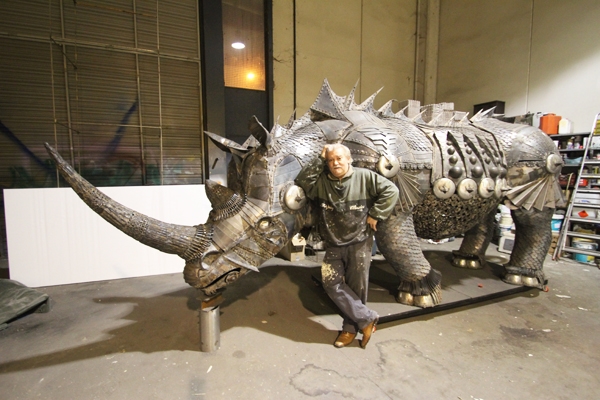
"Anomalías estructurales, Rinoceronte / Structural abnormalities, Rhino"

Rinoceronte a tamaño natural, en hierro reciclado, que se expuso en el Museo de la Evolución Humana de Burgos, con motivo de la muestra "Bestiaria. El descubrimiento de un Reino", Enero-Septiembre, 2015


Cristino Díez nació en Castrojeriz (Burgos) en 1956. Su familia se trasladó a Uríbarri (Bizkaia). Con 14 años regresa a Burgos y realizó su primera exposición en la Real y Antigua de Gamonal. Tras terminar el bachillerato, Cristino consigue una beca para hacer varios cursos de bellas artes en Madrid. De regreso a Burgos continua su formación en la academia de dibujo de El Espolón, con Jesús del Olmo. Posteriormente trabaja como cartelista del cine Avenida junto con el rotulista Timoteo Alonso, continuando la labor de este primero, pero con formatos mucho mayores y de gran dificultad. Pintaba lienzos de 10x2 metros con pinturas de pigmentos naturales que el mismo fabricaba y que ocupaban toda la fachada del teatro. Lamentablemente no queda nada de esas obras de arte, pues el lienzo se reutilizaba para cada nueva película. Desde entonces Cristino ha expuesto grabados, oleos, dibujos, técnicas mixtas y en lo últimos años, esculturas de hierro y otros materiales de diversos tamaños, seres mitológicos a medio camino entre la tierra y el mar.


A lifesize rhino on recycled iron, which was exhibited at the Museum of Human Evolution in Burgos, on the occasion of the exhibition "Bestiaria. The discovery of a Kingdom", January-September, 2015

Cristino Díez was born in Castrojeriz (Burgos) in 1956. His family moved to Uríbarri (Bizkaia). At 14 returns to Burgos and held his first exhibition at la Real y Antigua de Gamonal. After finishing high school, Cristino gets a scholarship to several courses of Fine Arts in Madrid. Back in Burgos continued his training at the academy of drawing El Espolon, with Jesus del Olmo. Later he works as a poster artist at cinema Avenue along with sign manufacturer Timoteo Alonso, continuing the work of the first, but with much larger formats and high difficulty. He painted 10x2 meters canvases with natural pigments manufactured by himself covering the entire facade of the theater. Unfortunately nothing remains of these works of art, because the canvas was reused for each new film. Since then Cristino has exhibited etchings, oil paintings, drawings, mixed media and in recent years iron and other materials sculptures of various sizes, mythological creatures halfway between land and sea.

Otra pieza en la muestra "La visión alterada"
Another piece at the show "The Altered Vision", Cajacírculo, 2/2016

Más sobre Cristino Díez en / More about Cristino Díez in: Website


Andrei Molnar

"Rinoceronte, desde el mundo Steampunk / Rhinoceros, from the Steampunk world"
Modelado en frío, latón negro soldado / cold modeled, welded black tin, 150 x 100 x 100 cm., 2012

Este rinoceronte, según puede verse aquí, es el trabajo de graduación de Andrei Molnar, alumno de la Universidad Nacional de Artes de Bucarest. No tengo más información sobre el artista.


This rhino, as you can see here, is the graduation work by Andrei Molnar, student at the National University of Arts in Bucharest. I have no more information about this artist.


Matt Buckley

"Rinoceronte / Rhinoceros", 49 x 54 x 28 cm.

Matt Buckley comenzó su carrera como escultor hace más de 20 años, y tuvo la oportunidad de perfeccionar su arte, siguiendo los pasos de su padrastro, Robert Harrop, mediante el trabajo en "Country Companions", más tarde llamado "Doggie People", que se ha mantenido con éxito hasta el día de hoy dentro de la industria de artículos para regalo y coleccionables más de 25 años.

Sobre las esculturas de Buckley, podemos leer en su página web:
Cada pieza es esculpida originalmente en arcilla. (...)
Los masters de arcilla terminados se moldean cuidadosamente para cada pieza a mano, usando cerámica polystone para permitir la reproducción fiel de los detalles y la textura de la escultura inicial.
El toque final es un hábil acabado a mano y pintura que da vida a la figura...

"Rinoceronte / Rhinoceros" (otra vista / another view)

Matt  Buckley started off his sculpting career over 20 years ago having been afforded the opportunity to hone his craft by following in the footsteps of his step father, Robert Harrop, by working on the ‘Country Companions’ and later named ‘ Doggie People’ range which have resided successfully to this day within the ‘giftware’ and ‘collectible’ industry for well over 25 years themselves.

About Buckley's sculptures, we can read in his website:
Each piece is originally sculpted in clay. (...)
The finished clay masters were then moulded with each subsequent piece then carefully hand cast using ceramic polystone to allow for the faithful reproduction of the detail and texture of the original sculpt.
The finishing touch is the skilful application of hand finishing and painting that brings the figure to life...

Matt Buckley en "El Hurgador" / in this blog: [Recolección (XIX)]


Leopoldo Martins

"Rinoceronte / Rhino", bronce patinado / patinated bronze

Leopoldo Martins nació en Belo Horizonte, Brasil, en 1961. En su infancia, en las horas libres, le gustaba diseñar y jugar con arcilla. Los diseños, recortes, dobleces y pegados se transformaban en objetos, maquetas y proyectos. Las primeras experiencias con la tridimensionalidad surgieron así naturalmente, de forma lúdica, divertida y despreocupada. Cada vez más atraído por la posibilidad de capturar, a través del trazo, la esencia de las formas transformándolas en un objeto de deseo, se dedicó a diseñar joyas, ahora con un aspecto más refinado. Esta experiencia forjó su identidad creadora caracterizada por la limpieza del trazo, el poder de síntesis, el corte preciso. La simplificación de la forma es su sello.

"Rinoceronte / Rhino" (detalle / detail)

"Rinoceronte / Rhino", resina ortoftálmica blanca / white ortoftalmic resin

Leopoldo Martins was born in Belo Horizonte, Brazil, in 1961. In his childhood, in his free time, he liked to design and play with clay. Designs, cuts, folds and pasted turned into objects, models and projects. The first experiences with the three-dimensionality came so naturally, in a playful, fun and carefree way. Increasingly attracted by the ability to capture, through the stroke, the essence of forms, transforming them into an object of desire, he devoted himself to designing jewelry, now with a more refined look. This experience shaped his creative identity characterized by the clean stroke, the power of synthesis, the precise cut. The simplification of form is his hallmark.

"Rinoceronte / Rhino" (vista superior / upper view)

Leopoldo Martins en "El Hurgador" / in this blog: [Recolección (XXXVII)], [Recolección (CXIII)]


No es la primera vez que vemos aquí rinocerontes hechos con madera recuperada del arrastre de las aguas. Ya disfrutamos hace un par de años de las creaciones de Tony Fredricksson. Ahora les traigo dos nuevos artistas que también trabajan con este material.

Is not the first time we see here rhinoceros made with driftwood. We already enjoyed the creations of Tony Fredriksson a couple of years ago. Now here you have two new artists that also work with this material.

Bevan van Druten


Bevan van Druten nunca tuvo instrucción artística. Era chef y trabajaba en hotelería. Era bueno en lo que hacía, pero tal vez cuando estaba en la cama, por las noches, sentía que se estaba perdiendo algo, eso que hace del mundo un lugar de oportunidades y maravillas sin fin. 
Entonces mientras surfeaba en la Red, se topó con los caballos a tamaño natural hechos por Heather Jansch con madera recuperada, y su mundo se dio vuelta. Como dice Heather, "La madera arrastrada por las corrientes tiene un poder y calidad auténticos que hace de ella algo extraordinario.


«Ya desde muy joven me he sentido fascinado por la naturaleza, y especialmente por las aves. Viviendo en Garden Route estoy muy cerca de mis pasiones.
He estado recolectando madera arrastrada por las corrientes en los estuarios de ríos y bosques desde hace cerca de diez años.
Algunas piezas son obras de arte naturales.
Yo ensamblo la madera recuperada utilizando tan sólo clavijas de madera, y creo aves, tales como grullas azules, pelícanos, garzas, y varias especies de animales, muchos de ellos africanos.»


Bevan Van Druten never trained as an artist. He was a chef and worked in hotel management. He was good at what he did, but maybe when he lay in bed at night, he sensed that something was missing; that piece that makes the world a place of limitless wonder and opportunity.
Then whilst browsing the Internet, he came across Heather Jansch‘s life-size driftwood horses and his world stood still. As Ms Jansch says: «The driftwood had a power and authentic quality that made it something extraordinary.»


«Ever since I was very young, I have been fascinated by nature and especially bird-life. Living in the Garden Route means that I’m close to both my passions.
I have been collecting driftwood from the river estuaries and forests for about ten years now.
Some pieces of wood are natural works of art.
I assemble the driftwood, using only wooden dowels, and create birds, such as Blue Cranes, Pelicans and Herons, several species of fish, and many other African animals.»

Más sobre van Druten en / More about van Druten in: Website, facebook
___________________________________________________________

Matt Torrens

Matt Torrens nació y se crió en Alberta, Canadá. 
Comenzó a dibujar a una edad muy temprana, y continuó desarrollando sus habilidades durante la adolescencia. 
«Me introduje en la escultura en el 7º grado, en la secundaria. Estudié el metal en las clases de carrocería de automóviles. He aplicado mis conocimientos artísticos siempre que he podido y con cualquier cosa: arcilla, metal, piedra, cualquier medio. ¡Me ancanta!. No sé cómo me convertí en artista, sólo sabía que quería serlo.»

"Navarro Blanc"

«En 2005 trabajaba por encargo, y no fue hasta 2006 que descubrí mi próximo medio: la madera de Manzanita arrastrada por las aguas,
Cada pieza de madera de Manzanita, con sus contornos y vetas, me ayuda a dotar de vida a mis esculturas realizadas antes con madera muerta. Selecciono estratégicamente cada pieza de madera recuperada en base a su tamaño y carácter. Naturalmente hay nudos en la madera que ayudan a dar forma a los animales, las imperfecciones aportan definición al contorno, mientras que otras piezas son usadas por su apariencia de músculos o huesos. Cada escultura es única, una obra de arte singular.»


He started drawing at a very early age, and continued to develop his art skills throughout adolescence. 
«I was introduced to the art of sculpture in the 7th grade; in high school, I studied metal in auto body class. I applied my knowledge of art whenever, and with whatever I could. Clay, metal, stone, any medium - I loved it! I did not know how I would become a working artist; I just knew I wanted to.»

"Kala"

«In 2005, I worked on private commissions, and it was not until 2006 that I discovered my next medium of choice, Manzanita driftwood.
Each piece of Manzanita driftwood, with its contours and veins, helps bring my otherwise dead-wood sculptures back to life. I strategically select each piece of driftwood based upon its size and character. Naturally occurring notches on the wood help the animals take shape; flaws provide definition and contour; while other pieces are used for their muscle and bone-like appearance. Each sculpture is a unique, one-of-a-kind, work of art.»