domingo, 4 de marzo de 2018

Aniversarios (CCXVI) [Marzo / March 1-4]

Todos los aniversarios de Marzo aquí / All anniversaries for March here.
_________________________________________________________

El 1 de Marzo es el cumple de

Anton Wilhelm Tischbein, conocido como El Tischbein de Hanauer, pintor alemán de la familia de artistas Tischbein, nacido en 1730 en Haina.
Su padre era panadero. Sus cuatro hermanos mayores eran todos pintores; el más conocido de ellos fue Johann Heinrich Tischbein. Su primer maestro fue su hermano Johann Valentin Tischbein. En 1753 se matriculó en la Real Academia de Arte de La Haya, que tenía una reputación internacional por su enseñanza en el estilo barroco.

"Bildnis der Frau / Retrato de la Sra./ Portrait of Mrs. Anna Maria Sondershausen von Gläsernthal"
Óleo sobre lienzo / oil on canvas, 88 × 72 cm., c.1780.
Historisches Museum (Frankfurt, Alemania / Germany). Wikimedia Commons

En 1758 entró al servicio del Conde Christian August von Solms-Laubach como su secretario. Se trasladó a Hanau en 1769 para convertirse en pintor de la corte de Guillermo I, elector de Hesse y, después de 1772, trabajó para establecer una academia de arte allí y se convirtió en maestro.
Trabajó no solo para la nobleza, sino también para aristócratas ricos, como Johann Christian Senckenberg, Brentanos y La Roches. Los retratos fueron su obra principal, pero también creó escenas históricas y pequeñas obras conocidas como "Kabinettstücke (Piezas de gabinete)", así como la decoración de Lustschloss en Wilhelmsbad, ahora un parque cerca de Hanau.
Murió en 1804.

"Bildnis der Gattin des Künstlers mit Söhnchen / Retrato de la esposa del artista con su hijo /
Portrait of the Artist's Wife With Their Son"
Óleo sobre lienzo / oil on canvas, 158 × 109 cm., c.1783.
Neue Galerie und Städtische Kunstsammlungen (Kassel, Alemania / Germany). Wikimedia Commons

On March 1 is the birthday of

Anton Wilhelm Tischbein, known as the Hanauer Tischbein, German painter from the Tischbein family of artists, born in 1730 in Haina.
His father was a baker. His four older brothers were all painters, the best-known of them being Johann Heinrich Tischbein. His first teacher was his brother Johann Valentin Tischbein. In 1753, he enrolled at the Royal Academy of Art in The Hague, which had an international reputation for its teaching in the Baroque style.

"Retrato de la princesa Carolina Guillermina de Orange y sus hijos /
Portrait of Princess Carolina Wilhelmina of Orange and her children"
Óleo sobre lienzo / oil on canvas, 104,5 x 149 cm.
Koninklijk Kabinet van Schilderijen Mauritshuis (La Haya, Holanda / The Hague, Netherlands)

In 1758, he entered the service of Count Christian August von Solms-Laubach as his secretary. He moved to Hanau in 1769 to become court painter for William I, Elector of Hesse and, after 1772, worked to establish an art academy there and became a teacher.
He worked not only for the nobility, but also for wealthy aristocrats, including Johann Christian Senckenberg, the Brentanos and the La Roches. Portraits were his main work, but he also created historical scenes and small works known as "Kabinettstücke (Cabinet Pieces)", as well as decorating the Lustschloss at Wilhelmsbad; now a park near Hanau.
He died in 1804.

"Porträt Familie Borris / Retrato de la familia Borris / Portrait of Borris Family" (detalle / detail)
Óleo sobre lienzo / oil on canvas, 85" × 68,9", c.1770-75
Museo histórico (Frankfurt, Alemania / Germany). Wikimedia Commons


El 2 de Marzo es el cumple de

Louis-Michel van Loo, pintor francés nacido en 1707 en Toulon.
Estudió con su padre, el pintor Jean-Baptiste van Loo, en Turín y Roma, y ganó un premio en la Académie Royale de Peinture et de Sculpture en París en 1725. En 1727-1732 estuvo en Roma con su tío, el pintor Charles-André van Loo, y en 1736 se convirtió en pintor de la corte de Felipe V de España en Madrid, donde fue miembro fundador de la Real Academia de Bellas Artes de San Fernando en 1752.

"Luisa Isabel de Borbón, mujer de don Felipe de Parma /
Louise-Élisabeth of France, Wife of the Infante Philip, Future Duke of Parma"
Óleo sobre lienzo / oil on canvas, 142 x 112 cm., 1745.
Museo del Prado (Madrid, España / Spain). Wikimedia Commons

Regresó a París en 1753 y pintó muchos retratos de Luis XV de Francia. En 1765 sucedió a Charles-André como Director de la escuela especial de la academia francesa conocida como la École Royale des Élèves Protégés. En 1766 hizo el retrato del estadista portugués Sebastião de Melo, marqués de Pombal.
Entre sus hermanos estaban los pintores François van Loo (1708-1732) y Charles-Amédée-Philippe van Loo (1719-1795).
Murió en 1771.

"Autorretrato / Self-portrait"
Óleo sobre lienzo / oil on canvas, 130 × 98 cm., 1762.
Château de Versailles (Francia / France). Wikipedia

On March 2 is the birthday of

Louis-Michel van Loo, French painter born in 1707 in Toulon.
He studied under his father, the painter Jean-Baptiste van Loo, at Turin and Rome, and he won a prize at the Académie Royale de Peinture et de Sculpture in Paris in 1725. With his uncle, the painter Charles-André van Loo, he went to Rome in 1727–1732, and in 1736 he became court painter to Philip V of Spain at Madrid, where he was a founder-member of the Royal Academy of Fine Arts of San Fernando in 1752

"Isabel Farnesio, Reina de España / Isabel Farnesio, Queen of Spain"
Óleo sobre lienzo / oil on canvas, 150 x 110 cm., c.1739
Museo del Prado (Madrid, España / Spain)

He returned to Paris in 1753, and painted many portraits of Louis XV of France. In 1765 he succeeded Charles-André as director of the special school of the French academy known as the École Royale des Élèves Protégés. In 1766 he made the portrait of the Portuguese statesman Sebastião de Melo, Marquis of Pombal.
Among his brothers were the painters François van Loo (1708–1732) and Charles-Amédée-Philippe van Loo (1719–1795).
He died in 1771.

"María Teresa Rafaela de España, Delfina de Francia / 
The Infanta María Teresa Rafaela of Spain, future Dauphine of France (1726-1746)"
Óleo sobre lienzo / oil on canvas, 271 × 195 cm., c.1745.
Château de Versailles (Francia / France). Wikimedia Commons

Louis-Michel van Loo en "El Hurgador" / in this blog: [Arte perdido (XI)]


El 3 de Marzo es el cumple de

Ronald William Fordham Searle, artista y dibujante satírico británico nacido en 1920 en Cambridge.
Empezó a dibujar a los cinco años y dejó la escuela (Central School - ahora Parkside School) a los 15. Se formó en Cambridge College of Arts and Technology (ahora Anglia Ruskin University) durante dos años.
En abril de 1939, al darse cuenta de que la guerra era inevitable, abandonó sus estudios de arte para alistarse en los Ingenieros Reales. En enero de 1942 estuvo destinado en Singapur. Después de un mes de combates en Malaya, fue hecho prisionero junto con su primo Tom Fordham Searle, cuando Singapur cayó ante los japoneses. Pasó el resto de la guerra como prisionero, primero en la prisión de Changi y luego en la jungla de Kwai, trabajando en el Ferrocarril de la Muerte Siam-Burma. Searle contrajo beriberi y malaria durante su encarcelamiento, que incluyó numerosas palizas, y su peso bajó a menos de 40 kilogramos. Fue liberado a fines de 1945 con la derrota final de los japoneses. Después de la guerra, se desempeñó como artista de la corte en los juicios de Nuremberg.

"Africa", Le Monde, 1989

Aunque Searle publicó la primera caricatura de St Trinian en la revista Lilliput en 1941, su carrera profesional realmente comienza con su documentación de las condiciones brutales del campo de su período como prisionero de guerra, en una serie de dibujos que se escondió debajo de los colchones de los prisioneros que murieron de cólera. Liberado a finales de 1945, Searle regresó a Inglaterra donde publicó varios de ellos.
Searle produjo un extraordinario volumen de trabajo durante la década de 1950, incluidos dibujos para Life, Holiday y Punch. Sus caricaturas aparecieron en The New Yorker, Sunday Express y News Chronicle.
Después de mudarse a París en 1961, trabajó más en reportajes para Life y Holiday, y menos en caricaturas. También continuó trabajando en una amplia gama de medios y creó libros (incluidos sus conocidos libros de gatos), películas animadas y esculturas para medallas conmemorativas, tanto para la Casa de moneda francesa como para la Sociedad británica de medallas de arte.
Murió en 2011.

"Payaso / Clown", Le Monde, 1971

On March 3 is the birthday of

Ronald William Fordham Searle, British artist and satirical cartoonist born in 1920 in Cambridge.
He started drawing at the age of five and left school (Central School - now Parkside School) at the age of 15. He trained at Cambridge College of Arts and Technology (now Anglia Ruskin University) for two years.
In April 1939, realizing that war was inevitable, he abandoned his art studies to enlist in the Royal Engineers. In January 1942, he was stationed in Singapore. After a month of fighting in Malaya, he was taken prisoner along with his cousin Tom Fordham Searle, when Singapore fell to the Japanese. He spent the rest of the war a prisoner, first in Changi Prison and then in the Kwai jungle, working on the Siam-Burma Death Railway. Searle contracted both beri-beri and malaria during his incarceration, which included numerous beatings, and his weight dropped to less than 40 kilograms. He was liberated in late 1945 with the final defeat of the Japanese. After the war, he served as a courtroom artist at the Nuremberg trials.
Although Searle published the first St Trinian's cartoon in the magazine Lilliput in 1941, his professional career really begins with his documentation of the brutal camp conditions of his period as a prisoner-of-war, in a series of drawings that he hid under the mattresses of prisoners dying of cholera. Liberated late in 1945, Searle returned to England where he published several of the drawings.
Searle produced an extraordinary volume of work during the 1950s, including drawings for Life, Holiday and Punch. His cartoons appeared in The New Yorker, the Sunday Express and the News Chronicle.

Casablanca, Marruecos / Morocco, Revista Holiday / Holiday Magazine, Enero / January, 1965

After moving to Paris in 1961, he worked more on reportage for Life and Holiday and less on cartoons. He also continued to work in a broad range of media and created books (including his well-known cat books), animated films and sculpture for commemorative medals, both for the French Mint and the British Art Medal Society.
He died in 2011.

"Ilustración para "Cuento de Navidad", de Charles Dickens / 
Illustration for Dickens' Christmas Carol"
__________________________________

Ernesto de la Cárcova y Arrotea, pintor argentino de la escuela realista nacido en 1866 en Buenos Aires.
Con un temprano interés en el lienzo, estudió en la Sociedad local para el Estímulo de Bellas Artes bajo la dirección del pintor Francisco Romero. Asistió a la prestigiosa Accademia Albertina en Turín, donde fue instruido por el pintor Giacomo Grosso.
En la 31ª Exposición de Bellas Artes de Turín en 1890 presentó "Cabeza de un anciano", un dibujo en color al pastel que vendió al Rey de Italia, Umberto I, para su exhibición en el Palazzo Quirinale en Roma. Al regresar a Argentina completó su obra más conocida, "Sin pan y sin trabajo", en 1893. Ambientada en el sur industrial de Buenos Aires durante la severa recesión que siguió al Pánico de 1890, la obra se exhibe hoy en el Museo Nacional de Bellas Artes.

"Sin pan y sin trabajo / No Bread, No Job"
Óleo sobre tela / oil on canvas, 125,5 x 216 cm., 1894
Museo Nacional de Bellas Artes (Buenos Aires, Argentina)

Adquiriendo cada vez más renombre, fue invitado a dirigir el Programa de Becas para Artistas Argentinos en París en 1902 y recibió una medalla de oro por su obra en la Exposición Universal de 1904 en St. Louis (Estados Unidos). Durante su estancia en Europa, se interesó por la escultura y compró varias reproducciones de obras en las colecciones de los Museos Estatales de Berlín, incluidas las de bustos y bronces antiguos de Egipto, Caldea y Grecia. Al regresar a Buenos Aires, exhibió varias de estas obras en la Exposición del Centenario de Buenos Aires en 1910 y fue invitado a la Academia Nacional de Bellas Artes por su fundador, el también pintor realista Eduardo Sívori.
Aceptó una cátedra en la Universidad de Buenos Aires y, al continuar participando en eventos internacionales, obtuvo una medalla de plata en la Exposición de Artes de París en 1916. Los diseños de De la Cárcova fueron elegidos para representar el centenario argentino con la medalla oficial y el gran sello de la Universidad de Buenos Aires en 1921. Fundador de la Escuela Superior de Bellas Artes en 1923, una institución que absorbió la academia de Sívori, la escuela es hoy parte del Instituto de Arte de la Universidad Nacional, la institución más importante en su clase en la Argentina.
Murió en 1927.

"Retrato de la esposa del artista / Portrait of Artist's Wife"
Óleo sobre tela / oil on canvas, 182 x 125 cm., 1914
Museo Nacional de Bellas Artes (Buenos Aires, Argentina)

Ernesto de la Cárcova y Arrotea, Argentine painter of the Realist school born in 1866 in Buenos Aires.
Taking an early interest in the canvas, he studied at the local Society for the Stimulus of Fine Arts under painter Francisco Romero. He attended the prestigious Accademia Albertina in Turin, where he was trained by painter Giacomo Grosso.
At the 31st Turin Fine Arts Exposition in 1890, he presented The Head of An Old Man, a pastel drawing he sold to the King of Italy, Umberto I, for display at the Palazzo Quirinale in Rome. Returning to Argentina, he completed his best-known work, Without Bread or Work, in 1893. Set in Buenos Aires' industrial southside during the severe recession that followed the Panic of 1890, the work is today displayed in the National Museum of Fine Art.

"En el jardín / In the Garden"
Óleo sobre madera / oil on wood, 40 x 32 cm., 1902
Museo Nacional de Bellas Artes (Buenos Aires, Argentina)

Gaining increasing renown, he was invited to direct the Argentine Artists' Fellowship Program in Paris in 1902 and received a gold medal for his work at the Universal Exposition of 1904 in St. Louis (United States). During his stay in Europe, he took an interest in sculpture, purchasing a number of reproductions of works in the Berlin State Museums collections, including those of a number of ancient Egyptian, Chaldean, and Greek busts and bronzes. Returning to Buenos Aires, he displayed a number of these works at the Buenos Aires Centennial Exposition in 1910 and was invited into the National Fine Arts Academy by its founder, fellow Realist painter Eduardo Sívori.
He accepted a professorship at the University of Buenos Aires and, continuing to participate in international events, he garnered a silver medal at a 1916 Paris Arts Exposition. De la Cárcova's designs were chosen to represent the Argentine Centennial as the official medal, and as the great seal of the University of Buenos Aires in 1921. Founder of the School Superior of Fine Arts in 1923, an institution that absorbed Sívori's academy. The school is today part of the National University Art Institute, Argentina's foremost institution of its type.
He died in 1927.

"Retrato de la Sra. / Portrait of Mrs. Maria de la Cárcova de Ferrari"
Óleo sobre tela / oil on canvas, 251 x 126 cm., 1894
Museo Nacional de Bellas Artes (Buenos Aires, Argentina)


Hoy, 4 de Marzo, es el cumple de

Sir Henry Raeburn, pintor de retratos escocés nacido en 1756 en Edimburgo. Fue el primer pintor de retratos importante de Escocia desde la Unión en permanecer en el país.
A los quince años fue aprendiz del orfebre James Gilliland de Edimburgo. Pronto se dedicó a la producción de miniaturas de retratos cuidadosamente acabadas; habiendo alcanzado éxito y mecenazgo, extendió su práctica a la pintura al óleo, en la que fue autodidacta. Gilliland observó el progreso de su alumno con interés y le presentó a David Martin, que había sido el asistente favorito de Allan Ramsay, y ahora era el pintor de retratos líder en Edimburgo. Raeburn fue especialmente ayudado por el préstamo de retratos para copiar. Pronto adquirió la habilidad suficiente para hacer que decidiera dedicarse exclusivamente a la pintura.
Era habitual que los artistas visitaran Italia, y Raeburn partió con su esposa. En Londres fue recibido amablemente por Sir Joshua Reynolds, el presidente de la Royal Academy, quien le aconsejó sobre qué estudiar en Roma, especialmente recomendando las obras de Miguel Ángel, y le dio cartas de presentación para Italia. En Roma conoció a sus colegas escoceses Gavin Hamilton, Pompeo Girolamo Batoni y Byers, un comerciante de antigüedades cuyos consejos resultaron particularmente útiles, especialmente la recomendación de que "nunca debe copiar un objeto de memoria, sino a partir de la figura principal, hasta el más pequeño accesorio, debe estar ante él". Después de dos años de estudios en Italia, regresó a Edimburgo en 1787 y comenzó una exitosa carrera como pintor de retratos.

"Retrato de / Portrait of Mrs. Eleanor Urquhart"
Óleo sobre lienzo / oil on canvas, 75 × 62 cm., c.1795
National Gallery of Art (Washington, D.C., EE.UU./ USA). Wikimedia Commons

Raeburn pasó su vida en Edimburgo, visitando Londres raras veces, y luego solo por breves períodos, preservando así su individualidad. Aunque él, personalmente, pudo haber perdido ventajas resultado de una asociación más cercana con los líderes del arte inglés, y del contacto con un público más amplio, el arte escocés ganó mucho de su desinterés por dejar su tierra natal. Se convirtió en el jefe reconocido de la escuela que crecía en Escocia a principios del siglo XIX, y su ejemplo e influencia en un período crítico fueron de gran importancia.
En 1812 fue elegido presidente de la Sociedad de Artistas en Edimburgo, en 1814 asociado, y al año siguiente miembro de pleno derecho de la Royal Scottish Academy. El 29 de agosto de 1822 fue nombrado Caballero por Jorge IV y Jefe de Su Majestad para Escocia en la casa del Conde de Hopetoun.
Murió en 1823.

"John Johnstone, Betty Johnstone, & Miss Wedderburn"
Óleo sobre lienzo / oil on canvas, 101,5 x 120 cm., c.1790-95
National Gallery of Art (Washington, D.C., EE.UU./ USA). Wikimedia Commons

Today, March 4, is the birthday of

Sir Henry Raeburn, Scottish portrait painter born in 1756 in Edinburgh. He was Scotland's first significant portrait painter since the Union to remain based in Scotland.
At the age of fifteen he was apprenticed to the goldsmith James Gilliland of Edinburgh. Soon he took to the production of carefully finished portrait miniatures; meeting with success and patronage, he extended his practice to oil painting, at which he was self-taught. Gilliland watched the progress of his pupil with interest, and introduced him to David Martin, who had been the favourite assistant of Allan Ramsay the Latter, and was now the leading portrait painter in Edinburgh. Raeburn was especially aided by the loan of portraits to copy. Soon he had gained sufficient skill to make him decide to devote himself exclusively to painting.

"La Sra. / Mrs John Campbell of Kilberry"
Óleo sobre lienzo / oil on canvas, 126 x 100 cm., c.1802
Neue Pinakothek (Múnich, Alemania / München, Germany)

It was usual for artists to visit Italy, and Raeburn set off with his wife. In London he was kindly received by Sir Joshua Reynolds, the president of the Royal Academy, who advised him on what to study in Rome, especially recommending the works of Michelangelo, and gave Raeburn letters of introduction for Italy. In Rome he met his fellow Scot Gavin Hamilton, Pompeo Girolamo Batoni and Byers, an antique dealer whose advice proved particularly useful, especially the recommendation that "he should never copy an object from memory, but, from the principal figure to the minutest accessory, have it placed before him." After two years of study in Italy he returned to Edinburgh in 1787, and began a successful career as a portrait painter. 
Raeburn spent his life in Edinburgh, rarely visiting London, and then only for brief periods, thus preserving his individuality. Although he, personally, may have lost advantages resulting from closer association with the leaders of English art, and from contact with a wider public, Scottish art gained much from his disinclination to leave his native land. He became the acknowledged chief of the school which was growing up in Scotland during the early 19th century, and his example and influence at a critical period were of major importance.
In 1812 he was elected president of the Society of Artists in Edinburgh; and in 1814 associate, and in the following year full member, of the Royal Scottish Academy. On 29 August 1822 he was knighted by George IV and appointed His Majesty's limner for Scotland at the Earl of Hopetoun house.
He died in 1823.

"Los niños Drummond / The Drummond Children"
Óleo sobre lienzo / oil on canvas, 239,4 x 153 cm., c.1808-09
The Metropolitan Museum of Art (Nueva York, EE.UU./ NYC, USA)

Henry Raeburn en "El Hurgador" / in this blog: [Recolección (VII)]

viernes, 2 de marzo de 2018

Gabriela Handal [Dibujo / Drawing]

Gabriela Handal

Gabriela Handal. Foto / Photo: Alejandra Rodríguez - Gini

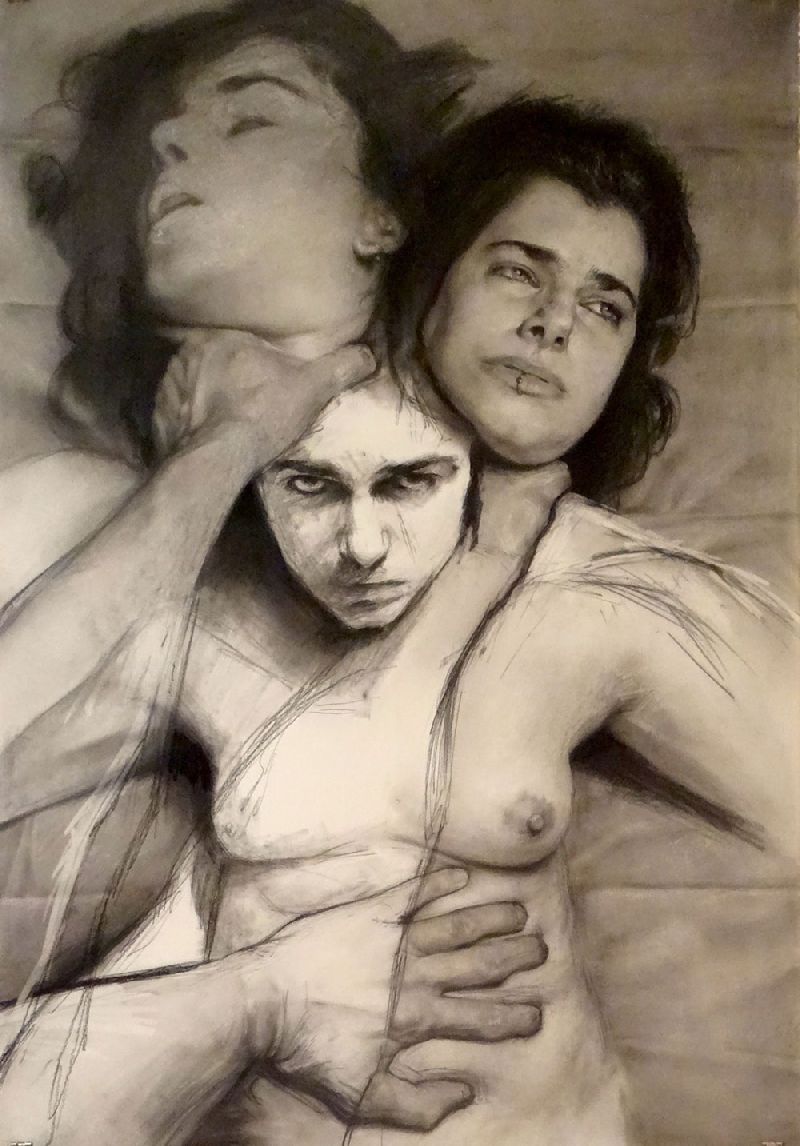
Gabriela Handal es una joven artista nacida en Panamá que se mudó a Nueva York a fines de 2013 para estudiar en la Academia de Arte de la ciudad, y se graduó en 2015 como dibujante.
Aquí les dejo una selección de su obra, su declaración artística, comentarios sobre algunos de sus trabajos, referencias y algunos extractos de una entrevista muy interesante que puede leerse completa en Anti-Heroin Chic (enlaces más abajo)

«Mi obra es, ante todo, sobre el cuerpo humano. Luego se ramifica en mi experiencia personal como mujer adulta y el arte de la fantasía, por lo que las imágenes que hago van orientadas desde lo anatómico o estudios de personajes, a lo muy personal y visceral.
Generalmente trabajo el dibujo, debido a su enorme portabilidad, versatilidad y maleabilidad. El dibujo es mi método de acceso, cada vez que pienso en hacer algo, siempre pienso primero en dibujar.
Actualmente estoy sumergida en un cuerpo de obra que tiene que ver con el miedo a la violencia y el abuso físico. Mientras trabajaba en ello, me di cuenta de cuán profunda es la preocupación por el abuso físico. Los dibujos me han hecho reconsiderar mis opiniones sobre el feminismo y sobre mí misma, mi comportamiento en relaciones previas.
Este cuerpo de obra consiste en autorretratos en los que una fuerza externa en forma de cuerda o la mano enorme de un hombre entra en el plano de la imagen y me hiere de algún modo. Las imágenes provienen específicamente de una relación anterior en la que mi compañero en aquél momento hizo cosas que yo no quería, y no me di cuenta hasta mucho después de lo incómoda que me resultó la experiencia. Los dibujos me ayudaron, entre otras cosas, a aceptar lo que sucedió y lidiar con ello".»


"Punto de vista / P.O.V."
Carboncillo sobre papel / charcoal on paper, 101,6 x 66,04 cm., 2015

Lápices Palomino sobre papel Stonehenge /
Palomino pencils on Stonehenge paper, 6" x 6", 2017

«Supongo que en cuanto a temas e inspiración, el cuerpo humano es lo principal. Desde hace un tiempo he pensado en el cuerpo humano como lo primero de lo que trata mi obra. Soy una fan del cuerpo humano en un sentido como médico, algo así como estéril y frío, pero también creo que es imposible, porque ¿cómo puede alguien no sentirse fascinado y conmovido por ello? Nos criamos, o al menos definitivamente yo me crié con ideas muy conflictivas sobre el cuerpo humano, con lo que veía en comerciales y revistas de glamour, y en menor medida, en casa y con la familia, que también son víctimas del lavado de cerebro que la sociedad nos hace, recibía comentarios sobre no ir al gimnasio porque me vería como un hombre o sobre otras mujeres que se vestían como "putas". Existe esta negación y fascinación con el cuerpo humano que veo en todas partes, pero he decidido ceder a la fascinación.
Lo segundo sobre lo que trata mi obra y me inspira, es lo que se siente siendo una mujer adulta. Sucede que amaba a todos los personajes femeninos fuertes en la fantasía, X-men (mi favorita siempre ha sido Storm), Killer Instinct (mi favorita es Orchid), Batman (mi favorita es Catwoman), y lo de la anti-heroína, la tentadora, Lilith, y eso siempre iba con la idea de que las mujeres solo pueden ser tan fuertes, porque entonces comienzan a intimidar a los hombres, y ¿quién va a ser el "más fuerte"? Así que las mujeres están "locas", "malhumoradas", "demasiado fuertes para ser una niña", "sexys", "femeninas", independientes, pero siempre sucumben a un fuerte protector masculino que la "domestica", así que esto era un oxímoron confuso. Luego, al comenzar mi estudio en la Academia de Arte de Nueva York, comencé a hacer autorretratos casi exclusivamente; mi conclusión fue que no podía creer que estuviera estudiando arte en Nueva York, así que hice imágenes de mí misma para verme aquí con mis propios ojos (volver a ver algo delante de mí, mirarme en el espejo no era suficiente), y luego me di cuenta de que estaba tratando de descubrir cuál era el oxímoron de la mujer para mí y empecé con imágenes donde aún estaba tratando de parecer "bonita", y luego comencé a explorar y distorsionar mi cara y mi cuerpo, y sin dudas es liberador. No hay mucho en el proceso, le di una paliza al papel, tratando de descubrir la imagen mientras estaba sobre él. Borro y dibujo nuevamente tantas veces como necesito, y hago mi mejor esfuerzo para no preocuparme de hacerlo bien la primera vez y no tener miedo de cambiar cosas o volver a empezar.»

"Manos fantasma / Ghost Hands", carboncillo sobre papel Stonehenge / 
charcoal on Stonehenge paper, 40" x 48", 2017

"Chica con man-bun / Girl With a Manbun"
Lápiz 2B Palomino sobre papel Stonehenge / 2B Palomino pencil on Stonehenge paper, 2017

«Mi comprensión del feminismo ha evolucionado constantemente mucho antes de considerar los autorretratos como víctima. Miro hacia atrás y recuerdo todo tipo de cosas horribles que pensé, dije y sentí, cosas que otras personas a mi alrededor todavía dicen. Pasé por estar avergonzada y dudar de llamarme a mí misma una feminista, la mujerzuela avergonzada y culpabilizada por otras personas, por querer encarnar a la mujer imposible de la que hablaba antes, hasta ahora.
Ahora siento que estoy empezando a entenderlo, o simplemente estoy yendo con lo que tiene más sentido para mí, que el feminismo se trata de la igualdad y el respeto de cualquier persona con la que entre en contacto, sin importar quiénes sean. Para mí es extremadamente importante recordar que todos somos humanos y personas, antes que nada, no somos infalibles ni absolutos, y que somos extremadamente complejos y versátiles.»

"Autorretrato como una furcia / Self Portrait as a Whore"
Carboncillo sobre papel Fabriano artístico / charcoal on Fabriano Artistico paper, 2017


«La recepción de los dibujos es realmente interesante. Algunas personas piensan que son BDSM, que parecen puestas en escena, que debo tener cuidado al usar ese lenguaje visual, otras personas piensan que son realmente eróticos y sexys, y otras personas los consideran una crítica a la violencia contra las mujeres. Uno o dos han mencionado que los dibujos les golpean muy de cerca. No recuerdo que nadie me haya dicho específicamente "también lo hice". No tengo intención de hablar por nadie más que por mí misma, lo cual es parte de respetar a todos los demás y ser muy consciente de que no tengo forma física de sentir lo que nadie más siente, eso es completamente imposible. Doy la bienvenida a cada reacción a los dibujos, todos los pensamientos son válidos, porque el lenguaje visual de todos es diferente; no me ofende si alguien piensa que los dibujos son candentes, porque si están en ese tipo de relación sexual, todo bien con ellos, y no me ofende si alguien piensa que los dibujos hablan en contra de la violencia contra las mujeres y que estoy tratando de hacer una declaración política.»

"Autorretrato como Venus / Self Portrait as Venus" (detalle / detail)
Carboncillo sobre papel Fabriano artístico / charcoal on Fabriano Artistico paper, 36" x 72", 2017

"Autorretrato antes del incidente / Self Portrait Before the Incident"
Lápices y polvo de carboncillo sobre papel Fabriano artístico /
charcoal pencils and powdered charcoal on Fabriano Artistico paper, 2017

«Con "no avergonzada, sin esconderme, no sumisa", estoy pensando en ser yo misma, más o menos. Me tomó tiempo poseer mi cuerpo y yo, como por ejemplo antes, si estaba en una relación, pensaba que no podría salir con amigos o poner una fotografía desnuda si tuviera ganas, o como si tuviera que perdir permiso para hacer ciertas cosas. Es la dinámica estereotípica masculina y femenina en una relación: la lucha por el poder y la batalla entre los sexos. Pensé que tenía que jugar con eso, y me tomó mucho tiempo dejarme pelos en las axilas, dejar de afeitarme las cejas, cortarme mi cabello muy corto, este tipo de cosas que de alguna manera inmediatamente invalidan el modelo de la "mujer".
Y no solo en la dinámica de la relación masculina y femenina. ¿Cómo se supone que una mujer debe usar ciertas cosas que son "favorecedoras" para su figura, dependiendo del peso y la edad? Simplemente no entiendo por qué nos hacemos esto unos a otros. Así que me tomó un tiempo alejarme de eso y comenzar a ser dueña de mi cuerpo nuevamente.»

"Novio melancólico / Melancholy Boyfriend"
Grafito sobre papel Fabriano artístico prensado en frío /
graphite on cold press Fabriano Artistico paper.

Referencia / Reference: Michael Fassbender. Foto / Photo: Peter Hapak

Gabriela Handal is a young artist born in Panama, that moved to New York City in late 2013 to study at the New York Academy of Art, and graduated in 2015 as a draughtsman.
Here you have a selection of her work, her artistic statement, her comments on some of her works,  references and some excerpts from a very interesting interview you can fully read in Anti-Heroin Chic (links below)

«My work is first and foremost about the human body. Afterwards, it ramifies into my personal experience as an adult female and fantasy art, so the images that I make will go from anatomy oriented or a character study, to very personal and visceral.
I generally work with drawing, because of it’s enormous portability, versatility and malleability. Drawing is my go-to method, whenever I think of making something, I always think of drawing first.
Currently, I am submerged in a body of work that has to do with a fear of violence and physical abuse. As I’ve been making the work, I’ve realized how much more profound the concern with physical abuse is. The drawings have made me reconsider my views on feminism and myself, my behavior in previous relationships.
This body of work consists of self-portraits in which an external force in the form of a rope or an enormous man hand enters the picture plane and harms me in some way. The imagery stems specifically from a previous relationship in which my partner at the time did things to my head that I didn’t want and I didn’t realize until much later how uncomfortable the experience made me. The drawings helped me, among other things, to deal with and accept what happened.»

"Sin título / Untitled"
Carboncillo sobre papel Stonehenge / charcoal on Stonehenge paper, 30" x 44", 2015

Lápiz sobre tarjeta de metro preparada con yeso /
pencil over a metro card prepared with gesso, 2014

«I guess for themes and inspiration, the human body is the main thing. For a while now, I have thought of the human body as the first thing that my work is about. I am a fan of the human body in the doctor, sort of sterile and cold sense, but I also think that is impossible, because how can somebody not be fascinated and moved by it? We are raised, or at least I definitely grew up with very conflicting ideas about the human body, what with what I saw in commercials and glamour magazines, and to a lesser degree, at home and with family, who are also victims of the brainwashing that society puts on us, I would get comments about not going to the gym because I would look like a man or about other women dressing like “sluts”. There is this denial and fascination with the human body that I see everywhere, but I have decided to just give in to the fascination.
The second thing my work is about and inspires me, is what it feels like to be an adult female human. It used to be that I loved all the strong female characters in fantasy, X-men (my favorite has always been Storm), Killer Instinct (my favorite is Orchid), Batman (my favorite is Catwoman), so the anti-heroine, the temptress, Lilith, and that always went with the idea that women can only be so strong, because then they start intimidating the men, and then who is going to be the “strongest”? So women are “crazy”, “moody”, “strong for a girl”, “sexy”, “feminine”, independent, but always succumb to a strong male protector that “tames” her, so it was this really confusing oxymoron. Then upon starting my study at the New York Academy of Art, I started doing almost exclusively self-portraits, my conclusion was that I couldn’t believe I was studying art in New York, so I made images of myself to see myself here with my own eyes (back to that seeing something in front of me, looking in the mirror wasn’t enough), and then it became that I was trying to figure out what the woman oxymoron was for me and I started with imagery where I still was trying to appear “pretty”, and then I started to explore and distort my face and body and it sure is liberating. There’s not that much to the process, I beat up my paper, trying to figure out the image while on the paper. I erase and draw again as many times as I need to, and I try my best to not care about getting it right the first time and not be afraid to move things or start over.»


Lápices Tombow 2B y HB sobre papel Fabriano artístico /
2B and HB tombow pencils on Fabriano Artistico paper, 8" x 10"

«Mi referencia e inspiración para esto es una fotografía de Marijn Baar, y también usé algunas fotografías de una amiga que tomé para ayudarme a exagerar su cuello.
Mi intención no era reproducir la fotografía original, sino exagerar las cosas que más me gustan, como su hermoso largo cuello, la mandíbula y el gesto de la postura, por lo que ni siquiera estoy buscando necesariamente un parecido. Me imagino que este es el fotograma de un video que ya está en ridícula cámara lenta, como la introducción de la película "Melancolia", así es como he representado su cabello en movimiento.
Además, marqué el ángulo de la mandíbula, el masetero, el cigomático y el esternocleidomastoideo, entre otras cosas, mucho más, así que siento que el dibujo tiene esta sutil "masculinidad" que realmente disfruto.»

Referencia / Reference: Marijn Baar. Foto / Photo: Chantal Ariëns

«My reference and inspiration for this is a photograph of Marijn Baar and i also used some photographs of a friend that i took to help me exaggerate her neck.
My intention wasn't to reproduce the original photograph, but to exaggerate the things that i like the most about it, like her beautiful long neck, the jaw and the gesture of the pose, so i'm not even necessarily looking for likeness. I imagine this to be the still of a video that is already in ridic slow motion like the intro of the movie Melancholia, that's how i picture her hair moving.
Moreover, i marked the angle of the jaw, masseter, zygomatic and sternocleidomastoid, among other things, way more so i feel like the drawing has this subtle "masculinity" to it, which i really enjoy.»

"Víctima de tres cabezas / Three Headed Victim"
Carboncillo sobre papel Stonehenge, montado sobre panel /
charcoal on Stonehenge paper mounted on panel, 30" x 40", 2016

«My understanding of feminism has evolved constantly long before I even considered the self-portraits as a victim. I look back and remember all kinds of horrible things that I thought, said and felt, things that other people around me still say. I went through being embarrassed and hesitant to call myself a feminist, the slut shamming and victim blaming of other people, to wanting to embody the impossible woman I talked about earlier, to now.
Now I feel like I’m beginning to get it, or just going with what makes the most sense to me, that feminism is about equality and respecting whomever you come in contact with, regardless of who they are. For me it is extremely important to remember that everyone is a human and a person, before they are anything else, we are not infallible or absolute, and that we are extremely complex and versatile.»

"Chica pony / Pony Girl", lápiz 3b sobre papel / 3b pencil on paper, 11" x 14", 2015

"Sin título / Untitled", (díptico vertical / vertical diptych), carboncillo sobre papel Fabriano /
charcoal on Fabriano paper, cada parte / each: 8" x 8"

"Mapa de pezón / Nipple Map", grafito sobre papel Fabriano, montado sobre panel /
graphite on Fabriano paper, mounted on cradled panel, 8" x 8"

«Estos son dos dibujos que me enorgullecen. Los pensé como un díptico. Estoy particularmente orgullosa del "Mapa de pezón", porque siento que la caída del pectoral mayor en el esternón es clara Y el comienzo del otro seno.
Estos dibujos son muy poco apreciados, porque generalmente, todas las personas ven "teta" y "coño", y porno, y no tengo nada en contra de esas cosas, pero hay ideas más profundas más allá de eso.
La forma y apariencia de un pecho, como una gota de agua, es muy delicada y elegante, tan versátil en todas las variaciones.
Y he pensado en la vulva como una especie de herida de arma blanca o rebanada realmente compleja. Y esa complejidad se manifiesta en todas las formas, pliegues y diferentes texturas cuando la piel se vuelve más áspera a medida que se acerca al interior.
Tengo sentimientos similares sobre la totalidad del cuerpo humano, masculino y femenino.»

"Funhouse", grafito sobre papel Fabriano, montado sobre panel /
graphite on Fabriano paper, mounted on cradled panel, 8" x 8"

«These two drawings that i'm really proud of. I think of them as a diptych. I'm particularly proud of "nipple map", because i feel the dip of pectoralis major into the sternum is clear AND the beginning of the other breast.
These drawings are really very under appreciated, because usually, all people see is "titty" and "pussy", and porn, and i have nothing against those things, but there are deeper ideas after that.
The shape and appearance of a breast, like a drop of water, it's very delicate and elegant, so versatile in all the variations. 
And i've thought of the vulva as a really complex sort of stab wound or slice. And that complexity manifests itself in all the shapes, folds, and different textures when the skin turns more raw as it approaches the inside.
I have similar feelings about the entirety of the human body, male and female.»

"No estamos sobre una alfombra / We Are not on a Mat"
Grafito sobre papel Fabriano montado sobre panel / graphite on Fabriano paper mounted on panel, 2016

Lápices Palomino sobre papel Stonehenge /
Palomino pencils over stonehenge paper, 2016

Referencia / Reference: Milla Jovovich. Foto / Photo: Peter Lindbergh

Milla Jovovich en "El Hurgador" / in this blog: [Todos los enlaces / All links]
Peter Lindbergh en "El Hurgador" / in this blog: [Aniversarios Fotografía (XCIX)]


«The reception of the drawings is really interesting. Some people think they’re BDSM, that they look staged, that I should be careful using that visual language, other people think they’re really erotic and sexy, and other people consider them a criticism of violence against women. One or two have mentioned the drawings hitting really close to home. I don’t remember anybody telling me specifically “I went through that, too”. I have no intention of speaking for anybody except myself, which is part of respecting everyone else and being very aware that I have no physical way of feeling what anybody else feels, that’s quite impossible. I welcome every reaction to the drawings, all the thoughts are valid, because everyone’s visual language is different, I don’t get offended if somebody thinks the drawings are hot, because if they’re into that sort of sexual relationship, all the power to them, and I don’t get offended if somebody thinks that the drawings are speaking out against violence against women and that I’m trying to make a political statement.»

"Anillo labial / Lipring", carboncillo prensado sobre papel Fabriano /
compressed charcoal on Fabriano paper, 20" x 30", 2015

Lápices Palomino sobre papel, pinceles y polvo de grafito /
Palomino pencils on paper, brushes and graphite powder, (parte de un díptico / part of a diptych), 2017

«With “not embarrassed, not hiding, not submissive”, I’m thinking of owning myself, sort of. It took me a while to own my body and myself, like for example before, if I was in a relationship I thought I couldn’t go out with friends or put up a nude photograph if I felt like it, or like I had to ask permission to do certain things. It’s the stereotypical male and female dynamic in a relationship, the power struggle and the battle between the sexes, I thought I had to play along with that, and it took me a long time to leave my armpit hair, stop shaving my eyebrows, cut my hair really short, this kind of thing that somehow immediately invalidates the “woman” mold.
And not just in the dynamic of the male and female relationship, but how a woman is supposed to wear certain things that are “flattering” to her figure, depending on weight and age? I just don’t understand why do we do this to each other. So it took me a while to remove myself from that and begin to own my body again.»

"Gabriela", óleo / oil, 20 x 24
pintada por / painted by Kyeong Keun Kyle No (facebook)

Fuentes / Sources:
* Website
* Entrevista en / Interview in Anti-Heroin Chic, 11/2016

Más sobre / More about Gabriela Handel: Website, Instagram, facebook

Imágenes publicadas con autorización de la artista (¡Muchas gracias, Gabriela!)
Images published here with artist's permission (Thanks a lot, Gabriela!)


Algunas referencias / Some references

«Algunas de mis primeras influencias fueron Boris Vallejo, Luis Royo y Dorian Cleavenger. Estos tipos trabajan dentro del espectro de la mujer que describía antes, lo cual está bien, porque también son víctimas del mismo lavado de cerebro, pero no era capaz de identificarlo cuando estaba fascinada con su obra. Quería ser como estas mujeres que se encontraban en situaciones muy incómodas, y que de alguna manera se las arreglaban para seguir siendo atractivas y tener el control, y que parecían cómodas independientemente de la situación. En estos días, dos artistas que realmente amo son Anne Harris y Maya Kulenovic. Anne, porque su trabajo es casi exclusivamente autorretratos y también está explorando a la mujer, y Maya porque su estética es muy satisfactoria.
Fuera del mundo de las artes visuales, considero que Trent Reznor influye, inspira e impacta mi obra y a mí misma. Me resulta increíblemente inspirador cómo nunca deja de hacer música o de querer hacer música o pensar en hacer música. (...)
Dan Carlin es otro tipo que me da combustible. Escucho sus podcasts cuando dibujo y realmente me gusta cómo se pone a ello, solo habla sobre el tema, sin efectos de sonido de fondo de radio (al menos ya no), y trata realmente de dar información imparcial.»

«Dorian Cleavanger tiene una pintura titulada "El regalo / The Gift" (ver más abajo), que fue mi pintura favorita durante mucho tiempo. Es esta mujer que tiene una incisión en Y en su torso, tiene perforaciones en todo tipo de lugares, sus iris son apenas visibles. La imagen me resulta muy violenta, hay odio en sus ojos, es como si estuviera realmente enojada y loca, tiene este gruñido en la cara. Resulta que el regalo del que se habla en el título es su corazón, que está en una caja de regalo frente a ella. Muy bello y trágico.
Estos dos que vi en persona en la sala del MET, no estoy seguro de que así se llame esa sala, pero programan una cita y miran los dibujos de los maestros, vi la Sibila líbica de Miguel Ángel y un boceto de Leonardo Da Vinci. Y la Sibila líbica me hizo llorar. Estos eran dos muchachos muy serios, y pensando que respiraban sobre estos pequeños dibujos, que tocaron el papel con el dorso de la mano mientras sostenían el lápiz, que tuvieron un diálogo interno mientras miraban sus dibujos, me dejó alucinada.
La Sibila libia es tan delicada y preciosa, he visto el dibujo tantas veces en libros, pero verla en persona fue muy conmovedor.»

«Some of my first influences were Boris Vallejo, Luis Royo and Dorian Cleavenger; these dudes work within the spectrum of woman that I was describing in the first question, which is fine, because they are also victims of the same brainwashing, but I wouldn’t have been able to put my finger on that at all when I was fascinated with their work. I wanted to be like these women that were in very uncomfortable situations that somehow managed to remain bombshells and in control, and just seem comfortable regardless of the situation. These days, two artists that I seriously love are Anne Harris and Maya Kulenovic. Anne, because her work is also almost exclusively self-portraits and she is also exploring the woman thing, and Maya because her aesthetic is so satisfying.
Outside of the visual arts world, I consider Trent Reznor to influence, inspire and impact my work and I. I find it incredibly inspiring how never stopped making music or wanting to make music or thinking about making music. (...)
Dan Carlin is another guy that gives me fuel. I listen to his podcasts when I draw and I really like how he just gets down to it, just talks about the subject, no radio background sound effects (at least not anymore), and tries really hard to give unbiased information.»

«Dorian Cleavanger has a painting titled “The Gift” (see below), which was my favorite painting for the longest time. It’s this woman that has the Y incision on her torso, has piercings in all sorts of places, her irises are barely visible. The image comes off to me a very violent, there’s hatred in her eyes, it’s like she’s really angry and insane, she has this snarl on her face. It turns out that the gift which is spoken of in the title is her heart, which is in a gift box that is in front of her. Very beautiful and tragic. 
These two that I saw in person at the MET’s drawing room, I’m not sure if that’s what that room is called, but you schedule an appointment and look at drawings from the masters, I saw the Libyan Sybil by Michelangelo and a sketch by Leonardo DaVinci. And the Libyan Sybil made me tear up. These were two very very serious guys, and thinking that they breathed on these little drawings, that they touched the paper with the side of their hand while they held their pencil, they had an internal dialogue whilst looking at their drawing, blew me away. 
The Libyan Sybil is so delicate and precious, I’ve seen the drawing so many times in books, but seeing her in person was very moving.»

Dorian Cleavanger

"El regalo / The Gift"
Ella tiene tanto amor por su alma gemela que quiere darle el último regalo ... su corazón /
She has so much love for her soulmate that she wants to give him the ultimate gift... her heart.
Modelo / Model: Heather Tennant

Dorian Cleavenger un artista estadounidense nacido en Massachusetts, mundialmente conocido por haber introducido un nuevo aspecto en el arte: un aspecto que este artista multifacético denomina "Pseudo-Realismo". Al principio de su carrera, Dorian trabajo de manera independiente para Disney, U.S. Steel y otras grandes corporaciones, pero ansiaba atacar por su cuenta y producir las imágenes que estaban ardiendo para ser liberadas de su mente creativa conceptual. Comenzando con portadas pintadas e historias ilustradas para cómics, nuevamente encontró una restricción en ese medio al requerir la representación de los personajes que otros diseñaban, en lugar de permitirle ser totalmente creativo. En poco tiempo, los editores y coleccionistas de todo el mundo le ofrecían encargos y compraban sus pinturas únicas y originales.
Se han publicado varios libros sobre su arte. Las ventas de pinturas originales y reproducciones de su arte se han extendido por todo el mundo. El tiempo de secado rápido de su medio favorito, el acrílico, le permite crear pinturas en un tiempo récord, a diferencia de los óleos que encuentra inhibidores al requerir un largo tiempo de secado.

"Regalo de los cíclopes / Gift of the Cyclops"
Como obsequio para los cíclopes, ella debe estar adornada con el tocado sacrificial para que el regalo sea aceptado /
As a gift for the Cyclops she must be adorned with the sacrificial headdress for the gift to be accepted

Dorian Cleavenger is an American artist born in Massachusetts, world-renowned for having introduced a new aspect to art: an aspect that this multi-faceted artist terms “Pseudo-Realism”. Early in Dorian’s career he did free-lance work for Disney, U.S. Steel and other large corporations, but he ached to strike out on his own and produce the images that were burning to be released from his conceptually creative mind. Starting with fully painted covers and illustrated stories for comic books, he again found a restriction in that medium by it requiring depiction of the characters others designed rather than allowing him to be fully creative. Within a short time publishers and collectors from throughout the world were offering him commissions and purchasing his unique and original paintings.
Several books were published on Dorian’s art. Sales of original paintings and reproductions of his art have spread throughout the world. The rapid drying time of his favorite medium, acrylics, has allowed him to create paintings in record time, unlike oils that he found inhibiting by requiring lengthy drying time.

"La captura / The Catch"
Lo que es la vida para un ser es comida para otro, porque incluso el capturador se convertirá algún día en la captura /
What is life for one being is food for another, for even the catcher will one day become the catch.

"La guarida de Arcadia / The Den of Arcadia"
________________________________________________

Luis Royo

"Portada del libro / Cover of the book 'New Women'", 2004

Luis Royo es un artista español nacido en 1954 en Teruel.
Es conocido por sus ilustraciones de fantasía publicadas en numerosos libros de arte, revistas como Heavy Metal y varios otros medios, incluyendo portadas de de libros y CDs de música, videojuegos y cartas del Tarot.
Comenzó su carrera como diseñador de muebles, se sintió atraído por la industria del cómic a fines de la década de 1970 por el trabajo de artistas como Enki Bilal y Moebius, y en 1979 recurrió al arte como carrera de tiempo completo.a los pocos años estaba publicando arte dentro y en las portadas de revistas como Comix Rambla Internacional, El Vibora, Heavy Metal, National Lampoon y Comic Art, además de proporcionar ilustraciones de portadas para varios editores estadounidenses.

"Hilos del deseo / Threads of Desire", 1995

"El anuncio / The Announcement", 1998

Luis Royo is a Spanish artist born in 1954 in Teruel.
He is best known for his fantasy illustrations published in numerous art books, magazines such as Heavy Metal and various other media including book and music CD covers, video games and Tarot cards.
Beginning his career as a furniture designer, he was attracted to the comics industry in the late 1970s by the work of artists like Enki Bilal and Moebius, and in 1979 he turned to art as a full-time career. Within a few years, he was publishing art within and on the covers of such magazines as Comix Rambla Internacional, El Vibora, Heavy Metal, National Lampoon and Comic Art as well as providing cover illustrations for several American publishers.

"Preliminar / Preliminary", 2000
________________________________________________

Anne Harris

"Retrato (vestido rojo) / Portrait (Red Robe)"
Óleo sobre lino / oil on linen, 52" x 33", 2012

Anne Harris es una artista estadounidense nacida en 1961 en Cleveland, Ohio, que ha expuesto en lugares que van desde Alexandre Gallery, DC Moore Gallery y Nielsen Gallery, hasta la National Portrait Gallery en el Smithsonian Institute, el Portland Museum of Art, el California Center para el Arte Contemporáneo y el Museo de Arte de Dakota del Norte. Su obra se encuentra en colecciones públicas como The Fogg Museum en Harvard, The Yale University Art Gallery y The New York Public Library. Las becas y premios recibidos incluyen una beca de la Fundación Guggenheim y una beca de NEA Individual Artists.
Harris actualmente enseña en los programas BFA y MFA en The School of the Art Institute de Chicago. Es miembro del consejo del Riverside Arts Centre y preside el Comité de Exposiciones. También es la creadora del proyecto de dibujo colaborativo The Mind's I-I, diseñado para investigar las complejidades de la percepción y la autopercepción a través del dibujo. La primera iteración de este proyecto tuvo lugar en la Galería Julio César en Chicago, noviembre-diciembre de 2012.

"Retrato (ojos de serpiente) / Portrait (Snake Eyes)"
Óleo sobre lino / oil on linen, 14" x 12" (aprox), 2002

"Invisible", óleo sobre lino / oil on linen, 31" x 29", 2012

Anne Harris is an American artist born in 1961 in Cleveland, Ohio, who has exhibited at venues ranging from Alexandre Gallery, DC Moore Gallery and Nielsen Gallery, to the National Portrait Gallery at the Smithsonian Institute, The Portland Museum of Art, the California Center for Contemporary Art and the North Dakota Museum of Art. Her work is in such public collections as The Fogg Museum at Harvard, The Yale University Art Gallery and The New York Public Library. Grants and awards received include a Guggenheim Foundation Fellowship and an NEA Individual Artists Fellowship. 
Harris currently teaches in the BFA and MFA programs at The School of the Art Institute of Chicago. She serves on the board of the Riverside Arts Center and is Chair of the Exhibition Committee. She also is the originator of The Mind’s I—a collaborative drawing project designed to investigate the complexities of perception and self-perception through drawing. The first iteration of this project took place at Julius Caesar Gallery in Chicago, Nov.-Dec. 2012.

"Autorretrato (camiseta amarilla) / Self Portrait (Yellow Shirt)"
Óleo sobre lino / oil on linen, 20" x 20", 1994
________________________________________________

Michelangelo Buonarroti (Miguel Ángel)

"Estudios para la Sibila líbica / Studies for the Libyan Sibyl (recto)"
Tiza roja, con pequeños toques de tiza blanca en el hombro izquierdo de la figura en el estudio principal /
Red chalk, with small accents of white chalk on the left shoulder of the figure in the main study
28,9 x 21,4 cm., c.1510-11
The Metropolitan Museum of Art (Nueva York, EE.UU./ NY, USA)
_____________________________________________

Sobre los otros artistas mencionados / About the other mentioned artists

Michelangelo Buonarroti en "El Hurgador" / Michelangelo in this blog: [Todos los enlaces / All links]
Boris Vallejo en "El Hurgador" / in this blog: [Aniversarios (LII)]
Maya Kulenovic en "El Hurgador" / in this blog: [Mujeres al pincel (IX)], [Aniversarios (V)]
Leonardo da Vinci en "El Hurgador" / in this blog: [Todos los enlaces / All links]