martes, 19 de agosto de 2014

Arte y Humor / Art & Humour (V)

El Grito / The Scream

________________________________________________________________

Rep
Miguel Repiso
(Buenos Aires, Argentina, 1963-)

Miguel Repiso, más conocido como Miguel Rep o Rep, es un dibujante y humorista gráfico autodidacta argentino nacido en 1961.
Pasó su infancia en el barrio de Boedo y publicó su primer dibujo a los 14 años.
Dibujó para la revista Humor, donde hizo la tira "Los Alfonsin", donde varios "nietitos" de Raúl Alfonsín le hacían reclamos al Presidente.
Publica a diario en el matutino Página/12, desde el primer número; en la semanal Revista Veintitrés y cada mes en Revista Fierro. También hizo colaboraciones para los diarios El País y La Vanguardia de España.


It would take too much to finish, Master?

Miguel Repiso, aka Miguel Rep or Rep, is a self-taught Argentine artist and cartoonist born in 1961.
He spent his childhood in the Boedo neighborhood and published his first drawing at the age of 14.
He drew for the journal Humor, where he made ​​the strip "The Alfonsin" where several "grandbabies" Raul Alfonsin made claims to the President. 
Published daily in the morning Page / 12, since the first issue; in the weekly magazine Twenty Three and monthly in the magazine Fierro. He also made contributions to the daily El País and La Vanguardia in Spain.
Rep en "El Hurgador" / in this blog: [Arte y Humor (XIII)]

Más sobre Rep / More about Rep: Website, Blog, Facebook
_________________________________________________________________________

Alberto José Montt Moscoso
(Quito, Ecuador, 1972-)


Leonardo Da Vinci Year 1948 Federico Sforza shows the sketch of the logo for his new gym on the outskirts of Milan.

Más sobre Montt / More about Montt

Alberto Montt en "El Hurgador" / in this blog: [Arte & Humor (II)], [Rinocerontes (XXXII)], [Arte y Humor (XII)]
________________________________________________________

Cifré
Guillem (Guillermo) Cifré Figuerola
(Barcelona, Catalunya / Cataluña, España / Catalonia, Spain, 1922 - 1962)

Guillermo Cifré Figuerola, conocido por su primer apellido, Cifré, fue un historietista, ilustrador y animador español nacido en 1922, creador de algunos de los personajes más representativos de la llamada "escuela Bruguera", como El repórter Tribulete y Don Furcio Buscabollos, y del tipo iconográfico del solterón (Cucufato Pi, Golondrino Pérez). También fue, con Peñarroya, el portadista "oficial" de muchas de las publicaciones de la casa, hasta su prematura muerte.
Debido a ello, se le considera uno de los "cinco grandes" de la editorial en los años 50, junto a Conti, Escobar, Giner (éste, dibujante realista) y Peñarroya. Es el padre del también historietista Guillem Cifré.
Murió en 1962.


Guillermo Cifré Figuerola, known by her first name, Cifré was an Spanish cartoonist, illustrator and animator born in 1922, creator of some of the most representative of the "Bruguera school" as El Reporter Tribulete and Don furcio Buscabollos and the iconographic type of the old bachelor (Cucufato Pi, Golondrino Pérez). He was also with Penyarroya, the "official" cover artist for many of the publications of the house, until his untimely death. 
As a result, he is considered one of the "big five" of publishing in the 50s, with Conti, Escobar, Giner (this, realistic artist) and Penyarroya. He is also the father of Guillem Cifré cartoonist.
He died in 1962.
__________________________________________________________________

José Peñarroya
(Forcall, Castellón, España / Spain, 1910 -
Barcelona, Catalunya / Cataluña / Catalonia, 1975)

José Peñarroya Peñarroya, fue un historietista español de la Escuela Bruguera nacido en 1910, creador de célebres personajes como Don Pío o Gordito Relleno. También fue, con Cifré, el portadista "oficial" de muchas de las publicaciones de la casa, hasta bien entrados los años 60.
Un autor de una generación posterior como Joan March, gran admirador de su obra, la elogiaba en 1981 con las siguientes palabras:
«A mí Peñarroya, Escobar, me parecen fantásticos, yo lo veo como un humor mucho más interiorizado y quizá más inteligente; con Ibáñez uno se ríe a carcajadas, es mucho más directo, es un humor explosivo; sin embargo el otro es más sutil, nadie se ríe a carcajadas con las páginas de Peñarroya, pero para mí es mucho más poético.»
Murió en 1975.


José Penyarroya Penyarroya, was a Spanish cartoonist of Bruguera School born in 1910, celebrated creator of characters like Don Pio or Gordito Relleno. He was also with Cifré, the "official" cover artist for many of the publications of the house, well into the 60s. 
An author of a later generation as Joan March, a great admirer of his work, praised in 1981 with the following words: 
"To me Penyarroya, Escobar, I look fantastic, I see it as a much more internalized and perhaps more intelligent humor; with Ibanez you laugh out loud, it's much more direct, is an explosive mood; however the other is more subtle, nobody laughs out loud at Penyarroya pages, but for me it is much more poetic. "
He died in 1975.
_________________________________________________________________________

Quino
Joaquín Salvador Lavado Tejón
(Mendoza, Argentina, 1932 - 2020)


Las viñetas recogidas aquí, pertenecen al libro "Ni arte ni parte", editado por Lumen en 1982.

Congratulations! You have the magic of Chagall
The poetry of Renoir
The vigour of Van Gogh
The freedom of Picasso
The fineness of Modigliani
...
I just wanted to be I!


The cartoons collected here belong to the book "Ni arte ni parte / Neither art nor part," edited by Lumen in 1982.

____________________________________________________________

____________________________________________________________


Quino en "El Hurgador" / in this blog: [Rinocerontes (XXXII)], [Arte y humor (X)], [Arte y Humor (XII)]
____________________________________________________________

Por último, hace unos días me enteré de la reapertura del Mauritshuis de La Haya, que permanecía cerrado desde hacía más de dos años por reformas. Entre las obras más importantes del Museo, se encuentra "La jóven de la perla", uno de los trabajos más reconocidos de Vermeer. También objeto de mucho humor, cierro con este simpático fotomontaje.


Finally, a few days ago I heard the reopening of the Mauritshuis in The Hague, which was closed for more than two years for renovations. Among the most important works of the Museum, is "Girl with a Pearl Earring," one of the most recognized works of Vermeer. Also the subject of much humor, I close with this funny photomontage.


Las Obras / The Works

El Grito, de Edward Munch, puede verse aquí / The Scream by Munch can be seen here:
Algunas obras de Modigliani aquí / Some works by Modigliani here:
La Lección de anatomía..., de Rembrandt, aquí / The Anatomy Lesson... by Rembrandt, here:
____________________________________________________________

Eduardo Sívori
"Le lever de la bonne / El despertar de la criada / Waking of the Servant"
Óleo sobre lienzo / oil on canvas, 198 × 131 cm., 1887
Museo Nacional de Bellas Artes (Buenos Aires, Argentina)

Eduardo Sívori en "El Hurgador" / in this blog: [Casas del Arte (VII)]

Un interesante video documental sobre la historia de esta obra dirigido por Marcelo Lezama / 
An interesting documentary (in Spanish) about the history of this work, directed by Marcelo Lezama.
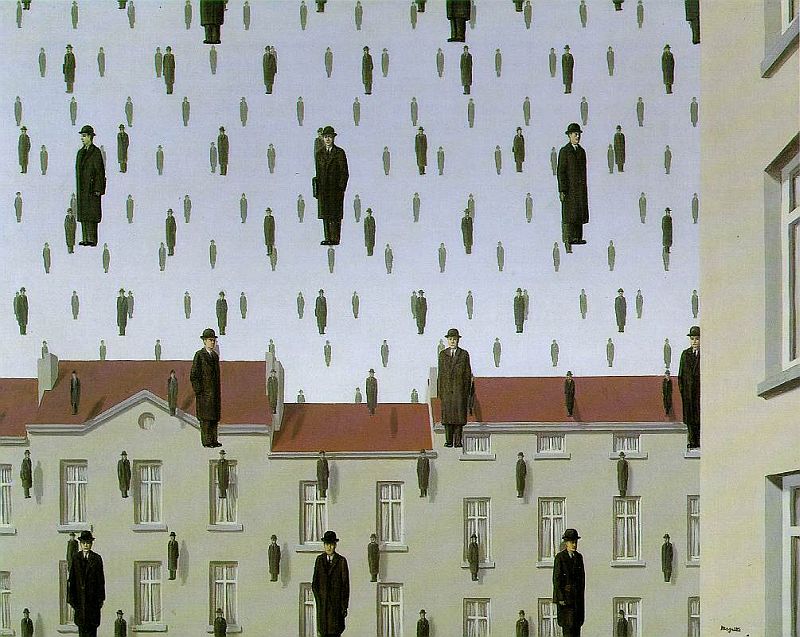


René Magritte
"Golconda", óleo sobre lienzo / oil on canvas, 100 x 81 cm., 1953. 
Menil Collection, Houston (Texas, Estados Unidos / USA)

Golconda es una de las pinturas más conocidas de Magritte, que presenta a los hombres con bombín lloviendo desde el cielo. Es uno de los mejores usos de la duplicación por parte de Magritte (ver En el mes de la vendimia), un proceso que comenzó en 1926 con varias imágenes especulares (ver Foolhardy). La duplicación no es exacta, lo que lo hace más real, y el uso de la perspectiva crea una ilusión perfecta.
Magritte tomó el nombre para esta pintura de su poeta y amigo Louis Scutenaire, quien a veces le ayudaba con los nombres para sus cuadros. En este caso, Golconda refiere a una ciudad de la India, que fue asentamiento de dos reinos diferentes entre los siglos XIV y XVII. La riqueza de la región, ya que era el centro de la industria del diamante, se ha hecho tan legendaria que el nombre es hoy en día sinónimo de "mina de riqueza."

Golconda is one of Magrite's best known paintings featuring the bowler hatted men raining from the sky. Is one of Magritte's best uses of duplication (see also The Month of the Grape Harvest), a process he began in 1926 with several mirror images (see: Foolhardy). The duplication is not exact making it more real, and his use of perspective creates the perfect illusion.
Magritte got the name for this painting from his poet friend Louis Scutenaire, who often helped him find names for his paintings. In this case, the name Golconda refers to a city in India, which was the seat for two different kingdoms from the 14th to 17th centuries. The richness of the region, as it was the center of the diamond industry, has become so legendary that the name is now synonymous with “mine of wealth.”

René Magritte en "El Hurgador" / in this blog: [Todos los enlaces / All links]


Johannes Vermeer
"Het meisje met de parel / La joven de la perla / Girl with a Pearl Earring"
Óleo sobre lienzo / oil on canvas, 46,5 × 40 cm., c.1665
Royal Picture Gallery Mauritshuis (La Haya, Holanda / Netherlands)

La imagen es un "tronie", descripción que se hacía en Holanda en el siglo XVII a los retratos solo de una "cabeza", que no tenía intención de ser un retrato. Tras la más reciente restauración de 1994, el sutil esquema de color y la íntima mirada fija de la chica hacia el espectador se han realzado mucho. Durante la restauración, se descubrió que el fondo oscuro, hoy algo moteado, pretendió ser un profundo verde como esmaltado. Este efecto se producía aplicando una fina capa transparente (veladura) sobre el fondo negro que tenemos hoy. Sin embargo, los dos pigmentos orgánicos de la veladura verde: índigo y amarillo indio, se han desvanecido.

The image is a tronie, the Dutch 17th-century description of a ‘head’ that was not meant to be a portrait. After the most recent restoration of the painting in 1994, the subtle color scheme and the intimacy of the girl’s gaze toward the viewer have been greatly enhanced. During the restoration, it was discovered that the dark background, today somewhat mottled, was initially intended by the painter to be a deep enamel-like green. This effect was produced by applying a thin transparent layer of paint, called a glaze, over the present-day black background. However, the two organic pigments of the green glaze, indigo and weld, have faded.

Johannes Vermeer en "El Hurgador" / in this blog: [Todos los enlaces / All links]

lunes, 18 de agosto de 2014

Rinocerontes (LIV)

Tony Fredriksson


Tony Fredriksson es un artista nacido en Harare, Zimbabwe, que comenzó a hacer esculturas con madera arrastrada por las aguas en 2007. Su primera muestra en solitario presentaba un pez con un guerrero Tambooti Masaai, en préstamo de un cliente. Recibió un encargo para hacer una escultura de una chica desnuda, con este tipo de madera, para la Galería White River.

"Rinoceronte blanco / White Rhino", madera flotante / driftwood

Las esculturas de peces llamaron la atención de una cadena de hoteles de las Seychelles que compraron su tiburón de madera exponiendo todos sus órganos internos, y un celacanto de 3 metros. Recibió un encargo de Seasons in Africa para hacer un esqueleto de ballena a tamaño natural en las islas Desroches, utilizando madera flotante depositada en la playa. La escultura de 13 metros le insumió 5 semanas de trabajo.
2011 fue el año de las aves, y 2012 el de los mamíferos y objetos mecánicos.

"Rinoceronte blanco / White Rhino", madera flotante / driftwood

Tony ha realizado numerosas esculturas de bronce para Leopard Creek, Nelspruit Golf club, Penryn College así como una colección de mamíferos sudafricanos que vendió cerca de 7000 ediciones limitadas por todo el mundo.

"Rinoceronte negro / Black Rhino", madera flotante / driftwood

Tony Fredriksson is an artist born in Harare, Zimbabwe, started doing driftwood sculptures 2007. His first solo exhibition featured fish with a Tambooti Masaai warrior which was on loan from a client. He was commissioned to do a nude driftwood sculpture of a female figure for the White River Gallery.

Tony trabajando / Tony at work

"Rinoceronte negro en la tienda / Black Rhino in Shop", madera flotante / driftwood

The game fish sculptures got the attention of a hotel group in the Seychelles who purchased his driftwood shark which displayed all the internal organs and a 3 meter Coelacanth. He was commissioned by Seasons in Africa to make a life size whale skeleton on the Desroches Island using driftwood found on the beach, the 13 meter sculpture took five weeks to complete.
2011 was the year for birds and in 2012 featured mammals and mechanical objects.

"Rinoceronte / Rhino", madera flotante / driftwood
Donado por Tony para "Arte contra la caza furtiva del rinoceronte". Lo recaudado fue donado a WESSA / 
The Rhino Tony donated to Art Against Rhino Poaching. Funds will be donated to WESSA.


Tony has made numerous bronze sculptures for Leopard Creek, Nelspruit Golf club, Penryn College as well as a collection of mammals of South Africa which sold close to 7000 limited editions that went all over the world. These were cast in marble and hand painted.

Tony Fredriksson en "El Hurgador" / in this blog: [Tony Fredriksson (Escultura)]

Más sobre Tony en / More about Tony in: Website, Facebook, South African Country Life


Xavier Cortada

101º E, Rinoceronte de Sumatra / Sumatran Rhinoceros, "Dicerorhinos Sumatrensis"

Xavier Cortada es un pintor estadounidense nacido en 1964 en Albany, Nueva York, que actualmente reside en Miami, Florida. Su obra se ha exhibido en museos, galerías y eventos culturales en las Américas, Europa y África.

Cortada ha creado instalaciones artísticas en los polos terrestres para concienciar acerca del cambio climático global. En 2007 utilizó la placa de hielo que se mueve bajo el Polo Sur como un instrumento para marcar el tiempo. La obra de arte se completó en 150.000 años. En 2008 plantó una bandera verde en el Polo Norte, reclamándolo para la naturaleza, y al hacerlo lanzó un esfuerzo eco-artístico mundial para la reforestación.

108º E, Rinoceronte Java / Javan Rhinoceros, "Rhinoceros Sondaicus"

Los rinocerontes pertenecen a la serie Mundo Amenazado: dibujos del Hemisferio Oriental, 180 dibujos a grafito sobre papel, cada uno 9" x 12", 2009 / 
The rhinos are part of the series Endangered World: Eastern Hemisphere drawings, 180 graphite drawings on paper, each 9″ x 12″. 2009

15º E, Rinoceronte negro / Black Rhinoceros, "Diceros Bicornis"
"Rinoceronte negro, 15º E / Black Rhino, 15 degrees E"

Xavier Cortada is an American painter born 1964 in Albany, New York, who now resides in Miami, Florida. His work has been exhibited in museums, galleries and cultural venues across the Americas, Europe, and Africa.

Cortada has created art installations in the Earth's poles to generate awareness about global climate change: in 2007 he used the moving ice sheet beneath the South Pole as an instrument to mark time; the art piece will be completed in 150,000 years. In 2008 Cortada planted a green flag at the North Pole to reclaim it for nature and in so doing launch a global reforestation eco-art effort.

88º E, Rinoceronte indio / Indian Rhinoceros, "Rhinoceros Unicornis"

Más sobre Xavier Cortada en / More about Xavier Cortada in: Website, Facebook, Wikipedia


Christiane Klatt

Christiane Klatt. Foto / Photo: Bert Loewenherz

Christiane Klatt es una artista alemana nacida en 1973. Residente en Berlín, presentó en 2011 su muestra "Salvaje" en la Galerie Cubus-M.
Christiane construyó una serie de rinocerontes de caucho, pero con agujeros estratégicamente situados que revelan un esqueleto de acero interior.
Debido a la vulnerabilidad de la armadura, Klatt nos descubre fragilidad inherente de sus criaturas, a pesar de su exterior fuerte y masivo.


Exposición / Exhibition "Salvaje / Wild", Foto / Photo © cubus-m

Christiane Klatt is a German artist born in 1973 based in Berlin. She presented in 2011 his show "Wild" at Galerie Cubus-M. 
Christiane built a series of rubber rhinoceros, but with strategically placed holes that reveal an inner steel skeleton. 
Due to the vulnerability of armor, Klatt reveals inherent fragility of his creatures, despite their exterior strength and bulk. 

Christiane Klatt. Foto / Photo: Bert Loewenherz

Exposición / Exhibition "Salvaje / Wild", Foto / Photo © cubus-m

No hay mucha información sobre Christiane / Not much information about Christiane...


Antonio Guerrero


Antonio Guerrero es un artista cubano-estadounidense nacido en Matanzas, Cuba, en 1968, bajo el gobierno de Castro.
Se crió en un ambiente en el que la expresión artística era apreciada y estimulada; aunque los materiales no siempre estaban disponibles, sus sueños e ideas siempre abundaban.
En 1968 fue reclutado por el ejércido e inmediatamente transportado a África para luchar en la Guerra de Etiopía. Recibió inspiración de la gente y escenas de África, y desarrolló su interés en el expresionismo moderno, comenzando a experimentar con formas modernas de arte visual. La popularidad de su obra le llevó a exponer sus pinturas en la base militar.
Antonio regresó a Cuba en 1988, donde continuó con su trabajo como artesano especializado en pintura, grabados en madera, escultura y trabajo en metal. 
Sintiéndose oprimido por el gobierno cubano, e infeliz con sus malas condiciones de vida, Antonio, junto con otros dos hombres, se subieron a una balsa que habían diseñado y construído secretamente. Flotando desde las costas de Matanzas, se echaron al mar durante cinco días hasta ser rescatados y llevados a Estados Unidos.

"El rinoceronte blanco / The White Rhino" 
Técnica mixta sobre lienzo / mixed media on canvas, 82,5" x 102" © 2011 Antonio Guerrero

Antonio Guerrero is a contemporary Cuban American Artist. He was born in 1968 in Matanzas Cuba, under the Castro regime. 
Guerrero grew up in a household where artistic expression was appreciated and encouraged; although materials were not always available, his dreams and ideas were always abundant.
In 1986 Antonio was drafted into the army and was immediately transported to Africa to fight in the Ethiopian War. He was inspired by the people and scenes of Africa and he developed an interest in modern expressionism and began to experiment with modern forms of visual art. The popularity of his work led to exhibits of his paintings at the military based  
Antonio returned to Cuba in 1988 where he resumed his job as an artisan specializing in painting, engraving wood carving, sculpting and metal work. Feeling increasingly oppressed by Cuba's government, and unhappy with the worsening living conditions, Antonio, along with two other men, climbed into a raft they had secretly designed and built. Floating off from the coast of Matanzas, they were at sea for five days before being rescued and brought to the U.S.

"El último rinoceronte / The Last Rhino"
Técnica mixta sobre lienzo / mixed media on canvas, 23" x 29" © 2012 Colección privada / Private Collection

Más sobre Antonio Guerrero en / More about Antonio Guerrero in: Website, Facebook


Los pintores Tingatinga / The Tingatinga painters

Adeusi
"Rinoceronte / Rhino", 60 x 60 cm. Foto / Photo © Svend Erik Sokkelund

A fines de la década de 1960, un hombre muy pobre de Tanzania comprendió que a los turistas y expatriados locales les gustaba comprar souvenirs de sus viajes para llevar de vuelta a casa, así que comenzó a producir pinturas de animales para vender. Su nombre era Edward Saidi Tingatinga, y por aquél entonces no sabía que esto sería el principio de un estilo de pintura único en África, que terminó por llevar su nombre, y que continúa hoy en día.
E. S. Tingatinga pintaba diseño sencillos de animales africanos, aves en la sabana o escenas de la vida en las aldeas. Pragmáticamente, utilizaba los materiales que tenía a mano: pintura en esmalte sobre paneles, creando su propia expresión distintiva en un estilo naïf, colorido y con superficies brillantes.
E. S. Tingatinga murió por una bala perdida en 1972, pero su estilo único de pintura se ha mantenido y desarrollado durante los últimos 40 años. La nueva generación de artistas Tingatinga continuaron pintando con esmalte, pero cambiaron los paneles por lienzos y añadieron diseños nuevos, audaces y humorísticos, y composiciones detalladas.

Lewis
"Vida salvaje / Wildlife", 60 x 60 cm. cada uno / each


Mbuka
"Kilimanjaro Safari", 75 x 75 cm.

In the late 1960s an impoverished Tanzanian man realised that tourists and local ex-pats liked buying souvenirs from their trip to bring back home, and so he started producing paintings of animals to sell. His name was Edward Saidi Tingatinga, and at the time he did not know that this would be the beginnings of a unique African paining style, which has come to bear his name, and which continues to this day.
E. S. Tingatinga painted simple designs of African animals, birds on the savannah or situations from village life. Pragmatically, he used the materials at hand; enamel paint on hard board - creating his own distinctive expression of naive, colourful designs with glossy surface.
E. S. Tingatinga died from a stray bullet in 1972, but the unique painting style has been maintained and developed over the past forty years. The new generation of Tingatinga artists continued to paint with enamel paints, but have swapped hard board for canvas and added new, bold, colourful and humorous designs and detailed compositions.

Mteko
"Estampida / Animals Running", pintura sobre lienzo / paint on canvas, 60 x 60 cm., 2011
 _________________________________________________________________________

Omari Amonde


Omary Amonde nació en 1940 en el poblado de Nakapanya, distrito de Tunduru, región de Rovuma (Tanzania). Se fue a Tanga en 1957 para trabajar en una finca de sisal, y en 1960 se mudó a Dar es Salaam por primera vez buscando trabajo. En 1972 se estableció definitivamente en la capital.
Omary Amonde es "medio hermano" de E. S. Tingatinga, y el más viejo de los pintores Tingatinga aún en activo. Trabajó con E.S. Tingatinga en 1972 hasta la muerte de éste. Amonde está considerado como el último y más legítimo heredero del legado de Tingatinga, y actualmente es el presidente de la TACS (Sociedad Artística Cooperativa Tingatinga)

"Rinoceronte, ave y mariposa / Rhino, Bird and Butterfly"

Omary Amonde was born in 1940 in the village of Nakapanya, Tunduru district, Rovuma Region. He went to Tanga in 1957 to work on a sisal estate and in 1960 he came to Dar es Salaam for the first time looking for work. In 1972 Omari Amonde definitely settles in the capital.
Omary Amonde is "half brother" of E.S. Tingatinga and the oldest of all Tingatinga painters still active. He worked with E.S. Tingatinga in 1972 until Tingatinga's death. Amonde is considered as the very last legitimate heir of Tingatinga's heritage and his currently Chairman of the TACS.

"Rinoceronte, ave y mariposa / Rhino, Bird and Butterfly" (pieza y detalle / piece and detail)
Esmalte oleoso sobre lienzo / oil enamel on canvas, 60 x 50 cm., c.2010


Más sobre Tingatinga en / More about Tingatinga in: Wikipedia, Tinga Tinga.org, Tinga Tinga.info


Sophie Standing

"Rinoceronte negro / Black Rhino", 160 x 90 cm.

Sophie Standing es una artista del bordado textil, de quien publiqué una selección de obras el mes pasado. Ella crea hermosos collages utilizando como tema principal la fauna salvaje africana. Me remito al citado post para más información e imágenes. Ahora, sus espléndidos rinocerontes bordados y dibujos.

"Rinoceronte negro / Black Rhino" (detalle / detail)

"Rinoceronte negro / Black Rhino" (dibujo / drawing)

"Dos rinocerontes / Two Rhinos"

"Dos rinocerontes / Two Rhinos" (detalle / detail)

Sophie Standing is a textile embroidery artist, whom I published a selection of works last month. She creates beautiful collages using as main theme African wildlife. I refer to that post for more information and pictures. Now, her splendid embroidered rhinos and drawings.

"Rinoceronte negro / Black Rhino"

"Rinoceronte negro / Black Rhino" (detalle / detail)

"Rinoceronte negro / Black Rhino" (detalle / detail)

"Rinoceronte negro / Black Rhino" (dibujo / drawing)

Sophie Standing en "El Hurgador" / in this blog: [Sophie Standing (Collages textiles)], [Rinocerontes (LXIV)]

Más sobre Sophie en / More about Sophie in: Website, Tumblr, Facebook
______________________________________________________________________

Gracias, como siempre, a la infatigable Shirley Rebuffo, a estas alturas ya una consumada pescadora de rinocerontes mientras navega en las procelosas aguas de la red. A ella le debemos el descubrimiento de varios de estos ejemplares.

Thanks, as always, to the indefatigable Shirley Rebuffo, now already an accomplished fisherwoman of rhinos while navigating the stormy waters of the Net. To her we owe the discovery of a number of these specimens.