Textos en inglés al final del post / English translation at the end of this post.
Todos los aniversarios de Septiembre aquí / All anniversaries for Septemberhere.
Yasuo Kuniyoshi (国吉康雄), pintor, fotógrafo y grabador estadounidense nacido en Okayama, Japón, en 1893.
Emigró a los Estados Unidos en 1906, la elección de no asistir a la escuela militar en Japón. Kuniyoshi originalmente la intención de estudiar Inglés y regresar a Japón para trabajar como traductor.
Pasó algún tiempo en Seattle, antes de inscribirse en la Escuela de Los Ángeles de Arte y Diseño. Kuniyoshi pasó tres años en Los Ángeles, el descubrimiento de su amor por las artes. Luego se trasladó a la ciudad de Nueva York para seguir una carrera artística. Kuniyoshi estudió brevemente en la Academia Nacional y en la Escuela Independiente en la ciudad de Nueva York, y luego estudió con Kenneth Hayes Miller en el Art Students League de Nueva York.
Papeles de Yasuo Kuniyoshi, Archivos de arte estadounidense /
Yasuo Kuniyoshi papers, Archives of American Art, Smithsonian Institution.
Más tarde enseñó en la Art Students League de Nueva York en la ciudad de Nueva York y en Woodstock, Nueva York. Nan Lurie fue uno de sus alumnos. Alrededor de 1930, el artista construyó una casa y estudio en Ohayo Mountain Road en Woodstock. Él era un miembro activo de la comunidad artística allí por el resto de su vida.
"Grupo de siete artistas en una fiesta en casa de Yasuo Kuniyoshi /
Group of seven artists at a party at the home of Yasuo Kuniyoshi", alrededor de / about, 1921
Los artistas fotografiados son / Pictured are Peggy Bacon, Alexander Brook, Isabella Howland, Katherine Schmidt, Betty Spencer, Niles Spencer & Dorothy Varian
Yasuo Kuniyoshi en "El Hurgador" / in this blog: [Recolección (LXI)]
El 2 de Septiembre es el cumple de
Lisa Kristine, fotógrafa humanitaria estadounidense nacida en 1965. Su fotografía, a lo largo de una carrera de 30 años, ha documentado las culturas indígenas y causas sociales, como la esclavitud moderna, en más de 100 países.
"Naranja / Orange", India
Empezó su aprendizaje de la fotografía a los 11 años, y comenzó a viajar a nivel internacional en la década de 1980. Ha visitado docenas de países en seis continentes, viajando con un traductor y obteniendo el permiso de todas las personas que fotografía. Se ha centrado en temas relacionados con los derechos humanos.
En 2009 colaboró con Free the Slaves (Liberen a los esclavos). Ha recibido atención global para sacar a la luz la esclavitud contemporánea a través de plataformas de medios, incluyendo la CNN y Atlántico, ha hablado en eventos TED, museos, ONGs, conferencias empresariales, colegios y universidades.
"Cuentas para rezar / Praying Beads", Bhutan
Lisa fue la ganadora del Premio Humanitario Lucie en 2013. Su trabajo ha sido respaldado por el arzobispo Desmond Tutu, la Reina Madre de Bután y Amnistía Internacional.
Ha publicado cinco libros y ha sido objeto de cuatro documentales.
Marcel Bovis, fotógrafo francés nacido en 1904, notable por sus fotografías de París.
Bovis estudió en la Escuela Nacional de Artes Decorativas en Niza y, posteriormente, llegó a París para trabajar como decorador.
"Quai du Louvre garçon en train de pêcher / chico pescando / Boy in Fishing", 1946
Se inició en la fotografía de manera autodidacta y empezó a producir fotos de París, en su mayor parte por la noche, desde 1927, y después de 1936 se convirtió en fotógrafo profesional. Ese mismo año tuvo su primera exposición personal en París. Esta exposición especial, que se celebró en el Pavillon de Marsan, era una colección de fotos que tomó junto con Pierre Mac Orlan.
"La queue pour le bus / La cola del autobús / The Queue for the Bus", Londres / London, 1947
En ellas se reproducen las celebraciones de festivales y circos famosos con una simpatía humanista. En 1946 se convirtió en uno de los miembros fundadores de la Le Groupe des XV, una asociación de fotógrafos franceses, y en 1952 exhibió su obra en la Exposición Mundial de la fotografía en Lucerna.
"Paris la nuit, Brasserie Dupont / París por la noche, Cervecería Dupont /
Paris Night, Dupont Brewery", 1950
Hoy, 4 de Septiembre, es el cumple de
Baron George Hoyningen-Huene, fotógrafo de moda seminal nacido en San Petersburgo, Rusia, en 1900. Pasó su vida laboral en Francia, Inglaterra y los Estados Unidos.
Durante la revolución rusa, los Hoyningen-Huene huyeron primero a Londres, y más tarde a París. En 1925 George ya había escalado por mérito propio hasta jefe de fotografía del Vogue francés. En 1931 conoció a Horst, el futuro fotógrafo, que se convirtió en su amante y modelo frecuente y viajó a Inglaterra con él aquel invierno. Una vez allí visitaron el fotógrafo Cecil Beaton, que trabajaba para la edición británica de la revista Vogue. En 1931, Horst comenzó su asociación con Vogue, publicando su primera fotografía en la edición francesa de la revista en noviembre de ese año.
"Nadadores / Divers", Paris, 1930
En 1935 Hoyningen-Huene se trasladó a la ciudad de Nueva York, donde hizo la mayor parte de su trabajo para Harper's Bazaar. Publicó dos libros de arte sobre Grecia y Egipto antes de trasladarse a Hollywood, donde se ganó la vida haciendo retratos de glamour para la industria cinematográfica.
Trabajó en grandes estudios. Más allá de la moda, fue un magistral retratista, tanto de las estrellas de Hollywood como de otras celebridades.
También trabajó en Hollywood en varios estamentos de la industria cinematográfica, en estrecha colaboración con George Cukor, asesor visual y de color, en particular en lo especial para la película de 1954 "Ha nacido una estrella", con Judy Garland como protagonista. Desempeñó un papel similar en la la película "Les Girls", de 1957, protagonizada por Kay Kendall y Mitzi Gaynor, "El pistolero de Cheyenne" con Sophia Loren y "El informe Chapman".
Yasuo Kuniyoshi (国吉康雄), American painter, photographer and printmaker born in Okayama, Japan, in 1893.
He migrated to America in 1906, choosing not to attend military school in Japan. Kuniyoshi originally intended to study English and return to Japan to work as a translator. He spent some time in Seattle, before enrolling at the Los Angeles School of Art and Design. Kuniyoshi spent three years in Los Angeles, discovering his love for the arts. He then moved to New York City to pursue an art career. Kuniyoshi studied briefly at the National Academy and at the Independent School in New York City, and then studied under Kenneth Hayes Miller at the Art Students League of New York. He later taught at the Art Students League of New York in New York City and in Woodstock, New York. Nan Lurie was among his students. Around 1930, the artist built a home and studio on Ohayo Mountain Road in Woodstock. He was an active member of the artistic community there for the rest of his life.
Lisa Kristine, American humanitarian photographer born in 1965. Her photography over a 30-year career has documented indigenous cultures and social causes, such as modern slavery, in more than 100 countries.
She began learning photography at the age of 11, and began travelling internationally in the early 1980s. She has since visited dozens of countries on six continents; she travels with a translator and secures permission from every person she photographs. She has focused on topics related to human rights.
In 2009, Kristine collaborated with Free the Slaves. She has received global attention for shining a light on contemporary slavery across media platforms, including CNN and The Atlantic, speaking at TED events, museums, NGO's, business conferences, colleges and universities.
Lisa was the recipient of the 2013 Lucie Humanitarian Award. Kristine's work has been endorsed by Archbishop Desmond Tutu, the Queen Mother of Bhutan, and Amnesty International.
She has published five books and has been the subject of four documentaries.
Marcel Bovis, French photographer born in 1904, most notable for his photographs of Paris.
Bovis studied at the National School of Decorative Arts in Nice and subsequently arrived to Paris to work as decorator. He self-taught photography and started to produce photos of Paris, predominantly at night, since 1927, and after 1936, he became a professional photographer. In the same year, he had the first personal exhibition in Paris. This particular exhibition, which was held in Pavillon de Marsan, was a collection of photos he took together with Pierre Mac Orlan. It records the celebrations of festivals and famous circuses with a humanist sympathy. In 1946 he became one of the founding members of the Le Groupe des XV, an association of French photographers, and in 1952, he exhibited at the World Exhibition of Photography in Lucerne.
Baron George Hoyningen-Huene, seminal fashion photographer born in Saint Petersburg, Russia, in 1900. He spent his working life in France, England and the United States.
During the Russian Revolution, the Hoyningen-Huenes fled to first London, and later Paris. By 1925 George had already worked his way up to chief of photography of the French Vogue. In 1931 he met Horst, the future photographer, who became his lover and frequent model and traveled to England with him that winter. While there, they visited photographer Cecil Beaton, who was working for the British edition of Vogue. In 1931, Horst began his association with Vogue, publishing his first photograph in the French edition of Vogue in November of that year.
In 1935 Hoyningen-Huene moved to New York City where he did most of his work for Harper's Bazaar. He published two art books on Greece and Egypt before relocating to Hollywood, where he earned a living by shooting glamorous portraits for the film industry.
He worked in huge studios. Beyond fashion, he was a master portraitist as well from Hollywood stars to other celebrities.
He also worked in Hollywood in various capacities in the film industry, working closely with George Cukor, notably as special visual and color consultant for the 1954 Judy Garland movie A Star Is Born. He served a similar role for the 1957 film Les Girls, which starred Kay Kendall and Mitzi Gaynor, the Sophia Loren film Heller in Pink Tights and The Chapman Report.
Textos en inglés al final del post / English translation at the end of this post.
Todos los aniversarios de Septiembre aquí / All anniversaries for September here.
Taddeo Zuccari o Zuccaro, pintor italiano nacido en 1529, uno de los miembros más populares de la escuela manierista romana.
Zuccari se trasladó a Roma a los 14 años, y consiguió, a una edad temprana, obtener conocimientos en pintura y patronos que lo emplearan.
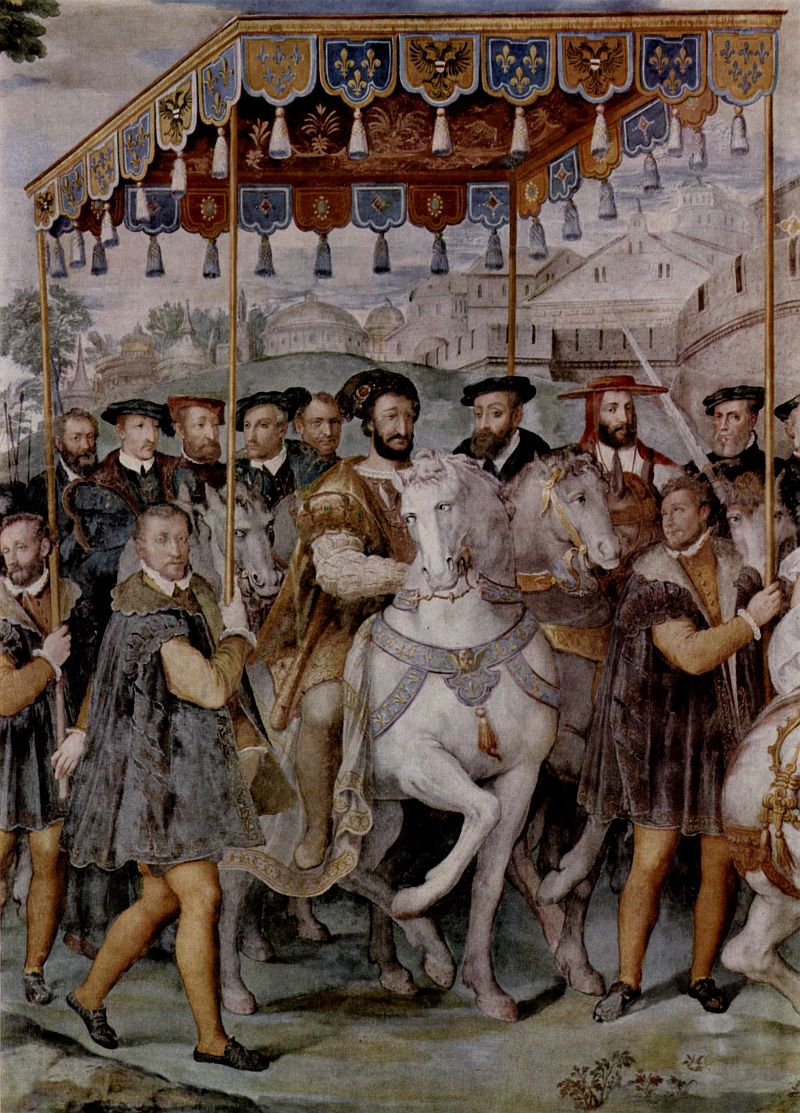
"La entrada solemne del Emperador Carlos V, Francisco I de Francia
y el Cardenal Alejandro Farnesio en París en 1540 /
The Solemn Entrance of Emperor Charles V, Francis I of France, and of Alessandro Cardinal Farnese into Paris in 1540"
Fresco, c.1559. Palazzo Farnese (Caprarola, Lazio, Italia / Italy)
Cuando tenía diecisiete años un alumno de Correggio, Daniel de Parma, lo contrató para ayudarle a pintar una serie de frescos en una capilla en Vitto cerca de Sora, en las fronteras de los Abruzos (no corroborado por Freedberg). Zuccari volvió a Roma en 1548 y comenzó su carrera como pintor de frescos, mediante la ejecución de una serie de escenas en blanco y negro de la vida de Marco Furio Camilo en el frente del palacio de un romano rico llamado Jacopo Mattei. A partir de ese momento se aseguró el éxito, y fue empleado por los papas Julio III y Pablo IV, por el della Rovere Duque de Urbino y por otros clientes ricos.
"Lucas el Evangelista / Luke the Evangelist"
Dibujo a pluma en aguada marrón oscura, complementado con tiza blanca y negra sobre papel azulado /
washed pen drawing in dark brown, complemented with white and black chalk on bluish paper
364 × 257 cm., c.1555
Museo de Arte (Olomouc República Checa / Czech Republic)
El dibujo es un boceto para el fresco en una pechina de la capilla de San Mateo de la iglesia de Santa Maria della Consolazione en Roma /
The drawing is a sketch for the fresco in a pendetive of St. Matthews Chapel of the Santa Maria della Consolazione Church in Rome.
Sus mejores frescos fueron una serie histórica pintada en las paredes y el techo de la Villa Farnese en Caprarola, construida para el cardenal Alessandro Farnese, para la cual Zuccari también diseñó una gran cantidad de ricas decoraciones en relieve de estuco al estilo de Giulio Romano y otra alumnos de Raphael. También pintó Historias de Alejandro en el Castello Orsini en Bracciano.
Óleo sobre lienzo / oil on canvas, 67 × 64 cm., 1913. Galería Tretyakov (Moscú, Rusia / Moscow, Russia)
Desde 1891 hasta 1894 estudió en la Escuela de Schneider en Kharkov. Entre 1894-1899 fue estudiante en la Academia de San Petersburgo. Fue a Múnich para estudiar en la escuela de Anton Ažbe, permaneciendo allí desde 1899 hasta 1900, año en que se casó con el pintor Dmitry Kardovsky.
"Маленькая женщина (Портрет дочери Екатерины, Катя Кардовская) /
Mujercita (retrato de la hija de la artista, Katia Kardovsky
Little Woman (portrait of the artist's daughter, Katia Kardovsky)", 1910
Museo Estatal Ruso (San Petersburgo, Rusia / St. Petersbourg, Russia)
Entre 1903 y 1917 expuso con la Nueva Sociedad de Artistas. A partir de 1911 y hasta 1916 también exhibió con la Unión de Artistas Rusos. Estuvo asociada con el grupo Zhar-Tsvet entre 1924 a 1928. Fue incluida en una gran exposición de 1927 en Moscú para conmemorar el décimo aniversario de la revolución rusa.
"Портрет Николая Гумилева / Retrato de / Portrait of Nikolay Gumilev", 1909
Galería Tretyakov (Moscú, Rusia / Moscow, Russia)
Della-vos-Kardovskaya en "El Hurgador" / in this blog: [Recolección (XXIII)]
Hoy, 3 de Septiembre, es el cumple de
Bengt Karl Erik Lindström, artista sueco nacido en 1925. Lindström fue uno de los más conocidos artistas contemporáneos suecos, con un estilo característico de colores inconfundibles, que a menudo incluía rostros contorsionados.
"Bajo la mirada de un dios / Under the Glance of a God", acrílico / acrylic, 146 x 114 cm., 1985
Lindström nació en 1925 en Storsjö kapell, Härjedalen, Suecia. En 1944 se marchó a Estocolmo a estudiar bajo la dirección del sueco Isaac Grünewald. En 1948 se trasladó a Paris, donde estudió con los franceses André Lhote y Fernand Léger. Permaneció en Francia, concretamente en Savigny sur Orge, durante el resto de su carrera artística. Fue padre de dos hijos, Alexandre y Marianne.
"Kerstin", acrílico / acrylic, 146 x 114 cm., 1985
Lindström es probablemente más popular por sus intervenciones en espacios abiertos, tales como pinturas murales y esculturas megalíticas. Una de sus más famosas esculturas es la Escultura-Y ubicada en el aeropuerto Midlanda al norte de Sundsvall, Suecia.
Taddeo Zuccari or Zuccaro, Italian painter born in 1529, one of the most popular members of the Roman mannerist school.
Zuccari moved to Rome by age 14, and he succeeded at an early age in gaining a knowledge of painting and in finding patrons to employ him. When he was seventeen a pupil of Correggio, named Daniele da Parma, engaged him to assist in painting a series of frescoes in a chapel at Vitto near Sora, on the borders of the Abruzzi (not corroborated by Freedberg). Zuccari returned to Rome in 1548, and began his career as a fresco painter, by executing a series of scenes in monochrome from the life of Marcus Furius Camillus on the front of the palace of a wealthy Roman named Jacopo Mattei. From that time his success was assured, and he was largely employed by the popes Julius III and Paul IV, by the della Rovere duke of Urbino, and by other rich patrons.
His best frescoes were a historical series in quadro reportati painted on the walls and ceiling of Villa Farnese at Caprarola, built for Cardinal Alessandro Farnese, for which Zuccari also designed a great quantity of rich decorations in stucco relief after the style of Giulio Romano and other pupils of Raphael. He also painted Histories of Alexander in the Castello Orsini at Bracciano.
Olga Lyudvigovna Della-Vos-Kardovskaya (Ольга Людвиговна Делла-Вос Кардовская), Russian painter and graphic artist born in 1875.
From 1891 until 1894 she studied at the Schneider School in Kharkov; from 1894 to 1899 she was a student at the Academy in Saint Petersburg. She went to Munich to study at Anton Ažbe's school, staying there from 1899 to 1900. In 1900 she married painter Dmitry Kardovsky.
Between 1903 and 1917 she exhibited with the New Society of Artists; from 1911 until 1916 she also exhibited with the Union of Russian Artists. She was associated with the Zhar-tsvet group from 1924 to 1928. She was included in a large 1927 exhibit in Moscow commemorating the tenth anniversary of the Russian Revolution.
Bengt Karl Erik Lindström, Swedish artist born in 1925. Lindström was one of Sweden's best known contemporary artists with a characteristic style of distinct colors, often including contorted faces.
Lindström was born in 1925 at Storsjö kapell, Härjedalen, Sweden. In 1944, he moved to Stockholm to study under the Swedish painter Isaac Grünewald. In 1948, he moved to Paris, where studied under the French painters André Lhote and Fernand Léger. He remained in France at Savigny sur Orge for the rest of his artistic career. He had two children Mariana and Alexandre.
Lindström is probably best known for his outdoor decorations, such as mural paintings and colorful sculptures. One of his most famous sculptures is the massive Y-sculpture at Midlanda Airport north of Sundsvall, Sweden.
En mayo de 2014 tuvimos oportunidad de visitar "Visiones de la Realidad", en el espacio de la Fundación Cajacanarias, en Tenerife, una exposición que presentaba una serie de obras de artistas españoles, centrada en el grupo conocido como los "Nuevos Realistas". Tal como expresa el texto de presentación: "Estos pintores anteponían en sus obras la temática de lo cotidiano, los momentos íntimos en espacios que reflejaban la austeridad y la dureza de la postguerra. Sus trabajos los han hecho herederos de la tradición española que iniciaron pintores como Zurbarán, Velázquez, Maíno o Sánchez Cotán. Estos pintores y escultores formados en la madrileña Escuela de San Fernando son Julio y Francisco López Hernández, María Moreno, Isabel Quintanilla, Esperanza Parada, Amalia Avia, a los que se suman Carmen Laffón, Cristóbal Toral y Eduardo Naranjo." De este último nos ocuparemos ahora. Eduardo Naranjo es un artista clave en la escena de la pintura figurativa española de las últimas décadas. Les presento una selección cronológica de obras, tan sólo una muestra de su amplia e interesantísima producción en la que invito a profundizar.
Texto en inglés al final del post, marcado con [*] en cada párrafo.
In May 2014 we visited "Visions of Reality" in the space of Cajacanarias Foundation in Tenerife, an exhibition presenting a series of works by Spanish artists, focusing on the group known as the "New Realists". As stated in the introductory text. "These painters put in front in his works the theme of everyday life, intimate moments in spaces that reflected the austerity and postwar harshness. Their works have made them heirs to the Spanish tradition that began painters as Zurbarán, Velázquez, Maíno or Sanchez Cotan. These painters and sculptors formed at the Madrid School of San Fernando are Julio and Francisco Lopez Hernandez, Maria Moreno, Isabel Quintanilla, Esperanza Parada, Amalia Avia, along with Carmen Laffon, Cristóbal Toral and Eduardo Naranjo." The latter is the theme of this post. Eduardo Naranjo is a key artist in the scene of the Spanish figurative painting in recent decades. I present a chronological selection of works, just a sample of his extensive and interesting production in which I invite you to deepen.
English text at the end of this post, marked with [*] in each pargraph.
Eduardo Naranjo es un reconocido pintor y grabador español nacido en 1944 en Monesterio, en la provincia de Badajoz, Extremadura.
En 1957 Eduardo Acosta (ver más abajo), después de ver los dibujos de Eduardo, animó a sus padres para que le permitieran estudiar arte en Sevilla. Tras un paso por la Escuela de Artes y Oficios, ingresó en la Escuela de Bellas Artes de Santa Isabel de Hungría, permaneciendo allí tan sólo un curso. Luego se trasladó a Madrid para continuar estudiando en la Escuela de San Fernando a partir de 1961. [1]
"Contemplación de la muñeca / Contemplation of the Doll", óleo sobre lienzo / oil on canvas, 85 x 68 cm., 1971
"Desnudo en la terraza / Nude at the Terrace", óleo sobre lienzo / oil on canvas, 85 x 68 cm., 1974
Principado de Asturias, Colección / Collection Pedro Masaveu
Su primera exposición individual tuvo lugar en las salas del Ateneo de Sevilla en 1962. Finalizada su carrera, en 1966, estudia grabado con Luis Alegre y Álvaro Paricio y pintura al fresco con Manuel López Villaseñor. Tras ejercer la docencia en la Escuela de Artes Aplicadas de Marqués de Cuba, a partir de 1971 pinta con gran intesidad, preocupado fundamentalmente por la luz, la materia y las texturas. En 1974 pinta dos cuadros altamente representativos de lo que será su evolución en lo sucesivo: “Traje de primera comunión con autorretrato” y “Desnudo en la terraza”. A partir de allí, décadas de un desarrollo sostenido en su obra, con innumerables exposiciones y reconocimientos tanto en España como en el extranjero. [2]
"Las manos de mi madre / The Hands of my Mother", lápiz sobre papel / pencil on paper, 35 x 29 cm., 1974
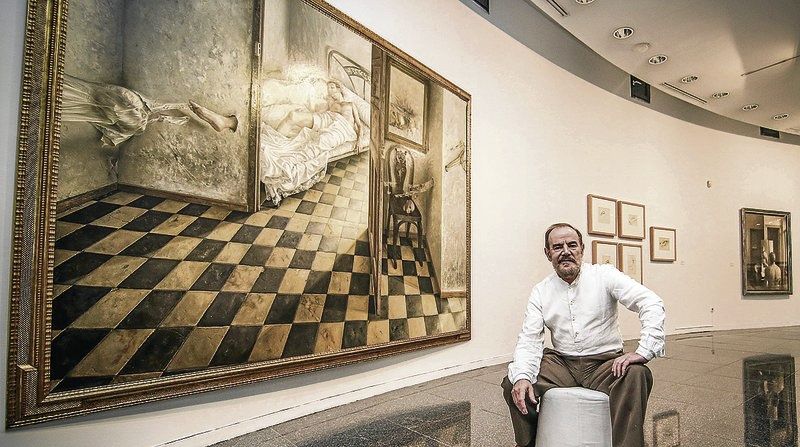
"El sueño con las musas / The Drean With The Muses", óleo sobre lienzo / oil on canvas, 225 x 300 cm., 1979.
Colección / Collection Museo Nacional Centro de Arte Reina Sofía (Madrid, España / Spain)
Eduardo frente a su obra "El sueño con las musas" / in front of his work "The Dream with the Muses"
Eduardo Naranjo es un hombre sencillo, familiar, cercano. Además del imprescindible silencio que acompaña la soledad del artista, a Eduardo le gusta la música clásica, el jazz, el flamenco. Le gusta viajar; ha viajado mucho, pero siempre le parece poco. Admira a todos los buenos artistas, todos aquellos que, por encima de las modas, saben expresar lo mejor de sí mismos. Eduardo hace arte por amor, con esa dosis de soberbia, defecto común a todos los artistas, que es a la vez un "arma de superación personal, sumamente válida aunque duela a veces a los demás y tienda a ser confundida." [3]
"Espacio para un recuerdo en tres fases / Space for a Memory in Three Phases"
Óleo sobre lienzo / oil on canvas, 189 x 172 cm., 1977
"La máscara del futuro sonríe / The Mask of the Future Smiles", técnica mixta / mixed media, 152 x 117 cm., 1978
Cuando se le pregunta sobre si su pintura puede calificarse de hiperrealista, Eduardo responde: "Yo daría más la razón a aquellos críticos teóricos que hablan de realismo onírico, fantástico y demás en mi obra, porque junto a ese realismo profundo y detallista que responde a mi estado de vigilia, también camina en paralelo dentro de mi obra el mundo de los sueños." [4]
"La escalera / The Stairs", óleo sobre tabla / oil on wood, 92 x 72 cm., 1980
"Las botas y la máscara / The Boots and the Mask", óleo sobre lienzo / oil on canvas, 66 x 51 cm., 1980
«Amo el dibujo, igual, imagino, que le ocurrió antes a Durero, Rubens, Goya, Fortuny,… Por no decir a Miguel Angel o Picasso. Pero reconozco que hoy es distinto, ha cambiado. No se necesita saber dibujar para hacer una instalación u obra digital. Y no obstante, mantengo que es el dibujo el alma que da forma a todo cuanto sale de las manos del artista: Dios nos dibujó, y se nota. Como se nota entre los artistas, sea cual sea su estilo o tendencia, quién dibuja y quien no.» [5]
"Desnudo de una mujer en un espejo / Nude of a Woman on a Mirror"
Óleo sobre lienzo / oil on canvas, 82 x 61 cm., 1982
"La creación de Adán / Creation of Adam"
Barniz blando y punta seca, una plancha / soft varnish and drypoint, one plate, 35,2 x 27,6 cm., 1984
«Hay que aprender a dibujar para después desdibujar. Es una frase rotunda. Hay que saber mucho para después olvidarlo e ir a lo esencial. Esos moldes académicos después los rompes tú mismo. Yo pienso que el auténtico pintor, escultor o arquitecto, en el fondo no deja de ser, aunque haya estudiado mucho, un autodidacta. (...) Ese autodidacta que llevamos dentro es el auténtico, el que te hace verdaderamente investigar. De nada sirve que tú pintes muy bien si no dices nada.» [6]
"Adán, Eva y el mar / Adam, Eve and the Sea"
Aguatinta, barniz blanco y punta seca / aquatint, white varnish and drypoint, 35,4 x 27,8 cm., 1985
"Retrato de un joven de los años veinte / Portrait of a Young Man of the Twenties"
Grafito sobre tabla preparada / graphite on prepared wood, 123 x 91 cm., 1985
«La inspiración es esa cosa extraña que en el fondo es un estado de ánimo, a lo mejor una buena digestión que has hecho ese día, diríamos que tu mente está más lúcida, y esas cosas que no ves normalmente, de pronto se enciende esa lucecita y sí las ves. En cuanto a cómo descubro el tema y lo afronto, que también es una inspiración, en qué nos inspiramos, es en el vivir diario, la mínima cosa, el mínimo elemento te puede servir para darte una idea, para tener una visión sobre eso. El resto ya concierne a la imaginación, a la fantasía.» [7]
"Yo pintando en julio el cráneo de un perro / I Painting in July the Skull of a Dog"
Óleo sobre tabla / oil on wood, 122 x 92 cm., 1985-91. Museo de Nagasaki (Japón / Japan)
"Asesinado por el cielo (del poema 'Vuelta de paseo')"
Uno de los trece grabados sobre el libro "Poeta en Nueva York", de Federico García Lorca
/ Murdered by the Sky (from the poem 'Back from a walk'),
One of the 13 engravings on the book "Poet in New York" by Federico García Lorca
Aguatinta y punta seca, dos planchas / aquatint and drypoint, two plates, 33,3 x 40,9 cm., 1987
Vuelta de paseo
de Federico Garcia Lorca
Asesinado por el cielo.
Entre las formas que van hacia la sierpe
y las formas que buscan el cristal,
dejaré crecer mis cabellos.
Con el arbol de muñones que no canta
y el niño con el blanco rostro de huevo.
Con los animalitos de cabeza rota
y el agua harapienta de los pies secos.
Con todo lo que tiene cansancio sordomudo
y mariposa ahogada en el tintero.
Tropezando con mi rostro distinto de cada día.
¡Asesinado por el cielo! [7b]
______________________________________
«Yo creo que todo arte nace en primer lugar de una emoción ante la vida, y esa emoción tú necesitas expresarla, de una forma que a tí te guste, que te lo pases bien, que veas que te sientes más grande a la hora de hacer eso. Ese es el ánimo que nos mueve prácticamente a todos. No a todos, también habrá quién persiga con esto simplemente salir en los periódicos, la televisión, los medios de información... armar ruido. Yo creo que el éxito mayor de un artista se tiene que ver reflejado en su obra, no en lo conocido que sea. Velázquez fue considerado durante siglos un simple fotógrafo de la corte, y hoy es la referencia mayor de todos.» [8]
"El ensueño / The Daydream", aguatinta y punta seca / aquatint and drypoint, 59,3 x 46,8 cm., 1987
"El sueño / The Sleep", aguatinta y punta seca / aquatint and drypoint, 59,3 x 46,8 cm., 1987
«La mayoría de mis obras, al verlas de nuevo, me siguen emocionando precisamente porque continúan hablándome de quien fui y sigo siendo, si bien ya distinto. No obstante, de haber de conceder primacía a algunas de las realizadas hasta ahora, ellas son “El sueño con las musas”, de 1979, y “Vanesa”, óleo mucho mas reciente, de 2001-2002. La primera dado que en ella se produjo (...) la búsqueda de mí mismo mediante el símbolo. Y la segunda por ser ejemplo de todo lo contrario; no existe en ésta ni rastro de mi “Yo”, sólo una verdad absoluta.» [9]
"Poema doble del Lago Edén"
Uno de los trece grabados sobre el libro "Poeta en Nueva York", de Federico García Lorca /
"Double Poem of Lake Eden"
One of the 13 engravings on the book "Poet in New York" by Federico García Lorca
Aguatinta, punta seca y manera negra, tres planchas /
aquatint, drypoint and black manner, three plates, 51 x 42,5 cm., 1987
Poema doble del lago Eden
de Federico Garcia Lorca
Era mi voz antigua
ignorante de los densos jugos amargos
la que vino lamiendo mis pies
sobre los frágiles helechos mojados.
¡Ay voz antigua de mi amor!
¡Ay voz de mi verdad! Voz de mi abierto costado
cuando todas las rosas brotaban de mi saliva
y el césped no conocía la impasible dentadura del caballo.
¡Ay, voz antigua que todos tenemos,
pero que todos olvidamos,
sobre el hombro de la hora, en las últimas expresiones
en los espejos de los otros y en el juego del tiro al blanco.
Estás bebiendo mi sangre
bebiendo mi amor de niño pasado
mientras mis ojos se quiebran en el viento
con el aluminio y las voces de los soldados.
Dejadme salir por la puerta cerrada
donde Eva come hormigas
y Adán fecunda peces…
Déjame salir hombrecillo de los cuernos
al bosque de los desperezas y los alegrísimos saltos.
Yo sé el uso más secreto
que tiene un viejo alfiler oxidado
y sé del horror de unos ojos despiertos
sobre la superficie concreta del plato.
Pero no quiero mundo ni sueño, voz divina
quiero mi libertad. Mi amor humano
en el rincón más oscuro de la tierra que nadie quiera
con mi nativo desprecio del arte y la correcta ley del canto.
Esos perros marinos se persiguen
y el viento acecha troncos descuidados.
¡Ay, voz antigua, quema con tu lengua
esta voz de hojalata y de talco!
Quiero llorar porque me da la gana
como lloran los niños del último banco
porque yo no soy un poeta, ni un hombre ni una hoja
pero sí un pulso herido que ronda las cosas del otro lado.
Quiero llorar diciendo mi nombre
Federico García Lorca, a la orilla de este lago
para decir mi verdad de hombre de sangre
matando en mí la burla y la sugestión del vocablo.
Aquí frente al agua en extremo desnuda
busco mi libertad, mi amor humano
no el vuelo que tendré, luz o cal viva,
mi presente en acecho sobre la bola del aire alucinado.
Poesía pura, Poesía impura.
Vana pirueteada, periódico desgarrado.
Torre de salitre donde se entrechocan las palabras
y aurora lisa que flota con la angustia de lo exacto.
No. No. Yo no pregunto. Yo deseo.
Voz mía libertada que me lames las manos.
En mi laberinto de biombos es mi desnudo el que recibe
la luna de castigo y el reloj encenizado.
Aquí me quedo solo, hombrecillo de la cresta
con la voz que es mi hijo. Esperando
no la vuelta al rubor y al primer gusto de la alcoba
pero sí mi moneda de sangre que entre todos me habéis quitado.
Así hablaba yo cuando Saturno detuvo los trenes
y la bruma y el sueño y la muerte me estaban buscando
allí donde mugen las vacas que tienen rojas patitas de paje.
Y allí donde flota mi cuerpo sobre los equilibrios contrarios. [9b]
"Autorretrato / Self Portrait", óleo sobre lienzo / oil on canvas, 83 x 108 cm., 2003
Foto / Photo: Javier Fuentes
"Laura", óleo sobre tabla / oil on wood, 38,3 x 30 cm., 2005
«Una pintura resuelta con magistral soltura puede ser profundamente realista y, en cambio, otra concienzudamente terminada, ser la antítesis de la realidad. (...) El realismo, o más que el realismo, la verdad de una realidad expresada, está en el ánimo y no tanto en el detalle. El detalle sólo sirve si está al servicio del primero y apoyado por el talento. Valga el ejemplo de el “Cardenal anónimo” (ver más abajo) en el Prado de Rafael. También existe el detalle en la fotografía y no le aporta vida, no nos hace vibrar. Como de otro lado, cualquier obra postrera de Goya, pese a su soltura, nos transmite la sensación de una fuerte realidad acaecida.» [10]
"Misteriosa Laura / Mysterious Laura", grafito sobre papel / graphite on paper, 41,6 x 31,4 cm., 2007
Imágenes publicadas con autorización (Muchas gracias Eduardo y Miguel Ángel por las imágenes y vuestro apoyo)
Images published here with permission (Thanks a lot Eduardo and Miguel Angel, for the images and your support)
Algunas referencias / Some References
Eduardo Acosta Palop
Eduardo Acosta Palop fue un pintor y ceramista español nacido en Villagarcía de la Torre (Badajoz) in 1905.
Se trasladó a Monesterio (Badajoz) cuando contaba cinco años. Allí residió hasta principios de los años veinte, en que se trasladó a Sevilla, ciudad en la que por entonces había una importante actividad artística previa a la Exposición Iberoamericana de 1929. Trabajó como ceramista en la Fábrica de José Mensaque y Vera junto al maestro José Recio del Rivero, mientras a la vez estudiaba en la Escuela de Artes y Oficios y Bellas Artes.
Sus años en Monesterio marcaron su carrera pictórica, de donde tomó la luz, los tipos y los paisajes. Completó su formación pictórica en la Academia de Bellas Artes de San Fernando en Madrid, obteniendo el título de profesor de dibujo.
En Sevilla sintió atracción por los maestros del realismo costumbrista (Gonzalo Bilbao y Gustavo Bacarisas), llegando a ser director de la Escuela de Artes y Oficios de la calle San Jacinto y profesor agregado de dibujo en el Instituto de Enseñanza Media San Isidoro. Pintor incansable y maestro de pintores (entre otros Eduardo Naranjo), presidió la sección de Bellas Artes del Ateneo sevillano y perteneció a la Academia de Bellas Artes Santa Isabel de Hungría, obteniendo numerosos premios y galardones artísticos.
Murió en 1991.
Tomado del texto recopilado por Martín Carlos Palomo García. Fuente
Eduardo Acosta Palop was a Spanish painter and ceramist born in Villagarcía de la Torre (Badajoz) in 1905
He moved to Monesterio (Badajoz) when he was five. There he lived until the early twenties, when he moved to Seville, where by then had an important artistic activity prior to the Ibero-American Exposition of 1929. He worked as a ceramist in the factory of José Mensaque y Vera with Master José Recio del Rivero, while at the same time he studied in the School of Arts and Crafts and Fine Arts.
His years in Monesterio marked his artistic career, where he captured the light, types and landscapes. He completed his artistic training at the Academy of Fine Arts of San Fernando in Madrid, earning the title of Professor of Drawing.
In Seville he was attracted by the masters of folkloric realism - Gonzalo Bilbao and Gustavo Bacarisas -, becoming director of the School of Arts and Crafts in San Jacinto Street and associated teacher at the Institute for Secondary Education San Isidoro. Tireless painter and Master of painter (among others Eduardo Naranjo), he chaired the Fine Arts section of the Seville Ateneo and belonged to the Academy of Fine Arts Santa Isabel of Hungary, garnering numerous awards and artistic awards.
He died in 1991.
From the text compiled by Martín Carlos Palomo García. Source
"Ritratto di cardinale / Retrato de cardenal / Portrait of a Cardinal"
Óleo sobre panel / oil on panel, 79 × 61 cm., 1510-11. Museo del Prado (Madrid, España / Spain)
El cuadro representa a un cardenal, seguramente miembro de la corte papal de Julio II. No ha sido identificado con seguridad, a pesar de la numerosas suposiciones de los estudiosos, que han visto en él a Bernardo Dovizi da Bibbiena, Innocenzo Cybo, Francesco Alidosi, Scaramuccia Trivulzio, Alejandro Farnese, Bandinello Sauli, Ippolito d'Este, Silvio Passerini, Antonio Ciocchi, Matthäus Schiner o Luigi d'Aragona. El mismo personaje aparece también en "La disputa del Sacramento", del mismo autor.
Pintado en Roma, Rafael dominaba en el arte del realismo en sus pinturas, con una habilidad para "pintar a la gente más real de lo que realmente era", como decían sus colegas.
Como la Mona Lisa de Leonardo da Vinci, el sujeto está sentado, formando una pirámide triangular con el cuerpo y los brazos. Los contrastes entre el rojo del sombrero, y el blanco de la manga y el rostro son notables. Pinceladas meticulosas ofrecen a la audiencia un carácter tridimensional, poniendo de relieve el interés en la escultura que tenía Rafael en aquellos años.
The picture represents a cardinal, probably a member of the papal court of Julius II. It has not been identified with certainty, despite the numerous assumptions of scholars, who have seen him as Bernardo Dovizi da Bibbiena, Innocenzo Cybo, Francesco Alidosi, Scaramuccia Trivulzio, Alexander Farnese, Bandinello Sauli, Ippolito d'Este, Silvio Passerini, Antonio Ciocchi, Matthäus Schiner or Luigi d'Aragona. The same character also appears in Disputation of the Holy Sacrament, the same author.
Painted in Rome, Rafael mastered the art of realism in his paintings, the ability to “paint people as more real than they really are,” as his peers put it.
Like Leonardo da Vinci’s Mona Lisa, the subject is seated, with formation of a triangle pyramid by the subjects' body and arms. The contrasts are striking between the red of his hat, whiteness of his sleeve and his face. Meticulous brushstrokes give the audience a three-dimensional character, revealing Rapahel’s interest in sculpture during those years.
Desde el concurso escolar ''Hoy'' el grupo El Pioco ha entrevistado a Eduardo en su casa, 2014 From the school contest "Today", the El Pioco group has made this interview with Eduardo at his home, 2014
Entrevista a Eduardo con motivo de su exposición individual "El poeta plástico y otros universos" en Galería Léucade, 11/2013 - 2/2014. Interview with Eduardo on ocassion of the solo exhibition "The Plastic Poet and Another Universes", in Leucade Gallery, 11/2013 - 2/2014
Texto en inglés / English Translation
[1]
Eduardo Naranjo is a renowned Spanish painter and engraver born in 1944 in Monesterio, in the province of Badajoz, Extremadura.
In 1957, Eduardo Acosta (see above) after seen the drawings of Eduardo, encourages his parents to allow him to study art in Seville. After a passage by the School of Arts and Crafts, entered the School of Fine Arts of St. Elizabeth of Hungary, staying there only one course. Then he moved to Madrid to continue studying at the School of San Fernando since 1961.
[2]
His first solo exhibition took place in the halls of Ateneo de Sevilla in 1962. Finished his career, in 1966, studied engraving with Luis Alegre and Alvaro Paricio and fresco painting with Manuel Lopez Villasenor. After teaching at the School of Applied Arts Marqués de Cuba, from 1971 he painted with great intensity, primarily concerned with light, matter and textures. In 1974 he paints two paintings highly representative of what will evolve in the future: "First Communion Suit With Self Portrait" and "Nude on the Terrace." From there, decades of sustained development in his work, with numerous exhibitions and awards both in Spain and abroad.
[3]
Eduardo Naranjo is a natural, familiar, close man. In addition to the essential silence that accompanies loneliness of the artist, Eduardo likes classical music, jazz, flamenco. He likes to travel; he has traveled extensively, but always seems too little. He admires all good artists, all those who, above fashion, know how to express the best of themselves. Eduardo makes art out of love, with that dose of pride, defect common to all artists, which is both a "weapon of self-improvement, extremely valid even if it hurts sometimes to others and tend to be confused."
[4]
When asked about whether his painting can be described as hyperrealist, Edward replies: "I would give more reason those critical theorists who speak of oniric realism, fantasy and so on in my work, because with that profound realism and detail referring to my waking state, within my work also walks in parallel the world of dreams. "
[5]
«I love drawing, same as -I imagine- happened before to Dürer, Rubens, Goya, Fortuny, ... not to mention Michelangelo or Picasso. But I recognize that today is different, has changed. No need to know how to draw for an installation or a digital artwork. And yet, I maintain that drawing is the soul that shapes everything out of the hands of the artist: God drew us, is particularly true. As it is evident among artists, whatever their style or trend who draws and who doesn't.»
[6]
«We must learn to draw and then 'undraw'. It is a resounding phrase. You have to know a lot and then forget it and go to the essentials. You broke those academic molds by yourself. I think the real painter, sculptor or architect, is basically a self-taught, no matter if he have studied a lot. (...) That self-taught we carry within is the real one, which makes you truly investigate. To paint very well saying nothing is useless.»
[7]
«Inspiration is that strange thing that at least is a mood, maybe a good digestion you've done that day, we would say that your mind is more lucid, and those things that do not normally see, suddenly lights that little light and you see them. As for how to discover the subject and I approach it, which is also an inspiration, what inspires us, is in daily living, the slightest thing, the minimum element can serve to give you an idea, to have a view on that. The rest concerns imagination, fantasy.» [7b] Back from a walk by Federico Garcia Lorca Murdered by the sky, Between the forms that move toward the serpent, And the forms that search for crystal, I will let my hair grow.
With the amputated tree that does not sing And the boy’s white face, like an egg.
With the little animals’ broken heads And the ragged water of dry feet.
With everything that has deaf and dumb weariness And the butterfly drowned in an inkwell.
Stumbling over my daily-changing face Murdered by the sky!
[8]
«I believe that all art is born first of an emotion to life, and that emotion you need to express it in a way that you like it, you enjoy it, that makes you feel bigger when doing it. That is the spirit that moves us virtually everyone. Not everyone, there will be also who pursued with this simply out in the newspapers, television, the media ... for making noise. I think the biggest success for an artist is all reflected in his work, not whether it is known or not. Velázquez was considered for centuries a simple court photographer, and today is the biggest reference of all.»
[9]
«Most of my work, when I see them again, still follow thrilling me precisely because they still talking about who was I and who I am, although already different. However, having to grant primacy to some of those made so far, they are "Sleep with the muses" 1979, and "Vanessa", much more recent oil painting, 2001-2002. The first one since in it happened (...) finding myself by the symbol. And the second one as an example of the opposite; It does not exist in in no trace of my "Self", only absolute truth.» [9b] Double-Poem of Lake Eden (Original version) by Federico Garcia Lorca It was my ancient voice unaware of the dense bitter juices that came licking at my feet under the drenched and fragile ferns Ay, ancient voice of my love! ay, voice of my truth! Voice of my open side when only roses flowered from my tongue and the turf did not know the impassive teeth of the horse! Ay, ancient voice that all have but which all forget over the hour’s shoulder, in the ultimate expressions, in the mirrors of others and in the game of darts. You are drinking my blood, drinking my past childhood’s love, while my eyes shatter in the wind with aluminum and soldiers’ voices. Let me pass through the closed door where Eve eats ants and Adam impregnates fishes… Let me pass, little horned man, to the woods of stretchings and joyful leaps. I know the most secret use that an old rusty pin possesses and I know the horror of wide-open eyes on the tangible surface of the plate. But I desire neither world, nor dream, divine voice, I desire my freedom, my human love, in the most hidden corner of the earth no one wants. My human love! Those sea-dogs chase each other and the wind lies in wait for unsuspecting trunks. Oh, ancient voice, burn with your tongue this voice of tin-plate and talcum powder! I want to cry because I feel like it like children cry on the last bench, because I am not a man, nor a poet, nor a sheet of paper, but a wounded pulse sounding out those things on the other side. I want to cry, calling my name, Federico García Lorca, on the shore of this lake, speaking my truth as a full-blooded man killing in myself the mockery and insinuation of the word. Here, beside the naked water I’m searching for my freedom, my human love; not for the flight I may have, light or searing lime, but my present moment lying in wait on the sphere of the crazed breeze. Pure poetry. Impure poetry. Vain pirouette, torn newspaper. Tower of saltpeter where words clash and smooth dawn that floats with the anguish of exactitude. No, no, I do not request, I demand my liberated voice, that you should lick my hands. In my labyrinth of screens, it is my nakedness that receives the moon’s punishment and the burning clock. I’ll stay here alone, little man with the crest, with the voice that is my child. Awaiting not the return of the blush and the first excitement of the bedroom, but my coin of blood that all of you have stolen from me. So I spoke when Saturn stopped the trains and fog and dream and death sought me There, where cows low with red duckling’s feet and where my body drifts among opposing equilibriums.
[10]
«A painting resolved with masterful ease can be profoundly realistic and, instead, another thoroughly completed, the antithesis of reality. (...) The realism, or more than realism, the truth of an expressed reality, is in the mind and not so much in the detail. The detail serves only if it serves the first, and supported by talent. For example the "Anonymous Cardinal" (see above) by Rafael in the Prado Museum. There is also details in photography and does not bring life, not make us vibrate. As other hand, any last work of Goya, despite its ease, conveys a strong sense of reality occurred.»