domingo, 3 de febrero de 2019

Aniversarios / Anniversaries (CCLXXII) [Enero / January 28-31]

Todos los aniversarios de Enero aquí / All anniversaries for January here.
_________________________________________________________

El 28 de Enero es el cumple de

Camil Ressu, pintor y académico rumano nacido en 1880 en Galați, una de las figuras artísticas más importantes de Rumania.
Su padre, Constantin Ressu, que era periodista y había estudiado leyes en Bruselas, era artista en su tiempo libre. En 1887 Ressu se matriculó en la Escuela de Bellas Artes de Bucarest. Continuó sus estudios en la Escuela de Bellas Artes en Iași, donde coincidió con los pintores Gheorghe Popovici y Gheorghe Panaiteanu Bardasare. En 1902, al terminar sus estudios allí, fue galardonado con una medalla de plata y se fue a París buscando desarrollar más sus habilidades artísticas. Estudió en la Académie Julian.

"Ţărăncuţe / Campesinas / Peasants"
Óleo sobre cartón / oil on cardboard, 62 × 43 cm. Artmark

En 1908 Ressu regresó a Rumania y se interesó por los asuntos sociales, aportando dibujos satíricos a varias publicaciones, entre ellas Furnica, Facla y Adevărul. Ese mismo año se convirtió en miembro del Partido Socialdemócrata de Rumania (o, más bien, de su círculo sobreviviente de Bucarest, la Unión Socialista de Rumania, formada alrededor del periódico România Muncitoare). En 1910 sus obras (paisajes y pinturas con temas bucólicos) se presentaron en la exposición Juventud artística. Ressu tuvo su primera exposición personal en 1914, en Bucarest.
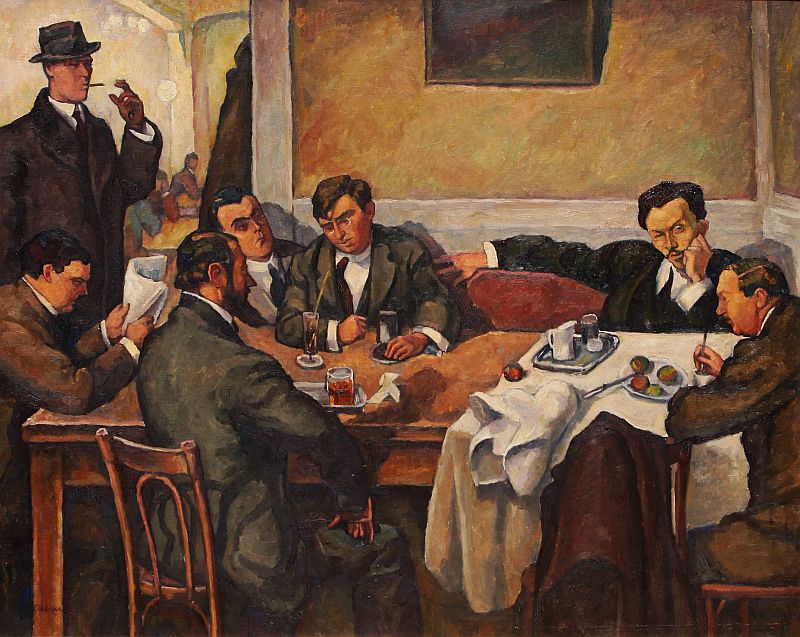
"Academia de la Terasă / Academia de la terraza / Academy of the Terrace"
Óleo sobre lienzo / oil on canvas, 1912. Link
Museo de Arte (Cluj-Napoca, Rumanía / Romania)

En 1917, junto con los pintores Nicolae Dărăscu, Ștefan Dimitrescu, Iosif Iser, Marius Bunescu y los escultores Dimitrie Paciurea, Cornel Medrea, Ion Jalea y Oscar Han, fundó la Asociación de Arte de Rumania en Iaii. Durante estos años, desarrolló su estilo como pintor de paisajes y visitó con frecuencia el campo en verano para pintar retratos de campesinos que trabajan en los campos y vistas de las aldeas. También pintó bodegones, retratos de diversas personalidades y desnudos.

"Lectură pe malul mării / Lectura en el paseo marítimo /
Reading on the Waterfront"
Óleo sobre cartón / oil on cardboard, 59 x 49,5 cm. Artmark

En 1921 se convirtió en el presidente de la Unión de Artistas de Rumania. En 1925, después de una prolongada estancia en el pueblo de Ilovăț, Mehedinți, Ressu terminó una de sus pinturas más conocidas, "Labradores descansando", que actualmente se encuentra en el Museo de Arte de Iași.

"Curățenia de primăvară / Limpieza de primavera / Spring Cleaning"
Óleo sobre cartón / oil on cardboard, 49,5 x 64,5 cm. Artnet

Además de sus actividades artísticas, Camil Ressu fue profesor en la Academia de Bellas Artes de Bucarest hasta 1941. Desde 1950, fue presidente honorario de la Unión de Artistas y profesor en el Instituto de Arte Nicolae Grigorescu. En 1955, el régimen comunista de Rumania le otorgó el título de "Artista del Pueblo", y más tarde se convirtió en miembro de la Academia Rumana.
Murió en 1962.

"Nud în atelier / Desnudo en el estudio / Nude in the Atelier"
Óleo sobre cartón / oil on cardboard, 49,5 × 70 cm. Artmark

On January 28 is the birthday of

Camil Ressu, Romanian painter and academic born in 1880 in Galați, one of the most significant art figures of Romania.
His father, Constantin Ressu, who was a journalist and had studied law in Brussels, was an artist in his spare time. In 1887, Ressu was enrolled at the School of Fine Arts in Bucharest. He continued his studies at the School of Fine Arts in Iași, where he studies with painters Gheorghe Popovici and Gheorghe Panaiteanu Bardasare. In 1902, he finished his studied in Iași, being awarded a silver medal, and left Romania for Paris, seeking to further develop his art skills. In Paris, he studied at the Académie Julian.

"Ștrengarul / Pilluelo / Urchin"
Óleo sobre cartón / oil on cardboard, 63,5 × 53 cm. Artmark

In 1908, Ressu returned to Romania and became interested in social matters, contributing satirical drawings to several publications, including Furnica, Facla and Adevărul. In the same year, he became a member of the Social Democratic Party of Romania (or, rather, its surviving Bucharest circle, Socialist Union of Romania, formed around the paper România Muncitoare). In 1910, his works (landscapes and paintings with bucolic themes) were featured in the Artistic Youth exhibition. Ressu held his first personal exhibition in 1914, in Bucharest.


"Familie de țărani / Familia de campesinos / Family of Peasants"
Óleo sobre cartón / oil on cardboard, 50 × 65,5 cm. Artmark

In 1917, along with the painters Nicolae Dărăscu, Ștefan Dimitrescu, Iosif Iser, Marius Bunescu and the sculptors Dimitrie Paciurea, Cornel Medrea, Ion Jalea and Oscar Han, he founded the Art of Romania association in Iași. During these years, he further developed his style as a landscape painter, and frequently visited the countryside in summer to paint portraits of peasants working in the fields and views of villages. He also painted still life, portraits of various personalities, and nudes.

"Aişé", óleo sobre lienzo / oil on canvas, 144,5 × 84,5 cm., 1928
Colección del Dr. / Collection of Doctor Iosif Dona. Link

"Aişé", óleo sobre cartón / oil on cardboard, 70 × 50 cm. Artmark

In 1921, he became the president of the Artists' Union of Romania. In 1925, after a prolonged stay in the village of Ilovăț, MehedințiCounty, Ressu finished one of his best-known paintings, Ploughmen Resting, currently housed in the Iași Museum of Art.


"La familia del granjero / Farmer's Family"
Óleo sobre cartón / oil on cardboard, 57,5 x 48 cm. Artnet

Aside from his artistic pursuits, Camil Ressu was a professor at the Academy of Fine Arts in Bucharest until 1941. From 1950, he was the honorary president of the Artists' Union and a professor at the Nicolae Grigorescu Art Institute. In 1955, Romania's Communist regime awarded him the title of "People's Artist", and he later became a member of the Romanian Academy.
He died in 1962.

"După baie / Después del baño / After the Bath"
Óleo sobre cartón / oil on cardboard, 68 × 49 cm. Artmark


El 29 de Enero es el cumple de

Tadeusz Makowski, pintor polaco nacido en 1882 en Oświęcim, que trabajó en Francia y estuvo asociado con la Escuela de París.
De 1902 a 1906 estudió filología clásica en la Universidad Jagellónica. Durante ese tiempo también comenzó a estudiar arte en la Academia de Bellas Artes de Cracovia con Jan Stanisławski y Józef Mehoffer. Al completar sus cursos allí en 1908 se mudó a París, donde viviría el resto de su vida.
Originalmente pintó en el estilo enseñado por sus profesores. Luego algunos frescos que atrajeron la atención de un grupo de pintores cubistas, dirigido por Henri Le Fauconnier, que trabajaba en Montparnasse. Esto tuvo una influencia decisiva en su trabajo.

"Palacze fajek / Los fumadores de pipa / The Pipe Smokers"
Óleo sobre lienzo / oil on canvas, 1931. Wikimedia Commons
Muzeum Narodowe we Wrocławiu / Museo Nacional (Wrocław, Polonia / Poland)

Por invitación de Władysław Ślewiński, pasó los años de guerra en Bretaña y volvería allí varias veces. Estos viajes lo inspiraron a abandonar el cubismo estricto y volver al estudio de la naturaleza, creando muchos paisajes estilizados.
Más tarde sus temas favoritos fueron carnavales, ferias y niños, realizados en un estilo inspirado en los antiguos maestros holandeses, el arte popular polaco y el arte ingenuo. También hizo ilustraciones de libros en xilografía. Durante la década de 1920 vivió brevemente en Holanda. De 1912 a 1931 llevó un diario que fue publicado en Varsovia en 1961 por el State Publishing Institute (PIW).
Murió en 1932.

"Pod drogowskazem / Bajo el cartel / Under the Signpost", 1930. Wikimedia Commons

"Zima / Invierno / Winter"
Óleo sobre lienzo / oil on canvas, 80,5 x 100 cm., 1918. Wikimedia Commons

On January 29 is the birthday of

Tadeusz Makowski, Polish painter born in 1882 in Oświęcim, who worked in France and was associated with the School of Paris.
From 1902 to 1906, he studied classical philology at the Jagiellonian University. During that time, he also began studying art at the Kraków Academy of Fine Arts with Jan Stanisławski and Józef Mehoffer. Upon completing his courses there in 1908, he moved to Paris, where he would live for the rest of his life.
Originally he painted in the style taught by his professors. Then, he painted some frescoes that attracted the attention of a group of Cubist painters, led by Henri Le Fauconnier, who worked in Montparnasse. This had a decisive influence on his work.

"Maskarada / Mascarada / Masquerade", 1928. Wikimedia Commons

At the invitation of Władysław Ślewiński, he spent the war years in Brittany and would return there several times. These trips inspired him to depart from strict cubism and go back to studying nature; creating many stylized landscapes.
Later, his favorite subjects were carnivals, fairs and children, done in a style inspired by the old Dutch Masters, Polish folk art and naïve art. He also did woodcut book illustrations. During the 1920s, he lived briefly in the Netherlands. From 1912 to 1931, he kept a diary that was published in Warsaw in 1961 by the State Publishing Institute (PIW).
He died in 1932.

"Kolejarze / Ferroviarios / Railwaymen"
Óleo sobre lienzo / oil on canvas, 80 x 98,5 cm., c.1930. Wikimedia Commons
Muzeum Narodowe w Warszawie / Museo Nacional (Varsovia, Polonia / Warsaw, Poland)


El 30 de Enero es el cumple de

Pierre-Nolasque Bergeret, pintor, pionero litógrafo y diseñador francés nacido en Burdeos en 1782, que estudió con Jacques-Louis David.
Recibió su primera instrucción en Burdeos, luego se mudó a París, donde trabajó en los talleres de François-André Vincent y luego de David, donde conoció a François Marius Granet y Jean-Auguste-Dominique Ingres. Bergeret desempeñó un papel importante en la introducción de la litografía, en parte a través de sus reproducciones según las pinturas de Nicolas Poussin y Rafael: su litografía Mercurio (1804), que reproduce un detalle del fresco de Rafael en la Villa Farnesina, y su caricatura de la moda de la época de París, Le Suprême Bon Ton Actuel (en 1805) se encuentran entre los primeros ejemplos de técnica litográfica.

"L’Arétin dans l’atelier du Tintoret / Aretino en el estudio de Tintoretto /
Aretino in the Studio of Tintoretto", óleo sobre lienzo / oil on canvas, 59 x 49 cm., c.1822
Colección privada / Private Collection. Wikimedia Commons

Tintoretto en "El Hurgador" / in this blog: [Fotógrafos japoneses (II)], [Arte y Humor (XI, Anexo)]

Bergeret recibió el encargo de diseñar medallas napoleónicas, o de proporcionar paneles tipo friso en camaïeu para ser pintados en porcelanas de Sèvres y diseños para los bajorrelieves de la Columna en la Place Vendôme, construida 1806-11, en competencia directa con la Columna de Trajano en Roma. La columna ha tenido una carrera azarosa, habiendo sido destruida y reemplazada dos veces.
Los temas de sus pinturas tienden hacia lo vívidamente anecdótico. Fue uno de los primeros artistas en tratar en su obra temas de la cultura del Renacimiento, en el estilo Trovador: "Honores rendidos a Rafael en su lecho de muerte", 1806 (Allen Art Museum, Oberlin College, Ohio), "Carlos V recogiendo el pincel de Tiziano", 1808, "Ana Bolena condenada a muerte" c.1814 (Musée du Louvre), "Aretino en el estudio de Tiziano" c.1822, "Fra Lippo Lippi, esclavizado en Tánger, pintando un retrato de su captor" hacia 1819. Otra pintura importante de la historia de Bergeret es "Marius meditando sobre las ruinas de Cartago". Otros temas típicos son las alegorías y representaciones propagandísticas de los acontecimientos de la época del Imperio Francés.
Murió en 1863.

"Filippo Lippi, esclave à Alger, traçant sur le mur le portrait de son maître /
Filippo Lippi, esclavo en Argel, dibujando sobre el muro el retrato de su maestro /
Filippo Lippi, Slave in Algiers, Drawing on the Wall The Portrait of his Master"
Óleo sobre lienzo / oil on canvas, 80,7 x 100,3 cm., 1819
Musée Thomas-Henry (Cherburgo, Francia / Cherbourg, France)
Foto / Photo: Stéphane Mahot, Flickr

Bergeret toma el tema de esta pintura de Giorgio Vasari, artista del siglo XVI que se ha hecho un nombre principalmente como biógrafo. En sus "Vidas..." (1550), una colección de biografías de artistas, describió la captura de Filippo Lippi por los moros. Lippi pudo obtener su liberación mediante un retrato fiel de su secuestrador al carbocillo. La historia se basa en el lugar común de que los musulmanes no están acostumbrados a las imágenes figurativas. Fue el realismo del retrato lo que impresionó al Moro y llevó a otorgarle la amnistía a Lippi. Link

"Filippo Lippi esclave a Alger / esclavo en Argel / Slave in Algiers"
Título en la lámina: "Filippo Lippi esclavo en Argel hace el retrato de su Maestro quien en recompensa le da la libertad /
Title in the plate: "Filippo Lippi slave in Algiers makes the portrait of his Master who in reward gives him freedom"
Aguafuerte / etching, 18 x 25 cm., 1838. Wikimedia Commons
Impreso por Ch. Chardon sobre papel de porcelana tintado marfil / Printed by Ch. Chardon on ivory-tinted china paper

Bergeret takes the subject of this painting from Giorgio Vasari, artist hands-on of the 16th century who has primarily made a name as a biographer. In its "Lives..." (1550), a collection of biographies of artists, he described the capture of Filippo Lippi by the Moors. Lippi was able to obtain his release by a faithful portrait of his abductor to charcoal. The story relies on the common place that wants that Muslims are not accustomed to the figurative images. It is the realism of the portrait which impressed the Moor and led to grant amnesty to Lippi.

On January 30 is the birthday of

Pierre-Nolasque Bergeret, French painter, pioneer lithographer and designer born in 1782 in Bordeaux, who studied with Jacques-Louis David.
He received his early training in Bordeaux, then moved to Paris, where he worked in the ateliers of François-André Vincent and then David, where he met François Marius Granet and Jean-Auguste-Dominique Ingres. Bergeret played a major role in introducing lithography, in part through his reproductive prints after paintings by Nicolas Poussin and Raphael: his lithograph Mercury (1804), reproducing a detail from Raphael’s fresco in the Villa Farnesina, and his caricature of current Paris fashion, Le Suprême Bon Ton Actuel (by 1805) are among the earliest examples of lithographic technique.

"Charles Quint ramassant le pinceau du Titien / Carlos V cogiendo el pincel de Tiziano /
Charles V Picking up Titian's Paintbrush"
Óleo sobre lienzo / oil on canvas, 96 x 129 cm., 1808
Bordeaux Beaux-arts museum (Burdeos, Francia / Bordeaux, France). Wikimedia Commons

Carlos I / Carlos V en "El Hurgador" / Charles I / Charles V in this blog:
[Pintando perros (IV)], [Sucedió en el museo (IX, Anexo)], [Arte perdido (XI)]
Tiziano en "El Hurgador" / Titian in this blog: [Todos los enlaces / All links]

Bergeret was commissioned to design Napoleonic medals, or provide frieze-like panels en camaïeu to be painted on Sèvres porcelains and to provide designs for the bas-reliefs on the Column in the Place Vendôme, built 1806–11 in direct competition with Trajan's Column in Rome. The Column has had a checkered career, destroyed and replaced twice.
The subjects of his paintings tend towards the vividly anecdotal. He was early among artists drawing subject matter from the culture of the Renaissance, in the style Troubadour: Honors Rendered to Raphael on His Deathbed 1806 (Allen Art Museum, Oberlin College, Ohio). Charles V Picking up Titian's Brush 1808; Anne Boleyn Condemned to Death ca. 1814 (Musée du Louvre); Aretino in the Studio of Titian ca 1822; Fra Lippo Lippi Enslaved in Tangiers, Painting a Portrait of His Captor ca 1819. Another major history painting by Bergeret is Marius Meditating on the Ruins of Carthage. Other typical subjects are propagandistic allegories and representations of current events of the French Empire.
He died in 1863.

"Rembrandt dans son atelier / en su estudio / at his Studio", óleo sobre lienzo / oil on canvas, 1834
Musée du Louvre (París, Francia / France)

Rembrandt van Rijn en "El Hurgador" / in this blog: [Todos los enlaces / All links] 


Hoy, 31 de Enero, es el cumple de

Marwan Kassab-Bachi (مروان قصاب باشي), conocido como Marwan, artista sirio nacido en 1934 en Damasco, que vivió la mayor parte de su vida en Berlín, Alemania.
Estudió literatura árabe en la Universidad de Damasco de 1955 a 1957. En 1957 se traslado a Berlín y estudió pintura con Hann Trier en la Hochschule für Bildende Künste.

"Gesichtslandschaft II / Paisaje facial II / Face landscape II", 1972
Óleo sobre lienzo / oil on canvas, 130 x 162 cm., 1972
Nationalgalerie, Staatliche Museen zu Berlin (Alemania / Germany)

A fines de la década de 1950 y principios de la década de 1960 trabajó en un estilo post-surrealista generalmente sombrío y ansioso, creando retratos de amigos, poetas, políticos y de sí mismo, que continuó a lo largo de la década.
Desde 1963 trabajó como pintor independiente en Berlín y perteneció al círculo de Georg Baselitz y Eugen Schönebeck. De 1977 a 1979 fue profesor visitante de pintura en la Universidad de las Artes de Berlín, donde en 1980 fue nombrado profesor titular de pintura y enseñó hasta 2002. De 1992 a 2000 fue miembro del jurado del Premio Fred Thieler de La Berlinische Galerie.

"Das Bein / La pierna / The Leg"
Óleo sobre lienzo / oil on canvas, 81 × 100 cm., 1965
Foto / Photo: Jörg von Bruchhausen © Marwan Kassab-Bachi. Postwar at Haus der Kunst

A pesar de vivir en Alemania, a menudo expresó sus opiniones sobre los derechos humanos en Siria, Irak y Palestina.
Murió en 2016.

"Sin título / Untitled", témpera sobre lienzo / tempera on canvas, 195 x 128 cm., 1977

"Cabeza grande (girada hacia la derecha) / Big Head (turned right)"
Óleo y témpera sobre lienzo / oil and tempera on canvas, 162 x 130 cm., 1974
Museo Árabe de Arte Moderno (Doha, Qatar). Fundación Banco de Santander

Today, January 31, is the birthday of

Marwan Kassab-Bachi (مروان قصاب باشي), known as Marwan, Syrian artist born in 1934 in Damascus, who lived lived most of his life in Berlin, Germany.
He studied Arabic literature at the University of Damascus from 1955 to 1957. In 1957 he went to Berlin and studied painting with Hann Trier at the Hochschule für Bildende Künste.

"Munif al-Razzaz 2", óleo sobre lienzo / oil on canvas, 130 x 89 cm., 1965. Nour Festival Blog

In the late 1950s and early 1960s, he worked in a post-Surrealist style generally somber and desirous, creating portraits of friends, poets, politicians, and himself, which he continued through the decade.
From 1963 he worked as a freelance painter in Berlin and belonged to the circle around Georg Baselitz and Eugen Schönebeck. From 1977 to 1979 he was Visiting Professor for Painting at the Berlin University of the Arts, where in 1980 he was appointed Full Professor of Painting and taught until 2002. From 1992 to 2000 he was a member of the jury for the Fred Thieler Prize of the Berlinische Galerie.

"Sin título (marioneta) / Untitled (puppet)"
Óleo sobre lienzo / oil on canvas,  97 x 195 cm., 1980-81. Link

Despite living in Germany, he often expressed views about human rights in Syria, Iraq, and Palestine.
He died in 2016.
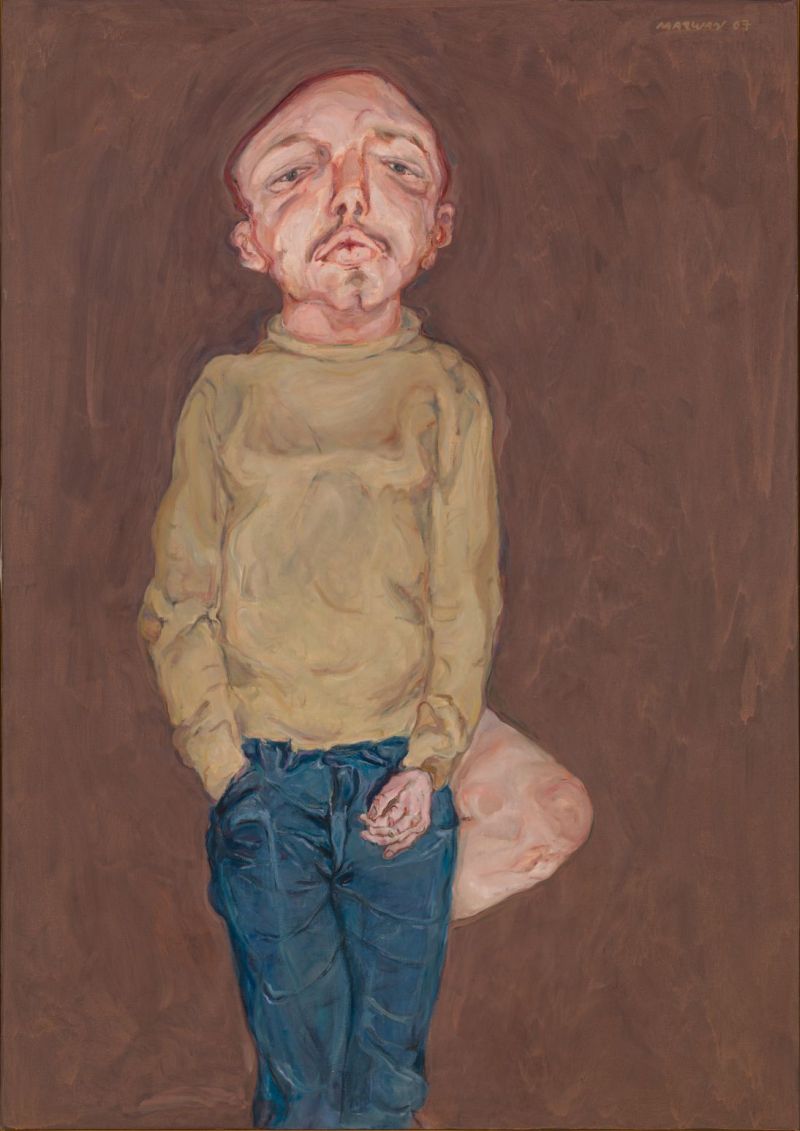

"Sin título / Untitled (Das Knie / La rodilla / The Knee)"
Óleo sobre lienzo / oil on canvas, 166,7 x 118,9 cm., 1967
Museum of Contemporary Art (Chicago, Illinois, EE.UU./ IL, USA)
Foto / Photo: Nathan Keay, © MCA Chicago

sábado, 2 de febrero de 2019

Aniversarios Fotografía / Anniversaries Photography (CCXIII) [Enero / January 27-31]

Todos los aniversarios de Enero aquí / All anniversaries for January here.
_________________________________________________________

El 27 de Enero es el cumple de

Aino Kannisto, artista de la fotografía finlandesa nacida en 1973 en Espoo, que vive y trabaja en Helsinki.
Se convirtió en Maestra en Artes (Fotografía) de la Universidad de Arte y Diseño (UIAH) por Helsinki en 2001. Es parte de la Escuela de Helsinki.
Ha presentado muestras individuales en muchas galerías privadas. Ha participado en varias exposiciones colectivas en Finlandia, Dinamarca, Alemania e Italia.

"Sin título (Habitación roja) / Untitled (Red Room)"
Copia de pigmentos sobre Diasec / pigment Ink Print on Diasec, 90 x 128 cm., 2013. Helsinki School

«He estado haciendo fotografías en escena durante los últimos 15 años. Construyo escenas ficticias que registro con la cámara. Preparo la escena, el vestuario y el maquillaje para las fotos. Construir un mundo visual completo para una fotografía es esencial para mí.
Yo tengo el papel protagonista en las fotos, sin embargo no representan situaciones reconstruidas de mi vida. Son proyecciones de mi paisaje emocional interno. En el sentido más profundo, podrían definirse como autorretratos.
Estoy influenciada por el mundo circundante, la literatura, el cine y las fotografías, así como por imágenes que no son fáciles de localizar, como recuerdos, fantasías y pesadillas. Las imágenes individuales no tienen título, ya que no quiero definirlas para que lo haga el observador.»

"Sin título (Sofá verde) / Untitled (Green Sofa)"
Copia de pigmentos sobre Diasec / pigment Ink Print on Diasec, 90 x 133 cm., 2013. Helsinki School

On January 27 is the birthday of

Aino Kannisto, Finnish photographic artist born in 1973 in Espoo, who lives and works in Helsinki.
She became Master of Arts (Photography) from the University of Art and Design (UIAH) in Helsinki in 2001. She is part of The Helsinki School.
She has had one-woman shows in many private galleries. She has taken part in several collective exhibitions in Finland, Denmark, Germany and Italy.

"Sin título (Balaustrada blanca) / Untitled (White Balaustrade)"
Copia de pigmentos sobre Diasec / pigment Ink Print on Diasec, 90 x 128 cm., 2013. Helsinki School

«I have been making staged photographs for the past 15 years. I build fictional scenes that I record with the camera. I set up the scene, costume and make-up myself for the pictures. Building a complete visual world for a photograph is essential for me.
I play the protagonist in the pictures; however, they do not represent reconstructed situations of my life. They are projections of my internal emotional landscape. In the deepest sense, they could be defined as self-portraits.
I am influenced by the surrounding world, literature, cinema and photographs, as well as not so easily located images, such as memories, daydreams and nightmares. The individual pictures are untitled, as I do not want to define them for the observer.»

"Sin título (Vestido negro) / Untitled (Black Slipdress)"
Copia de pigmentos sobre Diasec / pigment Ink Print on Diasec, 90 x 128 cm., 2012. Helsinki School


El 28 de Enero es el cumple de

Diego Vergés, fotógrafo español nacido en 1982 en Stuttgart.
Se graduó de "Imagen y sonido" en un colegio profesional, y después de eso ingresó en la Universidad para obtener un título de cinco años en "Comunicación audiovisual".
Su primer trabajo después de la Universidad fue en un estudio local en Madrid, donde practicó y se enfrentó a sus miedos y su amor por la iluminación, mientras organizaba las necesidades de producción de los clientes que alquilaban el espacio.
Después de 9 meses de trabajo, en julio de 2008, decidió abandonar su trabajo y seguir a su vecino, Pablo, que estaba investigando la malaria en Gabón (África central occidental). Pasó 4 meses disfrutando de la gente y tomando algunos retratos en las riberas del río Ogooue, hasta que sus ahorros se agotaron.

"Valle de Omo, Etiopía / Omo Valley, Ethiopia", 2012. Link

De vuelta en Madrid, intentó hacer dinero con las fotos, por lo que trabajó para diferentes revistas, además de trabajar como encargado en producciones audiovisuales y en tomando fotografías locales... Una vez que reunió algo de dinero pudo viajar nuevamente a diferentes países: India, Nepal, Indonesia, Filipinas, Guatemala, Etiopía, Rusia. Siempre ha viajado solo, siempre se ha costeado sus viajes y nunca tuvo la oportunidad de obtener encargos de ningún medio, pero siempre ha seguido y disfrutado de su pasión por la fotografía y los viajes.

"Familia de Calcuta / Kolkata Family", 2009. Link
Cerca del río Hooghly, en Calcuta, vive esta familia. La mujer de 28 años es una viuda sorda que gana 10 dólares al mes como empleada doméstica. Sin la ayuda de www.calcutarescue.org, sus dos hijos no tendrían la posibilidad de dos comidas diarias e ir a la escuela / 
Close to the Hooghly River in Kolkata lives this family.
The 28 years old woman is a deaf widow who earns 10$ a month as a housekeeper.
Without the help of www.calcuttarescue.org her two kids wouldn't be able to have two meals a day or going to school.

On January 28 is the birthday of

Diego Vergés, Spanish photographer born in 1982 in Stuttgart.
He graduated of “Image and Sound” in a professional college and after that he joined University to get a degree of five years in "Audiovisual Communication".
His first job after University was in a local studio in Madrid, where he was practicing and facing his fears and love for lighting, while arranging the productions needs of the clients who would rent the space.
After 9 months working, by July 2008, he decided to quit his job and follow his neighbour friend Pablo who was researching Malaria in Gabon (West Central Africa). He spent 4 months enjoying the people and taking some portraits at Ogooue River's side, until his savings where finished.

"Angeles City, Filipinas / Philippines", 2010. Link

Back in Madrid he tried to make money out of the photos, so he worked for different magazines, plus working as a gaffer in audio-visual productions and doing local photoshooting … Once he collected some money he was able to travel again to different countries: India, Nepal, Indonesia, Philippines, Guatemala, Ethiopia, Russia. He has always self sponsored his trips and he had never had the chance of getting assignments from any media, but he has always followed and enjoyed his passion of photography and travelling.

"Tierras altas de Wamena / Wamena Highlands, (Irian Jaya, Indonesia)", 2010. Link


El 29 de Enero es el cumple de

Zackery Michael, fotógrafo de moda y retratos con sede en Brooklyn nacido en 1987. Creció en el noroeste del Pacífico de los Estados Unidos y luego se mudó a la ciudad de Nueva York.
Sus imágenes capturan un naturalismo audaz impulsado por una narrativa contemporánea, seduciendo al espectador con hermosas manifestaciones cinematográficas de la cultura cotidiana. Las imágenes de Zackery son sutiles e íntimas, pero al mismo tiempo icónicas, lanzan historias intrigantes que juegan en la mente.

"Café matinal. Toscana. Verano de 2018 /
Morning Coffee. Tuscany, Summer 2018"

Su obra ha aparecido en editoriales de Vogue, GQ, Vanity Fair, Harpers Bazaar, Flaunt y más. Zackery también ha recibido encargos de trabajos comerciales para Burberry, YSL, Valentino, Tommy Hilfiger, Hollister, Brioni, Persol y Abercrombie & Fitch, entre otros.
Hizo las fotos promocionales de la gira de la gira 2013 de Arctic Monkeys. Anteriormente ya había fotografiado a la banda para su gira de 2011.

Modelo / Model: Kate Bogucharskaia

"Artic Monkeys", 2013

On January 29 is the birthday of

Zackery Michael, Brooklyn based fashion and portrait photographer born in 1987. He grew up in the Pacific Northwest of the United States and later relocated to New York City.
His pictures capture a fearless naturalism driven by a contemporary narrative, seducing the viewer with beautiful filmic manifestations of everyday culture. Zackery’s images are subtle and intimate, yet at the same time iconic, launching intriguing stories that play in the mind.


His work has been featured in editorials for Vogue, GQ, Vanity Fair, Harpers Bazaar, Flaunt and more. Zackery has also been commissioned for commercial work for the likes of Burberry, YSL, Valentino, Tommy Hilfiger, Hollister, Brioni, Persol and Abercrombie & Fitch amongst others.
He shot the tour promo photos for Arctic Monkey's 2013 tour. He previously photographed the band for their 2011 tour.

"Para la Revista P / For P Magazine"


El 30 de Enero es el cumple de

Chopailin Phraibueng (ช่อไพลิน ไพรบึง), fotógrafa, fotomanipuladora, ilustradora, diseñadora gráfica y creativa digital tailandesa nacida en 1993, con sede en Bangkok.

"Lujuriósfera / Lustmosphere". Behance

No hay mucha más información disponible, pero su imaginativa obra puede verse en diferentes sitios web.

"Juguetedehombrerico / Richmantoy". Behance

On January 30 is the birthday of

Chopailin Phraibueng (ช่อ ไพลิน ไพรบึง),  Thai photographer, photomanipulator, illustrator, graphic designer and digital creative born in 1993, based in Bangkok.

"Azul profundo / Deep Blue". Behance

There is not much more information available, but her imaginative work can be seen on different websites.

"Bailarina / Ballerina". Behance

Chopailin Phraibueng en "El Hurgador" / in this blog: [Recolección (XCIV)]


El 31 de Enero es el cumple de

Evelyn Richter, fotógrafa alemana nacida en 1930 en Bautzen.
Después de formarse como fotógrafa en Dresde con Franz Fiedler y Pan Walther de 1948 a 1951, trabajó como asistente de laboratorio en Vereinigte Kaufstätten Dresden y como fotógrafa en TU Dresden.
En 1953 comenzó sus estudios de fotografía en la Hochschule für Grafik und Buchkunst Leipzig (HGB) con Johannes Widmann, profesor del Instituto de Fotografía. Desde 1955 hasta 1980 trabajó como fotógrafa independiente (fotografía de teatro, publicidad).

"Leipzig" (Musikviertel / Distrito de los músicos / Musicians District)
Copia a la gelatina de plata / gelatin silver print, 28,2 × 37,2 cm., 1976. Grisebach

Desde 1981 enseñó en la HGB en Leipzig, donde fue profesora honorífica de 1991 a 2001. Desde 1990 hasta 1991, también tuvo una cátedra de fotografía en la Universidad de Ciencias Aplicadas de Bielefeld.
En 1992 fue galardonada con el Premio de Cultura de la Sociedad Alemana de Fotografía y el 18 de marzo de 2006 con el Premio de Arte de la ciudad de Dresde. El Museo Leonhardi en Dresde presentó una exposición con motivo de su 80 cumpleaños a principios de 2010.

* Murió el 10 de Octubre de 2021

"Otto Dix in der Druckwerkstatt von / en el taller de impresión de /
in the Print Workshop of Roland Erhardt"
Copia a la gelatina de plata / gelatin silver print, 26 x 39,3 cm., 1964. Ebay

"Otto Dix", postal / postcard, Dresde / Dresden, 1964. Hip Postcard

Otto Dix en "El Hurgador" / in this blog: [Todos los enlaces / All Links]

On January 31 is the birthday of

Evelyn Richter, German photographer born in 1930 in Bautzen.
After a training as a photographer in Dresden with Franz Fiedler and Pan Walther from 1948 to 1951, she worked as a laboratory assistant at the Vereinigte Kaufstätten Dresden and as a photographer at the TU Dresden.
In 1953 she began her studies of photography at the Hochschule für Grafik und Buchkunst Leipzig (HGB) with Johannes Widmann, professor of the Institute of Photography. From 1955 until 1980 she worked as a freelance photographer (theater photography, advertising)

"Selbstinszenierung / Autoproducción, Instituto de Mecánica Técnica de la Universidad de Dresde /
Self-production, TU Dresden", 57 x 49 cm., 1952.
Staatlichen Kunstsammlungen (Dresde, Alemania / Dresden, Germany)

From 1981 she taught at the HGB in Leipzig, where she held an honorary professorship from 1991 to 2001. From 1990 to 1991 she also took on a lectureship in photography at the University of Applied Sciences Bielefeld.
In 1992, Evelyn Richter was honored with the Culture Prize of the German Society for Photography and on 18 March 2006 with the Art Award of the City of Dresden. The Leonhardi Museum in Dresden showed an exhibition on the occasion of her 80th birthday in early 2010.

* She died on October 10th, 2021

"Güstrow", copia a la gelatina de plata /
gelatin silver print, 20,3 × 30,7 cm., antes de / before 1982. Grisebach

viernes, 1 de febrero de 2019

Mateo Pizarro (II) [Dibujo / Drawing]

Mateo Pizarro


Mateo Pizarro es un artista colombiano nacido en 1984 en Bogotá. Además de una depurada técnica, su obra destaca por sus interesantes planteamientos conceptuales y un gran sentido del humor. Después de un primer post donde nos deleitábamos con su "Bestiario de animales improbables", les dejo una selección del resto de su obra.

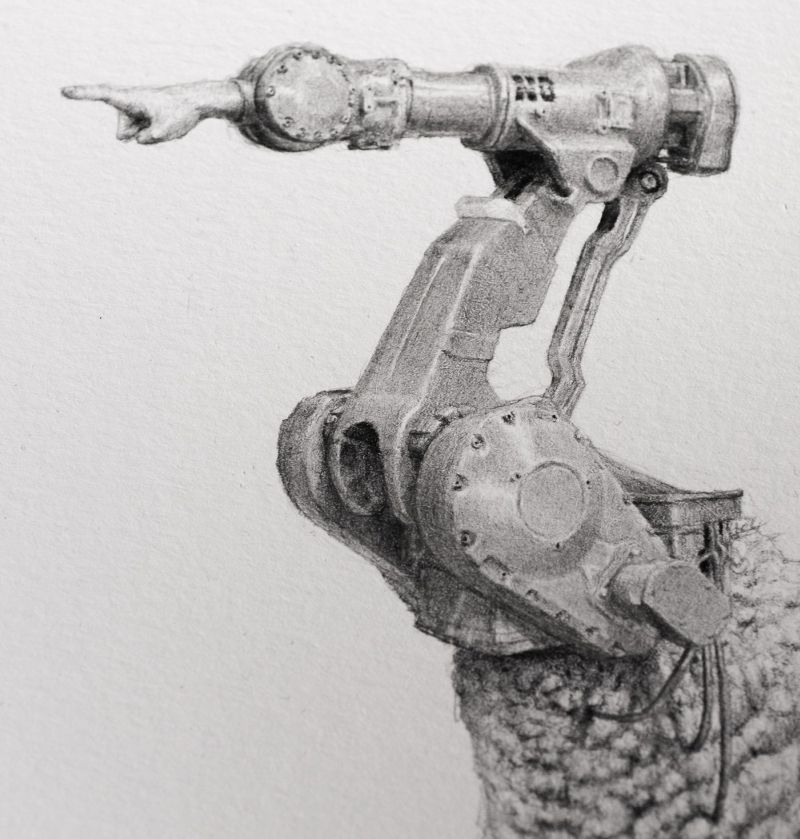
Serie Máquina / Animal - Animal / Machine Series

"Óyeme con los ojos / Hear Me With Your Eyes"
Ilustración a lápiz para una recopilación de poesía visual de los siglos XVI a XVIII /
Pencil ilustration for a compilation of XVI to XVIII century visual poetry.

"Imágenes del Terremoto del '19 (I) / Images from the earthquake of '19 (I)"

«Creo que la razón por la cual el arte se volvió un tema importante para mí es porque mi familia está muy relacionada con la historia del coflicto colombiano. Siento que los primeros impulsos artísticos que tuve fueron para sacar el conflicto de mí, para yo no entrar en esa dinámica de ser parte de la guerra de esa misma forma. Después eso fue evolucionando y convirtiéndose en la forma como entiendo el mundo a través del arte.»

"Imágenes del Terremoto del '19 (I, detalle) / Images from the earthquake of '19 (I, detail)"

Bestias sin nombre / Nameless Beasts
"X-Wing", grafito sobre papel / graphite on paper, 30 x 22 cm., 2017

 "Microbarroco (la quema) / Microbaroque (The Burning)", grafito sobre papel / graphite on paper

«Si uno mira mis imágenes, hay como una cierta oscuridad. Y por otro lado en mi historia familiar hay un montón de historias de las que yo me vengo a enterar incluso hasta ahora, y creo que de pronto es por eso que me gusta que en mis imágenes haya elementos... tú puedes tener mis piezas durante seis meses en tu casa y de pronto un día te das cuenta... este secretico no lo había visto, y eso modifica a veces el significado de la obra, o es un chiste... hay distintas formas en las que opera el secreto ahí.»

Serie Máquina / Animal - Animal / Machine Series

Serie Máquina / Animal (detalle) - Animal / Machine Series (detail)

«Uno puede pensar que el lápiz es sencillo, pero cada uno de estos dibujos no estoy utilizando un sólo lápiz. Hay entre 87 y 108 lápices distintos que utilizo en cada dibujo. Ha sido un proceso de aprendizaje muy intenso con el grafito.»

"Hombre con Avestruz / Man With Ostrich", para un proyecto de / for a project by Enrique Arellano


Mateo Pizarro is a Colombian artist born in 1984 in Bogotá. In addition to a refined technique, his work stands out for its interesting conceptual approaches and a great sense of humor. After a first post where we enjoyed his Bestiary of Improbable Animals, here you have a selection of the rest of his work.

"El gigante de 21 o Alegoría de una vida dentro de una pintura (Las catástrofes) /
The Giant of  '21 or Allegory of Life Inside a Painting (The Catastrophes)"
Grafito sobre papel / graphite on paper, 42 x 29,5 cm., 2017

Bestias sin nombre / Nameless Beasts

"A veces se siente extraño regresar / Sometimes It Feels A Little Strange To Come Back"

«I think the reason why art became an important issue for me is because my family is closely related to the history of the Colombian conflict. I feel that the first artistic impulses I had were to get the conflict out of me, so I would not enter into that dynamic of being part of the war in that same way. Then that was evolving and becoming the way I understand the world through art.»

"El tiempo, ese idiota interminable que corre gritando por todo el mundo /
Time, that endless idiot runs screaming around the world." Carson McCullers. 
Grafito sobre papel / graphite on paper, 28 x 43 cm.

Serie Máquina / Animal - Animal / Machine Series

La inmaculada concepción de Godzilla / The Inmaculate Conception of Godzilla

«If you look at my images, there is a certain darkness. And on the other hand in my family history there are a lot of stories that I come to know even now, and I think that's why I like that there are elements in my images ... you can have my pieces for six months at home and suddenly one day you realize ... this little secret had not seen, and that sometimes modifies the meaning of the work, or is a joke ... there are different ways in which the secret works there.»

Bestias sin nombre / Nameless Beasts

"Microbarroco (estrellas) / Microbaroque (Starlight)"
Grafito sobre papel / graphite on paper, 30 x 22 cm., 2017

«One may think that the pencil is simple, but each of these drawings I am not using a single pencil. There are between 87 and 108 different pencils that I use in each drawing. It has been a very intense learning process with graphite.»

"Sin título / Untitled", grafito sobre papel / graphite on paper, 21 x 15 cm., 2017
____________________________________________

Mateo Pizarro habla sobre su trabajo / talks about his work

____________________________________________

Mateo Pizarro en "El Hurgador" / in this blog: [Mateo Pizarro (Dibujo)], [Asonancias (XVIII)]

Más sobre / More about Mateo Pizarro: Behance, Instagram, facebook, HeartGo

Imágenes publicadas con autorización del artista (¡Muchas gracias, Mateo!)
Images published here with artist's permission (Thanks a lot, Mateo!)