lunes, 28 de mayo de 2018

Michael Leonard [Pintura, Dibujo / Painting, Drawing]

En las obras de Michael Leonard, el elemento clave es el dinamismo de las figuras. En sus pinturas y dibujos, el artista realiza un estudio de la forma humana, centrándose en la tensión de los músculos, captando a sus modelos en movimiento, congelando un momento de acción corporal con sus acrílicos, alquídico o grafito. Michael es también un consumado retratista, y tal vez la expresión más interesante de esta vertiente sea su serie "Retratos en el tiempo".
Aquí les dejo una muestra de su obra, junto con una selección de textos de su sitio web. Sobre los artistas mencionados por Michael, ver enlaces al final del post.

In the works of Michael Leonard, the key element is the dynamism of the figures. In his paintings and drawings, the artist makes a study of the human form, focusing on the tension of the muscles, capturing their models in motion, freezing a moment of body action with their acrylics, alkyds or graphite. Michael is also an accomplished portraitist, and perhaps the most interesting expression of this aspect is his series "Portraits in Time".
Here you have a set of his works, along with some text selections from his website. About other artists metioned by Michael, check out the links at the end of this post.
________________________________________________

Michael Leonard

"Autorretrato / Self Portrait", alquídico sobre masonita / alkyd on masonite, 22,9" x 24,2", 1987 © Michael Leonard

Michael Leonard es un artista figurativo nacido en India en 1933, de padres británicos. En 1945, al final de la guerra en Europa, regresó a Inglaterra para completar su educación.
«En 1954, después de dos años de Servicio Nacional en el ejército, fui a la Escuela de Arte de St Martin en Londres y estudié Diseño Comercial e Ilustración (temas que en ese momento parecían más propensos que las bellas artes a proporcionarme un futuro viable). Cuando dejé la Escuela de Arte en 1957 ya trabajaba como ilustrador independiente y durante muchos años estuve ocupado produciendo obras de arte para libros, revistas, publicidad y prensa. Gran parte del trabajo ofrecido era estimulante y agradable, pero después de un tiempo sentí la necesidad de expresar una visión más personal. Mis visitas de la hora del almuerzo a la National Gallery alimentaron una creciente ambición de hacer imágenes para la pared en vez de para las páginas, obras que se experimentaran en original en vez de reproducciones.»

"Cambio a blanco / Change into White"
Alquídico sobre masonita / alkyd on masonite, 81,3" x 76,2", 1994-96 © Michael Leonard

"Figura encorvada / Hunched Figure"
Grafito sobre papel / graphite on paper, 15,8" x 17,8", 1990 © Michael Leonard

Trabajó como ilustrador en un pequeño estudio, mientras experimentaba en casa tratando de encontrar su voz como pintor. En 1972 varias de sus pinturas se incluyeron en una exposición colectiva en Fischer Fine Art. Dos años más tarde realizó su primera exposición en solitario, y después dejó gradualmente la ilustración.
Sus primeras pinturas fueron formales y discretas: gente sentada en habitaciones, posando con sus perros o navegando por el río. Poco a poco su obra se volvió más animada y colorida. «Al otro lado de la calle, frente a mi estudio, había hombres trabajando con gracia inconsciente sobre una grilla de andamios, con el cielo de fondo, y esto me llevó a pintar varias imágenes muy estructuradas como "Montadores de andamios", "Pasaje de brazos" y "Sobre el techo".»

Retratos en el tiempo / Portraits in Time
"Ivor Braka c. s.XV / 15th (Memling)", lápiz sobre papel / pencil on paper, 31,1" x 24,8", 1996 © Michael Leonard

Retratos en el tiempo
«De vez en cuando me encuentro con un rostro que parece sacado de un retrato de uno de los grandes artistas del pasado como Holbein, Van Dyck o John Singer Sargent. Para recuperar esta sensación inquietante, ideé "Retratos en el tiempo", un conjunto de dibujos que hace retroceder en el tiempo a rostros contemporáneos, a un período que se adapta mejor a sus características faciales. Adoptando el estilo de un artista de la época, utilizo la técnica ilusionista del trompe-l'oeil (trampantojo) para presentar mi retrato como una reproducción arrancada de las páginas de un catálogo.
A menudo mis sujetos están intrigados por encontrar cuán completamente cómodos parecen en ese tiempo anterior, ¡incluso a veces más aún que en el presente! Mi retrato de George Hall, por ejemplo, lo sitúa a principios del siglo XVIII. Se ve tan cómodo allí, con una típica peluca de la época, que después de haber estado mirando mi dibujo por un tiempo, ¡tengo que luchar para devolverle la cara a la edad en que vivimos!»

"Nube de pelo negro / Cloud of Dark Hair"
Alquídico sobre masonita / alkyd on masonite, 19" x 16", 2017 © Michael Leonard

"Nube de pelo negro / Cloud of Dark Hair"
Grafito sobre papel / graphite on paper, 19,7" x 16", 2004 © Michael Leonard

«Las personas en mis cuadros generalmente eran amigos que tuvieron la amabilidad de modelar para mí, pero también pinté retratos por encargo. El desnudo, particularmente el desnudo masculino, ha sido un tema recurrente. Mis figuras generalmente están en movimiento o en un estado de transición, pero incluso cuando están en reposo, el diseño de la imagen ofrece dinamismo.
Casi todas mis pinturas del desnudo se basan en dibujos que, además de ser estudios preparatorios, son obras acabadas en sí mismas".

"Pasaje de brazos / Passage of Arms"
Acrílico sobre lona / acrylic on cotton duck, 80" x 86,4", 1979 © Michael Leonard

"Hombre agachado / Crouching Man"
Grafito sobre papel / graphite on paper, 21,3" x 16,5", 2003 © Michael Leonard

Desnudos tonales
"Estos dibujos deben mucho a mi entusiasmo por los de Seurat y Schiele. A Seurat lo admiro por su tratamiento del espacio negativo: las áreas alrededor de sus figuras tienen casi tanta energía como las figuras mismas. A Schiele por su poder erótico, perfección gráfica y sentido de diseño infalible, particularmente en sus dibujos tardíos.
Mis figuras están invariablemente atrapadas en el movimiento o en transición. Estoy fascinado por las interacciones sutiles de los músculos, los huesos y los tendones que entran en juego a medida que el cuerpo se mueve. Una media vuelta, un cambio de equilibrio, a veces la propia intención de moverse puede animar a una figura completa. Como esto se muestra más clara y dramáticamente en la anatomía masculina, la mayoría de mis figuras son hombres.

Retratos en el tiempo / Portraits in Time - "Robert Hughes. s.XVI / 16th (Durero / Dürer)"
Lápiz sobre papel / pencil on paper, 31,8" x 24,2", 1985 © Michael Leonard

"Bañista agachándose / Bather Reaching Down"
Alquídico oleoso sobre masonita / alkyd-oil on masonite, 86,4" x 71,1", 1996-97 © Michael Leonard

Durante sus años como ilustrador con ambición de ser pintor, buscando algo para encender su imaginación, encontró la obra de un pintor abstracto, Robyn Denny. En algunas de sus serigrafías hacía un uso particular del color de tonos estrechos en un formato de rectángulos verticales. Michael se preguntó si tales efectos podrían funcionar para las pinturas figurativas, por lo que utilizó efectos similares en algunas de sus primeras obras.
«Durante años me atrajeron los pintores de la corriente realista del arte estadounidense como Andrew Wyeth, Winslow Homer y Edward Hopper, y me animó descubrir que, como yo, tanto Homer como Hopper habían pasado gran parte de sus carreras tempranas trabajando como ilustradores. También me atrajeron algunos de sus sucesores, en particular Richard Estes, cuyos reflejos del paisaje urbano en las ventanas de vidrio me inspiraron a embarcarme en una serie de imágenes propias de "ventanas". Mis cuadros, sin embargo, eran más pequeños y menos complejos, y generalmente incluían figuras.
Más tarde llegué a admirar a un grupo más peculiar de realistas norteamericanos a los que a veces se hace conoce como "Realistas líricos". Entre ellos se encontraban George Tooker, Jared French, Alex Colville y Paul Cadmus. A menudo he encontrado inspiración en la obra de los grandes maestros de la pintura europea, muchos de cuyos cuadros se encuentran en la National Gallery de Londres.»

"Cambiándose / Changing", grafito sobre papel / graphite on paper, 22,8" x 22,2", 1982 © Michael Leonard

«En la escuela de arte -y durante un tiempo después- trabajé del natural o a partir de mi imaginación, pero como ilustrador profesional, con el tiempo limitado y plazos que cumplir, descubrí que mi cámara podía proporcionarme la mayoría de la información básica que necesitaba. Cuando se trataba de mis actividades como pintor, las fotografías, siempre mías, eran mi principal referencia. En la mayoría de los casos hice dibujos y estudios de color antes de embarcarme en la pintura en sí.»

«Trabajé en pintura acrílica hasta 1986 y luego cambié al alquídico oleoso. Al igual que el acrílico, el aquídico oleoso se seca rápidamente y, además, proporciona una gama más amplia de tonos y una mayor capacidad de sutileza y matiz, especialmente en la pintura de carne.»

"Cambiándose / Changing"
Acrílico sobre lona / acrylic on cotton duck, 80" x 76,2", 1981 © Michael Leonard

"Michael Leonard c. s.XVII / 17th (Van Dyck)"
Lápiz sobre papel / pencil on paper, 30,5" x 23,5", 2011 © Michael Leonard

Michael Leonard is a figurative artist born in India in 1933 to British parents. In 1945, at the end of the war in Europe, he returned to England to complete his education.
«In 1954, after two years of National Service in the army, I went to St Martin’s School of Art in London and studied Commercial Design and Illustration, (subjects that at the time seemed more likely than fine art to provide me with a viable future). By the time I left Art School in 1957 I was already working as a freelance illustrator and for many years was busy producing artwork for books, magazines, advertising and the press. Much of the work on offer was stimulating and enjoyable but after a time I felt the need to express a more personal vision. Lunch hour visits to the National Gallery fed a growing ambition to make pictures for the wall rather than the page — work that would be experienced in the original rather than in reproduction.»

"Bañista encorvado / Stooping Bather"
Acrílico sobre lona / acrylic on cotton duck, 55,9" x 50,8", 1980 © Michael Leonard
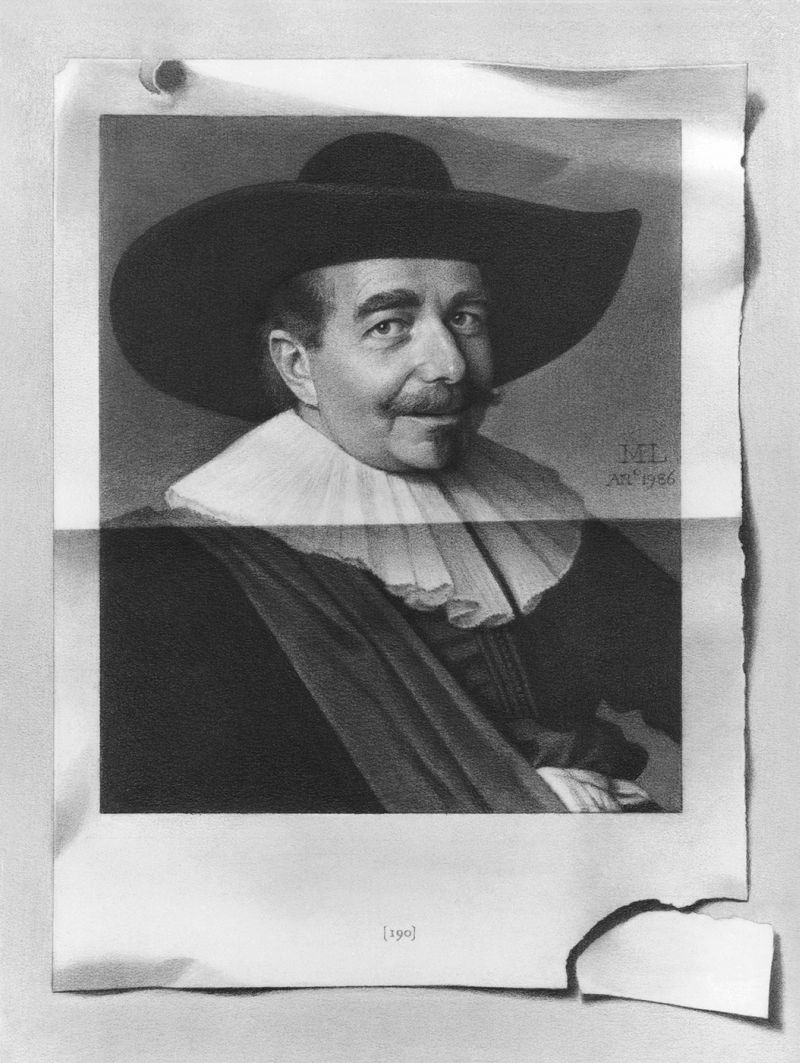
Retratos en el tiempo / Portraits in Time
"Richard Banks. c. s.XVII / 17th (Frans Hals)", 1986 © Michael Leonard

He worked as an illustrator in a small studio, while experimenting at home trying to find his voice as a painter. In 1972 several of his paintings were included in a group show at Fischer Fine Art. Two years later he hed his first One Man Show, and after that he gradually left illustration behind.
His first paintings were formal and low key: people sat in rooms, posing with their dogs or sailing on the river. Gradually his work became more animated and colorful. "Across the street from my studio men worked with unconscious grace against a grid of scaffolding and sky and this led me to paint several highly structured pictures such as Scaffolders, Passage of Arms and Up on the Roof."

"Cepillo de pelo rojo / Red Hairbrush"
Alquídico sobre masonita / alkyd on masonite, 55,8" x 61", 2006 © Michael Leonard

"Chica acurrucada / Girl Curled Up"
Grafito sobre papel / graphite on paper, 19,7" x 15,2", 1989 © Michael Leonard

«The people in my pictures were usually friends who were kind enough to model for me but I also painted portraits to commission. The nude, particularly the male nude, has been a recurring theme. My figures are usually on the move or in a state of transition but even when they are at rest dynamism is provided by the design of the picture.
Almost all my paintings of the nude are based on drawings which, besides being preparatory studies, are ends in themselves.»

"Montadores de andamios / Scaffolders"
Acrílico sobre lona / acrylic on cotton duck, 101,1" x 101,6", 1978 © Michael Leonard

During his years as an illustrator with ambitious to be a painter, looking for something to fire his imagination, he found the work of an abstract painter, Robyn Denny. A set of his screen prints made magical use of close-toned colour in a format of standing rectangles. Michael wondered if such effects could work for figurative paintings, so he used similar effects in some of his early works.
«For years I had been attracted to painters in the Realist mainstream of American art such as Andrew Wyeth, Winslow Homer and Edward Hopper and was encouraged to learn that, like me, both Homer and Hopper had spent much of their early careers working as Illustrators. I was also drawn to some of their successors, in particular Richard Estes, whose cityscape reflections in plate glass windows inspired me to embark on a series of ‘window’ pictures of my own. My pictures, however, were smaller and less complex and generally included figures.
Later I came to admire a quirkier group of North American realists sometimes referred to as The Lyric Realists. Among them were George Tooker, Jared French, Alex Colville and Paul Cadmus. I have often found inspiration in the past in the work of the great Masters of European Painting, many of whose pictures are in London’s National Gallery.»

"Hombre secándose el muslo / Man Drying his Thigh"
Grafito sobre papel / graphite on paper, 16,5" x 20,3", 1985 © Michael Leonard

Retratos en el tiempo / Portraits in Time - "Tom Phillips c. s.XVI / 16th (Rafael / Raphael)"
Lápiz sobre papel / pencil on paper, 1986 © Michael Leonard

Portraits in Time
«Every now and again I encounter a face that seems to be straight out of a portrait by one of the great artists of the past such as Holbein, Van Dyck or John Singer Sargent. To recapture this haunting sensation, I devised ‘Portraits in Time’, a set of drawings that pitches contemporary faces back through time to a period that better matches their facial characteristics. Adopting the style of an artist of the day, I use the illusionist technique of trompe-l’oeil to present my portrait as a reproduction, torn from the pages of a catalogue.
Often my subjects are intrigued to find how completely at home they seem in that earlier time - even more at home sometimes than in the present day! My portrait of George Hall for example, places him in the early eighteenth century. He looks so comfortable there, wearing a typical wig of the period, that after I’ve been looking at my drawing for a while, I have to struggle to return his face to the age we live in!

"Quitándose / Climbing Out"
Alquídico oleoso sobre masonita / alkyd-oil on masonite, 24" x 22", 2008 © Michael Leonard

"Bañista en dorado / Female Bather on Gold"
Alquídico oleoso sobre masonita / alkyd-oil on masonite, 62,3" x 61", 1988 © Michael Leonard

«At art school - and for a short while after - I worked from life or from my imagination but as a professional illustrator, with time at a premium and deadlines to meet, I found my camera could provide me with most of the basic information I needed. When it came to my activities as a painter, photographs - always my own - were my primary reference. More often than not, I then did further drawings and colour studies before embarking on the painting itself.»

«I worked in acrylic paint until 1986 and then switched to alkyd-oil. Like acrylic, alkyd-oil is quick-drying and in addition, provides a wider range of tone as well as a greater capacity for subtlety and nuance, particularly in the painting of flesh.»

"El Kimono de Marion / Marion’s Kimono"
Grafito sobre papel / graphite on paper, 17,8" x 17,8", 1996 © Michael Leonard

"Hombre durmiendo con manzanas / Sleeping Man with Apples"
Grafito sobre papel / graphite on paper, 19,4" x 17,8", 1996 © Michael Leonard

Tonal Nudes
«These drawings owe much to my enthusiasm for the drawings of Seurat and Schiele. Seurat I admire for his treatment of negative space - the areas around his figures have almost as much energy as the figures themselves. Schiele I admire for his erotic power, graphic perfection and infallible sense of design - particularly in his later drawings.
My figures are invariably caught on the move or in transition - I am fascinated by the subtle interactions of muscle, bone and sinew that come into play as a body moves. A half turn, a shift of balance, sometimes just an intention to move can animate an entire figure. As this shows up most clearly and dramatically in male anatomy, most of my figures are male.»

"Bañistas con toallas doradas / Bathers with Yellow Towels"
Acrílico sobre lona / acrylic on cotton duck, 55,9" x 50,8", 1980 © Michael Leonard

Más sobre / More about Michael Leonard: Website

Sobre la obra editorial, portadas e ilustraciones de libros de Michael, ver aquí /
About Michael's Editorial Art, Book Covers and Illustrations, please check out here.

Imágenes publicadas con autorización del artista (¡Muchas gracias, Michael y Viv!)
Images published here with artist's permission (Thanks a lot, Michael and Viv!)


Sobre los artistas mencionados, en este blog /
About mentioned artists, in this blog:

Georges Seurat[Adam Lister (Las obras, Anexo / The Works, Annex)], [Aniversarios (XLVI)]
Egon Schiele:
[Schiele, Yerka], [Aniversarios (XX)], [Asonancias (IV)], [Asonancias (V)], [Sucedió en el museo (VIII)], [Sucedió en el museo (VIII, Anexo)]
Robyn Denny: Wikipedia
Andrew Wyeth[Aniversarios (XXIV)], [Recolección (XXIV)], [Aniversarios (CLXXXV)]
Winslow Homer[Aniversarios (IV)], [Recolección (XXVI)], [Sucedió en el museo (VII-Anexo)]
Edward Hopper:
[Manos a la obra (XXVII)], [Arte perdido (V)], [Adam Lister (Las obras, Anexo / The Works, Annex)], [Aniversarios (XXVI)], [Recolección (XV)], [Recolección (XLI)]
Richard Estes[Aniversarios (CCXCII)]
George Tooker[George Tooker (Pintura)]
Jared French[Recolección (CIV)]
Alex Colville[Aniversarios (XXXI)], [Pintando perros (XLVIII)]
Paul Cadmus[Recolección (LXXXIV)]

Retratos en el tiempo / Portraits in Time

Hans Memling:
[Fotógrafos japoneses (II)], [Daria Endresen (Arte digital)], [Asonancias (XXV)], [Asonancias (XXV, Anexo)], [Pintando perros (LXXIX)]
Alberto Durero (Albrecht Dürer) [Todos los enlaces / All links]
Anthony Van Dyck: [Todos los enlaces / All links]
Frans Hals[Recolección (CXLV-1)], [Asonancias (XXVIII, Anexo)]
Rafael (Raffaello Sanzio) [Todos los enlaces / All links]

domingo, 27 de mayo de 2018

Aniversarios (CCXXVIII) [Mayo / May 21-27]

Todos los aniversarios de Mayo aquí / All anniversaries for May here.
_________________________________________________________

El 21 de Mayo es el cumple de

Carmelo Cappello, escultor italiano nacido en 1912 en Ragusa.
En 1925, siendo aún menor de edad, trabajó como escultor para un fabricante siciliano de carros. Asistió a la Escuela de Arte Comiso en 1928. Al año siguiente trabajó en Roma en el estudio de Ettore Colla. En 1930 se mudó a Milán, donde asistió a las clases nocturnas de la Scuola superiore d'Arte applicata all'Industria del Castello Sforzesco. Gracias a una beca pudo seguir las enseñanzas de Marino Marini en Monza.
En 1937 hizo su debut como escultor y al año siguiente realizó su primera exposición individual en la Galería Bragaglia en Roma. Desde 1941 consolidó su amistad con Gio Ponti, con quien continuó una larga colaboración.
Participó en varias ediciones de la Bienal de Venecia (1940, 1948, 1950, 1952, 1954, 1958), la Cuadrienal de Roma (1939, 1943, 1947, 1955, 1965, 1973, 1986) y la Trienal de Milán (1951, 1954, 1957).
En 1959 fue invitado a Documenta 2 de Cassel.

"Involuzione del Cerchio / Involución del círculo / Involution of the Circle"
Mármol / marble. Wikimedia Commons

En 1977 participó en la Cooperarte, donde colaboraron artistas como Carla Accardi, Getulio Alviani, Gianni Colombo, Antonio D'Agostino, Emilio Isgro, Mario Nangeroni, Mario Nigro, Luca Patella, Achille Perilli, Concetto Pozzati, Mimmo Rotella, Giulio Turcato y Nanda Vigo. Coopertarte era una cooperativa de artistas que buscaba explorar nuevas formas de relación y diálogo con el público. Su primera exhibición colectiva tuvo lugar el 26 de febrero de 1977 en el Centro Allende La Spezia. 
Después de un primer período figurativo se sintió atraído por la escultura de Moore, pasando del constructivismo ruso de Tatlin a la atención al espacio que le sugieren Brancusi, Pevsner y Gabo: la influencia de estas corrientes culturales en su lenguaje personal se encuentra en su forma de organizar ritmos y volúmenes lineales, El componente permanente de sus estructuras es la curva, que une el círculo puro enfatizado por la elipse, en un equilibrio estricto de relaciones bidimensionales.
En Ragusa, la Colección Cappello se inauguró en 1994, como resultado de la donación de sus obras a su ciudad natal.
Murió en 1996.

"Senza titolo / Sin título / Untitled"
Bronce / bronze, 46 x 50 x 21 cm., 1962. Liveauctioneers

On May 21 is the birthday of

Carmelo Cappello, Italian sculptor born in 1912 in Ragusa.
Still a minor, he worked in 1925 as a sculptor for a Sicilian carts manufacturer. He attended the Comiso School of Art in 1928. The following year, he worked in Rome in Ettore Colla's studio. In 1930, he moved to Milan where he attended the evening classes of the Scuola superiore d'Arte applicata all'Industria del Castello Sforzesco. Thanks to a scholarship, he followed the teaching of Marino Marini at Monza.
In 1937, he made his debut as a sculptor and the following year held his first solo exhibition at the Bragaglia Gallery in Rome. Since 1941 he consolidated his friendship with Gio Ponti, with whom he continued a long collaboration.
He participated in several editions of the Venice Biennale (1940, 1948, 1950, 1952, 1954, 1958), the Quadrennial of Rome (1939, 1943, 1947, 1955, 1965, 1973, 1986) and the Triennale of Milan (1951, 1954, 1957).
In 1959 he was invited to Documenta 2 of Cassel.

"Le fils de la mer / El hijo del mar / The Son of the Sea"
Bronce / bronze, 21,5 x 28 x 9 cm., 1955. Blouin Art

In 1977, he participated in the Cooperarte, where artists such as Carla Accardi, Getulio Alviani, Gianni Colombo, Antonio D'Agostino, Emilio Isgro, Mario Nangeroni, Mario Nigro, Luca Patella, Achille Perilli, Concetto Pozzati, Mimmo Rotella, Giulio Turcato and Nanda Vigo collaborated. The Coopertarte was a cooperative of artists who sought to explore new forms of relationship and dialogue with the public. Their first collective exhibition took place on February 26, 1977, at the Allende La Spezia Center.
After a first figurative period, he was attracted by Moore's sculpture, passing from Tatlin's Russian constructivism to the attention to space that Brancusi, Pevsner and Gabo suggest to him: the influence of these cultural currents on his personal language is found in his way of organizing linear rhythms and volumes. The permanent component of his structures is the curve, linking the pure circle emphasized by the ellipse, in a strict equilibrium of two-dimensional relations.
In Ragusa, the Cappello Collection was inaugurated in 1994, as a result of a donation of his works to his hometown.
He died in 1996.

"Velero / Sailboat", bronce con pátina dorada sobre base de caliza /
gold patinated bronze on limestone base, 57 x 36 x 12 cm., 1963. Blouin Art


El 22 de Mayo es el cumple de

Marisol Escobar, escultora francesa de herencia venezolana nacida en 1930 en París, que trabajó en la ciudad de Nueva York.
Comenzó a dibujar temprano en la vida, y sus padres fomentaron su talento llevándola a museos. Su talento en el dibujo a menudo le valió premios artísticos en las diversas escuelas a las que asistió antes de establecerse en Los Ángeles en 1946.
Ese mismo año comenzó su educación artística formal con clases nocturnas en el Instituto de Arte Otis y el Instituto de Arte Jepson en Los Ángeles, donde estudió con Howard Warshaw y Rico Lebrun. Estudió arte en la École des Beaux-Arts de París en 1949. Luego regresó para comenzar sus estudios en la Art Students League de Nueva York, en la New School for Social Research, y fue alumna del artista Hans Hofmann.
Durante el período de posguerra hubo un retorno de los valores tradicionales que restablecieron los roles sociales, conformando la raza y el género dentro de la esfera pública. Las obras escultóricas de Marisol jugaron con los roles sociales prescritos y las restricciones que enfrentan las mujeres durante este período a través de su descripción de las complejidades de la feminidad como una verdad percibida. Su práctica artística mostró una combinación dinámica de arte popular, dadaísmo y surrealismo, que en última instancia ilustra una aguda percepción psicológica de la vida contemporánea. Al mostrar los aspectos esenciales de la feminidad dentro de un ensamblaje de construcción improvisada, Marisol pudo tratar la construcción social de 'mujer' como una entidad inestable.

"Mujeres y perro / Women and Dog", 1963-64. om pom happy

Marisol imitó el papel de la feminidad en su grupo escultórico "Mujeres y perro", que produjo entre 1963 y 1964. Esta obra, entre otras, representó una respuesta crítica satírica bajo las apariencias de la feminidad fabricada, al asumir deliberadamente el papel de "feminidad" como forma de cambiar su naturaleza opresiva. Tres mujeres, una niña pequeña y un perro se presentan como objetos expuestos, saboreando su estatus social con confianza bajo la mirada del público. Las mujeres están esculpidas como calculadas y "civilizadas" en su estilo, monitoreando tanto a ellas mismas como a quienes las rodean.
Fue en la década de 1960 cuando Marisol comenzó a ser influenciada por artistas pop como Andy Warhol y Roy Lichtenstein. Ella misma apareció en dos películas de Warhol, "The Kiss" y "Las 13 chicas más bellas".
La artista se transitó por muchos movimientos. "'No pop, no op, es Marisol!' fue la forma en que Grace Glueck tituló su artículo en el New York Times en 1965 ... "El silencio fue una parte integral del trabajo y la vida de Marisol. Se dijo que ella no había hablado más de lo necesario, y en su trabajo se la describió como alguien que tenía que otorgar silencio con 'forma y peso'. Habló poco de su carrera y una vez afirmó: 'Siempre he sido muy afortunada. A la gente le gusta lo que hago'".
Murió en 2016.

"La visita / The Visit", 1964. Cultura colectiva

On May 22 is the birthday of

Marisol Escobar, French sculptor of Venezuelan heritage born in 1930 in Paris, who worked in New York City.
She had begun drawing early in life, with her parents encouraging her talent by taking her to museums. Her talents in drawing frequently earned her artistic prizes at the various schools she attended before settling in Los Angeles in 1946.
Marisol Escobar began her formal arts education in 1946 with night classes at the Otis Art Institute and the Jepson Art Institute in Los Angeles, where she studied under Howard Warshaw and Rico Lebrun. She studied art at the Paris École des Beaux-Arts in 1949. She then returned to begin studies at the Art Students League of New York, at the New School for Social Research, and she was a student of artist Hans Hofmann.
During the Postwar period, there was a return of traditional values that reinstated social roles, conforming race and gender within the public sphere. Marisol`s sculptural works toyed with the prescribed social roles and restraints faced by women during this period through her depiction of the complexities of femininity as a perceived truth. Marisol’s practice demonstrated a dynamic combination of folk art, dada, and surrealism – ultimately illustrating a keen psychological insight on contemporary life. By displaying the essential aspects of femininity within an assemblage of makeshift construction, Marisol was able to comment on the social construct of ‘woman’ as an unstable entity.

"Cita para cenar / Diner Date", 1963. om pom happy

Marisol mimicked the role of femininity in her sculptural grouping Women and Dog, which she produced between 1963 and 1964. This work, among others, represented a satiric critical response on the guises of fabricated femininity by deliberately assuming the role of ‘femininity’ in order to change its oppressive nature. Three women, a little girl, and a dog are presented as objects on display, relishing their social status with confidence under the gaze of the public. The women are sculpted as calculated and ‘civilized’ in their manner, monitoring both themselves and those around them.
It was in the decade of the 1960s that Marisol began to be influenced by pop artists such as Andy Warhol and Roy Lichtenstein. She appeared in two films by Warhol, The Kiss and 13 Most Beautiful Girls.
Marisol drifted through many movements. "'Not Pop, Not Op, It's Marisol!' was the way Grace Glueck titled her article in the New York Times in 1965…" Silence was an integral part of Marisol’s work and life. She was said to have spoken no more than she needed to, and in her work she been described as having to bestowed silence with "form and weight". She talked little of her career and once stated, "I have always been very fortunate. People like what I do."
She died in 2016.

"La familia / The Family"
Madera pintada, zapatillas, pomo de la puerta y placa, tres secciones /
painted wood, sneakers, door knob and plate, three sections, 209,8 x 166,3 x 39,3 cm., 1962 © 2018
The Museum of Modern Art (MoMA) (Nueva York, EE.UU./ NY, USA)


El 23 de Mayo es el cumple de

François Gaspard Adam, escultor rococó francés nacido en 1710 en Nancy.
Estudió con su padre, Jacob-Sigisbert. Luego siguió a sus dos hermanos a Roma en 1730, antes de mudarse a París. En 1740 obtuvo el segundo lugar en el concurso Prix de Rome, pero luego ganó el concurso y regresó a Roma en 1742 para estudiar allí en el campus de la Académie de France.

"Apolo con la Pitón muerta / Apollo with the killed Python"
Mármol / marble, 1752. Wikimedia Commons
Gran fuente, Palacio de Sanssouci / Great Fountain, Sanssouci Palace (Postdam, Alemania / Germany)


De 1747 a 1760 fue el principal escultor de Federico el Grande de Prusia. La mayor parte de su obra decora los terrenos del Palacio Sanssouci de Federico en Potsdam, Alemania.
Murió en 1761.

"Flora con Céfiro / Flora With Zephyr", mármol / marble, 1749. Wikimedia Commons
Cripta del rey Federico II / Crypt King Frederick II
Palacio de Sanssouci / Great Fountain, Sanssouci Palace (Postdam, Alemania / Germany)

On May 23 is the birthday of

François Gaspard Adam, French rococo sculptor born in 1710 in Nancy.
He studied under his father, Jacob-Sigisbert. He later followed his two brothers to Rome in 1730, before moving to Paris. In 1740, he took second in the Prix de Rome competition, but later won the contest and returned to Rome in 1742 to study at the Académie de France's campus there.

"La diosa Juno con un pavoreal / Goddess Juno with Peacock"
Mármol / marble, 1753. Wikimedia Commons
Gran fuente. Palacio de Sanssouci / Great Fountain, Sanssouci Palace (Postdam, Alemania / Germany)

From 1747 to 1760, Adam was the principal sculptor of Frederick the Great of Prussia. Most of his work decorates the grounds at Frederick's Sanssouci Palace in Potsdam, Germany.
He died in 1761.

"Minerva", mármol / marble, 1760. Wikimedia Commons
Gran fuente. Palacio de Sanssouci / Great Fountain, Sanssouci Palace (Postdam, Alemania / Germany)


El 24 de Mayo es el cumple de

Katharina Szelinski-Singer, escultora alemana nacida Katharina Singer en 1918 en Neusassen, cerca de Heydekrug, Memelland.
Estudió en la Universidad de las Artes de Berlín, donde fue alumna en un Master de Richard Scheibe. Poco después de terminar sus estudios a mediados de los años cincuenta, se le encargó hacer una escultura para el parque "Hasenheide" en Berlín. La escultura tenía como objetivo honrar a la alemana Trümmerfrauen (mujeres de los escombros), aquellas mujeres que después del final de la Segunda Guerra Mundial jugaron un papel importante en la reconstrucción de la ciudad limpiando los escombros de los edificios dañados. Esta escultura de piedra caliza es su obra más conocido en un lugar público. Después de varios encargos similares, aunque más pequeños, vivió desde 1956 hasta 1986 principalmente de las obras de restauración en el Palacio de Charlottenburg.

"Denkmal für die Trümmerfrauen des WK II / Escultura a las mujeres de los escombros de la 2ª Guerra Mundial /
Sculpture for the rubble women of World War II", caliza / limestone, 1955.
Parque / Park Hasenheide (Berlin-Neukoelln, Alemania / Germany). Wikimedia Commons

Se la consideraba una marginal en la escena del arte. Aunque por un camino diferente, siguió esculpiendo, pero hasta 1987 su obra rara vez se pudo ver en exposiciones. Esto cambió en 1987-88, cuando el Georg Kolbe Museum realzó una gran muestra dedicada exclusivamente a ella. En total se presentaron 45 de sus esculturas.
Su obra consiste en aproximadamente unas cien esculturas figurativas. Casi siempre muestra cuerpos o cabezas de mujeres, que muy a menudo son una imagen de ella misma o están influenciados por elementos de su propia vida. Con la serie de escultura Köpfe (Cabezas), pudo liberarse en cierta medida de la influencia de su maestro Richard Scheibe y desarrollar nuevas formas de expresarse. Esto resultó también en un uso más extensivo de bronce y yeso, después de un largo período de trabajo con piedra natural. Los expertos en arte consideran que su obra está en línea con la llamada "Berliner Bildhauerschule" (Escuela de escultura de Berlín).
Murió en 2010.

Izq./ Left: "Phönizierin", arenisca / sandstone, 14 x 40 x 14 cm., 1990. Wikimedia Commons
Der./ Right: "Kopf 1", arenisca / sandstone, 33 x 27 x 17 cm., 1997. Wikimedia Commons

"Sitzende / Sentada / Sitting", bronce / bronze, 1962. Wikimedia Commons

On May 24 is the birthday of

Katharina Szelinski-Singer, German sculptress born as Katharina Singer in 1918 in Neusassen, nearby Heydekrug, Memelland.
She studied at the Berlin University of the Arts, where she was a master student of Richard Scheibe. Shortly after finishing her studies in the mid-fifties she was commissioned to do a sculpture for park "Hasenheide" in Berlin. The sculpture was intended to honour the German Trümmerfrauen (German for: rubble women), those women who after the end of the Second World War played a major role in rebuilding the city by clearing up the rubble of the damaged buildings. This limestone-sculpture is until now her most well-known work in a public place. After several similar but smaller commissions she lived from 1956 till 1986 mainly from doing restoring work at the Charlottenburg Palace.

"Frau ein Gefäß auf dem Kopf tragend / Mujer llevando una vasija en la cabeza /
Woman Carrying a Vessel on Her Head"
Bronce con pátina / patinated bronze, altura / height: 37 cm. Blouin Art

She was considered an outsider in the art scene: Although following up a different career path she continued to sculpture, but till 1987 her work could only rarely be seen in exhibitions. This changed in 1987–88, when the Georg-Kolbe-Museum showed her work in a large exhibition dedicated only to her. All in all 45 of her sculptures have been shown there.
Her work consists roughly of one hundred figurative sculptures. She almost always showing bodies or heads of women; very often they are an image of herself or influenced by elements from her own life. With the sculpture series Köpfe (German for: Heads) she was able to free herself to some extent from the influence of her teacher Richard Scheibe and develop new ways to express herself. This resulted also in a more extensive usage of bronze and gypsum, after a long period of working with natural stone. Art experts judge her work to be in line with the so-called "Berliner Bildhauerschule" (Berlin sculptor school).
She died in 2010.

"Aschenputtel / Cenicienta / Cinderelle", caliza / limestone, 1970
Schulenburgpark (Berlin-Neukölln, Alemania / Germany). Wikimedia Commons


El 25 de Mayo es el cumple de

David Wynne, escultor británico de figuras, animales y retratos, nacido en 1926 en Lyndhurst, Hampshire.
Era hijo del comandante Charles Edward Wynne y Millicent (Beyts de nacimiento). Fue educado en Stowe School y luego sirvió en la Marina Real durante la Segunda Guerra Mundial y estudió Zoología en el Trinity College de Cambridge, dedicándose profesionalmente a la escultura desde 1950.

"Los cisnes / The Swans", Civic Centre, Newcastle-upon-Tyne, Reino Unido / UK. Wikimedia Commons

En 1959 se casó con Gillian Grant, hija del escritor Joan Grant y tuvo dos hijos, Edward y Roland, que formaron la banda de rock psicodélico Ozric Tentacles.
Hizo una escultura de bronce de Los Beatles en 1964 y posteriormente los presentó al Maharishi Mahesh Yogi.
Murió en 2014.

"El mensajero / The Messenger", Sutton, Gran Londres, Inglaterra / Greater London, England
Instalada en / Installed 1981. Wikimedia Commons


On May 25 is the birthday of

David Wynne, British sculptor of figures, animals and portraits, born in 1926 in Lyndhurst, Hampshire.
He was the son of Commander Charles Edward Wynne and Millicent (née Beyts). He was educated at Stowe School and then served in the Royal Navy during World War II and read Zoology at Trinity College, Cambridge, taking up sculpture professionally in 1950.

"Cresta Rider", Saint-Moritz, Suiza / Switzerland. Wikimedia Commons

He married Gillian Grant, daughter of the writer Joan Grant, in 1959 and had two sons, Edward and Roland, who formed psychedelic rock band Ozric Tentacles.
He did a bronze sculpture of The Beatles in 1964 and subsequently introduced them to the Maharishi Mahesh Yogi.
He died in 2014.

"Trabajo en equipo / Teamwork", granito / granite, 1958.
Por encargo de la compañía constructora Taylor Woodrow, Inglaterra /
Commissioned for the Taylor Woodrow construction company, England.
Foto / Photo: Oosoom, Wikimedia Commons


El 26 de Mayo es el cumple de

Nicolas Joseph "Claus" Cito, escultor luxemburgués nacido en 1882.
Es reconocido por haber creado la "Gelle Fra / Mujer dorada" que corona el memorial de la Primera Guerra Mundial. Cito se formó en la Académie Royale des Beaux-Arts en Bruselas. Su obra también se puede encontrar en la Catedral de Notre-Dame, Luxemburgo.

Fuente de la Plaza Claus Cito / Fountain at the Claus Cito Square (Käerjeng, Kapellen, Luxemburgo / Luxembourg)

Fue cofundador del movimiento de secesión de Luxemburgo en 1926, que promovió el expresionismo. Expuso en el primer salón en 1927.
Murió en 1965.

"Tumba en el cementerio de / Tomb on the cemetery of Erpeldange (Ettelbruck)". Wikimedia Commons

On May 27 is the birthday of

Nicolas Joseph "Claus" Cito, Luxembourgian sculptor born in 1882.
He is recognized for having created the "Gelle Fra / Golden Woman" that crowns the memorial of the First World War. Cito trained at the Académie Royale des Beaux-Arts in Brussels. His work can also be found at the Notre-Dame Cathedral, Luxembourg.

"Gëlle Fra / Mujer dorada / Golden Woman"
Memorial de la Primera Guerra Mundial / World War I Memorial 
Luxembourg City, Luxemburgo. Foto / Photo: Lisbeth Ganer. Link

Memorial de la guerra / War Memorial. Wikimedia Commons

He was a cofounder of the Luxembourg secession movement in 1926 which promoted Expressionism. He exhibited at the first salon in 1927.
He died in 1965.

"La frileuse / El frío / The Chilly", bronce / bronze, 1940-41. Link


Hoy, 27 de Mayo, es el cumple de

Vlasta Zorko, escultora eslovena nacida en 1934 en Maribor.
Estudió escultura en la Academia de Bellas Artes y Diseño de Ljubljana, junto con su colega escultor Zdenko Kalin, graduándose en 1959, después de lo cual estudió en el extranjero. Ha sido artista independiente desde 1972. Estuvo casada con el escultor Slavko Tihec de 1958 a 1983.

"Neugodje / Incomodidad / Unease", arcilla cocida patinada / patinated baked clay, 2014
Foto / Photo: Damjan Švarc. UGM

Sus esculturas están hechas de piedra, hormigón, metal y otros materiales.
Su tema principal es la figura humana. Ha creado retratos de muchas personalidades culturales y científicas eslovenas.

"Lenobnica / Niña perezosa / Lazy Gal", arcilla cocida patinada / patinated baked clay, 2000
Foto / Photo: Damjan Švarc. UGM

Today, May 27, is the birthday of

Vlasta Zorko, Slovenian sculptress born in 1934 in Maribor.
She studied sculpture at the Academy of Fine Arts and Design, Ljubljana, alongside fellow sculptor Zdenko Kalin, gruaduating in 1959. After graduating she studied abroad and has been a freelance artist since 1972. She was married to sculptor Slavko Tihec from 1958 to 1983.

"Naslonjena / Inclinada / Leant", arcilla cocida patinada / patinated baked clay, 1981
Foto / Photo: Damjan Švarc. UGM

Her sculptures are made out of stone, concrete, metal and other materials.
The main subject is the human figure. She has created portraits of many Slovenian cultural and scientific personalities. 

"Dogovor / Acuerdo / Agreement", arcilla cocida / baked clay, 1982
Foto / Photo: Damjan Švarc. UGM