lunes, 22 de febrero de 2021

Arte y Humor / Art & Humour (XVII)

Artistas y modelos / Artists and Models
Apuntes biográficos al final del post / Biographic notes at the end of this post

Stefaan Provijn
(Deinze, België / Bélgica / Belgium, 1960-)

© Steffan Provijn. Link
_________________________________________________________

Pablo "Pali" Díaz
(Córdoba, Argentina)

"Pintor ciego / Blind Painter". Toon Pool
_________________________________________________________

Margareta Chitacatii-Pelin "Margo"
(Moldavia / Moldova)

© Margo. Link
_________________________________________________________

Sylver Arts

© Sylver Arts, 2016. Instagram

Más sobre / More about Sylver Arts: Instagram, facebook, Partreon
_________________________________________________________

Horacio Altuna
(Córdoba, Argentina, 1941-)

© Horacio Altuna. Tebeosfera

© Horacio Altuna. Los acólitos de Kirby
_________________________________________________________

Pit Grove
(Deutschland / Alemania / Germany)

© Pit Grove
_________________________________________________________

André François
Andre Farkas
(Temesvár, Austria-Hungría [hoy Timisoara, Rumania] /
Austria-Hungary [now Timișoara, Romania], 1915 -
Grisy-les-Plâtres, Francia / France, 2005)

© André François. Link
_________________________________________________________

Anatol (Anatoly) Mironovich Kovarsky "Akov"
Анатолий Миронович Коварский
(Москва́, Россия [CCCP] / Moscú, Rusia [URSS] / Moscow, Russia [USSR], 1919 -
Manhattan, Nueva York, EE.UU./ NY, USA, 2016)

"Mascarón de proa / Figurehead". Arnold Zwicky's Blog

"Clase de pintura artística / Art Class Painting". Art Tribune
_________________________________________________________

Richard Taylor
(William, Ontario, Canadá, 1902 -
West Redding, Connecticut, EE.UU./ CT, USA, 1970)

"The New Yorker", Mar 6, 1943. Fine Art America

"Se alquila estudio / Studio for Rent", "The New Yorker", May 10, 1941. Fine Art America

"Sonría", "The New Yorker", Dec. 2, 1939. Fine Art America
_________________________________________________________

Daniel Brustlein "Alain"
(Mülhausen, Elsass, Deutsches Reich [heute Frankreich] /
Mulhouse, Alsacia, Imperio Alemán [hoy Francia] /
Alsace, German Empire [today France], 1904 - París, Francia / France, 1996)
"Esto será todo por hoy, Señorita Spitzer", The New Yorker, Jun., 21, 1941. Fine Art America
_________________________________________________________

Martin Perscheid
(Wesseling, Deutschland / Alemania / Germany, 1966-)

"El artista y su musa. Hoy: Auguste Rodin y Camella Claudel /
The Artist and his Muse. Today: Auguste Rodin and Camel Claudel". facebook
_________________________________________________________

Publicidad para el / Ad for the Equinox Fitness Club, Boston Magazine, 2007. adeevee

Un anuncio de un club de fitness publicado en la revista "Boston" que muestra a unas monjas dibujando a un hombre desnudo ha provocado protestas entre algunos miembros de la comunidad católica del Estado de la Bahía.
El anuncio del Equinox Fitness Club aparece en el número de este mes y algunas organizaciones católicas han criticado la foto por considerarla ofensiva.
C.J. Doyle, de la Liga de Acción Católica de Massachusetts, dijo que el anuncio muestra desprecio por la religión católica.
"Dice mucho sobre esta perversa obsesión, tanto en la industria de la moda como en la de la publicidad, de explotar, burlarse y sexualizar la imaginería religiosa católica", ha dicho Doyle.

Publicidad para el / Ad for the Equinox Fitness Club, Boston Magazine, 2007. adeevee

A fitness club ad running in Boston magazine that depicts nuns sketching a naked man has triggered protests among some members of the Bay State’s Catholic community.
The ad for the Equinox Fitness Club is running in this month’s issue and some Catholic organizations blasted the photo saying it was offensive.
C.J. Doyle of the Catholic Action League of Massachusetts said the ad shows contempt for the Catholic religion.
"It says a great deal about this perverse obsession in both the fashion industry and the advertising industry of exploiting and mocking and sexualizing Catholic religious imagery," Doyle said.
_________________________________________________________

Benoît Prévot
(Ardennes / Ardenas, Francia / France, 1968-)

"Décolleté / Escote / Cleavage". Imgur
_________________________________________________________

Fondo de pantalla / Wallpaper. Link
_________________________________________________________

Juben Iwag
(الدمّام‎ , ٱلْمَمْلَكَة ٱلْعَرَبِيَّة ٱلسَّعُوْدِيَّة / Dammam [Ar-Dammam], Arabia Saudí / Saudi Arabia)

"Flecha de cupido / Cherubims Arrow"
Óleo sobre lienzo / oil on canvas, 150 x 110 cm., 2018.© Juben Iwag Flickr

© Juben Iwag. Flickr
_________________________________________________________

Frans Mensink
(Nederland / Países Bajos / Netherlands)

"Musapeligrosa 2 / Dangermuse 2", 2013. deviantART

"Musapeligrosa editada / Dangermuse edit", 2020. Twitter

"Arte vivo / Art Alive", 2018. Pinterest

"Musapeligrosa / Dangermuse", 2012. Website
_________________________________________________________

Gürcan Gürsel
(Turhal, Türkiye / Turquía / Turkey, 1959-)

Ilustración de portada de "Guapas y Calientes", colección Maxmen, Nº2 /
Cover illustration for "Guapas y Calientes", Maxmen Collection, #2

Tira cómica en / Comic Strip in Rooie Oortjes

"Rooie Oortjes" (Orejas Rojas) es una serie belga de cómics para adultos lanzada por Dany en 1990. Empezó con dibujos comerciales y luego se pasó al cómic. La serie está publicada por Joker Editions.
Los libros consisten en varias historietas de una página, a veces también viñetas, sobre mujeres y hombres en situaciones eróticas, normalmente desnudos o casi desnudos. Se puede clasificar como chistes verdes, comedia negra y pornografía blanda. Hasta 2012, se han publicado 25 libros de la serie a cargo de varios dibujantes y guionistas. Dany dibujó los seis primeros libros bajo el nombre de "Ca vous intéresse?" ("¿Te interesa?"). La serie no tiene personajes recurrentes.

Tira cómica en / Comic Strip in Rooie Oortjes #14

"Rooie Oortjes" (Red Ears) is a Belgian adult comic book series launched by Dany in 1990. He started with commercial drawings and then moved on to comics. The series is published by Joker Editions.
The books consist of several one-page-long gag-a-day comics, sometimes gag cartoons too, about women and men in erotic situations, usually nude or almost nude. It can be classified as dirty jokes, black comedy and soft pornography. As of 2012, 25 books have been published in the series by various cartoonists and script writers. Dany drew the first six books under the name "Ca vous intéresse?" ("Does that interest you"). The series has no recurring characters.

Pen

Tira cómica en / Comic Strip in Rooie Oortjes #17
________________________________________________

Arte y Humor / Art & Humour
IIIIIIIVVVIVIIVIIIIXX
XIXI-AnexoXIIXIIIXIVXVXVIXVI-Anexo
________________________________________________

Sobre los artistas / About Artists

Stefaan Provijn nació el 5 de julio de 1960 en Deinze, Bélgica. Formación: siete años de escuela de arte en San Lucas y en la Real Academia de Bellas Artes (KASK) de Gante-Bélgica. En 1985 trabaja como ilustrador independiente en un estudio de dibujo de Bruselas realizando dibujos para encargos publicitarios durante un par de años. A continuación empieza a trabajar en el estudio de animación Pen Film de Gante, donde trabaja como artista de fondo en "Les Mondes Engloutis" para la televisión francesa TF 1. Después, se convierte en diseñador gráfico, ilustrador y dibujante autónomo en su propio estudio de Sint-Martens-Latem, trabajando para una variedad de diferentes clientes: editores, empresas, gobiernos, agencias de marketing.

Stefaan Provijn was born on 5th July 1960 in Deinze, Belgium. Education: seven years of art school at St Lucas and the Royal Academy for Fine Arts (KASK) in Ghent-Belgium. In 1985, Stefaan works as a freelance illustrator at a drawing studio in Brussels making drawings for advertising assignments for a couple of years. Then, he started to work at Pen Film animation studio in Ghent where he worked as a background artist on „Les Mondes Engloutis“ for Frenchtelevision TF 1. After that, he became a freelance graphic designer, illustrator and cartoonist at his own studio in Sint-Martens-Latem, working for a mix of different clients: editors, companies, governments, marketing agencies.

Pablo "Pali" Díaz es un ilustrador y caricaturista argentino nacido en Córdoba.

Pablo "Pali" Díaz is an Argentine cartoonist and illustrator born in Cordoba Province.

Sylver Arts es el seudónimo de un artista autodidacta que realiza ilustraciones de corte erótico.

Sylver Arts is the pseudonym of a self-taught artist who creates erotic illustrations.

Horacio Altuna es un artista e historietista argentino nacido en Córdoba en 1941. Es reconocido internacionalmente por su obra, entre las que se destacan las historietas "El Loco Chávez" y "Las puertitas del Sr. López", ambas con guiones de Carlos Trillo y "Ficcionario", al igual que una extensa labor en el campo del comic erótico. Recibió dos premios "Yellow Kid", en 1986 y 2004. Desde 1982 reside en Sitges (Cataluña, España).

Horacio Altuna is an Argentine artist and cartoonist born in Córdoba in 1941. He is internationally recognized for his work, among which stand out the comics "El Loco Chávez" and "Las puertitas del Sr. López", both with scripts by Carlos Trillo and "Ficcionario", as well as an extensive work in the field of erotic comics. He received two "Yellow Kid" awards, in 1986 and 2004. He has lived in Sitges (Catalonia, Spain) since 1982.

André François, nacido André Farkas, es un dibujante francés de origen húngaro nacido en 1915.
Estudió en la Academia de Bellas Artes de Budapest (1932-33). Se trasladó a París en 1934 y entró en el taller del famoso cartelista Adolphe Cassandre (1935-36). Obtuvo la nacionalidad francesa en 1939.
Trabajó como pintor, escultor y diseñador gráfico, pero se le recuerda sobre todo por sus caricaturas, cuyo sutil humor y amplia influencia se comparan con las de Saul Steinberg. François trabajó inicialmente para periódicos franceses de izquierda (Le Nouvel Observateur) e ilustró libros de autores como Jacques Prévert, pero poco a poco llegó a un público más amplio, publicando en las principales revistas del Reino Unido (Punch) y de Estados Unidos (The New Yorker). También realizó una obra maestra en la ilustración de la portada de la edición en rústica de Penguin de 1965 de "El señor de las moscas". Se convirtió en un estrecho amigo y colaborador de Ronald Searle. Fue miembro de la Alliance Graphique Internationale.
Murió en 2005.

André François, born André Farkas, is a Hungarian-born French cartoonist born in 1915.
He studied at the Academy of Fine Arts in Budapest (1932–33). He moved to Paris in 1934 and entered to the atelier of the famous poster artist Adolphe Cassandre (1935–36). He became a French citizen in 1939.
He worked as a painter, sculptor and graphic designer, but is best remembered for his cartoons, whose subtle humor and wide influence bear comparison to those of Saul Steinberg. François initially worked for French leftist newspapers (Le Nouvel Observateur) and illustrated books by authors such as Jacques Prévert, but gradually reached a larger audience, publishing in leading magazines of the United Kingdom (Punch) and the United States (The New Yorker). He also did a masterpiece cover illustration of the 1965 UK Penguin paperback edition of Lord of the Flies. He became a close friend and collaborator of Ronald Searle. He was member of Alliance Graphique Internationale.
He died in 2005.

Anatol Kovarsky fue un artista e ilustrador ruso nacido en 1959. Su sentido del capricho y del absurdo le convirtió en un fijo de The New Yorker desde finales de la década de 1940 hasta la de 1960, como dibujante y portadista.
Vivió en Polonia y Francia hasta 1941, y luego pudo escapar a Estados Unidos.
Produjo casi 300 caricaturas para The New Yorker. La primera se publicó el 1 de marzo de 1947.
Kovarsky dejó volar su imaginación libremente por sus portadas, que Art News, en 1978, calificó de "excursiones irónicas y a menudo hermosas en el patrón, el color, el movimiento y la vida estadounidense."
Murió en 2016.

Anatol Kovarsky was a Russian artist and illustrator born in 1959. His sense of whimsy and the absurd made him a fixture at The New Yorker from the late 1940s through the 1960s as both a cartoonist and a cover artist.
He lived in Poland and France until 1941, then was able to escape to the USA.
He produced nearly 300 cartoons for The New Yorker. His first was published on March 1, 1947
Mr. Kovarsky let his imagination roam freely for his covers, which Art News, in 1978, called “wry and often beautiful excursions into pattern, color, movement and American life.”
He died in 2016.

Richard Taylor fue un dibujante canadiense nacido en 1902, más conocido por sus caricaturas en la revista The New Yorker y en Playboy.
En la década de 1920 colaboró con publicaciones de Toronto; durante un año colaboró con el periódico Toronto Telegram, a partir de 1927 con la revista de humor de la Universidad de Toronto, The Goblin, y con el periódico del Partido Comunista de Canadá, The Worker. Aparte de caricaturas, realizaba arte comercial y en su tiempo libre pintaba. En 1935 The New Yorker empezó a publicar sus trabajos, y a partir de entonces se trasladó a Estados Unidos, donde había más oportunidades y mejor remuneración para los dibujantes. Se casó con Maxine MacTavish en Toronto, Ontario, y no tuvieron hijos. 
Taylor murió en 1970.

Richard Taylor was a Canadian cartoonist born in 1902, best known for his cartoons in the magazine The New Yorker and in Playboy.
In the 1920s, he contributed to Toronto-based publications; he contributed for a year to Toronto Telegram newspaper, from 1927 to the University of Toronto's humour magazine The Goblin, and the Communist Party of Canada newspaper The Worker. Aside from cartooning, he produced commercial art and in his spare time painted. In 1935, The New Yorker began publishing his work, and he thereafter moved to the United States, where there were more opportunities for better pay for cartoonists. He married Maxine MacTavish in Toronto, Ontario and they had no children. 
Taylor died in 1970.

Daniel Brustlein fue un artista, dibujante, ilustrador y autor de libros infantiles estadounidense nacido en Alsacia en 1904. Se le conoce sobre todo por las caricaturas y portadas que aportó a la revista The New Yorker bajo el seudónimo de "Alain" desde la década de 1930 hasta la de 1950.
Aunque no han recibido la misma aclamación pública que sus dibujos humorísticos, sus pinturas recibieron grandes elogios de críticos influyentes como Hilton Kramer, quien dijo que la obra de Brustlein tenía un gran refinamiento que mostraba "un bello control sobre la emoción precisa que quiere transmitir" y "un completo dominio del color y la forma manejados con una notable delicadeza y discreción".
En octubre de 1960, un cuadro de Brustlein apareció en la portada de ARTnews y su reputación como "pintor de pintores" pareció consolidarse tras ser objeto de un artículo en esa revista cuatro años después.
Murió en 1996.

Daniel Brustlein was an Alsatian-born American artist, cartoonist, illustrator, and author of children's books. He is best known for the cartoons and cover art he contributed to The New Yorker magazine under the pen name "Alain" from the 1930s through the 1950s.
Although they have not received the same public acclaim as his humorous drawings, his paintings drew strong praise from influential critics such as Hilton Kramer, who said Brustlein's work had great refinement showing "beautiful control over the precise emotion he wants it to convey" and "complete command of color and form handled with a remarkable delicacy and discretion."
In October 1960 a painting of Brustlein's appeared on the cover of ARTnews and his reputation as a "painter's painter" appeared to be firmly established after he was the subject of an article in that magazine four years later.
He died in 1996.

Martin Perscheid es un dibujante alemán nacido en 1966. Su estilo de dibujo se asemeja al de Gary Larson.
Sus obras se publican desde 1994 en varios periódicos y revistas alemanes, desde 1996 con el título "Perscheids Abgründe" ("El abismo de Perscheid"). Entre sus muchos reconocimientos, fue ganador del premio Max & Moritz de 2002 a la mejor serie de caricaturas en lengua alemana, así como del "Kulturplakette" (Premio de Cultura) de su ciudad natal, Wesseling.

* Murió el 31 de Julio de 2021

Martin Perscheid is a German cartoonist born in 1966. His drawing style resembles that of Gary Larson.
His works have been published since 1994 in various German newspapers and magazines, since 1996 under the title "Perscheids Abgründe" (“Perscheid's Abyss”). Of his many honors, he was winner of the Max & Moritz Prize of 2002 for the best German-language Cartoon Series, as well as the "Kulturplakette" (Culture Award) from his hometown of Wesseling.

* He died on July 31, 2021

"Benoit Prévot es un ilustrador y dibujante de cómics francés que se dedica a la homoerótica con estilo. También es ingenioso, una cualidad rara en el arte de esta naturaleza, al igual que el ambiente de los años veinte que tanto le gusta". John Coulthart, artista y diseñador
Benoît Prévot es también el ilustrador y guionista de Angelface, una serie ambientada en la época de la prohibición, el swing, los speak easies y la moral relajada. Un viaje fantástico que entrelaza la elegancia con el erotismo publicado en inglés por Class Comics.
"Nacida en las Ardenas, una hermosa región entre Francia y Bélgica, vivo en París, donde estudié y ahora trabajo desde hace bastantes años. Para ganarme la vida, empecé a trabajar en un pub, pero muy pronto me dediqué a la ilustración de dibujos animados. Por diversión y casi únicamente, mi página web presenta mis dibujos y mis diversos trabajos..." - Benoît Prévot

"Benoit Prévot is a French illustrator and comic artist with a sideline in stylish homoerotics. He’s witty too, wit being a rare quality in art of this nature, as is the Twenties’ atmosphere he so obviously enjoys". John Coulthart, artist and designer
Benoît Prévot is also the illustrator and writer of Angelface, a series set in an era of prohibition, swing, speak easies and loose morals! A fantastic journey that intertwines elegance with erotica released in English by Class Comics.
"Born in Ardennes, a beautiful region between France and Belgium, I live in Paris where I studied and now work for quite some years now. To earn my living, I started working in a pub, but very quickly I went into the cartoon illustration. For fun and almost only, my website features my drawings and my various works..." - Benoît Prévot

Frans Mensink es un ilustrador holandés. En su página web podemos leer:
"En este sitio encontrarás mis trabajos comerciales para agencias de publicidad, editoriales, otras empresas y museos. Los hay de casi todos los tamaños y tipos posibles.
Mi trabajo ha sido expuesto en el Museo de Limburgo en tamaños de 6 metros de ancho por 2 metros de alto y también en y sobre libros, catálogos, CD's, páginas web, apps, comunicaciones corporativas y aplicaciones educativas.
Soy versátil, varío cuando puedo y me adapto a lo que más convenga para cualquier encargo y plazo previsto. No soy sólo un ilustrador. También soy director de arte, escritor y pensador conceptual".

Frans Mensink is a Dutch illustrator. In his website we can read:
"On this site you'll find my commercial work for Advertising agencies, publishers, other companies and musea. Almost any size and kind are possible.
My work has been shown in the Limburgs Museum at sizes of 6 meters wide by 2 meters high and also in and on books, catalogues, CD's, websites, apps, corporate communications and educational applications.
I am versatile, vary when I can and adapt to whatever is most suitable for any commission and timeframe provided. I am not just an illustrator. I am an art director, writer and conceptual thinker as well."

Gürcan Gürsel nació en Turhal (Turquía) en 1959. Estudió en la Academia de Bellas Artes de Estambul de 1977 a 1981, mientras publicaba sus primeros cómics y caricaturas en revistas como Girgir. Gürsel siguió colaborando con esta revista durante unos 20 años, realizando tiras cómicas y caricaturas, al tiempo que hacía dibujos para la edición turca de la revista MAD.
En 1988 se trasladó a Bélgica, donde empezó a colaborar con la editorial De Boemerang y su "homóloga" francesa Joker Éditions. Ha colaborado ampliamente en las traviesas tiras cómicas "Rooie Oortjes" (Orejas rojas). Las escapadas eróticas de la enfermera 'Petra Borst' se publicaron en la revista para adultos Aktueel, mientras que Gürsel también realiza el cómic deportivo 'Los Campeones' desde 1998 y la tira de chistes sobre el gato 'Artie' en 2006.
En Francia, Joker Éditions ha publicado un gran número de libros de humor de una sola toma de Gürsel, como "Love me tender" (1997), "Pretty woman" (1998), "No satisafaction" (1998) y "Petites coquines" (2003), así como series como "Sea, sex and sun" (2002-05), "La restauration" (2006-07) y "Les Foots Furieux" (edición francesa de "The Champions" a partir de 2004). En 2007 comenzó su nuevo cómic deportivo "Top 15", esta vez una visión humorística del fútbol americano.

Gürcan Gürsel was born in Turhal, Turkey in 1959. He studied at the Academy of Fine Arts in Istanbul from 1977 to 1981, while publishing his first comics and cartoons in magazines like Girgir. Gürsel remained a contributor to this magazine for about 20 years, making comic strips and caricatures, while he also made drawings for the Turkish edition of MAD magazine.
He moved to Belgium in 1988, where he began his association with publisher De Boemerang and it's French "counterpart" Joker Éditions. He has contributed extensively to the naughty 'Rooie Oortjes' (Red Ears) comic strips. The erotic escapades of the nurse 'Petra Borst' were published in adult magazine Aktueel, while Gürsel also makes the sports comic 'The Champions' since 1998 and the gag strip about the cat 'Artie' in 2006.
In France, Joker Éditions has published a great many one shot humour books by Gürsel, including ' Love me tender' (1997), 'Pretty woman' (1998), 'No satisafaction' (1998) and 'Petites coquines' (2003), as well as series like 'Sea, sex and sun' (2002-05), 'La restauration' (2006-07) and 'Les Foots Furieux' (French edition of 'The Champions' starting in 2004). He started his new sports comic 'Top 15' in 2007, this time a humorous take on American football.

viernes, 19 de febrero de 2021

Pintando esculturas / Painting Sculptures (II)

Hugh Douglas Hamilton
(Dublín, Irlanda / Ireland, 1740 - 1808)

Hugh Douglas Hamilton fue un retratista irlandés nacido hacia 1740. Pasó considerables periodos en Londres y Roma antes de regresar a Dublín a principios de la década de 1790. Hasta mediados de la década de 1770 trabajó principalmente al pastel.
Murió en 1808.

"Antonio Canova en su estudio con Henry Tresham y un modelo en yeso para Cupido y Psique /
Antonio Canova in his studio with Henry Tresham and a plaster model for Cupid and Psyche"
Pastel sobre papel / pastel on paper, 42 x 58,4 cm., 1788-91
Victoria & Albert Museum (Londres, Reino Unido / London, UK)

Hay otra versión de esta obra. No está claro cual de ellas fue presentada en la Royal Academy en 1791, pero en el catálogo de la exposición, p.12, puede verse identificada como "380 - Portraits of a sculptor and friend - H.Hamilton"

Hugh Douglas Hamilton was an Irish portrait-painter born c.1740. He spent considerable periods in London and Rome before returning to Dublin in the early 1790s. Until the mid-1770s he worked mostly in pastel.
He died in 1808.

There is another version of the work. It is not clear which one was presented at the Royal Academy in 1791, but in the exhibition catalog, p.12, it can be seen identified as "380 - Portraits of a sculptor and friend - H.Hamilton".

"Retratos de un escultor y un amigo / Portraits of a Sculptor And Friend", pastel, 68,5 x 94 cm., c.1787

Hugh Douglas Hamilton en "El Hurgador" / in this blog[Recolección (XXXIII)]
Henry Tresham en "El Hurgador" / in this blog: [Recolección (XXXIII)] 

Antonio Canova
(Possagno, Italia / Italy, 1757 - Venezia / Venecia / Venice, 1822)

La primera versión del Louvre de "Psique reanimada por el beso del amor", de Antonio Canova, ya fue publicada en el blog aquí /
Antonio Canova's Psyche Revived by Cupid's Kiss, first version, Louvre Museum, was already posted in this blog here.

"Amore e Psiche / Psique reanimada por el beso del amor / Psyche Revived by Cupid's Kiss" (version 2)
Mármol / marble, 148 x 172 cm., 1794-1799. Wikimedia Commons
Эрмитаж / Museo Hermitage (San Petersburgo, Rusia / Saint Petersburg, Russia)

"Amore e Psiche / Psique reanimada por el beso del amor / Psyche Revived by Cupid's Kiss"
(detalle / detail). Wikimedia Commons

"Amore e Psiche / Cupido y Psique / Cupid and Psyche"
Yeso / plaster, 134,6 × 151,1 × 81,3 cm., 1794
Metropolitan Museum of Art (Nueva York, EE.UU./ NY, USA)

Antonio Canova en "El Hurgador" / in this blog: [Todos los enlaces / All links]
______________________________________________________________

Charles Meynier
(París, Francia / France, 1763 o / or 1768 - 1832)

Izq./ Left: "Statue de Mercure dans un paysage / Estatua de Mercurio en un paisaje / 
Statue of Mercury in a Landscape", óleo sobre lienzo / oil on canvas
Musée de la Révolution française (Vizille, Francia / France). Wikimedia Commons, Isère
Der./ Right: "Statue de Polymnie sur fond de paysage / Estatua de Polimnia en un paisaje /
Statue of Polyhymnia in a Landscape, óleo sobre lienzo / oil on canvas
Musée de la Révolution française (Vizille, Francia / France). Wikimedia Commons, Isère

Charles Meynier fue un pintor francés de temas históricos nacido en París en 1763 o 1768. Fue contemporáneo de Antoine-Jean Gros y Jacques-Louis David.
Meynier era hijo de un sastre. Desde muy joven se formó con Pierre-Philippe Choffard. Como alumno de François-André Vincent, Meynier obtuvo el segundo premio en el concurso del prix de Rome de 1789, que ganó Girodet. Se convirtió en miembro de la Académie de France à Rome. En 1793 regresó a París.
Realizó los diseños de los bajorrelieves y las estatuas del Arco del Triunfo del Carrusel y de la Bolsa de París. A partir de 1816 fue miembro de la Academia de Bellas Artes. En 1819 fue nombrado profesor de la École des Beaux-Arts.
Murió de cólera en 1832.

Los cuatro cuadros decorativos pintados por Meynier poco después de su regreso de Italia son el resultado de un encargo privado para una mansión parisina no identificada. Atestiguan del interés de Meynier por la Antigüedad, su sentido del espacio y la monumentalidad. Ganador del premio de la Real Academia en 1790 con "Joseph", reconocido por sus pares al mismo tiempo que Anne-Louis Girodet, fue interno de la Academia de Francia desde enero de 1790 hasta principios de 1793, cuando los disturbios antifranceses causaron la dispersión de los residentes del Palacio de Mancini. Sin embargo, Meynier pasó el resto del año en Florencia. Estaba de vuelta en París en 1794 y buscaba conseguir una clientela. Tres de las estatuas son de antigüedades famosas.

"Hermes Ludovisi (Mercurio Oratore / Mercurio el Orador / Mercury the Orator)"
Copia romana de fines del s.I, principios del s.II, según un original griego del s.V a.C. /
Roman copy late 1st — early 2nd century AD after a Greek original of the 5th century BC
Palazzo Altemps (Roma, Italia / Rome, Italy). Foto / Photo: Carole Radato. Wikimedia Commons

Mercurio, reconstrucción del Hermes (nombre griego de Mercurio) Ludovisi, Palazzo Altemps, Roma. Mercurio era el dios de los comerciantes, de ahí la bolsa que tiene en su mano derecha. Siempre se le representa sosteniendo un caduceo y llevando un sombrero alado, la petasa. La tortuga a sus pies evoca la primera lira hecha por el dios a partir de una concha que había cambiado con Apolo por su varita dorada que se convirtió en el caduceo.

Mercury, reconstitution from the Hermes (Greek name of Mercury) Ludovisi, Palazzo Altemps, Rome. Mercury was the god of traders, hence the stock exchange he holds in his right hand. He is always represented holding a caduceus and wearing a winged hat, the petase. The tortoise at his feet evokes the first lyre made by the god from a shell that he had exchanged with Apollo for his golden wand that became the caduceus.

Polimnia es una escultura antigua completamente imaginada por Meynier. Polimnia era la musa de la retórica, pero esta representación también podría ser la de Euterpe, la musa de la música o Terpsícore, la musa de la danza.

Polyhymnia is an Antique sculpture completely imagined by Meynier. Polyhymnia was the muse of rhetoric, but this representation could also be that of Euterpe, muse of music or Terpsichore, muse of dance.

Der./ Right: "Statue de Diane chasseresse sur fond de paysage / Estatua de Diana la Cazadora en un paisaje /
Statue of Diana the Huntress in a landscape, óleo sobre lienzo / oil on canvas
Musée de la Révolution française (Vizille, Francia / France). Wikimedia CommonsIsère
Izq./ Left: "Apollon du Belvédère sur fond de paysage / El Apolo del Belvedere en un paisaje /
Apollo Belvedere in a Landscape", óleo sobre lienzo / oil on canvas
Musée de la Révolution française (Vizille, Francia / France). Wikimedia Commons, Isère

Charles Meynier was a French painter of historical subjects born in Paris in 1763 or 1768. He was a contemporary of Antoine-Jean Gros und Jacques-Louis David.
Meynier was the son of a tailor. Already at a young age he was trained by Pierre-Philippe Choffard. As a student of François-André Vincent, Meynier won the second prize in the 1789 prix de Rome competition; Girodet won. He became a member of the Académie de France à Rome. In 1793 he went back to Paris.
He made designs for the bas-reliefs and statues on the Arc de Triomphe du Carrousel and the Paris Bourse. From 1816 onward, he was a member of the Académie des Beaux-Arts. In 1819 Meynier was appointed teacher at the École des Beaux-Arts.
He died of cholera in 1832.

The four decorative paintings painted by Meynier shortly after his return from Italy were the result of a private commission for an unidentified Parisian mansion. They testify to Meynier's interest in Antiquity, his sense of space and monumentality. Winner of the Royal Academy prize in 1790 with Joseph recognized by his peers at the same time as Anne-Louis Girodet, he was a resident of the Académie de France from January 1790 to early 1793, when anti-French riots caused the dispersal of the residents of the Mancini Palace. Nevertheless, Meynier spent the rest of the year in Florence. He was back in Paris in 1794 and sought to build up a clientele. Three of the statues are from famous Antiquities.

"Diana de Versalles o Artemisa, Diosa de la caza / Diana of Versailles or Artemis, Goddess of the Hunt"
Mármol / marble, altura / height: 200 cm.
Presumiblemente copia romana del s.I o II, de un original griego de Leocares
probably roman copy from 1st-2nd centuries, after a Greek original by Leochares
Musée du Louvre (París, Francia / France). Foto / Photo: Eric Gaba. Wikipedia 

Diana, copiada de la Diana de Versalles, Museo del Louvre. Diana, asociada con la luna, era la diosa de la caza. Desde el siglo XVII, esta escultura fue a menudo emparejada con el Apolo del Belvedere.

"Diana de Versalles o Artemisa, Diosa de la caza / Diana of Versailles or Artemis, Goddess of the Hunt"
Foto / Photo: Javier Fuentes, 8/2013

Diana, copied from the Diana of Versailles, Musée du Louvre. Diana, associated with the moon, was the goddess of hunting. Since the 17th century, this sculpture was often paired with the Apollo of the Belvedere.

La Diana de Versalles y posiblemente también el Apolo Belvedere, son copias de originales griegos de Leocares, escultor ateniense que vivió en el s.IV a.C.
Leocares trabajó en la construcción del Templo de Mausolo en Halicarnaso, una de las "Siete Maravillas" del Mundo Antiguo.

The Diana of Versailles and possibly also the Apollo Belvedere, are copies of Greek originals by Leocrates, an Athenian sculptor who lived in the 4th century BC.
Leochares worked at the construction of the Mausoleum of Mausolos at Halicarnassus, one of the "Seven Wonders of the Ancient World".

"Apolo / Apollo Belvedere, Apolo pitio / Pythian Apollo"
Mármol / marble, altura / height: 224 cm., c.120 / 140
Posiblemente copia de un original griego de Leocares / possibly a copy of a Greek original by Leochares
Museo Pio-Clementino (Vaticano, Roma, Italia / Vatican City, Rome, Italy)
Foto / Photo: Livioandronico2013. Wikipedia

Apolo, copiado de Apolo del Belvedere, en el Vaticano. Asociado con el sol, Apolo era el dios de la luz y la verdad. La estatua original, como la de Diana, debió llevar un arco en su mano izquierda. El girasol o heliotropo siempre girado hacia el sol está unido por la leyenda a este dios. Las Metamorfosis de Ovidio relatan la desesperación de Clytie, la ninfa del agua, transformada en girasol por Apolo.

"Apolo / Apollo Belvedere, Apolo pitio / Pythian Apollo". Foto / Photo: Javier Fuentes, 8/2011

Apollo, copied from Apollo of the Belvedere, Vatican. Apollo associated with the sun was the god of light and truth. The original statue, like that of Diana, must have held a bow in her left hand. The sunflower or heliotrope always turned towards the sun is united by legend to this god. Ovid's Metamorphoses recount the despair of Clytie, the water nymph, transformed into a sunflower by Apollo.

"Apolo / Apollo Belvedere", copia de la cabeza del original en el Vaticano /
copy of the head of the original in the Vatican, mármol / marble, 66,1 x 56,2 x 40 cm., c.1799
Boston Athenaeum (Massachussetts, EE.UU./ MA, USA)

Anónimo, Escuela inglesa / Anonymous, English School
"Busto romano en mármol / Roman Marble Bust"
Óleo sobre lienzo / oil on canvas, 72,5 x 52 cm., s.XIX / 19th Century. Carter's
______________________________________________________________

Francesco Stringa
(Modena, Italia / Italy, 1635 - 1709)

Atribuido a / Attributed to Francesco Stringa
"Naturaleza muerta alegórica con busto de mármol de Francisco I de Este (1610-1658), Duque de Módena, por Gian Lorenzo Bernini /
Allegorical still life with Gian Lorenzo Bernini marble bust of Francesco I d'Este (1610-1658), Duke of Modena"
Óleo sobre lienzo / oil on canvas, 135,89 x 101,92 cm.

Francesco Stringa fue un pintor italiano nacido en 1635 en Módena, activo durante el Barroco.
Estudió junto a Ludovico Lana. En 1659 aparece al servicio de Alfonso IV de Este, sucediendo a Flaminio Torri como conservador de las colecciones de arte de la familia Este (1661). Los conocimientos que obtuvo gracias a este cargo le permitieron desarrollar un estilo caracterizado por el uso de un fuerte claroscuro, convirtiéndose en una alternativa a las grandes figuras de la pintura boloñesa de aquella época: Lorenzo Pasinelli y Carlo Cignani.
Stringa acusó la influencia de Mattia Preti, que trabajó en Modena en la década de 1650. Realizó diversos trabajos en instituciones religiosas de la región, en los que muestró su conocimiento del arte boloñés, en especial de los Carracci. No dejó, sin embargo, de trabajar para los Este, que le concedieron diversos honores: fue elegido Director de la Accademia di Pittura en 1672 y, en 1685, Superintendente de las Fabbriche Ducali.
En 1674 comenzó una importante serie de decoraciones al fresco en el Palazzo Ducale de Modena, con la ayuda del quadraturista Baldassarre Bianchi. Entre 1695 y 1696 trabajó junto este último y Marcantonio Franceschini en el mismo palacio (Bodas de Cupido y Psyché). Aquí su estilo se hace más suave, probablemente influido por una reciente estancia en Venecia (1693-1694). El uso del color en obras posteriores confirman este dato.
Murió en 1709.

"Naturaleza muerta alegórica... / Allegorical still life ..." (detalle / detail)

Francesco Stringa was an Italian painter born in 1635 in Modena, active during the Baroque period.
He studied under Ludovico Lana. In 1659 he appeared in the service of Alfonso IV of Este, succeeding Flaminio Torri as curator of the art collections of the Este family (1661). The knowledge he gained from this position allowed him to develop a style characterized by the use of a strong chiaroscuro, becoming an alternative to the great figures of Bolognese painting of that time: Lorenzo Pasinelli and Carlo Cignani.
Stringa was influenced by Mattia Preti, who worked in Modena in the 1650s. He carried out various works in religious institutions in the region, in which he showed his knowledge of Bolognese art, especially that of the Carracci. He did not, however, cease to work for the Este, who granted him various honors: he was elected Director of the Accademia di Pittura in 1672 and, in 1685, Superintendent of the Fabbriche Ducali.
In 1674 he began an important series of fresco decorations in the Palazzo Ducale in Modena, with the help of the quadraturist Baldassarre Bianchi. Between 1695 and 1696 he worked with the latter and Marcantonio Franceschini in the same palace (Wedding of Cupid and Psyché). Here his style becomes softer, probably influenced by a recent stay in Venice (1693-1694). The use of color in later works confirms this fact.
He died in 1709.

Gian Lorenzo Bernini
(Napoli / Nápoles, Italia / Naples, Italy, 1598 - Roma / Rome, 1680)

"Busto de Francisco I de Este / Bust of Francesco I d'Este", mármol / marble, 100 cm., 1650-52
Palazzo dei Musei (Modena, Italia / Italy). Wikimedia Commons

Gian Lorenzo Bernini en "El Hurgador" / in this blog: [Todos los enlaces / All Links]
______________________________________________________________

Enrico Meneghelli
(Norte de Italia / Northern Italy, 1853 - c.1912)

"La Sala de las Doncellas, en el Museo de Bellas Artes, Copley Square, con esculturas de la Colección del Ateneo /
The Hall of the Maidens in the Museum of Fine Arts, Copley Square, with Casts from the Athenæum Collection"
Óleo sobre lienzo / oil on canvas, 35,9 x 23,5 cm., 1899
Ateneo de Boston / Boston Athenæum (Massachusetts, EE.UU./ MA, USA)

Tras formarse como artista en su Italia natal, Meneghelli llegó a Estados Unidos en 1876 y a partir de entonces pintó pequeños lienzos, muchos de los cuales representaban vistas interiores de galerías de arte y museos. Este cuadro representa una galería de esculturas del Museo de Bellas Artes de Boston, fundado en 1870. Cuando se inauguró el primer edificio del Museo en Copley Square en 1876, la colección del Museo era relativamente pequeña y muchos de los objetos que se exponían en él eran préstamos. El Athenæum fue la más activa entre las diversas instituciones de la zona que prestaron obras de arte al nuevo Museo: esta vista muestra muchos moldes de yeso de la colección de arte del Athenæum, entre ellos el Fauno Barberini, el grupo del Laocoonte y la Noche de Miguel Ángel.

Having been trained as an artist in his native Italy, Meneghelli was in the United States by 1876 and thereafter painted small canvases many of which depicted interior views of art galleries and museums. This painting depicts a sculpture gallery in the Museum of Fine Arts, Boston, which had been founded in 1870. When the Museum’s first building opened in Copley Square in 1876, the Museum’s collection was relatively small and many of the objects exhibited there were loans. The Athenæum was the most active among the several area institutions that lent works of art to the new Museum: this view shows many plaster casts from the Athenæum’s art collection, including the Barberini Faun, the Laocoon group, and Michelangelo’s Night.

Laocoonte en "El Hurgador" / Laocoon in this blog[Zoey Frank (Pintura, Dibujo)]
Fauno Barberini en "El Hurgador" / Barberini Faun in this blog[Léo Caillard (Fotografía)]

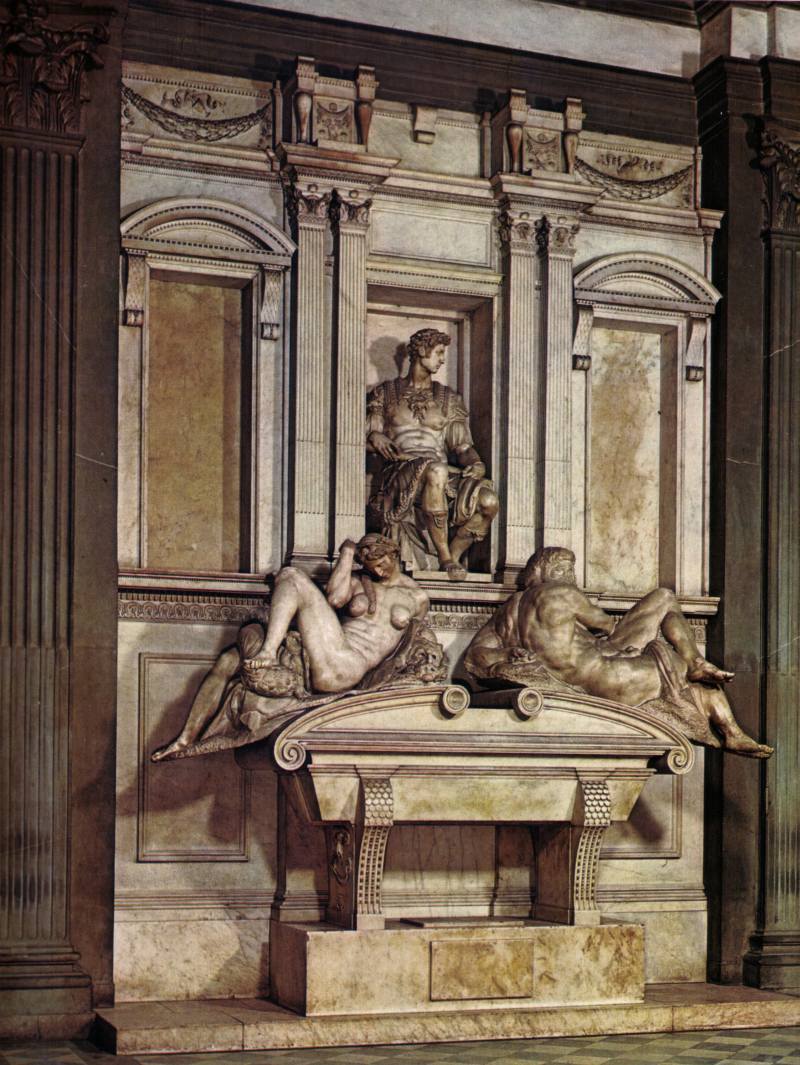
Michelangelo Buonarroti (Miguel Ángel)
(Caprese, Italia / Italy, 1475 - Roma / Rome, 1564)

"La noche / Night" (detalle / detail), mármol / marble, 155 x 150 cm.
Long. max. 194 cm en diagonal / maximum length 194 cm diagonally
Basilica di San Lorenzo (Firenze / Florencia, Italia / Florence, Italy). Wikimedia Commons

Tumba de Giuliano di Lonenzo de Médici, Duque de Namours, con "La noche", "El día", y una estatua de Giuliano /
Tomb of Giuliano di Lorenzo de' Medici, Duke of Namours, with the Night and Day along with a statue of Giuliano
Complejo arquitectónico con estatuas / Architectural complex with statues, mármol / marble, 630 x 420 cm.
Nueva sacristía / New Sacristy, Basilica di San Lorenzo (Firenze / Florencia, Italia / Florence, Italy). Wikimedia Commons

"La noche / Night". Foto / Photo: shakko. Wikimedia Commons
Museo Pushkin (Moscú, Rusia / Moscow, Russia)

Miguel Ángel en "El Hurgador" / Michelangelo Buonarroti in this blog: [Todos los enlaces / All links]
______________________________________________________________

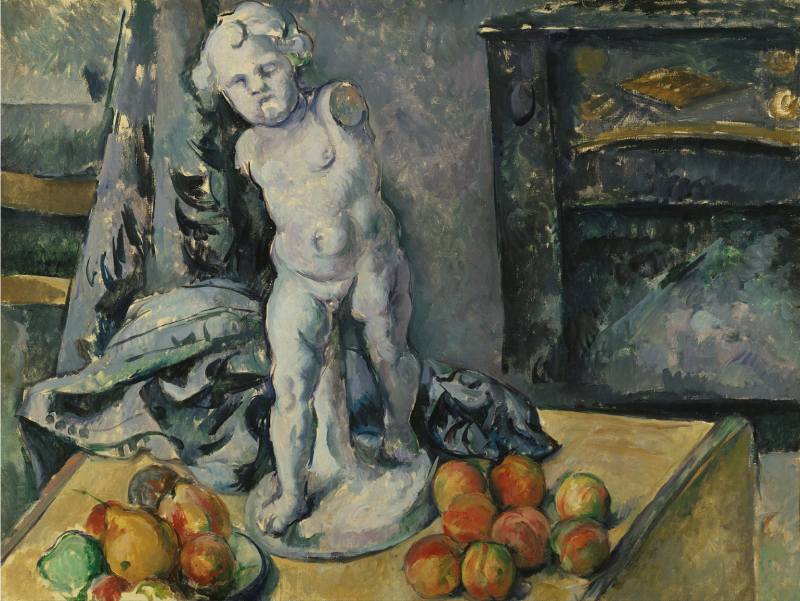
Paul Cézanne
(Aix-en-Provence, Francia / France, 1839 - 1906)

"Nature morte au chérubin / Bodegón con yeso de Cupido (Bodegón con querubín) /
Still Life with Plaster Cupid (Still Life With Cherub)"
Óleo sobre papel, sobre tabla / oil on paper, on board, 70 x 57 cm., c.1894.
The Samuel Courtauld Trust, Courtauld Institute of Art, Universidad de Londres
(Reino Unido / London, UK). Wikimedia Commons

"Bodegón con Cupido de yeso / Still Life with Plaster Cupid"
Óleo sobre lienzo / oil on canvas, 63 × 81 cm., c.1895 
Nationalmuseum (Estocolmo, Suecia / Stockholm, Sweden)
Foto / Photo: Anna Danielsson / Nationalmuseum

"La estatuilla de Cupido utilizada como accesorio en las pinturas de Cézanne /
The Cupid Statue Used as a Prop in Paul Cezanne’s Paintings"
Estudio del artista / Artist's Studio (Aix-en-Provence, Francia / France). Red Cardinal

Paul Cézanne en "El Hurgador" / in this blog: [Todos los enlaces / All links] 
______________________________________________________________

Mark Beard
(Salt Lake City, Utah, EE.UU./ UT, USA, 1956-)

Mark Beard es un artista estadounidense nacido en 1956 en Salt Lake City.
Además de ser un destacado escenógrafo, Beard trabaja con grabados, pintura y como escultor. Sus retratos, desnudos, bronces y libros artesanales se han expuesto en todo el mundo.
Beard reside en un estudio en Hell's Kitchen que compró con su socio, James Manfredi. Entre 1986 y 1997 diseñó más de 20 decorados teatrales en Nueva York, Londres, Colonia, Viena y Frankfurt.
Beard destaca por su objeción al hecho de que, si bien los artistas pueden pasar por diferentes etapas o periodos, el éxito pasa por marcar al artista con un estilo concreto. Por ello ha desarrollado varias personalidades artísticas distintas, cada una de ellas con una biografía detallada y un retrato fotográfico, para poder trabajar en una variedad de estilos y medios.
Sus diferentes personalidades artísticas incluyen:
* Bruce Sargeant (1898-1938), (una parodia de John Singer Sargent) que murió en un trágico accidente de lucha libre;
* Hippolyte-Alexandre Michallon (1849-1930), pintor francés de beaux-art que fue el maestro de Bruce Sargeant;
* Edith Thayer Cromwell (1893-1962), amiga y colega inglesa de Michallon;
* Brechtholdt Streeruwitz (1890-1973), rival de Cromwell en Viena; y
* Peter Coulter (nacido en 1948), artista afroamericano afincado en Nueva York que recibió la influencia de la obra de Cromwell y Streeruwitz.
Cada uno de estos artistas trabaja en un estilo diferente. Por ejemplo, Streeruwitz es expresionista y más sombrío, mientras que el estilo de Coulter es el arte posmoderno.

"Panorama del Oeste con escultura de un guerrero nativo americano /
Western Panorama with Sculpture of Native American Warrior"
Óleo sobre lienzo / oil on canvas, 132,1 x 195,6 x 5,1 cm., 1982. Artsy

Mark Beard is an American artist born in 1956 in Salt Lake City.
In addition to being a noted stage set designer, Beard works in prints, paint, and as a sculptor. His portraits, nudes, bronzes, and handicrafted books have been exhibited all over the world.
Beard resides in a studio in Hell's Kitchen that he bought with his partner, James Manfredi. Between 1986 and 1997, he designed more than 20 theatrical sets in New York City, London, Cologne, Vienna, and Frankfurt.
Beard is noted for his objection to the fact that while artists may pass through different stages or periods, success comes from branding the artist with one particular style. Beard therefore has developed a number of distinct artistic personalities, each with a detailed biography and portrait photograph, to enable himself to work in a variety of styles and mediums.
His different artistic personalities include:
* Bruce Sargeant (1898–1938), (a spoof on John Singer Sargent) who died in a tragic wrestling accident;
* Hippolyte-Alexandre Michallon (1849–1930), French beaux-art painter who was the teacher of Bruce Sargeant;
* Edith Thayer Cromwell (1893–1962), an English friend and colleague of Michallon;
* Brechtholdt Streeruwitz (1890–1973), a rival of Cromwell from Vienna; and
* Peter Coulter (b. 1948), a New York-based African-American artist who was influenced by Cromwell and Streeruwitz's work.
Each of these artists works in a different style. For example, Streeruwitz is expressionist and more somber, while Coulter's style is postmodern art.

Thomas Gibson Crawford
(Nueva York, EE.UU./ NY, USA, 1814 -
Londres, Reino Unido / London, UK, 1857)

"El indio: Jefe indio moribundo contemplando el progreso de la civilización /
The Indian: The Dying Chief Contemplating the Progress of Civilization"
Mármol blanco y madera / white marble and wood, 152,4 x 141 x 71,1 cm., c.1856
Historical Society (Nueva York, EE.UU./ NY, USA). Foto / Photo: Jim.henderson, Wikimedia Commons

Thomas Gibson Crawford en "El Hurgador" / in this blog[Aniversarios (CCLXXXII)]