Lo que en sus inicios fue una propuesta de Shirley Rebuffo para dedicar un post al arte relacionado con la odontología se ha convertido, gracias a minuciosas búsquedas de material en la red (una cosa lleva a la otra) en una miniserie en la que recopilamos obras de carácter artístico en la que se representan diferentes elementos relacionados con esta disciplina. Sin ánimo de ser extraordinariamente exhaustivos en el análisis, nos interesa presentar una selección más o menos cronológica de registros visuales en los que de alguna manera se trata el tema, centrándonos básicamente en la pintura y algunas otras representaciones gráficas de interés.
En este segundo capítulo, imágenes de códices y manuscritos iluminados, con especial atención a la figura de Santa Apolonia, patrona de la odontología, cuyo martirio fue representado con frecuencia en miniaturas y todo tipo de pinturas e ilustraciones.
What in its beginnings was a proposal by Shirley Rebuffo to dedicate a post to art related to dentistry has become, thanks to meticulous searches for material on the net (one thing leads to another) in a miniseries in which we compile works of an artistic nature in which different elements related to this discipline are represented. Without wishing to be extraordinarily exhaustive in the analysis, we are interested in presenting a more or less chronological selection of visual records in which the subject is dealt with in some way, focusing basically on painting and some other graphic representations of interest.
In this second chapter, images of illuminated codices and manuscripts, with special attention to the figure of Saint Apollonia, patron saint of dentistry, whose martyrdom was frequently depicted in miniatures and all kinds of paintings and illustrations.
___________________________________________________
Códice Nicetas / Niketas Codex

"Códice Nicetas / Codex Niketas"
Hippocratis Chirurgica (Ippokratous Cheirourgika)
Seu potius veterum chirurgorum insignis collectio. 25 x 36 cm., 1001-1100. Plut. 74.7, f.198v
Biblioteca Medicea Laurentiana (Firenze / Florencia, Italia / Florence, Italy)
El códice quirúrgico ilustrado más antiguo que se conserva fue escrito e iluminado en Constantinopla por el médico bizantino Niketas (Nicetas) hacia el año 900 de la era cristiana. Contiene 30 imágenes a toda página que ilustran el comentario de Apolonios de Kition al tratado hipocrático "Sobre las dislocaciones" (Peri Arthron) y 63 imágenes más pequeñas repartidas por las páginas del tratado sobre el vendaje de Soranos de Éfeso. Las pinturas apolíneas representan diversas manipulaciones y aparatos empleados en la reducción de luxaciones; cada una de las imágenes está enmarcada al estilo bizantino en un arco de diseño ornamentado.
Según el artículo de Vivian Nutton sobre el códice en Grafton et al eds., "La tradición clásica" (2010) 638, el códice Nicetas "se incluyó en la biblioteca del Orfanato de Alejo Comneno, y más tarde en la del Hospital de los Cuarenta Mártires". En 1492 o 1495, el erudito griego Janus Laskaris compró el códice Nicetas en Creta para Lorenzo de Medici. En 1530 pertenecía a Guilio de Medici, el Papa Clemente VII, "quien se lo prestó a Lascaris para que hiciera una propuesta de edición de los textos médicos y quirúrgicos que contenía, que nunca llegó a completarse". A partir de una copia realizada por Lascaris, que se encuentra en París en la Biblioteca Nacional, Ferdinando Balami realizó la primera traducción al latín de "Sobre los huesos" de Galeno (1535). Este ejemplar, iluminado por Santorinos de Rodas, entró en la biblioteca del cardenal Ridolfi, quien dispuso que Christoph Auer preparara un tercer ejemplar y lo enviara como regalo a Francisco I en 1542. Este volumen, que ahora también se encuentra en la Biblioteca Nacional, fue llevado a París por un joven médico florentino, Guido Guidi, que había preparado una traducción al latín de los textos quirúrgicos" (Nutton, op. cit.) El códice original de Nicetas fue adquirido posteriormente por el cardenal Nicolás Rudolfi, y se conserva en la Biblioteca Laurenciana (Biblioteca Laurenziana, Plut. 74.7 [Códice Nicetas]). Fuente

"Códice Nicetas / Codex Niketas", f.198v (detalle / detail)
The earliest surviving illustrated surgical codex was written and illuminated in Constantinople for the Byzantine physician Niketas (Nicetas) about 900 CE. It contains 30 full-page images illustrating the commentary of Apollonios of Kition on the Hippocratic treatise On Dislocations (Peri Arthron) and 63 smaller images scattered through the pages of the treatise on bandaging of Soranos of Ephesos. The Apollonian paintings represent various manipulations and apparatus employed in reducing dislocations; each of the images is framed in the Byzantine style in an archway of ornate design.
According to Vivian Nutton's article on the codex in Grafton et al eds., The Classical Tradition (2010) 638, the Nicetas codex "was included in the library of the Orphanage of Alexius Comnenus, and later in that of the Hospital of the Forty Martyrs." In 1492 or 1495 Greek scholar Janus Laskaris purchased the Nicetas Codex in Crete for Lorenzo de' Medici. By 1530 it belonged to Guilio de' Medici, Pope Clement VII, "who loaned it back to Lascaris for a proposed and never completed edition of the medical and surgical texts it contained. From a copy made by Lascaris, now in Paris in the Bibliothèque Nationale, Ferdinando Balami produced the first Latin translation of Galen's On Bones (1535). This copy, illuminated by Santorinos of Rhodes, entered the library of Cardinal Ridolfi, who arranged for yet a third copy to be prepared by Christoph Auer and sent as a present to Francis I in 1542. This volume, now also in the Bibliothèque Nationale, was taken to Paris by a young Florentine doctor Guido Guidi, who had prepared a Latin translation of the surgical texts" (Nutton, op. cit.) The original Nicetas codex was later acquired by Cardinal Nicolas Rudolfi, and is preserved in the Laurentian Library (Biblioteca Laurenziana, Plut. 74.7 [Codex Niketas]). Source
___________________________________________________________
Schachzabelbuch
(Libro del ajedrez / Chess Book)

"Schachzabelbuch"
Württembergische Landesbibliothek Stuttgart Cod. poet. et phil. fol. 2, Hagenau, 1467, f.59v
Württembergischen Landesbibliothek (Stuttgart, Alemania / Germany)
Este manuscrito es una copia del "Schachzabelbuch", de Konrad von Ammenhausen, una traducción en verso de la media Edad Media del "Liber de moribus hominum et officiis nobilum ac popularium super ludo saccharum" (Libro de las costumbres de los hombres y deberes de los nobles, o el Libro del Ajedrez), de Jacobus de Cessolis, creado en 1337. Incluye numerosos dibujos a pluma y tinta con relatos alegóricos.

"Schachzabelbuch", f.59v (detalle / detail)
This manuscript consists of a copy of Schachzabelbuch by Konrad von Ammenhausen, a Middle High German verse translation of Jacobus de Cessolis' Liber de moribus hominum et officiis nobilum ac popularium super ludo saccharum ('Book of the customs of men and the duties of nobles, or the Book of Chess') which was completed in 1337. It includes numerous pen-and-ink drawings of the allegorical tales within.
___________________________________________________________
Omne Bonum
(Todo lo bueno / Every Good Thing)

"Omne Bonum", Royal 6 E
por / by James le Palmer, publicado / published c.1360-c.1375
VII (Circumcisio-Dona Spiritui Sancti). f.503v
British Library (Londres, Reino Unido / London, UK)
Detalle de una inicial historiada "D"(ientes), de un dentista extrayendo dientes de un hombre sentado.
Muestra un instrumento dental en un cinturón o piel de serpiente con dientes cosidos. Estos dispositivos fueron utilizados por "dentistas" itinerantes más bien como un moderno "par de tenazas", a menudo en ferias rurales. Richard Schmidt, Washington. Fuente
La enciclopedia se compone de 1100 folios e incluye más de 650 ilustraciones. Los trabajos cubren una variedad de temas, que incluyen teología, historia natural, geografía y figuras históricas, con un interés particular en el derecho canónico. Las entradas aparecen en orden alfabético (o al menos agrupadas por su primera letra). Aunque alguna forma de ordenación alfabética similar ya se había utilizado en varios tipos de textos desde finales del siglo XII (véase, por ejemplo, el Manipulus Florum de Thomas de Irlanda), Omne Bonum es la obra enciclopédica más antigua que se conserva en alfabetizar temas de diversas materias juntos, en lugar de emplear una estructura temática o jerárquica general. Fuente
Detail of a historiated initial 'D'(entes) (Teeth) of a dentist extracting teeth of a seated man.
Shows a dental instrument on a belt or snakeskin with sewn-in teeth. Such devices were used by itinerant “dentists” rather like a modern “pair of pliers,” often at country fairs. Richard Smith, Washington. Source
The encyclopedia extends to 1100 folia and includes more than 650 illustrations. Entries cover a variety of topics, including theology, natural history, geography, and historical figures, with a particular interest in canon law. Entries appear in alphabetical order (or at least, grouped by their first letter). Although some form of similar alphabetical arrangement had already been in use in various types of texts since the late twelfth century (see, for example, Thomas of Ireland's Manipulus Florum), Omne Bonum is the earliest surviving encyclopedic work to have alphabetized topics of various subject matters together, rather than employing an overall thematic or hierarchical structure. Source
___________________________________________________________
Santa Apolonia / Saint Apollonia
Francisco de Zurbarán
(Fuente de Cantos, Badajoz, España / Spain, 1598-1664)

"Santa Apolonia / Saint Apollonia"
Óleo sobre lienzo / oil on canvas, 115 x 67 cm., c.1636-40
Musée du Louvre (París, Francia / France)
Zurbarán en "El Hurgador" / in this blog: [Recolección (XI)], [Asonancias (XXIV)], [Asonancias (XXVII)]
Santa Apolonia (Apolonia de Alejandría) está considerada como patrona de la odontología, y su festividad se celebra el 9 de febrero.
Bajo el mandato del emperador Filipo El Árabe, la premisa era perseguir, represaliar y torturar a los cristianos y así se hacía en Alejandría (parte oriental del imperio). En una de esas acciones (alrederdor del año 249, siglo III D.C.), los soldados capturaron a Apolonia, una diaconisa virgen de avanzada edad, y la torturaron con el objetivo de que se arrepintiera de su fe cristiana y adorase a los dioses paganos. Al negarse padeció la ira de la turba alejandrina, quienes la golpearon, perdiendo buena parte de sus dientes y los restantes le fueron arrancados como tortura. Según el relato de Dionisio, obispo de Alejandría (247-265), en una carta dirigida al obispo de Antioquía que se conserva en el Eusebius Historia Ecclesiae (yo: vi: 41):
"En ese tiempo Apolonia, parthénos presbytis (probablemente se refiere al cargo de diaconisa), era considerada importante. Estos hombres la agarraron también y con repetidos golpes rompieron todos sus dientes. Entonces amontonaron palos y encendieron una hoguera afuera de las puertas de la ciudad, amenazando con quemarla viva si ella se negaba a repetir, después de ellos, palabras impías, como blasfemias contra Cristo o invocación a dioses paganos. Por petición propia, fue entonces ligeramente liberada, saltando rápidamente en el fuego, quemándose hasta la muerte."

"Der Heiligen Leben / Vidas de santos / Saints Life"
Cod. Donaueschingen 117, papel / paper, 189 Bl., 15 x 11 cm.
Füssen (Alemania / Germany), 1454. Wikimedia Commons
Saint Apollonia (Apollonia of Alexandria) is considered the patron saint of dentistry, and her feast day is celebrated on February 9.
Under the rule of Emperor Philip the Arab, the premise was to persecute, retaliate and torture Christians and this was done in Alexandria (eastern part of the empire). In one of these actions (around the year 249, 3rd century A.D.), the soldiers captured Apollonia, an elderly virgin Deaconess and tortured her so that she would repent of her Christian faith and worship the pagan gods. When she refused, she suffered the wrath of the Alexandrian mob, who beat her, losing most of her teeth, and the rest were pulled out as torture. According to the account of Dionysius, bishop of Alexandria (247-265), in a letter addressed to the bishop of Antioch preserved in the Eusebius Historia Ecclesiae (I: vi: 41):
"At that time Apollonia, parthénos presbytis (mostly likely meaning a deaconess) was held in high esteem. These men seized her also and by repeated blows broke all her teeth. They then erected outside the city gates a pile of wood and threatened to burn her alive if she refused to repeat after them impious words (either a blasphemy against Christ, or an invocation of the heathen gods). Given, at her own request, a little freedom, she sprang quickly into the fire and was burned to death."
Giovanni di Giacomo Gavazzi (Gavazio)
(Italia / Italy, s.XVI / 16th Century)

Atribuido a / Attributed to Giovanni di Giacomo Gavazzi
"Martirio de Santa Apolonia / Martyrdom of Saint Apollonia"
Chiesa di Sant'Agata Del Carmine / Iglesia de Santa Ágata del Carmen /
Church of Sant 'Agata Del Carmine (Bérgamo, Italia / Italy). Wikimedia Commons
____________________________________________________________________
Santa Apolonia en Manuscritos del s.XV /
Saint Apollonia in 15th Century Manuscripts
Horas de Carlos VIII / Hours of Charles VIII

"Livre d'heures de Charles VIII / Libro de Horas de Carlos VIII / Book of Hours of Charles VIII"
Pergamino / parchment, 112h, 25 x 17 cm., s.XV. f.109v
Biblioteca Nacional (Madrid, España / Spain)
Obra de extraordinario interés hecha para Carlos VIII en el taller parisino de Antonio Verard, cuyo retrato figura en h. 112r., y su anagrama en h. 112v. Tiene 16 miniaturas a página entera y otras tantas a media página, además de otras más pequeñas que ilustran el calendario y las orlas de todas las hojas. Destaca la que representa a Luis XII en oración, y detrás de él, en pie, Carlomagno; la cabeza de Luis XII sustituye a la de Carlos VIII, que originariamente figuraba en la composición (h. 13v)
Al parecer, Luis XIII entregó el códice a un personaje español, embajador de Francia o confesor de la reina Ana. Después perteneció al Conde de Peñaranda y al Marqués de Mejorada, pasando a la Biblioteca Real en 1708. BDH

"Santa Apolonia / Saint Apollonia"
"Livre d'heures de Charles VIII", f.109v (detalle / detail)
A work of extraordinary interest made for Charles VIII in the Parisian workshop of Antoine Verard, whose portrait appears in h. 112r. and his anagram in h. 112v. It has 16 full-page miniatures and as many half-page miniatures, as well as other smaller ones that illustrate the calendar and the borders of all the leaves. The one depicting Louis XII in prayer stands out, and behind him, standing, Charlemagne; the head of Louis XII replaces that of Charles VIII, which originally appeared in the composition (h. 13v).
It seems that Louis XIII gave the codex to a Spanish personage, ambassador of France or confessor of Queen Anne. It later belonged to the Count of Peñaranda and the Marquis of Mejorada, passing to the Royal Library in 1708. BDH
Horas de Dunois / Dunois Hours

"Libro de Horas, para uso en Roma (Las horas de Dunois) /
Book of Hours, Use of Rome ('The Dunois Hours')"
Yates Thompson MS 3
Manuscrito, gótica cursiva, latín con un calendario en francés /
manuscript, Gothic cursive with a French calendar, c.1440-50 (después de / after 1436)
British Library (Londres, Reino Unido / London, UK). BL
Libro de horas francés muy decorado, encargado por Jean d'Orléans (m. 1471), conde de Dunois.
Entre la extensa decoración del libro, que aparece en casi todas las páginas del manuscrito, hay sesenta ilustraciones a toda página, pintadas en colores y oro, y acompañadas de grandes iniciales y bordes decorados. Los temas de estas ilustraciones incluyen escenas de la Vida de la Virgen y de la Vida de Cristo, retratos de los Cuatro Evangelistas y de otros santos cristianos, una representación del Oficio de Difuntos y personificaciones de los Siete Vicios.
Una inscripción francesa añadida al manuscrito en el siglo XVI indica que, tras la muerte de Dunois en 1471, el Libro de Horas fue entregado a su sobrino, el futuro rey de Francia, Luis XII (r. 1498-1515). Posteriormente pasó a manos del coleccionista de libros Abbé Fauvel, capellán de Luis XIV (r. 1643-1715) y de Luis XV (r. 1715-1774). BL

"Las horas de Dunois / The Dunois Hours". f.284v
Detalle de la miniatura de Apolonia, con vestido azul y manos atadas, mientras le arrancan los dientes durante el martirio /
Detail of a miniature of Apollonia in a blue dress and bound hands, having her teeth pulled during her martyrdom
A highly decorated French Book of Hours, commissioned by Jean d’Orléans (d. 1471), Count of Dunois.
Among the book’s extensive decoration, which appears on nearly every page of the manuscript, there are sixty full-page illustrations, painted in colours and gold and accompanied by large decorated initials and borders. The subjects of these illustrations include scenes from the Life of the Virgin and the Life of Christ; portraits of the Four Evangelists and other Christian saints; a representation of the Office of the Dead; and personifications of the Seven Vices.
A French inscription added to the manuscript in the 16th century indicates that after Dunois’s death in 1471, the Book of Hours was given to his nephew, the future King of France, Louis XII (r. 1498–1515). It later came into the possession of the book collector Abbé Fauvel, chaplain to Louis XIV (r. 1643–1715) and Louis XV (r. 1715–1774). BL

"Libro de Horas, para uso en París / Book of Hours, Use of Paris". Egerton 2019
Gótica, latín y algo de francés / Gothic, Latin and some French, 19,5 x 14 cm., f.217
British Library (Londres, Reino Unido / London, UK)

Libro de Horas, estilo de París / Book of Hours, Use of Paris", f.217 (detalle / detail)
Miniatura del martirio de Apolonia, al comienzo de su sufrimiento. Dos asistentes con turbante le extraen los dientes con pinzas mientras un hombre con corona la observa, con la inicial "B" (eata) iluminada y una orla foliada completa. BL
Miniature of the martyrdom of Apollonia, at the beginning of her suffrage. Two attendants in turbans extract her teeth with pincers whilst man with a crown looks upon, with an illuminated initial 'B'(eata) and a full foliate border. BL
Horas de Varie / Varie Hours

"Libro de horas de / Book of Hours of Simon de Varie"
Manuscrito iluminado en pergamino / Illuminated manuscript in parchment
KB 74 G37a, 1455. f.17r.
Koninklijke Bibliotheek (Den Haag / La Haya, Holanda / The Hague, Netherlands)
El Libro de Horas de Simón de Varie (o las Horas de Varie) es un libro de horas manuscrito francés encargado por el funcionario de la corte Simón de Varie, con miniaturas atribuidas a al menos cuatro artistas; la mano A, que puede haber sido un miembro del taller del Maestro de Bedford, los ilustradores anónimos conocidos como el Maestro de Jean Rolin II, el Maestro de Dunois (mano C) y el miniaturista francés Jean Fouquet. Se terminó en 1455 y consta de 49 grandes miniaturas y decenas de viñetas decorativas e iniciales pintadas, que suman más de 80 decoraciones.
El libro fue dividido en 3 volúmenes por su propietario del siglo XVII, Philippe de Béthune. Dos de ellos se encuentran actualmente en la Biblioteca Nacional de los Países Bajos, en La Haya, y fueron adquiridos en 1816 y 1890. El tercero se creyó perdido durante mucho tiempo, pero resurgió en 1983 cuando fue redescubierto por el historiador del arte y medievalista James Marrow en posesión de un librero anticuario de San Francisco. Ese volumen contiene 97 hojas y se encuentra hoy en el Getty Center de Los Ángeles. Wikipedia (English)

"Libro de horas de / Book of Hours of Simon de Varie"
Martirio de Santa Aplonia / Saint Apollonia Martyrdom, f.17r
The Book of Hours of Simon de Varie (or the Varie Hours) is a French illuminated manuscript book of hours commissioned by the court official Simon de Varie, with miniatures attributed to at least four artists; hand A who may have been a workshop member of the Bedford Master, the anonymous illustrators known as the Master of Jean Rolin II, the Dunois Master (hand C) and the French miniaturist Jean Fouquet. It was completed in 1455 and consists of 49 large miniatures and dozens of decorative vignettes and painted initials, which total over 80 decorations.
The book was divided into 3 volumes by its 17th century owner Philippe de Béthune. Two are currently housed at National Library of the Netherlands, in The Hague and were acquired in 1816 and 1890. The third was long thought to be lost, but resurfaced in 1983 when it was rediscovered by art historian and medievalist James Marrow in the possession of an antiquarian bookseller in San Francisco. That volume contains 97 leaves, and is today in the Getty Center in Los Angeles. Wikipedia
Libro de Horas / Book of Hours (MS M.348)

"Libro de Horas / Book of Hours"
MS M.348, latín, Littera bastarda, vitela / vellum, 12,5 x 8,5 cm., 274 hojas / leaves, f.259v
Aviñón, Francia / Avignon, France, c.1485-90
© The Morgan Library & Museum (Nueva York, EE.UU./ NY, USA)
Johannes Parvus

"Libro de Horas, para uso en Rennes / Book of Hours, use of Rennes"
Escriba / scribe Johannes Parvus (su firma en / signed his name on f.206v)
manuscrito, latín, francés / manuscript, Latin, French, gótica / gothic bookhand, 10,5 x 6,5 cm., 206 hojas / leaves
mcaw041951 (Widener 4), París (Francia / France), c.1405. f.195r
Biblioteca pública de Filadelfia / Free Library of Philadelphia (Pensilvania, EE.UU./ PA, USA)
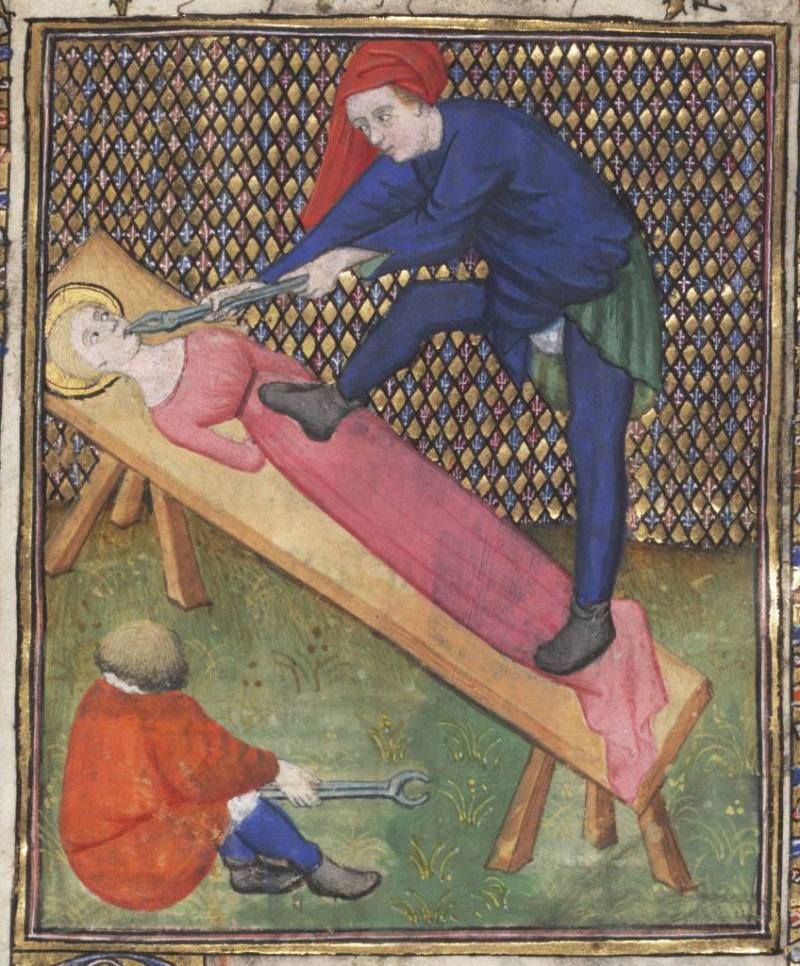
Santa Apolonia / Saint Apollonia. mcaw041951 (Widener 4), f.195r
Esta miniatura comienza la plegaria a Santa Apolonia de Alejandría, y fue pintada por el Maestro de Luçon, uno de los mejores pintores que trabajaban en Francia a principios del siglo XV. Su obra es un excelente ejemplo del Estilo Internacional, un estilo asociado a la cultura cortesana europea de esta época.
This miniature begins the Suffrage to St. Apollonia of Alexandria, and was painted by by the Luçon Master, one of the finest painters working in France in the beginning of the fifteenth century. His work is a prime example of the International Style, a style associated with courtly European culture at this time.
Horas de Carlos el Temerario / Hours of Charles the Bold

"Libro de horas de Carlos el Temerario / Prayer Book of Charles the Bold"
Témpera, pan de oro, pintura dorada, pintura plateada y tinta sobre pergamino /
tempera, gold leaf, gold paint, silver paint, and ink on parchment, 2 1/2" x 1 13/16"
Ms. 37 (89.ML.35), 1469, fol. 50v. Getty
Artistas / Artists:
Maestro vienés de María de Borgoña y taller / Vienna Master of Mary of Burgundy and workshop (Flamenco / Flemish, activo / active c.1470-80)
Lieven van Lathem y taller / and workshop (Gante, Bélgica / Ghent, Belgium, c.1430 - Antwerpen / Amberes / Antwerp, 1493)
Nicolas Spierinc (Flamenco / Flemish, activo / active 1455 - 1499)
Carlos el Temerario, duque de Borgoña e hijo del bibliófilo Felipe el Bueno, llevó a cabo muchos de los encargos de libros inacabados de su padre; este libro de oraciones es uno de los raros encargos que inició el propio Carlos. Las cuentas de los duques borgoñones registran pagos en 1469 al escriba Nicholas Spierinc de Gante, al iluminador Lieven van Lathem de Amberes y al orfebre que hizo los broches originales para la encuadernación de este costoso libro. Junto a Lathem colaboraron en este proyecto varios iluminadores anónimos, entre ellos el maestro vienés de María de Borgoña. En la década de 1480 se añadieron al volumen una serie de oraciones adicionales con miniaturas de un iluminador francés. Getty

"El martirio de Santa Apolonia / The Martyrdom of Saint Apollonia"
Charles the Bold, duke of Burgundy and son of bibliophile Philip the Good, saw many of his father's unfinished book commissions through to completion; this prayer book is one of the rare commissions Charles initiated himself. The accounts of the Burgundian dukes record payments in 1469 to the scribe Nicholas Spierinc of Ghent, to the illuminator Lieven van Lathem of Antwerp, and to the goldsmith who made the original clasps for the binding of this costly book. Along with Lathem, several anonymous illuminators collaborated on this project, including the Vienna Master of Mary of Burgundy. In the 1480s, a series of additional prayers with miniatures by a French illuminator was added to the volume. Getty
Horae ad usum Parisiensem

"Horae ad usum Parisiensem / Horas para uso en París / Hours for use in Paris"
Latín, pergamino / parchment, 27 x 19 cm., hojas / leaves 189., s.XV
Latin 1176 (Colbert 4282 / Regius 4233). f.3v
Bibliothèque Nationale (París, Francia / France). Archives et manuscrits

Horae ad usum Parisiensem, "Santa Apolonia / Saint Apollonia" (detalle / detail)
Jean Fouquet
(Tours, Francia / France, c.1420 - 1481)

"El martirio de Santa Apolonia / The Martyrdom of St Apollonia"
Iluminación / illumination, 16,5 x 12 cm., entre / between 1452 - 1460
Musée Condé (Chantilly, Francia / France). WGA

"El martirio de Santa Apolonia / The Martyrdom of St Apollonia" (detalle / detail)
Jean Fouquet en "El Hurgador" / in this blog: [Recolección (LXXXVIII)]
Libro de horas de los retablos /
Book of Hours of the Altarpieces

"Libro de horas de Alonso Fernández de Córdoba, o Libro de horas de los retablos /
Book of Hours of Alonso Fernández de Córdoba aka Book of Hours of the Altarpieces"
Manuscrito iluminado / Illuminated manuscript, pergamino / parchment, 23 x 16 cm., hojas / leaves: 194, c.1465
Artistas: Maestro de las Horas de Madrid, Maestro de Jeanne de France
Artists: Master of Hours of Madrid, Master of Jeanne de France
VITR/25/3. f.184v. Biblioteca Nacional (Madrid, España / Spain)
Ornamentación muy rica y abundantes miniaturas a modo de retablo, con una escena superior más grande, y varias inferiores, a modo de predela. En la predela de h. 175, mujer orante, probablemente la dama para la que fue hecho el libro
Según Durrieu, la decoración muestra influencias de Fouquet, de Barthelemy Clerc y del autor de las Grandes horas de Rohan, en la Biblioteca Nacional de París. Para Van den Gheyn es obra flamenca, a la manera de Vrelant. Otros autores lo atribuyen a la escuela de Jean de Tavernier. BDH

Libro de horas de los retablos / Book of Hours of the Altarpieces"
Very rich ornamentation and abundant miniatures in the form of an altarpiece, with a larger upper scene, and several lower ones, in the form of a predella. In the predella of f. 175, a praying woman, probably the lady for whom the book was made.
According to Durrieu, the decoration shows influences of Fouquet, Barthelemy Clerc and the author of the Great Hours of Rohan, in the National Library of Paris. For Van den Gheyn it is a Flemish work, in the manner of Vrelant. Other authors attribute it to the school of Jean de Tavernier. BDH
______________________________________________________
Idea, Textos / Idea, Texts: Shirley Rebuffo
Búsqueda de imágenes, Documentación / Image Search, Documentation: Javier Fuentes
Fuentes / Sources:
* "El códice Nicetas, el códice quirúrgico ilustrado más antiguo /
The Niketas Codex, the Earliest Surviving Illustrated Surgical Codex". History of Information
* "Schachzabelbuch (WLS Cod. poet. et phil. fol. 2)", Medieval Manuscripts Unlocked, 12/2017
* "Ouch, Oh and Oh No!". The New York Times, 1/2020
* Omne Bonum. Wikipedia (English)
Otros posts de esta serie / Other Posts of This Series: [Arte y odontología (I)]
______________________________________________________
Shirley Rebuffo es Licenciada en Bibliotecología y Archivología por la Escuela Universitaria de Bibliotecología y Ciencias Afines (Montevideo, Uruguay), Técnica en Museología por la Facultad de Humanidades y Ciencias (opción de Antropología), Objeto, símbolo y espacio en Curaduría. Museología Aplicada y Museología Social – Conceptos, técnicas y prácticas (Campo Grande, BR), Coaching (Campo Grande, BR), Planeamiento Estratégico (Campo Grande, BR) y estudiante de arte y pintura con el maestro Eduardo Espino.
Shirley Rebuffo has a Degree in Library Science and a Degree in Archivology by the Universitary School of Library and Related Sciences (Montevideo, Uruguay), Technician in Museology by the Faculty of Humanities and Sciences (Anthropology option), Object, Symbol and Spance in Curatorship Applied Museology and Social Museology - Concepts, Technics and Practice (Campo Grande, Brazil), Coaching (Campo Grande, Brazil), Strategic Planning (Campo Grande, Brazil), and Art and Painting student under Master Eduardo Espino.