sábado, 30 de marzo de 2019

Aniversarios Fotografía / Anniversaries Photography (CCXXIII) [Marzo / March 28-31]

Todos los aniversarios de Marzo aquí / All anniversaries for March here.
_________________________________________________________

El 28 de Marzo es el cumple de

Roger Fenton, fotógrafo británico pionero, uno de los primeros fotógrafos de guerra, nacido en 1819.
En 1838 Fenton fue a la Universidad de Oxford, donde se graduó en 1840 con una licenciatura de "primera clase" en Artes, habiendo estudiado inglés, matemáticas, griego y latín. En 1841, comenzó a estudiar leyes en la Universidad, evidentemente de forma esporádica, ya que no pudo llegar a ser abogado hasta 1847, en parte porque se interesó en el aprendizaje de pintura.
Es probable que en el otoño de 1854, cuando la guerra de Crimea atrajo la atención del público británico, que algunos amigos poderosos y clientes - entre ellos el Príncipe Alberto y el duque de Newcastle, secretario de Estado para la guerra - instaron a Fenton a ir Crimea para registrar los acontecimientos.

"Capitán Burnsby de la Guardia de Granaderos / Captain Burnsby of the Grenadier Guards"
Copia en papel salado de un negativo de vidrio /
salted paper print from a glass negative, 16,3 x 15,6 cm., 1855
Metropolitan Museum of Art (Nueva York, EE.UU./ USA)

Debido al tamaño y la naturaleza engorrosa de su equipo fotográfico, Fenton se vio limitado en la elección de sus motivos. Como el material fotográfico de su tiempo necesitaba exposiciones largas, sólo fue capaz de producir imágenes de objetos estacionarios, fotos en su mayoría posadas; evitó hacer imágenes de los soldados muertos, heridos o mutilados. Pero también fotografió el paisaje, incluyendo una zona cercana a donde tuvo lugar la carga de la brigada ligera, que se hizo famosa por el poema de Tennyson.
Sin dejarse intimidar por la falta de éxito comercial por sus fotografías de Crimea, Fenton mantuvo el impulso con gran energía para perfeccionar su arte y para registrar imágenes significativas y artísticas. Viajó mucho sobre Gran Bretaña para fotografiar paisajes y naturalezas muertas.
Murió en 1869.


Guerra de Crimea / Crimea War
"Teniente General / Lieutenant General Sir George Brown G.C.B. y oficiales de su equipo / & officers of his staff Major Hallewell, Coronel / Colonel Brownrigg, orderly, Coronel / Colonel Airey, Capitán / Captain Pearson, Capitán / Captain Markham, Capitán / Captain Ponsonby
Copia en papel salado / salted paper copy, 17,3 x 16,7 cm., 1855
Biblioteca del Congreso / Library of Congress (Washington, EE.UU./ USA)

On March 28 is the birthday of

Roger Fenton, pioneering British photographer, one of the first war photographers, born in 1819.
In 1838 Fenton went to the University of Oxford where he graduated in 1840 with a "first class" Bachelor of Arts degree, having read English, mathematics, Greek and Latin. In 1841, he began to read law at University College, evidently sporadically as he did not qualify as a solicitor until 1847, partly because he had become interested in learning to be a painter.
It is likely that in autumn 1854, as the Crimean War grabbed the attention of the British public, that some powerful friends and patrons - among them Prince Albert and Duke of Newcastle, secretary of state for war - urged Fenton to go the Crimea to record the happenings.

"Estudio orientalista de una mujer / Orientalist Study of a Woman"
Copia a la albúmina de plata de un negativo de vidrio /
albumen silver print from glass negative, 26,2 x 18,2 cm., 1858
Metropolitan Museum of Art (Nueva York, EE.UU./ USA)

Due to the size and cumbersome nature of his photographic equipment, Fenton was limited in his choice of motifs. Because the photographic material of his time needed long exposures, he was only able to produce pictures of stationary objects, mostly posed pictures; he avoided making pictures of dead, injured or mutilated soldiers. But he also photographed the landscape, including an area near to where the Charge of the Light Brigade - made famous in Tennyson's poem - took place.
Undaunted by the lack of commercial success for his Crimean photographs, Fenton remained driven with great energy to perfect his art and to record meaningful and artistic images. He travelled widely over Britain to record landscapes and still life images.
He died in 1869.

"La entente cordial / L'Entente Cordiale", copia en papel salado de un negativo de vidrio /
salted paper print from a  glass negative, 16 x 17 cm., 1855. Musée d'Orsay (París, Francia / France). GAP


El 29 de Marzo es el cumple de

Bruce Weber, fotógrafo de moda y cineasta ocasional estadounidense nacido en 1946.
Es conocido por sus campañas publicitarias para Calvin Klein, Ralph Lauren, Pirelli, Abercrombie & Fitch, Revlon y Gianni Versace, así como su trabajo para las revistas Vogue, GQ, Vanity Fair, Elle, LIFE, Interview y Rolling Stone.
La fotografías de moda de Weber aparecieron por primera vez a finales de 1970 en la revista GQ, donde tuvo frecuentes fotos de portada. Nan Bush, su compañera de toda la vida y agente, fue capaz de conseguir un contrato con Federated Department Stores para fotografiar el catálogo por correo de Bloomingdales en 1978. Llegó al público en general a finales de la década de 1980 y principios de 1990 con sus imágenes publicitarias para Calvin Klein y su retrato del entonces joven actor Richard Gere. Sus tomas directas en blanco y negro, que muestran una pareja heterosexual desnuda en un columpio frente a frente, dos hombres vestidos en la cama, y ​​el modelo Marcus Schenkenberg con tan sólo unos jeans, frente de sí mismo en una ducha, lo catapultaron al primer plano nacional. Su fotografía para Calvin Klein de atleta olímpico Tom Hintnaus en calzoncillos blancos es una imagen icónica.

"Luiza Brunet, Rio de Janeiro, Brasil / Brazil, 1986

Luiza Brunet en "El Hurgador" / in this blog: [Asonancias (V)]

Algunas otras fotografías tempranas de Weber apareció en SoHo Weekly News y mostraban una cantidad de hombres vestidos sólo con su ropa interior. Las fotos se convirtieron en centro de controversia y algunos dijeron que Weber nunca volvería a encontrar trabajo como fotógrafo de moda. Esta reputación lo acompaña. Al respecto ha dicho: "Yo en realidad no trabajo en gran número de revistas, porque muchas de ellas no quieren el tipo de fotografías que hago. Es demasiado arriesgado para ellos."

"B.B.King", Nashville, Tennessee, EE.UU. / USA, 1990

B.B.King en "El Hurgador" / in this blog:
[Ziliotto, Greban, Calcinaro, Niños chinos], [Blues & Jazz / Black & White (II)], [Aniversarios Fotografía (CCV)]

Después de hacer sesiones de fotos para y de personajes famosos (muchos de los cuales fueron presentados en la revista Interview de Andy Warhol), Weber hizo películas cortas de boxeadores adolescentes (Broken Noses / Narices rotas), sus queridos perros de compañía, y después, una película más larga titulada "Chop Suey". Dirigió "Let's Get Lost", un documental de 1988 sobre el trompetista de jazz Chet Baker.
Las fotografías de Weber son de vez en cuando en el color, sin embargo, la mayoría son en blanco y negro o en matices tonales.

"Louise Bourgeois", Nueva York, EE.UU./ NY, USA, 1997

Louise Bourgeois en "El Hurgador" / in this blog:
[Aniversarios (XLIX)], [Aniversarios Fotografía (CXLVIII)], [Aniversarios (VI, Anexo)]

On March 29 is the birthday of

Bruce Weber, American fashion photographer and occasional filmmaker born in 1946.
He is most widely known for his ad campaigns for Calvin Klein, Ralph Lauren, Pirelli, Abercrombie & Fitch, Revlon, and Gianni Versace, as well as his work for Vogue, GQ, Vanity Fair, Elle, Life, Interview, and Rolling Stone magazines.
Weber's fashion photography first appeared in the late 1970s in GQ magazine, where he had frequent cover photos. Nan Bush, his longtime companion and agent, was able to secure a contract with Federated Department Stores to shoot the 1978 Bloomingdales mail catalog. He came to the attention of the general public in the late 1980s and early 1990s with his advertising images for Calvin Klein, and his portrait of the then young actor Richard Gere. His straightforward black and white shots, featuring an unclothed heterosexual couple on a swing facing each other, two clothed men in bed, and model Marcus Schenkenberg barely holding jeans in front of himself in a shower, catapulted him into the national spotlight. His photograph for Calvin Klein of Olympic athlete Tom Hintnaus in white briefs is an iconic image.

"Ric Arango & Natalie Gabrielli"
Calvin Klein, Campaña Obsesión / Obsession Campaign
Montecito, California, EE.UU./ CA, USA, 1987

Some of Weber's other earliest fashion photography appeared in the SoHo Weekly News and featured a spread of men wearing only their underwear. The photos became the center of controversy and Weber was told by some that he would never find work as a fashion photographer again. This reputation stuck with him, as he says: "I don’t really work editorially in a large number of magazines because a lot of magazines don’t want my kind of photographs. It’s too risky for them.".

"Roy Lichtenstein", Nueva York, EE.UU./ NY, USA, 1993

Roy Lichtenstein en "El Hurgador" / in this blog: [Todos los enlaces / All links]

After doing photo shoots for and of famous people (many of whom were featured in Andy Warhol's Interview magazine), Weber made short films of teenage boxers (Broken Noses), his beloved pet dogs, and later, a longer film entitled Chop Suey. He directed Let's Get Lost, a 1988 documentary about jazz trumpeter Chet Baker.
Weber's photographs are occasionally in color; however, most are in black and white or toned shades.

"Monica Bellucci", Palermo, Sicilia, Italia / Sicily, Italy, 2002

Monica Bellucci en "El Hurgador" / in this blog: [Todos los enlaces / All links]
Bruce Weber en "El Hurgador" / in this blog: [Asonancias (V)]


Hoy, 30 de Marzo, es el cumple de

Harold Cazneaux, fotógrafo pictorialista australiano nacido en 1878 en Wellington, Nueva Zelanda. Fue un pionero cuyo estilo tuvo un impacto indeleble en el desarrollo de la historia fotográfica australiana.
Su padre, Pierce Mott Cazneaux, era un fotógrafo nacido en Inglaterra, y su madre Emily Florence era una colorista, pintora miniaturista y fotógrafa de Sydney. En la década de 1890 la familia se mudó a Adelaide. Harold comenzó a trabajar en el estudio de su padre y asistió a las clases nocturnas de H. P. Gill en la Escuela de Diseño, Pintura y Artes Técnicas.
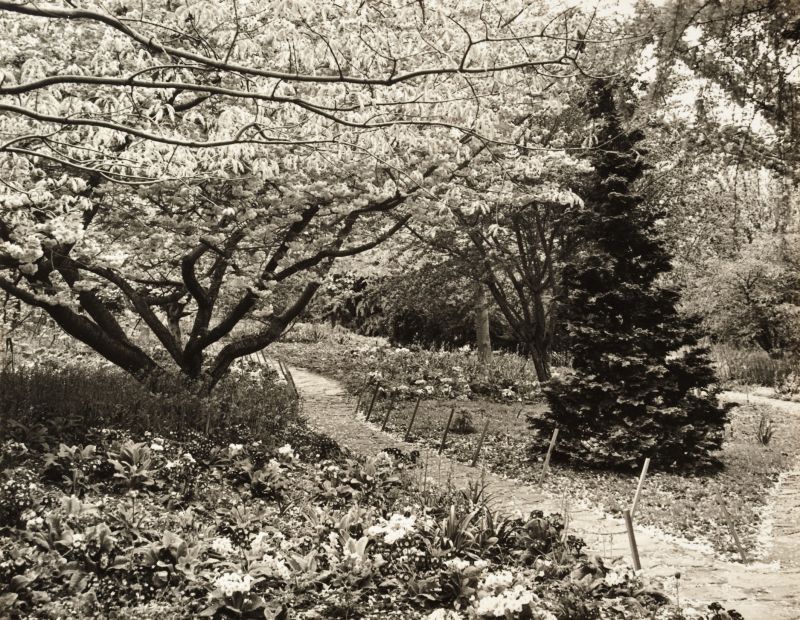
"El paseo de los cerezos cerca de la calle Denison, Everglades, Leura, Nueva Gales del Sur /
The cherry walk near Denison Street, Everglades, Leura, NSW", Australia, 12,6 x 17,3 cm., c.1945
Caroline Simpson Library & Research Collection (Sydney, Australia)

En 1904 decidió mudarse a Sydney, donde asumió un puesto en uno de los estudios fotográficos más antiguos de Sydney, Freeman & Co. Era muy bueno en el trabajo, ya que más tarde fue nombrado gerente y operador principal de la empresa. Al mismo tiempo perfeccionó sus habilidades fotográficas para documentar la arquitectura de la antigua Sydney, y en 1907 expuso la Sociedad Fotográfica de Nueva Gales del Sur. En 1909 realizó la primera exposición individual en Australia.
Las copias de Cazneaux se exhibieron en exposiciones individuales en las ventanas del Kodak Salon, Sydney, así como en muestras internacionales organizadas por el London Salon of Photography (1911 a 1952), y luego se incluyeron en los salones anuales de la Royal Photographic Society de Gran Bretaña. En 1914 ganó el concurso "Happy Moment" de Kodak, y el premio de £ 100 los destinó a un depósito para su futuro hogar.

"Camino de piedras / Stepping Stone", negativo de vidrio / glass negative, 15,8 x 11,5 cm., 1934
Biblioteca Nacional / National Library (Sydney, Australia)

Fue uno de los fundadores del Sydney Camera Circle cuyo "manifiesto" pictorialista fue redactado y firmado el 28 de noviembre de 1916 por un grupo de seis fotógrafos: Cecil Bostock, James Stening, WS White, Malcolm McKinnon y James Paton, luego se unió Henri Mallard.
En 1921 fue elegido miembro del Salón de Londres y en 1937 fue el primer australiano en recibir una beca honorífica de la Royal Photographic Society. Más allá de su obra fotográfica también fue un escritor prolífico.
Murió en 1953.

"Autorretrato de Harold Cazneaux en el espejo de un tocador /
Self-portrait of Harold Cazneaux in dressing table mirror", North Sydney, Australia
Negativo de vidrio / glass negative, 15,8 x 11,5 cm., c.1910
Biblioteca Nacional / National Library (Sydney, Australia)

Today, March 30, is the birthday of

Harold Cazneaux, Australian pictorialist photographer born in 1878 in Wellington, New Zealand. He was a pioneer whose style had an indelible impact on the development of Australian photographic history.
His father Pierce Mott Cazneaux was an English-born photographer and his mother Emily Florence was a colourist, miniature painter and photographer from Sydney. In the 1890s the family moved to Adelaide and Harold started to working in his father's studio and attended H. P. Gill's evening classes at the School of Design, Painting and Technical Arts.
In 1904 he decided to move to Sydney where he took up a position with one of Sydney's oldest photo studios, Freeman & Co. Clearly he was good at the job as he was later appointed the firm's manager and chief operator. At the same time he honed his photographic skills documenting the architecture of old Sydney and in 1907 exhibited the Photographic Society of New South Wales. In 1909 he held the first one-man exhibition in Australia.

"Fuente Archibald por la noche / Archibald Fountain At Night (Hyde Park, Sydney)"
Copia a la gelatina de plata / gelatin silver print, 29,5 x 24,3 cm., 1933
Josef Levobic Gallery (Kensington, Nueva Gales del Sur / NSW, Australia)

Cazneaux's prints were exhibited in solo shows in the windows of the Kodak Salon, Sydney, as well as international shows organised by the London Salon of Photography (1911 to 1952), and later included in the Royal Photographic Society of Great Britain's annual salons. In 1914 he won Kodak's "Happy Moment" competition, and the £100 prize money went to a deposit for his future home.
He was a founder of the Sydney Camera Circle whose Pictorialist "manifesto" was drawn up and signed on 28 November 1916 by a group of six photographers: Cecil Bostock, James Stening, W. S. White, Malcolm McKinnon and James Paton, later joined by Henri Mallard.
In 1921 he was elected a member of the London Salon and in 1937 he was the first Australian to be conferred an Honorary Fellowship by the Royal Photographic Society. Beyond his photographic oeuvre, Cazneaux was also a prolific writer.
He died in 1953.

"Espíritu de resistencia / Spirit Of Endurance"
Copia a la gelatina de plata / gelatin silver print, 9,3 x 11,1 cm., 1937.
Josef Levobic Gallery (Kensington, Nueva Gales del Sur / NSW, Australia)


El 31 de Marzo es el cumple de

Hilde Lotz-Bauer, fotógrafa alemana nacida en 1907 en Munich.
Es conocida por capturar el arte y la arquitectura de Florencia con cámaras de placa de vidrio. También fue pionera en la fotografía callejera, inmortalizando la vida de la gente común en la Italia de 1930 con su Leica portátil.
Viajó a unos 100 pueblos y ciudades de Italia y Sicilia, capturando unas 7.000 imágenes. A menudo sus modelos parecen desconocer su presencia. Su trabajo es, como ha dicho el maestro Gianni Berengo Gardin, un ejemplo temprano de periodismo fotográfico, incluso antes de su contemporáneo Henri Cartier-Bresson. Estas composiciones antes de la guerra están influenciadas por su formación artística histórica, su sensibilidad estética y un fuerte sentimiento por la dura vida de las mujeres en las aldeas remotas de las colinas.
Por encargo de Friedrich Kriegbaum, director del instituto de arte histórico alemán en Florencia (KHI), en 1939 Hilde documentó el patrimonio medieval y renacentista de la ciudad. Fotografió la joya de Ammanati, el Ponte Santa Trinita, antes de que los nazis destruyeran los puentes de la ciudad el 3 de agosto de 1944.
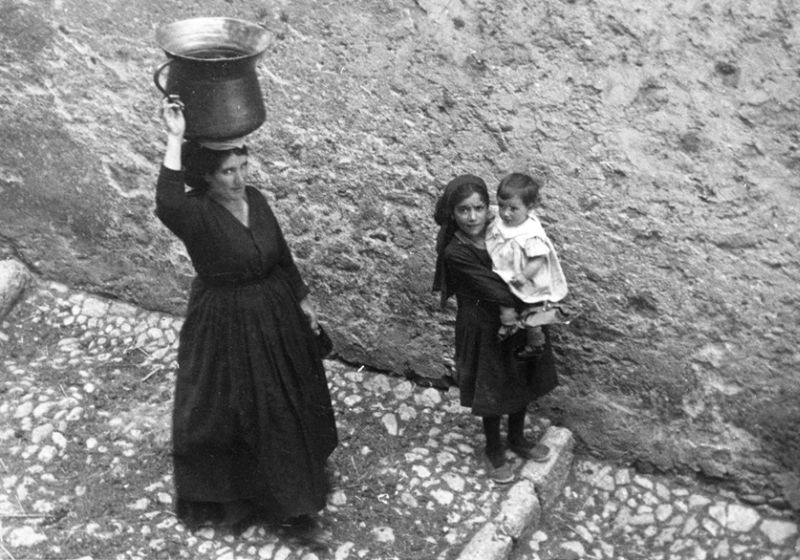
"Scanno, Italia / Italy"

A finales de la década de 1970 las fotos de Hilde se mostraron por primera vez en Florencia, Bonn y Londres con gran éxito de crítica. En 1993 colaboró ​​con el fotógrafo Franz Schlechter, quien restauró e imprimió 80 de sus imágenes de antes de la guerra de gentes, paisajes y ciudades italianos para una exposición individual en el Museo Reiss de Mannheim. En agradecimiento por sus esfuerzos, Hilde le entregó unos 7,000 de los negativos de Leica de antes de la guerra. Desde entonces, los ha estado restaurando digitalmente.
Hilde murió en 1999.

"Vista desde el este a la Torre dei Donati (con Torre degli Albizi) /
View From the East to the Torre dei Donati (with Torre degli Albizi)"
Antes de / before 1943. Florencia, Italia / Florence, Italy
Kunsthistorisches Institut in Florenz - Max-Planck-Institut (Florencia, Italia / Florence, Italy)

On March 31 is the birthday of

Hilde Lotz-Bauer, German photographer born in 1907 in München.
She is best known for capturing the art and architecture of Florence using glass plate cameras. She also pioneered street photography, immortalising the lives of ordinary people in 1930s Italy with her portable Leica.
She travelled to some 100 villages and towns throughout Italy and Sicily, capturing some 7,000 images. Often her subjects seem unaware of her presence. Her work is, as maestro Gianni Berengo Gardin has said, an early example of photojournalism, at times even before her close contemporary Henri Cartier-Bresson. These pre-war compositions are informed by her art historical training and aesthetic sensibility and a strong feeling for the harsh life of women in remote hill villages.
Commissioned in 1939 by Friedrich Kriegbaum, director of the German art historical institute in Florence (KHI), Hilde documented the city’s medieval and renaissance heritage. She photographed Ammanati's jewel, the Ponte Santa Trinita, before the Nazis destroyed the city's bridges on 3 August 1944.

"Scanno, Italia / Italy"

In the late 1970s, Hilde’s photos were shown for the first time in Florence, Bonn and London to critical acclaim. In 1993 she collaborated with photographer Franz Schlechter, who restored and printed 80 of her pre-war images of Italian people, landscapes and towns for a solo exhibition at Mannheim’s Reiss Museum. In thanks for his efforts, Hilde presented him with some 7,000 of her pre-war Leica negatives. Since then, he has been digitally restoring them.
She died in 1999.

"Scanno, Italia / Italy"

Aniversarios Fotografía / Anniversaries Photography (CCXXII) [Marzo / March 24-27]

Todos los aniversarios de Marzo aquí / All anniversaries for March here.
_________________________________________________________

El 24 de Marzo es el cumple de

Jos. J. Betting, fotógrafo holandés nacido en 1962 en Hengelo.
Se graduó de la AKI (Academia de Artes e Industria) en Enschede (1986-1991). Desde 1995 dirige su propia galería Foto21 en Bredevoort.
Los contrastes dramáticos juegan un papel importante en la fotografía de Jos J. Betting. Esto se aplica tanto a sus paisajes como a su fotografía callejera.

"Foz de Iquaçu", Brasil / Brazil, 2008 

"Mardi Gras", New Orleans, Louisiana, EE.UU./ USA, 1991

En la serie "Jardín del Edén" reproduce paisajes de manera impresionista. Utilizando una técnica desarrollada por él de varias tomas una encima de la otra, crea magníficas impresiones naturales. Las fotografías en color se tomaron en diferentes épocas del año y bajo diferentes condiciones de iluminación. Son imágenes monumentales que dan la impresión de estar pintadas.

"Kenya", África Occidental / West Africa

On March 24 is the birthday of

Jos. J. Betting, Dutch photographer born in 1962 in Hengelo.
He graduated from the AKI (Academy for Arts & Industry) in Enschede (1986-1991). Since 1995 he runs his own Gallery Foto21 in Bredevoort.
Dramatic contrasts play a major role in Jos J. Betting's photography. This applies to both his landscapes and his street photography.

"Jardín del Edén / Garden of Eden"

In the series "Garden of Eden" he reproduces landscapes in an impressionistic way. Using a technique developed by him of several shots on top of each other, create magnificent natural impressions. The color photographs were taken at different times of the year and under different lighting conditions. These are monumental images that give the impression of being painted.

"Daytona Bikeweek", Florida, EE.UU./ USA, 1991

"Belleza francesa / French Beauty", Cannes, Francia / France, 1990


El 25 de Marzo es el cumple de

Alexander Artemiev, nacido en 1903 en Gomel, Bielorrusia, Imperio Ruso. Era el menor de nueve hijos. De adolescente luchó en el Ejército Blanco y fue herido en su pierna izquierda. Huyó y se exilió en Europa (Belgrado, Praga, París) durante años hasta que pudo entrar a Estados Unidos, cosa que hizo por Ellis Island en junio de 1922 con el nombre de Alexander Artway.
Permaneció en la ciudad de Nueva York durante los siguientes 18 años. Se unió a la marina mercante y más tarde se convirtió en capitán de barcos y navegó por el mundo tomando fotos.
Vio mucho más del mundo que la persona promedio de aquellos tiempos y llevó una vida poco convencional.

"Vista hacia el puente Hell Gate desde el techo de Radio City /
Looking toward Hell Gate Bridge from roof of Radio City"
Copia a la gelatina de plata / gelatin silver print, 7,62 x 11,43 cm., 11/11/1934
Impresa / printed c.1934. Stephen Bulger Gallery

Artway estaba fascinado por los rascacielos. Fotografió las estructuras icónicas de Nueva York desde todos los ángulos, desde las la azoteas, y quizás incluso desde aviones. Asistió a la Universidad de Nueva York y se licenció en arquitectura en 1934.
Lejos de toda familia, salvo de su hermano John que vivía en Brooklyn, Artway tuvo que buscar nuevos contactos. Conoció a Lena, una mujer cuya familia aún estaba en Ucrania. Los dos exploraron la ciudad juntos y llevaron adelante una aventura que duró muchos años.
Artway fotografió de forma casi compulsiva durante unos 15 años y solo se desaceleró después del nacimiento de su primer hijo. En Filadelfia se convirtió en un verdadero hombre de familia, y las fotografías posteriores a 1942 reflejan la identidad recién descubierta de Artway.
Murió en 1963.

"Bajo Manhattan desde el puente de Brooklyn /
Lower Manhattan from Brooklyn Bridge"
Copia a la gelatina de plata / gelatin silver print, 10,8 x 7,62 cm., 1/7/1935
Impresa / printed c.1935. Stephen Bulger Gallery

On March 25 is the birthday of

Alexander Artemiev, born in 1903 in Gomel, Belarus, Russian Empire. He was the youngest of nine children. As a teenager he fought in the White Army and was wounded in his left leg. He fled and went into exile in Europe (Belgrade, Prague, Paris) for years until he was able to enter America. He entered on Ellis Island in June of 1922 under the name Alexander Artway.
He remained in New York City for the next 18 years. He joined the Merchant Marines and later became a captain of ships and sailed around the world taking pictures.
He saw much more of the world than the average person of these times and led a rather unconventional life.

"Estación meteorológica y oficina del tiempo. Central Park, Nueva York, EE.UU. /
Meteorological Station & Weather Bureau. Central Park, New York, USA"
Copia a la gelatina de plata / gelatin silver print, 11.43 x 8.26 cm., , 12/2/1935
Impresa / printed c.1935. Stephen Bulger Gallery

Artway was fascinated by the skyscrapers going up. He photographed New York's iconic structures from every angle and rooftop, and perhaps even from airplanes. He attended  NYU and earned a degree in architecture in 1934.
Away from all family but his brother John, who lived in Brooklyn, Artway had to seek out new connections. He found Lena, a woman whose family was still in Ukraine. The two explored the city together and carried on an affair that lasted many years.
Artway photographed nearly compulsively for about 15 years and only slowed down after the birth of his first child. In Philadelphia he became a true family man, and the photographs after 1942 are reflective of Artway’s newfound identity.
He died in 1963.

"Sin título [Rayos de sol a través de las ventanas laterales, Gran Estación Central] /
Untitled [Sun rays through side windows, Grand Central Station]"
Copia a la gelatina de plata / gelatin silver print, 11,43 x 8,26 cm., c.1935. Stephen Bulger Gallery


El 26 de Marzo es el cumple de

Hugo Adolf Bernatzik, antropólogo y fotógrafo austriaco nacido en 1897 en Viena, fundador del concepto de antropología alternativa.
Después de la escuela, en 1915, se ofreció como voluntario para unirse al Ejército Austro-Húngaro y se desplegó entre otros lugares en Albania. En 1920 abandonó sus estudios médicos por razones financieras y se convirtió en un hombre de negocios. Después de la muerte temprana de su primera esposa, Margarete Ast (1904-1924), emprendió numerosos viajes y expediciones para tomar fotografías, que se convirtieron en su profesión y pasión: España y África noroccidental en 1924, Egipto y Somalia en 1925, Sudán anglo-egipcio en 1927, Rumania y Albania entre 1926 y 1930, Guinea portuguesa en 1930-1931 (con Bernhard Struck, Museo de Etnología, Dresde), Las Islas Salomón británicas, Nueva Guinea británica y Bali en Indonesia en 1932-1933, La Laponia sueca en 1934, Birmania, Tailandia e Indochina francesa (Vietnam, Laos, Camboya) en 1936-1937, y el Marruecos francés en 1949-1950.

"Esposa del jefe Mangbetu, Congo Belga / Wife of Mangbetu Chief, Belgian Congo"
Von dem Buch "Der dunkle Erdteil: Afrika, Landschaft / Volksleben" /
Del libro "El continente negro: África, los paisajes y las gentes" /
From the book "The dark continent: Africa, the landscape and the people"
Primera edición / first edition: 1931. Archive

Bernatzik financió su investigación y sus gastos vitales como escritor de viajes y científico independiente, publicando coberturas fotográficas, dando conferencias públicas y comprando colecciones para museos etnológicos en Alemania y Suiza. Su actividad periodística y sus excepcionales fotografías de personas extranjeras lo hicieron bastante prominente. Preparó un archivo fotográfico mundial de gentes de tribus remotas consideradas amenazadas. Con respecto a las políticas coloniales, Bernatzik argumentó que los administradores coloniales deberían tomar en cuenta las costumbres, el modo de vida y el ambiente tribal. A partir de 1930 estudió etnología, antropología y geografía en la Universidad de Viena y se doctoró en 1932.
Durante la guerra también trabajó en la finalización de su publicación más importante, una monografía de los Akha y los Miao. Entre 1940 y 1942 viajó repetidamente a París ocupada para cooperar con los etnólogos franceses y acceder a varios archivos coloniales para su trabajo. Intentó, en la medida de lo posible, ayudar a los colegas perseguidos en el Musee de l'Homme y prevenir el vandalismo de archivos y colecciones.
Murió en 1953.

"Guerrero Shilluk con tocado / Shilluk Warrior With Hood Coiffure"
Von dem Buch "Der dunkle Erdteil: Afrika, Landschaft / Volksleben" /
Del libro "El continente negro: África, los paisajes y las gentes" /
From the book "The dark continent: Africa, the landscape and the people"
Primera edición / first edition: 1931. Archive

On March 26 is the birthday of

Hugo Adolf Bernatzik, Austrian anthropologist and photographer born in 1897 in Vienna, founder of the concept of alternative anthropology.
After school, in 1915, he volunteered to join the Austro–Hungarian Army and was deployed among other places in Albania. In 1920, he abandoned his medical studies for financial reasons and became a businessman. After the early death of his first wife Margarete Ast (1904–1924), he embarked on extensive travels and expeditions taking photographs, which became his profession and passion: Spain and north–west Africa in 1924; Egypt and Somalia in 1925; Anglo-Egyptian Sudan in 1927; Romania and Albania between 1926 and 1930; Portuguese Guinea in 1930–1931 (with Bernhard Struck, Museum of Ethnology, Dresden); British Solomon Islands, British New Guinea, as well as Bali in Indonesia in 1932–1933; Swedish Lapland in 1934; Burma, Thailand and French Indochina (Vietnam, Laos, Cambodia) in 1936–1937; and, French–Morocco in 1949–1950.

"Mujer Sara con platos labiales / Sara Woman With Labrets"
Von dem Buch "Der dunkle Erdteil: Afrika, Landschaft / Volksleben" /
Del libro "El continente negro: África, los paisajes y las gentes" /
From the book "The dark continent: Africa, the landscape and the people"
Primera edición / first edition: 1931. Archive

Bernatzik financed his research and living expenses as a travel writer and freelance scientist, by publishing photo coverages, giving public slide lectures and purchasing collections for ethnological museums in Germany and Switzerland. His journalistic activity and his exceptional photographs of foreign people made him quite prominent. He prepared a worldwide photo archive of remote tribal people considered as threatened. With regard to colonial policies, Bernatzik argued that colonial administrators should take the customs, way of life and the tribal environment into account. From 1930 on, he studied ethnology, anthropology and geography at the University of Vienna and completed a PhD doctorate in 1932.
During the war, Bernatzik also worked on the completion of his most important publication, a monograph of Akha and Miao. Between 1940 and 1942, he travelled repeatedly to occupied Paris to cooperate with French ethnologists and to access various colonial archives for his work. He tried as far as possible to help persecuted colleagues at the Musee de l'Homme and to prevent the vandalism of archives and collections.
He died in 1953.

"Chica Eliri / Eliri Girl"
Von dem Buch "Der dunkle Erdteil: Afrika, Landschaft / Volksleben" /
Del libro "El continente negro: África, los paisajes y las gentes" /
From the book "The dark continent: Africa, the landscape and the people"
Primera edición / first edition: 1931. Archive


El 27 de Marzo es el cumple de

Louise Rosskam (Louise Rosenbaum), fotógrafa estadounidense de la Administración de Seguridad Agrícola (FSA) y de la Standard Oil Company a mediados del siglo XX.
Nació en 1910 en Filadelfia, Pensilvania. Junto con su esposo, Edwin Rosskam (1903-1985), documentaron la vida estadounidense durante la Gran Depresión. Los Rosskam fueron parte de un grupo de talentosos fotógrafos contratados por Roy Stryker, el jefe de la FSA entre 1935 y 1944, durante lo que a menudo se llama la "Edad de Oro de la Fotografía Documental".
En 1929, Louise conoció a Edwin Rosskam, un artista y aspirante a fotógrafo que ayudaría a Louise a desarrollar su talento. En 1933 Louise se graduó en biología en la Universidad de Pennsylvania.

"Cody, Wyoming", Julio / July, 1944. Flickr

Durante sus carreras, Louise y su esposo Edwin trabajaron como fotógrafos para la Administración de Seguridad de Granjas, la Oficina de Información de Guerra, la Standard Oil Company de Nueva Jersey, la Oficina de Información de Puerto Rico y el Departamento de Educación de Nueva Jersey. Muchas de sus fotos, tomadas mientras trabajaban para las agencias gubernamentales, están ahora en los archivos de la Biblioteca del Congreso y son parte del dominio público.
En 1948 Rosskams publicó Towboat River, un libro fotográfico que detalla la vida en el río Mississippi.
Residentes de Roosevelt, Nueva Jersey, los Rosskams tuvieron dos hijas, Anita y Susan.
Louise murió en 2003.

"Haciendo muñecas en la División de Industrias Manuales de la Compañía de Desarrollo Industrial de Puerto Rico /
 Making dolls in the Manual Industries Division of the Puerto Rico Industrial Development Company"
Cerca de / near Isla Verde, Puerto Rico
Copia a la gelatina de plata / gelatin silver print, May. 1947. Musings

On March 27 is the birthday of

Louise Rosskam (Louise Rosenbaum), American photographer for the Farm Security Administration (FSA) and the Standard Oil Company during the mid-20th century.
She was born in 1910 in Philadelphia, Pennsylvania. Together with her husband, Edwin Rosskam (1903–1985), the pair documented American life during the Great Depression. The Rosskams were part of a group of talented photographers hired by Roy Stryker, the head of the FSA between 1935 and 1944, during what is often called the "Golden Age of Documentary Photography"
In 1929, Louise met Edwin Rosskam, an artist and aspiring photographer who would help Louise develop her talent. In 1933, Louise graduated from the University of Pennsylvania with a degree in Biology.

"Granjero en su campo de papas, cerca de Bristol /
Farmer in his potato field near Bristol", 1944. Vermont, EE.UU. / USA. Photogrammar

During their careers, Louise and her husband Edwin worked as photographers for the Farm Security Administration, the Office of War Information, the Standard Oil Company of New Jersey, the Puerto Rico Office of Information, and the New Jersey Department of Education. Many of their photos taken while working for the Government agencies are now in the archives of the Library of Congress, and are part of the public domain.
In 1948, the Rosskams published Towboat River, a photographic book detailing life on the Mississippi River.
Residents of Roosevelt, New Jersey, the Rosskams had two daughters, Anita and Susan.
Louise died in 2003.

"Un niño espera el comienzo de un desfile militar en la Calle N, SW en Washington /
A young boy waits for a military parade to begin on N Street, SW in Washington, D.C.", 1938. Wikimedia Commons

domingo, 24 de marzo de 2019

Aniversarios / Anniversaries (CCLXXXII) [Marzo / March 21-24]

Todos los aniversarios de Marzo aquí / All anniversaries for March here.
_________________________________________________________

El 21 de Marzo es el cumple de

Jean Marius Carlus, escultor francés nacido en 1852 en Lavaur.
Alumno de Alexandre Falguière y Antonin Mercié en la École des Beaux-Arts de París, es el autor del Monumento a Buffon en el Jardin des Plantes de París, cuyo modelo de yeso se conserva en Montbard, en el Museo de Buffon.

"Georges-Louis Leclerc, comte de / Conde de / Count of Buffon (1707-1788)"
Bronce / bronze, 1883. Wikimedia Commons
Jardin des Plantes, Muséum national d'histoire naturelle (Paris, Francia / France)

Georges Louis Leclerc en "El Hurgador" / in this blog: [Todos los enlaces / All Links]

Wikimedia Commons

Georges-Louis Leclerc en "El Hurgador" / in this blog:
[Rinocerontes (XLVI)], [Rinocerontes (LX)], [Aniversarios (CXLII)], [Recolección (CLIV-2)]

Miembro del jurado del "Salon des artistes français" donde expuso en 1880, se convirtió en miembro de la Sociedad de Artistas Franceses en 1886 y expuso allí. Fue premiado por sus trabajos en 1886 (medalla de tercera clase) y 1899 (medalla de primera clase). En 1889 ganó una medalla de bronce en la Feria Mundial, y una medalla de plata en la de 1900.
Fue nombrado Caballero de la Legión de Honor en 1920.
Murió en 1930.

"L'Eau / El agua / The Water"
Mármol / marble, Salon de 1910
Quartier de Bonnefoy (Toulouse, Francia / France). Wikimedia Commons

"L'Eau / El agua / The Water"

On March 21 is the birthday of

Jean Marius Carlus, French sculptor born in 1852 in Lavaur.
A pupil of Alexandre Falguière and Antonin Mercié at the École des Beaux-Arts in Paris, Jean Carlus is notably the author of the Monument to Buffon in the Jardin des Plantes in Paris, whose plaster model is preserved in Montbard at the Buffon Museum.

"Tumba de / Tomb of Jules-Louis-Joseph Vallès (1832-1885)"
Busto de bronce / bronze bust, altura / height: 65 cm.
Cementerio / Cemetery Père Lachaise (París, Francia / France). Wikimedia Commons

Member of the jury of the Salon des artistes français where he exhibited in 1880, he became a member of the Society of French Artists in 1886 and exhibited there. He was rewarded for his works in 1886 (3rd class medal) and 1899 (1st class medal). In 1889, he won a bronze medal at the World Fair, and a silver medal in the one of 1900.
He was appointed Knight of the Legion of Honor in 1920.
He died in 1930.

"Tumba de / Tomb of Jules-Louis-Joseph Vallès (1832-1885)". Wikimedia Commons


El 22 de Marzo es el cumple de

Thomas Gibson Crawford, escultor estadounidense nacido en 1814 en la ciudad de Nueva York, conocido por sus numerosas contribuciones artísticas al Capitolio de los Estados Unidos.
Su amor por el arte lo llevó, a la edad de 19 años, a ingresar a los estudios de la ciudad de Nueva York de John Frazee y Robert Eberhard Launitz, artistas y artífices del mármol.
En 1834 se fue al extranjero para la promoción de estudios artísticos, y en el verano de 1835 estableció su residencia en Roma de por vida. Launitz le entregó a Crawford una carta de presentación para Bertel Thorwaldsen, y al llegar a Roma se convirtió en alumno de este. Bajo su guía, Crawford se dedicó al estudio de los modelos antiguos y del natural.
Su primer trabajo ideal fue un grupo de Orfeo y Cerbero, ejecutado en 1839 y comprado, algunos años más tarde, para el Athenaeum de Boston. Actualmente se exhibe en el Museo de Bellas Artes de Boston. Esto fue seguido por una sucesión de grupos, figuras individuales y bajorrelieves, cuya rápida producción fue testigo de la fertilidad y la versatilidad de su genio.

"El indio: Jefe indio moribundo contemplando el progreso de la civilización /
The Indian: The Dying Chief Contemplating the Progress of Civilization"
Mármol blanco y madera / white marble and wood, 152,4 x 141 x 71,1 cm., c.1856
Historical Society (Nueva York, EE.UU./ NY, USA). Wikimedia Commons

En 1849, durante una visita a Estados Unidos, recibió del estado de Virginia un encargo para que se erigiera un monumento en Richmond. Inmediatamente regresó a Roma y comenzó el trabajo, cuyo diseño fue una estrella de cinco rayos, cada uno de ellos con una estatua de algún histórico de Virginia, Patrick Henry y Thomas Jefferson entre ellos. La obra está coronada por un plinto, en el que se encuentra una estatua ecuestre de George Washington. Estas estatuas fueron modeladas en Roma y fundidas en Munich.
Las obras más importantes de Crawford después de éstas fueron ordenadas por el gobierno federal para el Capitolio de los Estados Unidos en Washington. La primera de ellas fue un frontón de mármol con figuras de tamaño natural que simbolizan el progreso de la civilización estadounidense. Luego vino una figura de bronce, Libertad triunfante en la guerra y la paz, que corona la cúpula, y la última, la obra de vida, fue una puerta de bronce en la que se modelan varias escenas de la vida pública de Washington. Entre las obras de Crawford también se destacaba su estatua de un jefe indio, muy admirado por el escultor inglés Gibson, quien propuso que se conservara en Roma una copia de bronce.
Crawford murió en 1857.

"Raphael", mármol / marble, 41" x 16" x 14", 1855
High Museum of Art (Atlanta, Georgia, EE.UU./ USA). Wikimedia Commons

Rafael Sanzio en "El Hurgador" / in this blog: [Todos los enlaces / All Links]

On March 22 is the birthday of

Thomas Gibson Crawford, American sculptor born in 1814 in New York City, who is best known for his numerous artistic contributions to the United States Capitol.
His love of art led him, at the age of 19, to enter the New York City studios of John Frazee and Robert Eberhard Launitz, artists and artificers in marble.
In 1834, he went abroad for the promotion of artistic studies, and in the summer of 1835 took up his residence in Rome, for life as it proved. Launitz had provided Crawford with a letter of introduction to Bertel Thorwaldsen and upon arriving in Rome, Crawford became a pupil of Thorwaldsen. Under his guidance, Crawford devoted himself to the study both of the antique and of living models.
His first ideal work was a group of Orpheus and Cerberus, executed in 1839, and purchased, some years later, for the Boston Athenaeum, and now displayed at the Museum of Fine Arts, Boston. This was followed by a succession of groups, single figures, and bas-reliefs, whose rapid production bore witness to the fertility as well as the versatility of his genius.

"Chica mexicana muriendo / Mexican Girl Dying"
Mármol / marble, 51,4 x 138,4 x 49,5 cm., esculpida en / carved 1848
Metropolitan Museum of Art (Nueva York, EE.UU./ NY, USA) . Wikimedia Commons

In 1849, while on a visit to this country, he received from the state of Virginia an order for a monument to be erected in Richmond. He immediately returned to Rome and began the work, of which the design was a star of five rays, each one of these bearing a statue of some historic Virginian, Patrick Henry and Thomas Jefferson among the number. The work is surmounted by a plinth, on which stands an equestrian statue of George Washington. These statues, modeled in Rome, were cast at a Munich foundry.
Crawford's most important works after these were ordered by the federal government for the United States Capitol at Washington. First among these was a marble pediment bearing life-size figures symbolical of the progress of American civilization; next in order came a bronze figure Freedom Triumphant in War and Peace which surmounts the dome; and last of these, and of his life-work, was a bronze door on which are modelled various scenes in the public life of Washington. Prominent among Crawford's works was also his statue of an Indian chief, much admired by the English sculptor Gibson, who proposed that a bronze copy of it should be retained in Rome as a lasting monument.
Crawford died in 1857.

"Orfeo y Cerbero / Orpheus & Cerberus", mármol / marble, 171,5 x 91,4 x 137,2 cm., 1843
Museum of Fine Arts (Boston, Massachusetts, EE.UU./ USA)

"Orfeo y Cerbero / Orpheus & Cerberus" (detalle / detail)

Thomas Gibson Crawford en "El Hurgador" / in this blog: [Pintando esculturas (II)]


El 23 de Marzo es el cumple de

Jürgen von Woyski, escultor y pintor alemán nacido en 1929 en Stolp. En 1947, después de la guerra, se mudó con sus padres y su hermano menor Klaus a Osterwieck.
En 1948 viajó con Klaus para estudiar en Halle (Saale) en la escuela de arte Burg Giebichenstein. Comenzó a estudiar escultura con Gustav Weidanz, mientras que su hermano comenzó a estudiar pintura con Charles Crodel. En 1949 participó en un seminario para maestros de taller en Halle an der Saale y fue nombrado nuevo maestro en la escuela en Köthen. A partir de 1952 continuó sus estudios de arte con Fritz Koelle y Heinrich Drake en la Kunsthochschule Berlin-Weißensee, Departamento de Plástica, y se graduó en 1955 con un diploma.

"Liebespaar unter dem Schirm / Amantes bajo el paraguas / Lovers Under the Umbrella"
Skulpturenpark auf der Freundschaftsinsel / Parque de esculturas en la Isla de la Amistad /
Friendship Island Sculpture Park (Potsdam, Alemania / Germany). Wikimedia Commons

Woyski comenzó el trabajo de cerámica en Marwitz en 1955, y en 1956 acudió al llamado del arquitecto de la ciudad de Hoyerswerda, Ferdinand Rupp, quien había invitado a jóvenes artistas a ayudar a dar forma a la nueva ciudad emergente, con esculturas y fuentes. Desde 1975 Woyski fue Director Artístico del Simposio de Escultores de Hoyerswerda, en el que artistas internacionales crearon esculturas en la ciudad, principalmente de arenisca. Von Woyski vivió durante 45 años desde 1955 en Hoyerswerda, ciudad de la que fue nombrado ciudadano honorario en 1998, y a finales de 1998 se mudó a Dresde. Desde 1969 fue miembro de la Academia de Artes de la RDA. Fue el iniciador y director artístico del simposio bienal de escultores de Hoyerswerda. De 1981 a 1986 enseñó en la Kunsthochschule Berlin Weißensee como jefe del departamento de cerámica de la construcción. En 1993 recibió una cátedra honorífica de diseño escultórico en la Universidad Técnica de Cottbus. Las obras del artista se pueden encontrar no solo en Hoyerswerda sino también en Berlín, Potsdam, Cottbus, Eisenhüttenstadt, Guben, Jessen, Lübben (Spreewald), Schwedt, Senftenberg, Vetschau / Spreewald y Weißwasser.
Murió en el 2000.

"Trompeter / Trompetista / Trumpeter"
Schloss Hoyerswerda / Museo Castillo de Hoyerswerda (Alemania / Germany). Wikimedia Commons

"Gespann / Carro de caballos / Horse Cart", piedra / stone, 1985
Weißwasser, Tierpark / Zoo de Weisswasser (Weißwasser/Oberlausitz, Alemania / Germany). Wikimedia Commons

On March 23 is the birthday of

Jürgen von Woyski, German sculptor and painter born in 1929 in Stolp. In 1947, after the war, he moved with his parents and younger brother Klaus to Osterwieck.
In 1948 he went with Klaus to study in Halle (Saale) in the art school Burg Giebichenstein. He began studying sculpture with Gustav Weidanz, while his brother began studied painting with Charles Crodel. In 1949 he took part in a workshop teacher seminar in Halle an der Saale and was appointed new teacher in the school in Köthen. From 1952 he continued his studies of art with Fritz Koelle and Heinrich Drake at the Kunsthochschule Berlin-Weißensee, Department of Fine Arts, and graduated in 1955 with a diploma.

"Junges Mädchen / Chica joven / Young Girl", bronce / bronze, 1965
Frente a la Clínica Lusatian Lakeland, Calle Maria Grollmuss, 10 /
in front of the Lusatian Lakeland Clinic, Maria-Grollmuß-Straße 10
(Hoyerswerda, Alemania / Germany). Wikimedia Commons

Woyski started ceramic work in Marwitz in 1955 and followed in 1956 the call of the city architect of Hoyerswerda, Ferdinand Rupp, who had invited young artists to help shape the newly emerging new city, with sculptures and fountains. From 1975, Woyski was Artistic Director of the Hoyerswerda Sculptors' Symposia, in which international artists in Hoyerswerda created sculptures mainly of sandstone. Von Woyski lived for 45 years since 1955 in Hoyerswerda. He was named honorary citizen in 1998, and moved in late 1998 to Dresden. Since 1969 Woyski was a member of the Academy of Arts of the GDR. He was the initiator and artistic director of the biennial Hoyerswerda Sculptors Symposium. From 1981 to 1986 he taught at the Kunsthochschule Berlin Weißensee as head of the building ceramics department. In 1993 he was awarded an honorary professorship for sculptural design at the Technical University of Cottbus. Works by the artist can be found not only in Hoyerswerda but also in Berlin, Potsdam, Cottbus, Eisenhüttenstadt, Guben, Jessen, Lübben (Spreewald), Schwedt, Senftenberg, Vetschau / Spreewald and Weißwasser.
He died in 2000.

"Stehende und Hockende / De pie y agachada / Standing and Crouching"
Bronce / bronze, calle Laugk en / Laugkstraße in Senftenberg
(Brandenburgo, Alemania / Brandenburg, Germany). Wikimedia Commons


Hoy, 24 de Marzo, es el cumple de

Mateo Inurria Lainosa, escultor español nacido en 1867 en Córdoba.
Comenzó sus estudios artísticos en el taller de su padre. Hasta 1883 asistió a la Escuela Provincial de Bellas Artes bajo la dirección de Rafael Romero Barros. De 1883 a 1885 estudió en la Escuela Especial de Pintura, Escultura y Grabado en Madrid.
Sus logros académicos fueron notados por miembros de la Diputación Provincial de Córdoba (gobierno regional) quienes le otorgaron una beca para que pudiera continuar sus estudios en la Real Academia de Bellas Artes de San Fernando hasta 1890, cuando tuvo su primera muestra en la Exposición Nacional de Bellas Artes con "Un náufrago" realizado de manera tan realista que algunos jurados sospecharon que había sido vaciada de un modelo vivo.

"Lucio Anneo Séneca", yeso patinado / patinated plaster, 1894-95
Museo de Bellas Artes (Córdoba, España / Spain). Wikimedia Commons

Séneca en "El Hurgador" / in this blog: [Aniversarios (IX)], [Aniversarios (XXXIX)]

Entre 1891 y 1901, Inurria vive inmerso en un ambiente provinciano, poco abierto a la crítica y al público, e inicia su labor como restaurador y profesor. Su escultura supera las restricciones del academicismo y tiende hacia un naturalismo sobrio, de expresión sencilla y carente de detalles anecdóticos, en el que ya se advierte la tendencia a idealizar sus modelos que impregnará su obra de madurez. Inurria se considera a sí mismo un autodidacto, llegando a afirmar: «No he tenido maestro, me he hecho solo». Trabaja la escultura religiosa y conmemorativa, y durante toda su carrera, en Córdoba y en Madrid, recibe abundantes encargos monumentales para homenajear a celebridades de la vida local y nacional, que no siempre llegan a erigirse. También, en esta época, vivió temporalmente en Roma donde coincidió con otros artistas de su generación como el también cordobés Rafael Romero de Torres y con el artista burgalés Marceliano Santa María.

"Ensueño / Daydream", mármol / marble, 48 x 49 x 54 cm.
Real Academia de Bellas Artes de San Fernando (Madrid, España / Spain). Wikimedia Commons

Finalmente se convirtió en catedrático de Modelado de la Figura y Dibujo del Antiguo en la Escuela Municipal de Artes y Oficios de Córdoba, y en 1901 fue nombrado Director de la Escuela Superior de Artes Industriales. En 1905 el escultor Rodin llega a España acompañado de su íntimo amigo Ignacio Zuloaga. Inurria tiene la ocasión de conocerlo y acompañarlo en su visita a Córdoba. Desde esta época, Inurria participa periódicamente en los jurados de la sección de escultura de las Exposiciones Nacionales de Bellas Artes de Madrid.
En 1911 fue nombrado profesor de término de Modelado y Vaciado en la Escuela de Artes y Oficios de Madrid. Ahora que estaba en la capital, pudo hacer más contactos para promover su obra y se concentró cada vez más en su tema preferido, el desnudo femenino. Obtuvo la Medalla de Oro en la Exposición Nacional de Bellas Artes de 1920 y dos años después se convirtió en Académico en la Real Academia de Bellas Artes de San Fernando.
Murió en 1924.

"Monumento a / Monument to Lope de Vega"
Plaza de la Encarnación (Madrid, España / Spain). Wikimedia Commons

Lope de Vega en "El Hurgador" / in this blog: [Recolección (LXXVI)]

Today, March 24, is the birthday of

Mateo Inurria Lainosa, Spanish sculptor born in 1867 in Córdoba.
His began his artistic studies in his father's workshop. Until 1883, he attended the "Escuela Provincial de Bellas Artes" under Rafael Romero Barros. From 1883 to 1885, he studied at the "Escuela Especial de Pintura, Escultura y Grabado" in Madrid.
His academic achievements were noted by members of the "Diputación Provincial de Córdoba" (the regional government) who granted him a scholarship so he could continue his studies at the Real Academia de Bellas Artes de San Fernando until 1890, when he had his first showing at the National Exhibition of Fine Arts with "The Castaway", which was done so realistically that some jurors suspected it of having been cast from life.

"La parra / The Vine", piedra / stone, 96 x 23 x 18 cm., 1920
Museo Nacional Centro de Arte Reina Sofía (Madrid, España / Spain)

Between 1891 and 1901, he lived in the countryside, oblivious to critics and the public, becoming established as a teacher and art restorer. His many projects included the Mosque–Cathedral of Córdoba and the Medina Azahara. During these years, his work took on greater simplicity and he always spoke of himself as having been self-taught. He produced mostly religious and commemorative sculptures, in Córdoba and Madrid, receiving many commissions to create monuments for local and national celebrities, many of which were not erected. Also, at this time, he lived temporarily in Rome where he coincided with other artists of his generation such as the Cordovan Rafael Romero de Torres and the Burgos artist Marceliano Santa María.
Eventually, he became a Professor of modelling and figure drawing at the "Escuela Municipal de Artes y Oficios" (Arts & Crafts) in Córdoba and, in 1901, was appointed Director of the "Escuela Superior de Artes Industriales". In 1905 the sculptor Rodin arrives in Spain accompanied by his close friend Ignacio Zuloaga. Inurria has the opportunity to meet him and accompany him on his visit to Córdoba. From this time, Inurria regularly participates in the juries of the sculpture section of the National Exhibitions of Fine Arts in Madrid.
In 1911, he was named Professor of modelling and casting at the "Escuela de Artes y Oficios" in Madrid. Now that he was in the capital, he was able to make more connections to promote his work and he concentrated on his preferred theme; idealizing the nude female form. He obtained the Gold Medal at the National Exhibition in 1920 and, two years later, became an Academician at the Real Academia de Bellas Artes de San Fernando.
He died in 1924.

"Un náufrago / A Castaway", bronce / bronze, 1890
Museo de Bellas Artes (Córdoba, España / Spain). El Día de Córdoba