viernes, 11 de febrero de 2022

Leandro Niro (II) [Cerámica, Entrevista / Ceramic, Interview]

Volvemos a Argentina para adentrarnos en el mundo artístico de otro interesante creador rioplatense: Leandro Niro. Shirley Rebuffo nos presenta esta nueva entrevista, que acompañamos con tres posts repasando en imágenes la amplitud y variedad de su obra. Leandro se expresa utilizando diferentes medios y técnicas, tales como la cerámica, pintura, dibujo, acuarela, carboncillo...
Un primer post con cerámica y la entrevista en español, el segundo con la misma en inglés, y el tercero con una selección de sus dibujos y pinturas, y algunas preguntas y respuestas específicas sobre estas disciplinas.

We return to Argentina to delve into the artistic world of another interesting creator from Rio de la Plata: Leandro Niro. Shirley Rebuffo presents this new interview, which we accompany with three posts reviewing in images the breadth and variety of his work. Leandro expresses himself using different media and techniques, such as ceramics, painting, drawing, watercolor, charcoal...
A first post with ceramics and the interview in Spanish, the second with the same in English, and the third with a selection of his drawings and paintings, and some specific questions and answers about these disciplines.
________________________________________________________

Leandro Niro
(Olivos, Buenos Aires, Argentina, 1975-)

Leandro Niro junto a su obra "Sumergido" / with his work "Submerged"
Foto / Photo: Pablo Jantus (c) ARSOmnibus

"The idea is to give things a soul, to give them life and, within the figurative, to break the schemes and distort them in an arbitrary way without leaving an aesthetic harmony.", L.N.

Leandro Niro is an Argentine artist born on September 2, 1975 in Olivos, Buenos Aires.
He began his career experimenting as a self-taught artist. Later he attended several drawing and painting workshops, already with the decision to enter the University of Buenos Aires (UBA) in the career of Industrial Design. Realizing that his search was directed towards the plastic arts, he switched to the career of Graphic Design. Thus, in 1996 he enters the National School of Fine Arts "Prilidiano Pueyrredón", graduating as a national professor of sculpture. In 2004 he began the seminar of university equivalencies at the National University Institute of Art. 
Leandro is characterized by a voice that communicates with a sincere serenity, typical of a master transmitter of knowledge. This means that when he describes his works, he announces his craft with exquisite detail.
He currently teaches sculpture, drawing and painting at Leo Tavella's workshop. He has made numerous exhibitions, being also juror in the 58th. Annual International Exhibition of Ceramic Art. He has given several lectures and seminars.

"Sumergido / Submerged", cerámica, hierro / ceramic, iron, 28 x 165 x 31 cm., 2017

"La familia ventosa / Cupping Glasses Family", cerámica, vidrio / ceramic, glass, 11 x 15 x 10 cm., 2006

"Esta fue una de las primeras obras donde comencé a poner cosas en la cabeza, siempre con objetos reciclados.", L.N.

"This was one of the first works where I started to put things on the heads, always with recycled objects.", L.N.

"Resurgir / Resurgence", cerámica / ceramic, 150 x 68 x 155 cm., 2017

Interview by Shirley Rebuffo

Shirley Rebuffo: You are a multifaceted artist, therefore, I have to ask a broad question: How, and why did you become an artist?
Leandro Niro: I don't know if I am multifaceted, but I like everything in the visual art world. Obviously now the visual theme has expanded a lot with the use of computers. We work with audio and video. It's not that I'm very involved, but I'm glad it's there.  
I started drawing when I was six or seven years old. I never stopped. When you are a child you have certain interests that later decline, but in no way I gave up drawing because I always felt very comfortable expressing myself that way.
I have a family that has been changing little by little. Before, they didn't see art as a profession, they didn't see drawing, painting, sculpture as a career. They didn't see it as an economic outlet. But they still supported me because it was clear to me that my life came that way and there was nothing else with which I felt satisfied.
When I started high school, I began to turn towards design careers in the artistic field. I chose industrial design because I liked to draw cars. Then I turned to graphic design because it was more free, with freehand drawing, not so much theory or mathematics and physics. 
They saw my inclinations and told me I should do fine arts. I honestly didn't know, and I looked through the phone books. I called and signed up. That's when I discovered sculpture.
When I finished my Fine Arts degree I wanted to continue sculpting and I looked for a workshop in an almost desperate way. I found Leo Tavella's, [September 23, 1920, Gálvez, Santa Fe - July 30, 2015, Buenos Aires], who came from the same experience of Fine Arts schools and then discovered ceramics. Today the U.N.A. (Universidad Nacional de las Artes "National University of Arts", that's the name of the workshop) is focused on fire arts. When I was a student, fire arts were not well regarded. We are witnessing a resurgence, but there are still people who don't like them. They don't consider ceramics as one of the strongest arts.

"Resurgir / Resurgence", cerámica / ceramic, 150 x 68 x 155 cm., 2017

"Clases / Classes", cerámica, madera / ceramic, wood, 40 x 8 x 50 cm., 2019

"The Scuba Series is a composition of different sculptures that highlight this object, expressing aesthetics, rigidity and beauty.
Although that object leads observers to take different interpretations and sometimes very ambiguous, the expression of the author in his works was that of Protection. To protect oneself from the unknown, from the exposure that sometimes weakens.
The scuba will be a tool, a nexus, a starting point to approach the deepest that dwells in us, leading us to a self-knowledge in search of truth. These depths meet us with different sensations and characters, from the most intimate and at the same time universal."

"Isaac & Mabel", cerámica / ceramic, 15 x 18 x 6 cm., 2009

SR: Is what you do the sum of your experiences, of your memories of those experiences, or of the history you have woven from them?
LN: There's a little bit of everything. There is a lot of practice, there are memories. I also inform myself and absorb other people's experiences.
I'm quite nostalgic. I like very much that stage of kids from 4 to 12 years old, when they have their whole life ahead of them. That stage of my life was one of the best and maybe that's why I feel the nostalgia. I like watching movies with characters of that age. My way of looking at it is that it's a stage where everything is picturesque. I look for a lot of information about that era, just like the one I lived through. It would be the 70s, when people played in the street, the clothes were different, the toys were different. I like to bring back that period of my childhood, and I take a lot of information from those memories: movies, photos, series, images.

SR: When did you introduce ceramics in your imaginary?
LN: Ceramics came into my world when I graduated in 2003. In 2000 I graduated as a teacher and in 2002 I took homologation courses. For certain reasons I started to look for a workshop and I came to Leo Tavella's workshop. After a few years Leo hired me as an assistant and for reasons of life he wanted me to be in charge of the workshop, in charge of his care since he was starting to be alone. All his students were a big family, we were close to him. I continue with the classes, now having my own students.

"Contra el raquitismo / Against Rickets", cerámica, madera / ceramic, wood

Izq./ Left: "Introspección / Introspection", cerámica / ceramic, 80 x 160 x 45 cm., 2014
Der./ Right: "Homenaje / Tribute", cerámica en molde / cast ceramic, 5 x 21 x 4 cm., 2021

SR: In your ceramic sculptures, you make works with a wide incorporation of materials: ceramics, papier-mâché, iron, wood... They are like a staging, achieving great dynamism. Is everything well thought out or does it all emerge as you make them?
LN: The world of ceramics opened up and I began to investigate the subject in depth. For me it is one of the most beautiful disciplines because what you do is what remains. There is no passage to bronze, no passage to plaster, you don't have to make a mold or anything. What it has is that it reduces, depending on the paste and the firing, once it dries and goes to the oven, it reduces approximately between 10% and 15%. That also has small drawbacks in terms of the assemblies. If something has to be added to what is made and it is modeled with that something that is not going to go to the oven, it is necessary to see the size, how it reduces, so that in the assembly it fits well. 
You have to think about it beforehand, a priori. That object that I want to add to the ceramic is the trigger of the idea. Sometimes I want to create something from that object that I want to incorporate, and other times I want it to be the main part of the composition. Maybe I'm lying if I tell you that everything is thought out beforehand; it almost always happens on the fly. 
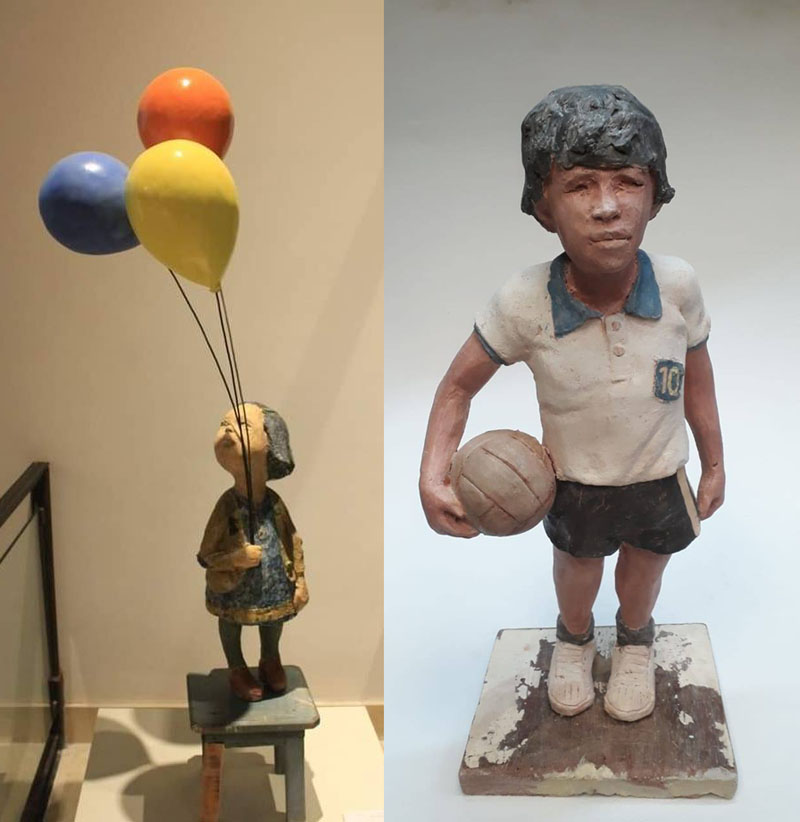
Then there is the complication of the assembly. I think about how I'm going to solve it, how to finish the piece, what to add later. It is difficult to work everything a priori. There are always surprises. And for me those surprises are the most beautiful thing because they can even change the whole composition. For example, the girl with balloons, but how do I add the balloons? Well, yes, I made them with paper, but I never worked with papier-mâché, it was an innovation for me. I simply did it to make the balloons, so they wouldn't weigh so much.
Iron and wood are materials that I always keep in mind. I pick up wood and iron from the street and I think I'm going to do something with this or that. In other words, the whole composition is put together by means of a material I found. Or explore with the ceramics that I am modeling and at the same time thinking about what I can put in one part or another.
The scenographies are nice because I open myself to possibilities and add materials that are not all ceramic, because of the weight. The fact that they are assembled things means that the movement of the piece is not so dependent on aids and freight, but it is possible to move it and assemble it in other exhibition places.
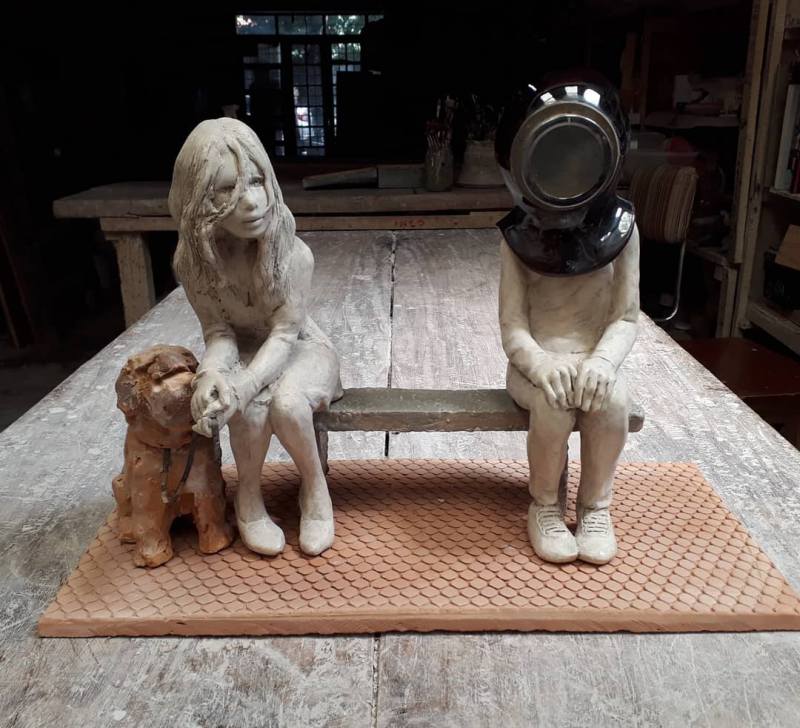

"Un banco, una plaza, en un lugar / A Bench, A Square, In a Place"
cerámica, escultura / ceramic, sculpture, 45 x 20 x 23 cm.

"Camilleros / Stretcher-bearers", Serie Fútbol / Soccer Series
Cerámica, madera / ceramic, wood, 28 x 21 x 12 cm., 2017

"In this series I want to express or tell, with a spectator's view, part of some experiences, what happens to us with soccer in terms of passion, joy, sadness, nostalgia, disappointment, frustration, crying and... I can go on with more adjectives, because soccer is that.
But in this series I highlight and put a look at the defeats: the one who scored the goal, the stretcher bearers, the substitutes' bench, the fans, the one who listens to the game alone in a room. It is a look of nostalgia perhaps, but also about what they do not have, that protagonism, although they are always there.
I think soccer encompasses all this, because it's simply a matter of being attentive, and all these emotions appear.", L.N.

Serie Capuchas / Hoods Series, cerámica, madera / ceramic, wood, 26 x 16 x 12 cm., 2021

"Perplejidad metafísica / Metaphysical Perplexity", cerámica / ceramic, 50 x 195 x 50 cm., 2009

SR: The glazes you use on ceramics are single-use. Explain to us what that's like.
LN: Since I don't come from a ceramics school, my way of working is quite spontaneous, it's a matter of experimenting with my work. The result is the derivation of various influences: the firing, the paste, the raw material inputs, the amount of glaze that is added. All this changes constantly, it is a wide range. A ceramist has to see well the raw material, its preparation, make the samples properly and at the end put it in the last piece he wants to make. I almost never do tests, I send them directly to the sculpture.
Then there are certain enamels that, as the spray torch is used a lot in the workshop, this causes a lot of enamel to be wasted and I recover it again in the cabin. So I end up making another glaze with the rejoining of all that leftover. And there are things left over that, in themselves, do not have a formula, so when that glaze is finished, it no longer exists. It is a unique glaze, so when I use them, the piece becomes absolutely unique because the glaze is finished.

SR: What does it mean to you to enjoy your work?
LN: To be able to do it. Maybe deep down inside I knew that I wasn't going to stop doing this. I couldn't tell you if it was a hobby, a job or what I became, but I was never going to stop. Luckily I do it because I can do it, it's who I am and my income is from the classes, which I love. It's nice to teach, but the nicest thing is to make art, to express, to make sculptures, drawings, and if you can make a living from that, all the better. It is also nice to show it and receive what people perceive and feel. But I think the most pleasurable thing is to have something in your mind and do it. Sometimes I try to put myself in the head of people who don't need to do this and it's very difficult to understand. Just as there are people who don't understand why I want to do this, what's the point of doing something with clay, why spend hours with that clay. There are many people who don't understand why we do this kind of work. We do it because it satisfies us. It is something that is in our minds and then it is palpable, we can touch it: something that did not exist now exists. For me that is wonderful, I enjoy it very much. It means my life.

"Sereno / Night Watchman", cerámica, madera / ceramic, wood, 10 x 8 x 5 cm., 2009

"Basta / Stop", cerámica / ceramic, 25 x 32 x 12 cm., 2021

SR: What is your greatest weakness when facing a new creation?
LN: I don't think it won't come out. Nor do I think that it will be different from what I imagined. Then, if I don't like it, I don't like it. Sometimes in works I do for someone, if it already has a purpose, for whoever, or commissions, there are always difficulties. That makes me quite nervous because I work differently. They ask you for something and it has to be the same as something they had seen before. The energies are not the same. That's why I don't like to work on something in series, to redo something I liked. I like to do, to work on it, if it looks good, but if it doesn't look good, it doesn't. I think that's the weakness of working on something in series. I think that's the weakness of working on something already done. It's not so dramatic either.

SR: Could you comment on any artistic curiosity?
LN: I'm not one to be connected to what's going on in the art world. Maybe I'm wrong. I applaud when art opens up and new things appear. Sometimes, as I'm quite classic in my work, it's hard for me to see something that is very different from what I understand as classic-art. I don't understand that they buy a space and put branches and nothing else and people buy the paper and the title of the work. I have a hard time seeing that as art. I think that maybe I have to study it more, to know why they do that, if it is a form of criticism of today's world. I have to get more involved, to study these art forms. That's a curiosity. 

"Elena y Fausto", cerámica, madera, hierro / ceramic, wood, iron, 125 x 50 x 100 cm., 2014

"En 'Elena y Fausto', Elena, la perra, es 'la musa inspiradora'.  Está realizada con un barro español, tiene un poco de mira, óxido y cristal en el hocico y en los ojos. El coche está fabricado con cosas encontradas en la calle. Fausto está hecho con pasta blanca. La malla tiene esmalte y óxido de hierro y manganeso, muy suave, y un esmalte mate realizado con fundente plúmbico y carbonato de calcio. El chupete es el mismo barro de Elena.", L.N.
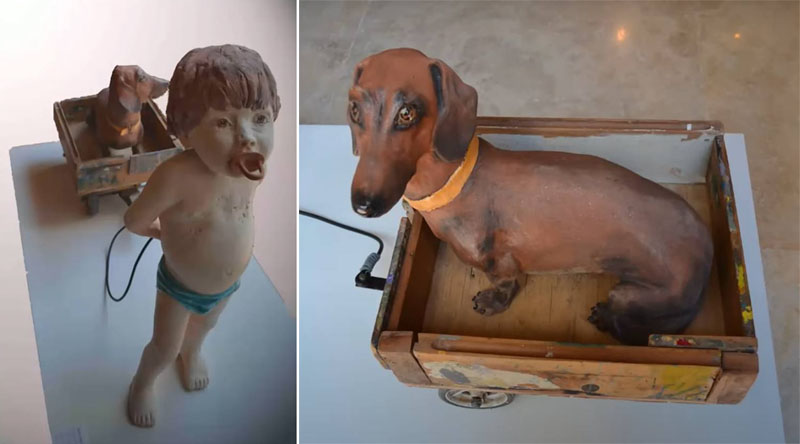
"Elena y Fausto", cerámica, madera, hierro / ceramic, wood, iron, 125 x 50 x 100 cm., 2014

"In 'Elena and Fausto', Elena, the dog, is 'the inspiring muse'.  She is made with a Spanish clay, she has a little bit of [mira], rust and glass on the muzzle and in the eyes. The car is made from things found in the street. Fausto is made with white paste. The mesh has enamel and iron and manganese oxide, very soft, and a matte enamel made with plumbic flux and calcium carbonate. The pacifier is the same clay as Elena's.", L.N.

"Hay equipo / There's a Team", cerámica, hierro / ceramic, iron, 87 x 47 x 40 cm., 2008

SR: What have your travel experiences been like with regard to ceramics?
LN: I've been invited to seminars at some ceramic art schools. The experience is beautiful, like this thing we are doing now, internalizing and getting into what you do, which usually you don't think about as much. However, when I have seminars where I have to talk about my work, it makes me internalize more and think about what I'm doing and where I'm standing. That's nice, thinking about what I'm doing.
On my first trip to Europe, I had to take my stuff, I showed it, it had good repercussions, I sold work, I made contacts. The experience was beautiful. That experience makes it a part of the trip because it was my first trip to Europe, so I was more of a tourist. Maybe if I travel more, with more involvement in art, I will have other experiences that I'm sure will be very good.

"Nélida", cerámica, hierro / ceramic, iron, 100 x 160 x 100 cm., 2014

SR: Can you tell us about your workshop?
LN: As I mentioned, I started as a student in Tavella's workshop. It's a very old workshop. Leo has been working there for about 50 years. It is located in the northern area, in Acassuso [San Isidro, Buenos Aires province, Argentina]. It has three kilns, woodworking tools and all the working tools, big tables. It is divided in two: ceramics and sculpture, and pottery. I share the workshop with Stella Cardigonde, who is a potter. With her we gave the word to Leo Tavella to continue with the workshop open, so that it does not disappear. It is a kind of homage to Leo to always be there. I feel comfortable because, beyond everything, he always allowed me to work freely. I feel great respect for keeping his works alive, he also gave me the freedom to grow as an artist and not always be stuck to his art. 
It is a beautiful workshop, with a lot of energy. Very old, it seems to be all messy, that everything is chaos, but it is not like that. It's nice, because wherever you look up you can see things of art. It gives me pleasure to be there.

Serie "Capuchas" / Hoods Series
Izq./ Left: Cerámica, madera, hierro / ceramic, wood, iron, 4 x 14 x 4 cm., 2020
Der./ Right: Cerámica / ceramic, 16 x 23 x 7 cm., 2021

"Tribuna / Stand", cerámica, madera, hierro / ceramic, wood, iron, 68 x 65 x 56 cm., 2017

SR: In relation to your role as an art teacher, what is the contribution of the artist who models his practice and works with students?
LN: I contribute because of what I studied in terms of composition, the way I teach. As an artist, in practice, I make things and my mistakes or what I get right, I pass on to my students. Sometimes as a trial or error, I transfer them and that makes some of their steps shorter and they don't enter into a failure. Everything I do and what I feel I can teach; what I feel is right, I pass it on to them as a teacher. 

SR: What projects do you have for the future?
LN: There are always projects, I always find something to do. Drawing in a notebook, keeping those notes in mind makes me set topics and tasks. I always have projects to present in salons, National, municipal. That makes me work in bigger sizes, I don't feel comfortable in small sizes. I always propose these projects in order to have large works and then, if an exhibition comes out, I can show those works.
Projects with the theme of children, not with toys and their difficulties, but in situations. The scuba will always be there. Maybe as a goal I would like to do more drawings because sometimes I start them and then I put them aside, days go by and I would like to get more into the world of drawing.

Leandro Niro esmaltando en su taller / glazing at his workshop, 2007

Más sobre / More about Leandro Niro: Blog, facebook

¡Muchas gracias por la entrevista, Leandro!
Thanks a lot for the interview, Leandro!

________________________________________________________

Shirley Rebuffo has a Degree in Library Science and a Degree in Archivology by the Universitary School of Library and Related Sciences (Montevideo, Uruguay), Technician in Museology by the Faculty of Humanities and Sciences (Anthropology option), Object, Symbol and Spance in Curatorship Applied Museology and Social Museology - Concepts, Technics and Practice (Campo Grande, Brazil), Coaching (Campo Grande, Brazil), Strategic Planning (Campo Grande, Brazil), and Art and Painting student under Master Eduardo Espino.

Leandro Niro (I) [Cerámica, Entrevista / Ceramic, Interview]

Volvemos a Argentina para adentrarnos en el mundo artístico de otro interesante creador rioplatense: Leandro Niro. Shirley Rebuffo nos presenta esta nueva entrevista, que acompañamos con tres posts repasando en imágenes la amplitud y variedad de su obra. Leandro se expresa utilizando diferentes medios y técnicas, tales como la cerámica, pintura, dibujo, acuarela, carboncillo...
Un primer post con cerámica y la entrevista en español, el segundo con la misma en inglés, y el tercero con una selección de sus dibujos y pinturas, y algunas preguntas y respuestas específicas sobre estas disciplinas.

We return to Argentina to delve into the artistic world of another interesting creator from Rio de la Plata: Leandro Niro. Shirley Rebuffo presents this new interview, which we accompany with three posts reviewing in images the breadth and variety of his work. Leandro expresses himself using different media and techniques, such as ceramics, painting, drawing, watercolor, charcoal...
A first post with ceramics and the interview in Spanish, the second with the same in English, and the third with a selection of his drawings and paintings, and some specific questions and answers about these disciplines.
_____________________________________________________________

Leandro Niro
(Olivos, Buenos Aires, Argentina, 1975-)

Leandro Niro en su taller / at his workshop

"La idea está en ponerle un alma a las cosas, que tengan vida y, dentro de lo figurativo, romper los esquemas y distorsionarlos en forma arbitraria sin salir de una armonía estética.", L.N.

Leandro Niro es un artista argentino nacido el 2 de setiembre de 1975 en Olivos, Buenos Aires.
Comenzó su carrera experimentando como autodidacta. Más adelante asistió a varios talleres de dibujo y pintura, ya con la decisión de ingresar a la Universidad de Buenos Aires (UBA) en la carrera de Diseño Industrial. Comprendiendo que su búsqueda estaba dirigida hacia la plástica, se cambió a la carrera de Diseño Gráfico. Es así que en 1996 ingresa a la Escuela Nacional de Bellas Artes "Prilidiano Pueyrredón", egresando como profesor nacional de escultura. En el año 2004 comienza el seminario de equivalencias universitarias en el Instituto Universitario Nacional de Arte. 
Leandro se caracteriza por tener una voz que comunica con una serenidad sincera, propia de un maestro transmisor de conocimiento. Eso hace que cuando describe sus obras anuncia su oficio con exquisito detalle.
Actualmente es profesor de escultura, dibujo y pintura en el taller de Leo Tavella. Ha realizado numerosas exposiciones, siendo además jurado en el 58ª. Salón Anual Internacional de Arte Cerámico. Ha impartido varias conferencias y seminarios.

"Tejido / Weave", cerámica, madera, hierro / ceramic, wood, iron, 14 x 5 x 12 cm., 2021

"En el cuarto / At the Room", Serie Fútbol (Boca) / Soccer (Boca) Series
Cerámica, hierro / ceramic, iron, 39 x 22 x 28 cm., 2017

"En esta serie quiero expresar o contar, con una mirada de espectador, parte de algunas vivencias, lo que nos pasa con el fútbol en cuanto a la pasión, alegría, tristeza, nostalgia, decepción, frustración, llanto y... puedo seguir con mas adjetivos, porque el fútbol es eso.
Pero en esta serie destaco y pongo una mirada a las derrotas: al que le metieron el gol, a los camilleros, al banco de suplentes, a la hinchada, al que escucha el partido estando solo en una pieza. Es una mirada de nostalgia quizás, pero también sobre aquello que no tienen, ese protagonismo, aunque siempre están.
Creo que el fútbol abarca todo esto, porque simplemente es cuestión de estar atentos, y ahí aparecen todas estas emociones.", L.N.

"Dónde estoy / Where I Am", cerámica, hierro / ceramic, iron, 42 x 48 x 38 cm., 2021

Entrevista de Shirley Rebuffo

Shirley Rebuffo: Eres un artista polifacético, por lo tanto, tengo que hacer una pregunta amplia, ¿cómo, y porqué te convertiste en artista?
Leandro Niro: No sé si soy polifacético, pero me gusta todo en el mundo del arte visual. Obviamente que ahora el tema visual se expandió bastante con el uso de la informática. Se trabaja con audio y video. No es que sea muy partícipe, pero me alegra que esté ahí.  
A los seis o siete años comencé a dibujar. Nunca lo dejé. Cuando uno es niño tiene ciertos intereses que después decaen, pero de ningún modo renuncié al dibujo porque siempre me sentí muy cómodo expresándome así.
Tengo una familia que de a poco fue cambiando. Antes veía que el arte no era una profesión, no veían como una carrera eso de dibujar, pintar, hacer escultura. No lo veían como una salida económica. Pero igual me apoyaron porque tuve claro que mi vida venía por ahí y no había otra cosa con la cual me sintiera satisfecho.
Cuando comencé en la secundaria me fui volcando en el terreno artístico hacia las carreras de diseño. Elegí diseño industrial porque me gustaba dibujar autos. Después me volqué al diseño gráfico porque era más libre, con dibujo a mano alzada, no tanta teoría o  matemáticas y física. 
Se ve que vieron mis inclinaciones y me dijeron que debería hacer Bellas Artes. Sinceramente no conocía, y busqué por las guías telefónicas. Llamé y me anoté. Ahí descubrí la escultura.
Al terminar la carrera de Bellas Artes quise seguir haciendo escultura y busqué un taller de una forma casi diríamos desesperada. Encontré el de Leo Tavella, [23 de septiembre de 1920, Gálvez, Santa Fe – 30 de julio de 2015, Buenos Aires], quien venía de la misma experiencia de escuelas de Bellas Artes y después descubrió la cerámica. Hoy en día el U.N.A. (Universidad Nacional de las Artes, así se llama el taller) está volcado hacia las artes de fuego. Cuando yo estudiaba, las artes de fuego no eran bien vistas. Estamos presenciando un resurgimiento, pero todavía hay gente que no las quiere bien. No consideran a la cerámica como una de las artes más fuertes.

"La espera / The Wait", cerámica, madera / ceramic, wood, 41 x 31 x 56 cm., 2020

"Marquito quiso volar / Marquito Wanted to Fly", cerámica, hierro / ceramic, iron, 38 x 168 x56 cm., 2007

SR: ¿Lo que realizas es la suma de tus experiencias, de tus recuerdos de esas experiencias o de la historia que has tejido a partir de ellas?
LN: Hay un poco de todo. Hay mucha práctica, hay recuerdos. Además me informo y absorbo experiencias de otras personas.
Soy bastante nostálgico. Me gusta mucho esa etapa de los chicos de entre 4 hasta 12 años, cuando tienen toda su vida por delante. Esa etapa de mi vida fue una de las mejores y quizá por eso siento la nostalgia. Me gusta ver películas con personajes de esa edad. Mi forma de verlo es que es una etapa donde todo es pintoresco. Busco mucha información sobre esa época, tal como la que yo viví. Serían los años 70, en que se jugaba en la calle, la ropa era distinta, los juguetes eran otros. Me gusta traer ese período de la infancia, y tomo mucha información de esos recuerdos: películas, fotos, series, imágenes.

SR: ¿Cuándo introdujiste la cerámica en tu imaginario?
LN: La cerámica vino a mi mundo cuando me recibí de la Licenciatura, en el 2003. En el 2000 me recibí con el profesorado y en el 2002 hice materias de homologación. Por ciertas causalidades comencé a averiguar buscando taller y llegué al taller de Leo Tavella. Pasados unos años Leo me contrató como ayudante y por motivos de la vida quiso que esté a cargo del taller, a cargo de su cuidado ya que empezaba a estar solo. Todos sus alumnos y alumnas fuimos una gran familia, estábamos cerca de él. Sigo con las clases, ya teniendo mis propios alumnos.

"Salamandra / Woodstove", instalacion / installation
Cerámica, hierro, chapa, madera / ceramic, iron, metal sheet, wood, 200 x 168 x 200 cm., 2011

"Penitencia / Grounded", cerámica / ceramic, 4 x 10 x 7 cm., 2012

SR: En tus esculturas cerámicas, realizas obras con amplia incorporación de materiales: cerámica, papel maché, hierro, madera, son como una puesta en escena, logrando gran dinamismo. ¿Está todo muy pensado o surge todo a medida que se van realizando?
LN: El mundo de la cerámica se abrió y empecé a investigar a fondo el tema. Para mí es una de las disciplinas más lindas porque lo que haces es lo que queda. No hay un pasaje a bronce, un pasaje a yeso, no hay que hacer un molde ni nada. Lo que tiene es que reduce, según la pasta y la cocción, una vez que se seca y va al horno, reduce aproximadamente entre el 10 % y el 15 %. Eso también tiene pequeños inconvenientes en cuanto a los ensambles. Si a lo que se hace hay que agregar algo y se modela con ese algo que no va a ir al horno, hay que ver el tamaño, cómo reduce, para que en el ensamble quede bien. 
Eso hay que pensarlo antes, a priori. Ese objeto que se quiere agregar a la cerámica es el disparador de la idea. A veces quiero crear algo a partir de ese objeto que quiero incorporar, y otras veces quiero que sea la parte principal de la composición. Quizá te mienta si te digo que está todo pensado antes; casi siempre va sobre la marcha. 
Después está la complicación del armado. Pienso cómo voy a solucionarlo, cómo se para la pieza, qué le agrego después. Es difícil trabajar todo a priori. Siempre hay sorpresas. Y para mí esas sorpresas son lo más lindo porque te pueden, incluso, cambiar toda la composición. Por ejemplo, la nena con globos, pero ¿cómo le agrego los globos? Bueno, sí, los hice con papel, pero nunca trabajo el papel maché, fue una innovación para mí. Simplemente lo hice para hacer los globos, para que no pesaran tanto.
El hierro y la madera son materiales que tengo siempre presente. Levanto de la calle maderas, hierros, y pienso que algo voy a hacer con esto o con lo otro. O sea, toda esa composición se va armando por medio de un material que encontré. O explorar con la cerámica que voy modelando y a la vez pensando qué puedo meter en una u otra parte.
Las escenografías son lindas porque me voy abriendo a posibilidades y voy agregando materiales que no sean todo cerámica, por el peso. El que sean cosas ensambladas hace que el movimiento de la pieza no sea tan dependiente de ayudas y fletes, sino que queda trasladarlo y armarlo en otros lugares de exposición.

Izq./ Left: "Aventura / Adventure", cerámica, madera / ceramic, wood, 102 x 27 x 125 cm., 2020
Der./ Right: "Balero / Ball-and-Stick", cerámica, madera / ceramic, wood, 38 x 164 x 48 cm., 2012

"Juntadxs / Gathered", cerámica, hierro / ceramic, iron, 31 x 5 x 42 cm., 2018

SR: Los esmaltes que usas en cerámica son de un solo uso. Explícanos cómo es eso.
LN: Como yo no vengo de la escuela de cerámica mi forma de trabajo es bastante espontánea, es ir probando sobre mis trabajos. El resultado es la derivación de diversas influencias: el horneado, la pasta, los insumos de la materia prima, la cantidad de esmalte que se agrega. Todo eso cambia constantemente, es un abanico grande. Un ceramista tiene que ver bien la materia prima, su preparado, hacer las muestras adecuadamente y al final ponerlo en la última pieza que quiera hacer. Yo casi no hago pruebas, los mando directamente en la escultura.
Después hay ciertos esmaltes que, como se usa mucho el soplete de aspersión en el taller, eso hace que mucho esmalte se desperdicie y vuelvo a recuperarlo en la cabina. Así termino haciendo otro esmalte con el rejunte de todo ese sobrante. Y quedan cosas que, en sí, no tienen fórmula, eso hace que cuando se termina ese esmalte ya no exista más. Es un esmalte único, por eso cuando los uso, la pieza pasa a ser absolutamente única porque el esmalte se terminó.

SR: ¿Qué significa para ti disfrutar de tu trabajo?
LN: Poder hacerlo. Quizá muy dentro de mí sabía que no iba a dejar de hacer esto. No sabría decirte si por hobby, por trabajo o por lo que me convertí, pero nunca lo iba a dejar. Por suerte lo hago porque lo puedo hacer, es lo que soy y mis ingresos son por las clases, que me gustan. Es lindo enseñar, pero lo más lindo es hacer arte, expresar, hacer esculturas, dibujos y si uno puede vivir de eso, mejor. También es lindo mostrarlo y recibir lo que la gente percibe y siente. Pero creo que lo más placentero es tener algo en la mente y hacerlo. A veces trato de ponerme en la cabeza de las personas que no necesitan hacer esto y es muy difícil poder entenderlo. Así como también hay personas que no entienden que yo quiera hacer esto, qué ganancia tiene hacer algo con barro, porqué estar horas con ese barro. Hay mucha gente que no entiende por qué se hace un trabajo así. Lo hacemos porque nos satisface. Es algo que está en nuestras mentes y después es palpable, lo podemos tocar: algo que no existía ahora existe. Para mí eso es maravilloso, lo disfruto mucho. Significa mi vida.

"Incertidumbre / Uncertainity", cerámica, hierro / ceramic, iron, 59 x 62 x 97 cm., 2016

"La serie 'Escafandra' es una composición de diferentes esculturas que destacan dicho objeto, expresando estética, rigidez y belleza.
Aunque el mismo lleve a los observadores a tomar diferentes interpretaciones y a veces muy ambiguas, la expresión del autor en sus obras fue la de Protección. Protegerse de lo desconocido, de la exposición que en ocasiones debilita.
La escafandra será una herramienta, un nexo, un punto de partida para abordar lo más profundo que habita en nosotros, llevándonos a un autoconocimiento en búsqueda de la verdad. Dichas profundidades nos topan con diferentes sensaciones y personajes, desde lo más íntimo y a la vez universal."

"Pandemia / Pandemic", cerámica / ceramic, 30 x 28 x 25 cm., 2017

SR: ¿Cuál es tu mayor debilidad a la hora de enfrentarte a una nueva creación?
LN: No pienso que no me va a salir. Tampoco pienso que me va a quedar distinta a lo que me imaginaba. Después si no me gusta, no me gusta. A veces en trabajos que hago para alguien, si ya tiene un fin, para quien sea, o encargos, siempre hay dificultades. Eso me pone bastante nervioso porque trabajo distinto. Te piden algo y te tiene que quedar igual a algo que habían visto algo. Las energías no son iguales. Por eso no me gusta trabajar algo en serie, volver a hacer sobre algo que me gustó. Me gusta hacer, trabajarlo, si queda, bien, pero si no queda, no queda. Creo que esa es la debilidad trabajar sobre algo ya hecho. Tampoco es tan dramático.

"Elena", cerámica / ceramic, 46 x 31 x 25 cm., 2011

"Vivito y coleando / Alive and Kicking", madera, hierro / wood, iron, 17 x 28 x 38 cm., 2021

SR: ¿Podrías comentar alguna curiosidad artística?
LN: No soy de estar conectado con lo que está pasando en el mundo artístico. Quizá haga mal. Aplaudo a que el arte se abra y aparezcan cosas nuevas. A veces, como soy bastante clásico en mis trabajos, me cuesta ver algo que sea muy distinto a lo que entiendo como clásico-arte. No entiendo eso de que compran un espacio y colocan ramas y nada más y la gente compra el papel y el título de la obra. Eso la verdad me cuesta verlo como arte. Pienso que quizá sea que yo me tenga que poner a estudiarlo más, saber porqué llegan a hacer eso, si es una forma de crítica del mundo actual. Me tengo que involucrar más, estudiar esas formas de arte. Eso es una curiosidad. 

"Te cuido modelado / I Take Care of You", cerámica, madera / ceramic, wood, 68 x 18 x 7 cm., 2021

"Miedo / Fear", cerámica, hierro, madera / ceramic, iron, wood, 21 x 7 x6 cm., 2019

SR: ¿Cómo han sido tus experiencias de viajes con respecto a las cerámicas?
LN: Me han invitado a seminarios en algunas escuelas de arte de cerámica. La experiencia es hermosa, como esto que hacemos ahora, interiorizar y adentrarse en lo que uno hace, que por lo general no se piensa tanto. Sin embargo, cuando tengo seminarios en los que tengo que hablar de mi obra, hace que me interiorice más y piense en lo que estoy haciendo y dónde estoy parado. Eso es agradable, pensar en lo que hago.
En mi primer viaje a Europa, tuve que llevar mis cosas, las mostré, tuvo buena repercusión, vendí obra, quedaron contactos. La experiencia fue hermosa. Esa experiencia hace que sea una parte del viaje porque fue mi primer viaje a Europa, entonces fui más de turista. Por ahí, si viajo más, con más involucramiento en el arte, tengo otras experiencias que seguro deberán ser muy buenas.

"Amigos / Friends", cerámica, hierro / ceramic, iron, 200 x 195 x 150 cm., 2011

"Carnicero / Butcher", cerámica, madera / ceramic, wood, 10 x 23 x 6 cm., 2011

SR: ¿Puedes hablarnos de tu taller?
LN: Como te he mencionado, yo empecé como alumno en el taller de Tavella. Es un taller muy viejo. Leo estuvo trabajando unos 50 años trabajando ahí. Queda en zona norte, en Acassuso [partido de San Isidro, provincia de Buenos Aires, Argentina]. Tiene tres hornos, herramientas para trabajar la madera y todas las herramientas de trabajo, mesas grandes. Se divide en dos: la cerámica y escultura, y la alfarería. Comparto el taller con Stella Cardigonde, que es alfarera. Con ella le dimos la palabra a Leo Tavella de continuar con el taller abierto, que no desaparezca. Es una especie de homenaje siempre a Leo el estar ahí. Me siento cómodo porque, más allá de todo, siempre me permitió trabajar libremente. Siento un respeto grande el mantener en vida sus obras, él también me dejó esa libertad de crecer como artista y no estar siempre pegado a su arte. 
Es un taller hermoso, con mucha energía. Muy viejo, parece estar todo desordenado, que todo es un caos, pero no es así. Es lindo, porque donde se levanta la vista se ven cosas de arte. Me da placer estar en él.

Izq./ Left: "Globos / Balloons", cerámica, madera, hierro, papel mache /
ceramic, wood, iron, papier mache, 67 x 165 x 70 cm., 2015
Der./ Right: "Cebollita", ceramica / cerámica, 5 x 21 x 4 cm., 2021

"Banco de suplentes (Banquillo) / Bench", Serie Fútbol / Soccer Series
Cerámica, madera / ceramic, wood, 28 x 21 x 14 cm., 2017

SR: En relación a tu rol como profesor de arte, ¿cuál es el aporte del artista que modela su práctica y trabaja con los estudiantes?
LN: Aporto por lo que estudié en cuanto a la composición, a la forma de enseñar. Como artista, en la práctica, hago cosas y mis errores o lo que me queda bien, se lo trasmito a mis estudiantes. A veces como prueba o error, se los traslado y eso hace que se acorten algunos pasos de ellos y que no entren en un fracaso. Todo lo que hago y lo que siento puedo enseñarlo; lo que siento que está bien, se los transmito como profesor. 

SR: ¿Qué proyectos tienes para el futuro?
LN: Siempre hay proyectos, siempre encuentro algo qué hacer. Dibujar en algún cuadernito, tener presente esas anotaciones hace que me ponga temas y tareas. Proyectos siempre tengo como para presentar en salones, Nacional, municipal. Eso hace que trabaje en tamaños más grandes, que no me acomode en tamaños pequeños. Siempre me propongo esos proyectos para tener obras grandes y después si sale una muestra, sacar esos trabajos.
Proyectos con el tema de los niños, no ya con juguetes y sus dificultades, sino en situaciones. La escafandra siempre va a estar ahí. Quizá como meta hacer más dibujos porque a veces los comienzo y luego los voy dejando de lado, van pasando los días y me gustaría meterme más en el mundo del dibujo.

Entrada del taller / Workshop entrance. Cerámica / ceramic, 50 x 195 x 50 cm., 2008-09

Más sobre / More about Leandro Niro: Blog, facebook

¡Muchas gracias por la entrevista, Leandro!
Thanks a lot for the interview, Leandro!

________________________________________________________

Shirley Rebuffo es Licenciada en Bibliotecología y Archivología por la Escuela Universitaria de Bibliotecología y Ciencias Afines (Montevideo, Uruguay), Técnica en Museología por la Facultad de Humanidades y Ciencias (opción de Antropología), Objeto, símbolo y espacio en Curaduría. Museología Aplicada y Museología Social – Conceptos, técnicas y prácticas (Campo Grande, BR), Coaching (Campo Grande, BR), Planeamiento Estratégico (Campo Grande, BR) y estudiante de arte y pintura con el maestro Eduardo Espino.

lunes, 7 de febrero de 2022

Asonancias / Assonances (XLII) - Cuadros y pelis / Pictures and Movies (III)

Nuevo post con similitudes, imitaciones, recreaciones, interpretaciones y coincidencias más o menos casuales que dan como resultado paralelismos siempre interesantes en el mundo del arte.
Tercera parte de una miniserie dedicada a la visión cinematográfica de la pintura. Infinidad de directores han representado obras pictóricas a través de imágenes en movimiento, y en otros casos, de forma más o menos deliberada, esta maravillosa intersección de las artes ha dado lugar a significativas analogías visuales. Aquí les dejo algunos ejemplos.

New post with similarities, imitations, recreations, interpretations and more or less casual coincidences that result in always interesting parallels in the art world.
Third part of a mini-series dedicated to the cinematographic vision of painting. Countless directors have represented pictorial works through moving images, and in other cases, more or less deliberately, this wonderful intersection of the arts has given rise to significant visual analogies. Here you have some examples.
______________________________________________________________________

James Abbott McNeill Whistler
(Lowell, Massachusetts, EE.UU./ MA, USA, 1834-1903)

"Arreglo en gris y negro nº 1, más conocido como Retrato de la madre del artista / 
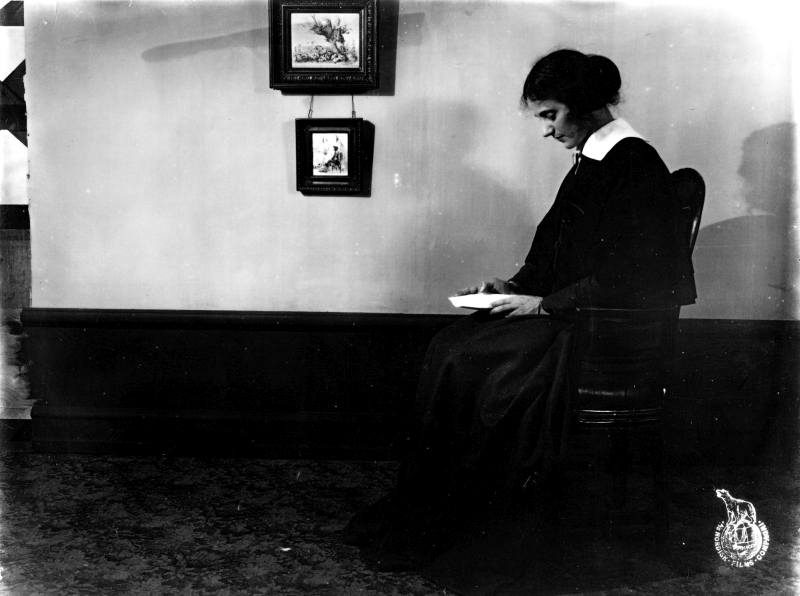
Arrangement in Grey and Black No.1, famous under its colloquial name Whistler's Mother"
Óleo sobre lienzo / oil on canvas, 144,3 cm × 162,4 cm., 1871. Musée d'Orsay (Paris, Francia / France)

James McNeill Whistler en "El Hurgador" / in this blog:

"El presidente / The President", Carl Theodore Dreyer, 1919. Filmaffinity. Imdb
______________________________________________________________________

David Alexander "Alex" Colville
(Toronto, Canadá, 1920 - Wolfville, 2013)

"Hacia la isla Príncipe Eduardo / To Prince Edward Island", 1965

Alex Colville en "El Hurgador" / in this blog: [Aniversarios (XXXI)], [Pintando perros (XLVIII)], [Sobre la vestimenta y otros textiles (II)]

"Moonrise Kingdom", Wes Anderson, 2012. Filmaffinity. Imdb
______________________________________________________________________

Thomas Gainsborough
(Sudbury, Suffolk, Inglaterra / England, 1727 - Londres / London, 1788)

"El joven azul / The Blue Boy", óleo sobre lienzo / oil on canvas, 177,8 × 112,1 cm., c.1770
Biblioteca Huntington (San Marino, California, EE.UU./ CA, USA). Wikipedia. Wikimedia Commons

Thomas Gainsborough en "El Hurgador" / in this blog:

Jamie Foxx como / as Django Freeman
"Django desencadenado / Django Unchained", Quentin Tarantino, 2012. Filmaffinity. Imdb

Quentin Tarantino en "El Hurgador" / in this blog: [Jason Seiler (Ilustración, Caricatura)], [Aniversarios Fotografía (CCIX)]
______________________________________________________________________

Francisco José de Goya y Lucientes​
(Fuendetodos, Zaragoza, España / Spain, 1746 -
Burdeos, Francia / Bourdeaux, France, 1828)​

"Duelo a garrotazos o La riña / Fight with Cudgels"
Óleo sobre muro trasladado a lienzo / oil mural transferred to canvas, 123 x 266 cm., 1819-23
Museo del Prado (Madrid, España / Spain)

Francisco de Goya en "El Hurgador" / in this blog: [Todos los enlaces / All links]

"Jamón jamón", Pedro Almodóvar, 1992. Filmaffinity. Imdb

Pedro Almodóvar en "El Hurgador" / in this blog: [Aniversarios Fotografía (L)], [José Haro (Fotografía, Cine)]
______________________________________________________________________

Diego Rodríguez de Silva y Velázquez
(Sevilla, Andalucía, España / Seville, Andalusia, Spain, 1599 - Madrid, 1660)

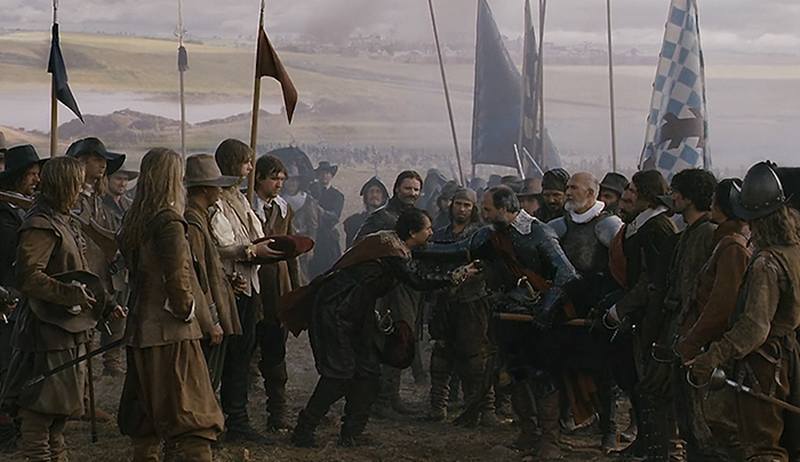
"Las lanzas o La rendición de Breda / The Surrender of Breda", óleo sobre lienzo / oil on canvas, 307 x 367 cm., c.1635
Museo Nacional del Prado (Madrid, España / Spain)

Diego Velázquez en "El Hurgador" / in this blog: [Todos los enlaces / All links]

"Alatriste (El capitán Alatriste)", Agustín Díaz Yanes, 2006. Filmaffinity. Imdb
______________________________________________________________________

Grant DeVolson Wood
(Anamosa, Iowa, EE.UU./ IA, USA, 1891 - Iowa City, 1942)

"Maíz joven / Young Corn", óleo sobre masonita / oil on masonite, 23 3/4" x 29 3/4", 1931
Cedar Rapids Museum of Art (Cedar Rapids, Iowa, EE.UU./ IA, USA). Wikiart

Grant Wood en "El Hurgador" / in this blog: [Arte & Humor (II)], [Aniversarios (II)], [Adam Lister (Acuarelas)]

"El imaginario del Dr. Parnasus / The Imaginarium of Dr. Parnassus", 2009. Terry Gilliam. Filmaffinity. Imdb

Terry Gilliam en "El Hurgador" / in this blog: [Allan Amato (Fotografía)], [Asonancias (XLI)]
______________________________________________________________________

John Singer Sargent
(Firenze / Florencia, Italia / Florence, Italy, 1856 -
Londres, Reino Unido / London, UK, 1925)

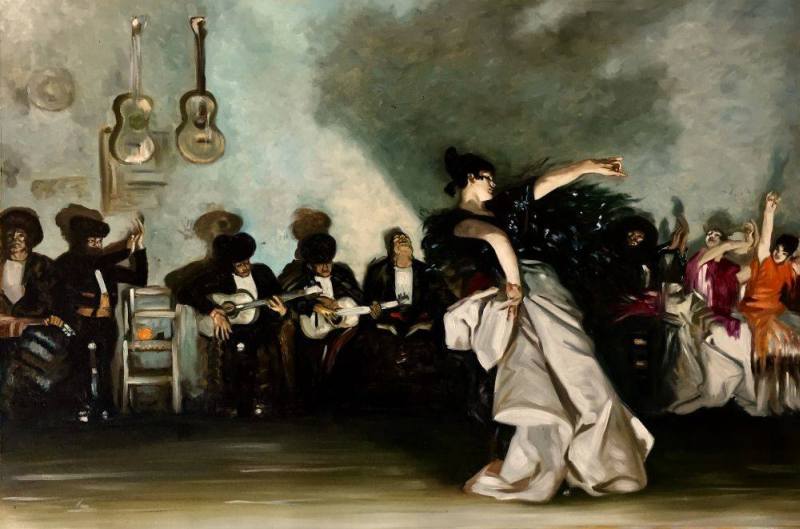
"El jaleo", óleo sobre lienzo / oil on canvas, 232 x 348 cm., 1882
Isabella Stewart Gardner Museum (Boston, Massachusetts, EE.UU./ MA, USA). Wikipedia

John Singer Sargent en "El Hurgador" / in this blog: [Todos los enlaces / All links]

"El Álamo / The Alamo", John Wayne, 1960. Filmaffinity. Imdb
______________________________________________________________________

Norman Percevel Rockwell
(Nueva York, EE.UU./ NY, USA, 1894 - Stockbridge, Massachusetts / MA, 1978)

"Libertad de vivir sin miedo / Freedom From Fear"
Óleo sobre lienzo / oil on canvas, 116,2 x 90 cm., entre / between 1941-45
National Archives at College Park (Maryland, EE.UU./ MD, USA). Wikimedia Commons

Norman Rockwell en "El Hurgador" / in this blog:

"El imperio del sol / Empire Of The Sun", Steven Spielberg, 1987. Filmaffinity. Imdb
______________________________________________________________________

Wilhelm Heinrich Otto Dix
(Gera, Alemania / Germany, 1891 - Singen [Hohentwiel], 1969)

"Retrato de la periodista / Portrait of the journalist Sylvia von Harden"
Técnica mixta de óleo y témpera sobre tabla / mixed media of oil and tempera on wood, 121 × 89 cm., 1926
Musée National d'Art Moderne, Centre Pompidou (París, Francia / France). Wikipedia (English)

Otto Dix en "El Hurgador" / in this blog: [Todos los enlaces / All links]

"Cabaret", Bob Fosse, 1972. Filmaffinity. Imdb
______________________________________________________________________

René François Ghislain Magritte
(Lessines, België / Bélgica / Belgium, 1898 -
Brussel / Bruselas / Brussels, 1967)

"Le Fils de l'Homme / El hijo del hombre / The Son of Man"
Óleo sobre lienzo / oil on canvas, 116 x 89 cm., 1964. Colección privada / Private Collection. Link

René Magritte en "El Hurgador" / in this blog: [Todos los enlaces / All links]

"El secreto de Thomas Crown / The Thomas Crown Affair", John McTiernan, 1999. Filmaffinity. Imdb

Pierce Brosnan como / as Thomas Crown 
______________________________________________________________________

Andrew Newell Wyeth
(Chadds Ford, Pennsylvania, EE.UU. / PA, USA, 1917 - 2009)

"El mundo de Cristina / Christina's World"
Témpera sobre panel / tempera on panel, 81,9 x 121,3 cm., 1948
Museum of Modern Art (Nueva York, EE.UU./ NY, USA)

Andrew Wyeth en "El Hurgador" / in this blog: [Todos los enlaces / All links]

"Forrest Gump", Robert Zemeckis, 1994. Filmaffinity. Imdb
______________________________________________________________________

Amedeo Clemente Modigliani
(Livorno, Italia / Italy, 1884 - París, Francia / France, 1920)

"Madame Zborowska con las manos juntas / With Clasped Hands"
Óleo sobre lienzo / oil on canvas, 100 x 65 cm., c.1917. Colección privada / Private Collection. Wikiart

Amedeo Modigliani en "El Hurgador" / in this blog: [Todos los enlaces / All links]

Judith. "It", Andy Muschietti, 2017. Filmaffinity. Imdb

Con su rostro alargado y deformado y sus ojos inquietantemente vacíos, "la mujer del cuadro" (llamada Judith en los créditos de la película) se parece mucho a "Mamá", la entidad titular de la anterior película de Muschietti, que, curiosamente, fue interpretada por Javier Botet. Esto se debe a que tanto Mamá como Judith se inspiran en las pinturas del artista Amedeo Modigliani.
"Es la traducción literal de un miedo infantil muy personal", explicó recientemente Muschietti respecto a la creación de Judith. "En mi casa había un grabado de un cuadro de Modigliani que me parecía aterrador. Y la idea de encontrarme con una encarnación de la mujer que aparece en él me volvía loco".
Continuó: "[Modigliani] suele hacer estos retratos con personajes alargados. Su visión de los humanos era con cuellos alargados, caras torcidas y ojos vacíos la mayoría de las veces. Era tan deforme que, de niño, no lo ves como el estilo de un artista. Lo ves como un monstruo". Fuente

Fotograma de la película / Still of the Movie

With her elongated, deformed face and eerily vacant eyes, "the woman in the painting" (named Judith in the film’s credits) looks a whole lot like Mama, the titular entity from Muschietti’s previous film - who was, funny enough, played by Javier Botet. That’s because both Mama and Judith were inspired by the paintings of artist Amedeo Modigliani.
"It’s a literal translation of a very personal childhood fear,” Muschietti recently explained the creation of Judith. "In my house, there was a print of a Modigliani painting that I found terrifying. And the thought of meeting an incarnation of the woman in it would drive me crazy."
He continued, "[Modigliani] often does these portraits with elongated characters. His vision of humans were with elongated necks, crooked faces and empty eyes most of the time. It was so deformed that as a child, you don’t see that as an artist’s style. You see it as a monster." Source

Daniel Jimenez Villalba
(Madrid, España / Spain)

"Judith con flauta / flute", arte digital / digital art. ArtStation

Más sobre / More about Daniel Jiménez: ArtStation
______________________________________________________________________

Otros posts de esta miniserie / Other posts in this miniseries


Todos los posts de la serie "Asonancias" aquí / All posts in Assonances Series here