lunes, 19 de junio de 2023

Libros de artista / Artist's Books (VII) - María Guerreiro, Rimer Cardillo, Raúl de Paula

Séptimo artículo de esta serie, presentada por Shirley Rebuffo, con más obras y textos que nos ayudan a profundizar sobre el concepto, ideas e historia de estos versátiles objetos de expresión artística.

Seventh article in this series, presented by Shirley Rebuffo, with more works and texts that help us to deepen our understanding of the concept, ideas and history of these versatile objects of artistic expression.
___________________________________________________________________

María Guerreiro
(Algarve, Portugal)
en / at Buenos Aires, Argentina

Maria Guerreiro. Foto / Photo: Pablo Jantus (c) ARSOmnibus

María Guerreiro es una artista visual luso-argentina nacida en el Algarve, Portugal, que vive y trabaja en Buenos Aires.
Se graduó en la Escuela Nacional de Bellas Artes, en Argentina.
Ha sido seleccionada e invitada a exponer en importantes salones, museos y galerías nacionales e internacionales. Participó en las ferias internacionales de ArteBA, Buenos Aires, Argentina; en la Primera Bienal de Ushuaia, Tierra del Fuego, Argentina; en ArtBO, Feria Internacional de Arte de Bogotá, Colombia; en Arteaméricas, Miami, Estados Unidos; en Affordable Art Fair, NY, Estados Unidos; y en Estampa, Madrid, España.
En 2020/2023 participo con el CDE en las muestras: “Ancestros” Suances, Cantabria, España; "Infancia/Kindheit" Einladung zur Ausstellung, Voitsberg, Austria; "Litografías" Estudio y Art Gallery, Miami Beach, Estados Unidos de Norteamérica, y "Pequeño formato" Villa Angostura, Argentina.
Sus pinturas, grabados y libros de artista, merecieron diversos premios, destacándose el 2º premio por dibujo/grabado en la Bienal Internacional de Arte Contemporáneo de Florencia Italia 2003.
______________________________________________________________

"Tu palabra y la mía / Your Word And Mine"
Libro de artista / Artist's Book, Ed.5, 2004
Impresión digital y grabado / digital printing and engraving
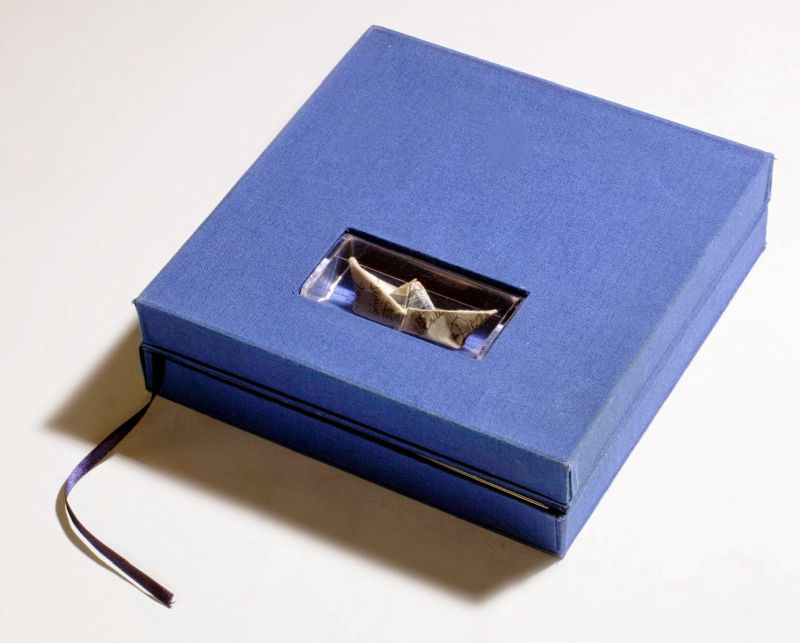
Tu palabra y la mía

Diez  años de cartas transformadas en obra
El papel, los  sobres , sellos, palabras…
ausencias…
Humo … generando  nuevos canales de comunicación.
Velos… como veleros transbordando mensajes
fechas … lugares … recibimientos … adioses.

                            El encuentro con lo  pequeño, con lo íntimo
                            Un nuevo mensaje que espera ser recibido.

María Guerreiro

Your word and mine

Ten years of letters transformed into work
Paper, envelopes, stamps, words...
absences...
Smoke ... generating new channels of communication.
Veils ... like sailboats transshipping messages
Dates ... places ... welcomes ... farewells.

                            The encounter with the small, with the intimate.
                            A new message waiting to be received.

María Guerreiro
______________________________________________________________

"... que sepa bordar / ... who knows how to embroider (*)"
Libro de artista / Artist's Book
Papel de algodón y papel vegetal. Gofrados en papel de algodón /
Cotton paper and tracing paper. Cotton paper embossing
Edición única / Unique edition, Buenos Aires, Argentina, 2016

(*) Verse of a traditional children's song


______________________________________________________________

Maria Guerreiro is a Portuguese-Argentine visual artist born in Algarve, Portugal, who lives and works in Buenos Aires.
She graduated from the National School of Fine Arts in Argentina.
She has been selected and invited to exhibit in important national and international salons, museums and galleries. She participated in the international fairs of ArteBA, Buenos Aires, Argentina; in the First Biennial of Ushuaia, Tierra del Fuego, Argentina; in ArtBO, International Art Fair of Bogota, Colombia; in Arteaméricas, Miami, USA; in Affordable Art Fair, NY, USA; and in Estampa, Madrid, Spain.
In 2020/2023 she participated with the CDE in the following exhibitions: "Ancestros" Suances, Cantabria, Spain; "Infancia/Kindheit" Einladung zur Ausstellung, Voitsberg, Austria; "Litografías" Estudio y Art Gallery, Miami Beach, USA; and "Pequeño formato" Villa Angostura, Argentina.
Her paintings, engravings and artist's books have been awarded several prizes, including the 2nd prize for drawing/engraving at the International Biennial of Contemporary Art in Florence, Italy 2003.
______________________________________________________________

"Tu mar distante / Your Distant Sea"
Libro de artista / Artist's Book
Cubos de papel grabado / Engraving paper cubes
Ejemplar único / Unique piece, 2004

______________________________________________________________

"Guardar Vacíos / Keep Emptinesses"
Libro objeto / Object Book
Papel de algodón gofrado en caja de acrílico /
Embossed cotton paper in an acrylic box, 46,5 x 20 cm., 6/2014. Florida, Buenos Aires


En el punto … donde  silencio y  soledad,
se cruzan con la noche y con el frio, esperé como quien
espera en vano. Tan nítido y preciso era el vacío.

Sophía de Mello Breyner Andresen


At the point ... where silence and solitude,
intersect with the night and the cold, I waited as one who
waits in vain. So clear and precise was the emptiness.

Sophía de Mello Breyner Andresen

______________________________________________________________

"Vuelos / Flights"
Libro objeto / Object Book
Caja de madera y espejos, impresión digital y grabado
Wooden box and mirrors, digital print and engraving
Ejemplar único / Unique piece, 2004


Más sobre / More about María Guerreiro: Blog, facebook

Imágenes publicadas con autorización de la artista (¡Muchas gracias, María!)
Images published here with artist's permission (Thanks a lot, María!)
___________________________________________________________________

___________________________________________________________________

Rimer Cardillo
(Montevideo, Uruguay, 1944-)

Rimer Cardillo

Rimer Cardillo es un artista visual, escultor y grabador uruguayo nacido en Montevideo el 17 de agosto de 1944, residente en los Estados Unidos desde 1979.
Profesor Emérito de la Universidad Estatal de Nueva York, New Paltz, recibió su Maestría en la Escuela de Bellas Artes de la Universidad de Uruguay. Pasó dos años en Alemania estudiando en la Escuela de Arte y Arquitectura de Weissensee, Berlín, y en la Escuela de Arte Gráfico de Leipzig. En 1997 recibió una beca John Simon Guggenheim. Recibió tres becas de la Fundación para las Artes de Nueva York, entre muchas otras distinciones. Con una formación muy sólida en grabado y tecnologías relacionadas con la fotografía, Cardillo ha desarrollado un cuerpo de trabajo grande y poderoso que incluye grabados, fotografías, esculturas e instalaciones. Su obra presenta a los espectadores su indagación continua sobre las preocupaciones culturales y ambientales.
 
En 1994 el Museo de las Artes del Bronx exhibió una muestra de diez años de su trabajo. Fue seleccionado para representar a Uruguay en la Bienal de Venecia de 2001. En 2003 fue invitado por la Tate Modern de Londres a dar una conferencia y presentar un video sobre sus creaciones. En 2004 el Museo de Arte Samuel Dorsky en SUNY New Paltz organizó la primera encuesta exhaustiva de la carrera de Cardillo. En 2010 se exhibió una gran instalación de su Cupís en Temple Space - Museo Kiscell en Budapest, Hungría. El Museo de Arte del Condado de Nassau presentó una extensa exhibición de sus obras en septiembre de 2011. El Museo de Arte de las Américas en Washington, D.C. exhibió sus obras en 2016 ocupando todo el museo. Recientemente el Museo Nacional de Artes Visuales en Montevideo organizó una exposición retrospectiva del artista.
 
Con frecuentes viajes a América Latina, donde mantiene su estudio en Montevideo, el artista vive y trabaja actualmente en el valle del río Hudson y en la ciudad de Nueva York.

"Relicario con diez cajas / Reliquary with Ten Boxes"
De la serie Objeto Gráfico-Ecológico /
From the Graphic-Ecological Object Series, 1974-75 & 1978-79.
Madera de imbuya, vidrio y tres grabados sobre papel (cuatro impresiones pequeñas de insectos y un grande debajo, y cuatro hojas impresas con una grande debajo)
Imbuya wood, glass, and ten prints on paper (four small insects prints with one large insect print beneath, and four leaf prints with one large leaf print beneath)
Pieza única / Unique object
Abierto / Open: 11 3/8" x 14 3/8" x 8" - Cerrado / Closed: 11 3/8" x 8 3/4" x 4 1/2"


Rimer Cardillo is a Uruguayan visual artist, sculptor and printmaker born in Montevideo on August 17, 1944, living in the United States since 1979.
Professor Emeritus at the State University of New York, New Paltz, he received his MFA from the School of Fine Arts at the University of Uruguay. He spent two years in Germany studying at the School of Art and Architecture in Weissensee, Berlin, and at the School of Graphic Art in Leipzig. In 1997 he received a John Simon Guggenheim Fellowship. He received three fellowships from the New York Foundation for the Arts, among many other distinctions. With a strong background in printmaking and photography-related technologies, Cardillo has developed a large and powerful body of work that includes prints, photographs, sculptures and installations. His work presents viewers with his ongoing inquiry into cultural and environmental concerns.
 
In 1994 the Bronx Museum of the Arts exhibited a ten-year survey of his work. He was selected to represent Uruguay at the 2001 Venice Biennale. In 2003 he was invited by the Tate Modern in London to give a lecture and present a video about his creations. In 2004 the Samuel Dorsky Museum of Art at SUNY New Paltz organized the first comprehensive survey of Cardillo's career. In 2010 a large installation of his Cupís was exhibited at Temple Space - Kiscell Museum in Budapest, Hungary. The Nassau County Museum of Art presented an extensive exhibition of his works in September 2011. The Art Museum of the Americas in Washington, D.C. exhibited his works in 2016 occupying the entire museum. Recently the National Museum of Visual Arts in Montevideo organized a retrospective exhibition of the artist.
 
With frequent trips to Latin America, where he maintains his studio in Montevideo, the artist currently lives and works in the Hudson River Valley and New York City.


Rimer Cardillo trabajando / at work

Rimer Cardillo en "El Hurgador" / in this blog: [Libros de artista (XVI)]

Más sobre / More about Rimer Cardillo: Website, Instagram, Wikipedia

Imágenes publicadas con autorización del artista (¡Muchas gracias, Rimer!)
Images published here with artist's permission (Thanks a lot, Rimer!)
___________________________________________________________________

___________________________________________________________________

Raúl De Paula (Tato)
(Montevideo, Uruguay, 1948-)

Raúl De Paula nace en Montevideo el 30 de octubre de 1948.
Desde joven manifiestó interés por el arte en general, y fue mediante la habilidad del dibujo que establece un diálogo permanente con el mismo, incursionando con sus diseños en el grabado sobre linóleo.
Su obra se centra en la creación de pequeños objetos a modo de escultura, realizados mediante manipulación de materiales diversos tales como piedras, alambres, desechos de plástico, restos metálicos y herramientas en desuso, y también realiza pequeños muebles con decoraciones artísticas.
______________________________________________________________

"La mano, el corazón y el ojo /
The Hand, The Heart and The Eye"
Libro de artista / Artist's Book, 2023
Fotos de dibujos y pinturas modificadas con Photoshop y detalles de color a mano /
Photos of drawings and paintings modified with Photoshop and hand-colored details


Hombre con sombrero,
ingrávida gota de sangre,
roja calma chicha.
Extraña paz,
extraña la paz.
La hacedora mano
busca
la última gota de veneno.


Man with hat,
weightless drop of blood,
red calm.
Strange peace,
missing peace.
The maker hand
searches
the last drop of poison.


A partir de 1995 asiste al taller de Guillermo Büsch, incorporando, desde ese momento, y de forma definitiva, un color rotundo en su obra, empleando el acrílico sobre tela, madera o cartón como uno de sus medios preferidos.

Sus obras son el resultado de un aire ansioso y lúdico, y carecen tal vez de un acabado virtuoso, pues se limita a plasmar con total honestidad y entrega esas "cosas que me habitan".
Ha presentado su obra en exposiciones colectivas e individuales, siendo la primera de ellas la de Barcelona en 1999, única realizada en el exterior, bajo el título “Postales desde el Uruguay”, en la que se mostraban las cartas dirigidas a un entrañable amigo y su familia que se encontraban en el exilio, a las que le agregaba sus propios dibujos.


Así. Como un mecanismo que se rompe
Un ojo que se queda ciego
Un corazón que no funciona
Como un cuerpo que no responde
Una pregunta sin respuesta
Como una mínima esperanza vana
Así

Thus. Like a mechanism that breaks
An eye that goes blind
A heart that doesn't work
Like a body that does not respond
A question without an answer
Like a slim hope in vain
Thus

Tozuda e infantil figuración
La mano, el corazón y el ojo
Que tanto hicieron que cuánto han sentido
Que como han visto
Juego niño adentro para no sentirme abandonado

Stubborn and childish figuration
The hand, the heart and the eye
That so much they did that how much they have felt
That as they have seen
I play childishly inside so as not to feel abandoned

______________________________________________________________

Raúl De Paula was born in Montevideo on October 30, 1948.
From a young age he showed interest in art in general, and it was through the ability of drawing that he established a permanent dialogue with it, dabbling with his designs in engraving on linoleum.
His work focuses on the creation of small objects as sculpture, made by manipulating various materials such as stones, wires, plastic waste, metal scraps and disused tools, and also makes small pieces of furniture with artistic decorations.

Since 1995 he attends Guillermo Büsch's workshop, incorporating, from that moment on, and in a definitive way, a resounding color in his work, using acrylic on canvas, wood or cardboard as one of his preferred media.

His works are the result of an anxious and playful air, and perhaps lack a virtuous finish, as he limits himself to capture with total honesty and dedication those "things that inhabit me".
He has presented his work in group and solo exhibitions, the first of which was in Barcelona in 1999, the only one held abroad, under the title "Postcards from Uruguay", which showed letters addressed to a dear friend and his family who were in exile, to which he added his own drawings.
______________________________________________________________


Ojos devenidos
en lunas
Lunas en píldoras
Cápsulas de muerte
Manos árboles
estrellas
Manos que ofrecen
que quitan
Manos
Imágenes
Palabras
Líneas 
que articulan 
La vida
Crean y destruyen

Eyes turned
into moons
Moons in pills
Capsules of death
Hands trees
stars
Hands that offer
that take away
Hands
Images
Words
Lines 
that articulate 
Life
They create and destroy


«Uno de los textos presentes en esta obra, de algún modo, representa una síntesis de mi expresión. Los ojos, las manos, son presencias habituales en el dibujo. El corazón, a veces, no está presente visualmente, sin embargo, está en mi obra pues es desde allí que nacen las ideas y las inquietudes, presencias que me desbordan, voces que me obligan a hacer cosas, de las que no me arrepiento y que resultan tan necesarias como respirar.
He optado en este trabajo por la integración del dibujo manual y la palabra manuscrita, con técnicas digitales, efectos y diseño de página. Siento la necesidad de optar finalmente por un trabajo que se pueda reproducir, más fiel al libro tradicional que a la obra única.»

«One of the texts present in this work, in a way, represents a synthesis of my expression. The eyes, the hands, are usual presences in the drawing. The heart, sometimes, is not visually present, however, it is in my work because it is from there that ideas and concerns are born, presences that overflow me, voices that force me to do things, of which I do not regret and that are as necessary as breathing.
In this work I have opted for the integration of manual drawing and the handwritten word, with digital techniques, effects and page design. I feel the need to finally opt for a work that can be reproduced, more faithful to the traditional book than to the unique work.»

Más sobre / More about Raúl de Paula: Junarte

Imágenes publicadas con autorización del artista (¡Muchas gracias, Raúl de Paula!)
Images published here with artist's permission (Thanks a lot, Raúl de Paula!)
___________________________________________________________________

Otros posts de esta serie / Other posts of this series:

___________________________________________________________________

Shirley Rebuffo es Licenciada en Bibliotecología y Archivología por la Escuela Universitaria de Bibliotecología y Ciencias Afines (Montevideo, Uruguay), Técnica en Museología por la Facultad de Humanidades y Ciencias (opción de Antropología), Objeto, símbolo y espacio en Curaduría. Museología Aplicada y Museología Social – Conceptos, técnicas y prácticas (Campo Grande, BR), Coaching (Campo Grande, BR), Planeamiento Estratégico (Campo Grande, BR) y estudiante de arte y pintura con el maestro Eduardo Espino.

Shirley Rebuffo has a Degree in Library Science and a Degree in Archivology by the Universitary School of Library and Related Sciences (Montevideo, Uruguay), Technician in Museology by the Faculty of Humanities and Sciences (Anthropology option), Object, Symbol and Spance in Curatorship Applied Museology and Social Museology - Concepts, Technics and Practice (Campo Grande, Brazil), Coaching (Campo Grande, Brazil), Strategic Planning (Campo Grande, Brazil), and Art and Painting student under Master Eduardo Espino.

martes, 6 de junio de 2023

Libros de artista / Artist's Books (VI) - Marcelo Larrosa, Andrea Bustelo, Álvaro Bustelo

Sexto artículo de esta serie, presentada por Shirley Rebuffo, con más obras y textos que nos ayudan a profundizar sobre el concepto, ideas e historia de estos versátiles objetos de expresión artística.

Sixth article in this series, presented by Shirley Rebuffo, with more works and texts that help us to deepen our understanding of the concept, ideas and history of these versatile objects of artistic expression.
___________________________________________________________________

Marcelo Larrosa Martinatto
(Montevideo, Uruguay, 1971-)

Marcelo Larrosa

Marcelo Larrosa Martinatto es un artista uruguayo nacido el 13 de junio de 1971.
Estudió con Carlos Medina en Barquisimeto-Venezuela, y fue discípulo de Julio Alpuy y Anhelo Hernández.
En 2003 consigue una beca en Palazzo Spinelli, Florencia, Italia.
En 2007 crea su taller a instancias de Julio Alpuy, en el que da clases en base al espíritu constructivo.

Expuso en diversos países de América y Europa:
"Passion et raison d´un espírit constructif (Pasión y razón de un espíritu constructiv)", Biarritz, Francia, 1999
Museo de Arte Contemporáneo El País (Montevideo, Uruguay), 2013
En 2015 Forma parte de la colección Katoen Natie siendo representado con una obra en el libro "Arte desde América Latina" de Laurens Dhaenens Bélgica.
Arte Abstracto Uruguayo Saronno; 2016 "Constructivo-Madí" en Milán, Torino y Buenos Aires. En esta última ciudad conoce a Tomás Maldonado.
En 2017 expone colectivamente "La Tradición Rebelada" en el Museo Nacional de Artes Visuales de Montevideo.
Participa en "Context art Miami" y en 2017/18 en "Rofa Proejcts LA art show", 2018 "Volta Art Fair", 2018 "Art Marbella"; 2018 "Constructivo-Madí-Deconstructivo" en París. Ese mismo año ejecuta el diseño y la realización del telón y la escenografía de la obra Bokeh en el Teatro Solís presentada al público en 2019.

"Kompositionen (Composición / Composition)"
Óleo y tinta china sobre hoja partitura /
oil and India ink on score sheet, 23 x 30,5 cm., 2020/2021


Participación en el proyecto "Archivo degli Angeli", Milán, 2019.
"Constructivo-Madí, Larrosa-Britez", en el marco del Festival de Poesía de Milán, 2019.
"Homenaje a Julio Uruguay Alpuy", Museo Mazzoni, Maldonado, 2020.
"Homenaje a Julio Uruguay Alpuy", Museo de Historia del Arte, Montevideo, 2020.
Galería 2020 Lissiers-Francia; IkiGai Art Gallery. Roma, Italia; "Covimetry" 2020-2021 Polonia-EEUU.
"Correspondencias" muestra colectiva en la Fundación Atchugarry, Maldonado, 2020/21.
"Notaciones", Museo Mazzoni, 2021.
"Serra – Batalla – Larrosa" Rofa Projects Gallery, Maryland EEUU.
AAMA Asían & African and Mediterranean Art international 18ª Exhibition.
Exposición iberoamericana Instituto Cervantes San Pablo.
Exposición Amoris Laetitia Monasterio De San Salvador de Grijo.
Galería de Arte Virginia SÉ Portugal.
Embajada de Uruguay en Washington Dc, "La obra en si misma" Batalla | Larrosa | Serra, 2022.
Museo Torres García, Marinas Geométricas, 2022 (exposición individual)
Rofa Art Gallery, "Southern Patterns", 2023 Batalla, Larrosa, Serra
Es invitado a participar en Variaciones Cracco, taller de Pintura al Fresco dirigido por Federico Méndez.


«Soy profesor en Facultad de Artes de Montevideo, Uruguay.
Bellas Artes comparte edificio con la Escuela de Música. A veces la Facultad deshecha de algunos materiales, los que se ponen a disposición de otros que vemos la posibilidad de enriquecernos con ellos de alguna forma. Generalmente de alguna manera casi todo les sirve, algunos están en buenas condiciones (discos, partituras, tapas, etc.).
Allí encontré las partituras un poco "destruidas", amarillentas y con detalles, por eso aproveché para intervenirlas. Seguro que si hubieran estado sanas me hubiese dado pena trabajarles encima.
El texto de la tapa, en alemán, es casualidad: "Composición". Mientras trabajaba me di cuenta que el título era significativo y decidí dejarlo a la vista ya que tiene que ver con la forma en que se hace la obra. Siempre tiene que existir un orden para llegar a la unidad. 
Este es un trabajo dentro de la idea de la estructura, con libertad, pero dentro de un orden geométrico, lo que va generando diferentes formas, una especie de pruebas de artista, bocetos, configuraciones libres, con ideas que vengo desarrollando y que luego me abrirá puertas otros nuevos universos infinitos de ideas.
Creo que básicamente esa es la función de este libro: una especie de "libro de consulta" para cuando estoy creando otros proyectos». M.L.


Marcelo Larrosa Martinatto is an Uruguayan artist born in 1971.
He studied with Carlos Medina in Barquisimeto-Venezuela, and was a disciple of Julio Alpuy and Anhelo Hernández.
In 2003 he was awarded a scholarship at Palazzo Spinelli, Florence, Italy.
In 2007 he created his workshop at the request of Julio Alpuy, where he teaches classes based on the Constructive spirit.

He exhibited in several countries in America and Europe:
"Passion et raison d'un espírit constructif (Passion and reason of a Constructiv spirit)", Biarritz, France, 1999.
Museum of Contemporary Art El País (Montevideo, Uruguay), 2013
In 2015 his work is part of the Katoen Natie collection being represented with a work in the book "Art from Latin America" by Laurens Dhaenens Belgium.
Uruguayan Abstract Art Saronno; 2016 "Constructive-Madi" in Milan, Turin and Buenos Aires. In the latter city he meets Tomás Maldonado.
In 2017 he exhibits collectively "La Tradición Rebelada" at the National Museum of Visual Arts in Montevideo.
He participates in "Context art Miami" and in 2017/18 in "Rofa Proejcts LA art show", 2018 "Volta Art Fair", 2018 "Art Marbella"; 2018 "Constructive-Madi-Deconstructive" in Paris. That same year he executes the design and realization of the curtain and scenography of the play Bokeh at the Teatro Solis presented to the public in 2019.


Participation in the project "Archivio degli Angeli", Milan, 2019.
"Constructive-Madí, Larrosa-Britez", within the framework of the Milan Poetry Festival, Milan, 2019.
"Homage to Julio Uruguay Alpuy," Museo Mazzoni, Maldonado, 2020.
"Homage to Julio Uruguay Alpuy", Museum of Art History, Montevideo, 2020.
Gallery 2020 Lissiers-France; IkiGai Art Gallery. Rome, Italy; "Covimetry" 2020-2021 Poland-USA.
"Correspondences" group show at the Atchugarry Foundation, Maldonado, 2020/21.
"Notaciones", Museo Mazzoni, 2021.
"Serra - Batalla - Larrosa" Rofa Projects Gallery, Maryland USA.
AAMA Asian & African and Mediterranean Art international 18th Exhibition.
Iberoamerican Exhibition Instituto Cervantes San Pablo.
Amoris Laetitia Exhibition Monasterio De San Salvador de Grijo.
Virginia SÉ Portugal Art Gallery.
Embassy of Uruguay in Washington Dc, "The work itself" Batalla | Larrosa | Serra, 2022.
Torres García Museum, "Geometric Seascapes", 2022 (solo exhibition)
Rofa Art Gallery, "Southern Patterns", 2023 Batalla, Larrosa, Serra
Invited to participate in Variaciones Cracco, Fresco Painting workshop directed by Federico Méndez. 


«I am a professor at the Faculty of Arts in Montevideo, Uruguay.
Fine Arts Faculty shares a building with the School of Music. Sometimes the Faculty gets rid of some materials, which are made available to others who see the possibility of enriching ourselves with them in some way. Generally in some way almost everything is useful to them, some are in good condition (records, scores, covers, etc.).
There I found the scores a bit "destroyed", yellowed and with details, that's why I took the opportunity to intervene them. I'm sure that if they had been in good condition I would have been sorry to work on them.
The text on the cover, in German, is a coincidence: "Composition". While I was working I realized that the title was significant and decided to leave it in view because it has to do with the way the work is done. There always has to be an order to reach unity. 
This is a work within the idea of structure, with freedom, but within a geometric order, which generates different forms, a kind of artist's proofs, sketches, free configurations, with ideas that I have been developing and that later will open doors to other new infinite universes of ideas.
I think that's basically the function of this book: a sort of "reference book" for when I'm creating other projects». M.L.


Todas las fotografías del libro de artista de Luis Jubin /
All artist's book photos by Luis Jubin

Más sobre / More about Marcelo Larrosa: Website, Instagram, facebook

Imágenes publicadas con autorización del artista. (¡Muchas gracias, Marcelo!)
Images published here with artist's permission (Thanks a lot, Marcelo!)
___________________________________________________________________

___________________________________________________________________

Los orígenes del arte del libro de artista

¿Desde cuándo podemos comenzar a hablar del libro de artista? Mucho se discute al respecto.

Tenemos antecedentes que cumplen con las características de este tipo de obra en la antigua China. Allí fueron descubiertos rollos de papel y tejidos que, además de satisfacer necesidades comunicativas, trataban de explorar el soporte para la escritura, el rollo como "objeto único". Aunque, en la que es considerada la muestra más antigua de escritura, la tablilla de Kish, hallada en Tell al-Uhaymir (Irak) alrededor del año 3500 a.C., pueden reconocerse dos aspectos que ensamblan a la perfección lo artístico en el libro: "lo objetual y lo plástico con una función comunicativa, aspectos que se encontraban conjuntamente en estos testimonios cuneiformes" Masaki Fujihata, Beyond Pages (1995). Al decir de Magda Polo: "En el Medievo los códices eran los grandes libros en los que se recogía la cultura, se alternaba lo textual con las miniaturas llevadas a cabo por los copistas o amanuenses y en este caso, al ser un libro hecho a mano, puede considerarse como una obra de arte, estos ejemplares eran únicos y abundaba en ellos la exhibición de detalles con la finalidad de embellecer el libro".

Tablilla de Kish
Tablilla de piedra caliza hallada en Tell al-Uhaymir, aldea ubicada en la gobernación de Babilonia (Irak), en el emplazamiento de la antigua ciudad sumeria de Kish. Ha sido datada en el 3500 a. C. (a mediados del período Uruk). Foto: Peel Academy

Magda Polo también señala en su artículo "El libro como una obra de arte" (2011) la importancia de Aldo Manuzio, y el Humanismo en general, para la total integración de texto e imagen en el libro: fue en pleno Humanismo cuando se acuñaron dos términos que dotaron al libro de su doble naturaleza, la cultural y la de "producto manufacturado", esos términos fueron los de "mercancía de honor" y "mercancía de utilidad". Aldo Manuzio supo, con su visión editorial, unir indisolublemente ambos conceptos en la concepción de un libro que debía responder al prestigio del editor y a las necesidades del lector en una simbiosis que nunca descuidaba el equilibrio entre el contenido y lo artístico que lo complementaba.

Se piensa que el precursor de los libros de artista contemporáneos sea el británico William Blake, quien trabajó a finales del siglo XVIII y principios del XIX. Blake fue poeta, pintor y grabador, con la idea integradora del trabajo visual y el escrito. Si bien produjo libros de formato tradicional, jugó un papel preponderante en este cambio.

Pero es a mediados de los años sesenta cuando surge con fuerza el concepto de libro de artista gracias a los trabajos de Diter Roth (abril 21, 1930 Hannover, Alemania – June 5, 1998, Hegenheimer Strasse en Basilea, Suiza) y Edward Ruscha (Omaha, Nebraska, en 1937), donde se consideraban así ediciones limitadas realizadas por artistas.

Sea cual sea el precursor, todos cuentan con la validación y el reconocimiento al haber contribuido a la producción cultural y artístico-estética.

Formas de hacerlos hay varias. Pueden tener texto donde surgen las alegrías, los deseos, los conflictos, el presente y el pasado y el futuro, las noches de insomnio. Resulta entonces un recurso de los mil mandatos inconscientes que se hacen conscientes y toman cuerpo.

¿Y qué lo convierte en una obra de arte? Decididamente lo que lo hace es la iniciativa artística. Están la ilustración, la elección de los materiales, el proceso de creación, la maquetación y el diseño, esto es: el concepto prima de igual manera que la presentación del objeto.

Concluyendo, lo realmente importante es que los artistas continúen produciendo lo que sienten y los represente, demandando expresarse con su libro de artista sin que las definiciones coarten el sentido que quieran darle a su obra, dejando fluir el libre albedrío del espectador, sorprendiéndonos por el alcance imaginativo y en evolución constante.

Shirley Rebuffo, 5/2023
___________________________________________________________________

Andrea Bustelo Acosta
(Montevideo, Uruguay, 1965-)
en / at Neptunia, Canelones

Andrea Bustelo

Andrea Bustelo Acosta es una artista visual y educadora social uruguaya nacida en Montevideo, que vive y trabaja en Neptunia (Canelones)
Estudió en la Escuela Nacional de Bellas Artes y se especializó en textiles con varios docentes.
Gestora y Host de diferentes retiros textiles en Uruguay, referidos al fieltro y los tintes naturales (desde 2013).
Ha realizado exposiciones en Madrid, Chile, Argentina, Barraquilla (Colombia), Beijing, Irlanda y Uruguay.

"Mujer y el jazmín / Woman and the Jasmine"
Libro de artista / Artist's Book
Fieltro intervenido con sedas y puntadas /
felt intervened with silks and stitches, 14 x 14 x 4 cm.
Inspiración textil sobre el relato de Lia Schenck (ver más abajo) /
Textile inspiration based on Lia Schenck's story (see below)


«Vengo de una línea de mujeres que nunca tuvieron sus manos quietas, siempre sanando con palabras, plantas, tejidos e instantes sencillos.
De ahí proviene mi arte, que intenta conectar desde el lugar donde están la belleza y la calma que llevamos dentro.
Mi búsqueda está en expresar un arte muy material, sano, regenerativo, que sea el diálogo armónico entre mi sentir, mis deseos y el ambiente que me rodea.
Me mueve el vínculo con la naturaleza y su movimiento, la ida y vuelta entre pasado y presente, la búsqueda de caminos de comunicación entre mundos materiales y también espirituales o etéreos. Creo que es por eso que solo utilizo materiales que sean cálidos y perecederos, y colores que vengan de vegetales y minerales.» A.B.


When a woman...

"Una vez una mujer no tenía de qué agarrarse.
El mundo desaparecía bajo sus pies, las estanterías se venían abajo, el canasto de la ropa se desbordaba, y ella no tenía de qué agarrarse.
El agua de los floreros hablaba de malos tiempos.
Las canillas anunciaban pérdidas.
Estaba a punto de caer cuando se agarró de un olor a jazmín que entró por la ventana sin hacerle caso a los floreros...
Cuando una mujer a punto de caerse se deja rescatar por un olor a jazmín, todos los jazmines del planeta la sostienen..."
Lia Schenck

... lets herself be rescued...

... by the scent of a jasmine...

... all the jasmines...

Andrea Bustelo Acosta is an Uruguayan visual artist and social educator born in Montevideo, who lives and works in Neptunia (Canelones).
She studied at the National School of Fine Arts and specialized in textiles with various teachers.
Manager and Host of different textile retreats in Uruguay, referring to felt and natural dyes (since 2013).
She has held exhibitions in Madrid, Chile, Argentina, Barraquilla (Colombia), Beijing, Ireland and Uruguay.

... all the jasmines...

 ... on the planet...

 ... support her.

«I come from a line of women who never had their hands still, always healing with words, plants, fabrics and simple instants.
That's where my art comes from, which tries to connect from the place where the beauty and calmness we carry inside are.
My search is to express a very material, healthy, regenerative art, which is the harmonious dialogue between my feelings, my desires and the environment that surrounds me.
I am moved by the link with nature and its movement, the back and forth between past and present, the search for ways of communication between material and also spiritual or ethereal worlds. I think that's why I only use materials that are warm and perishable, and colors that come from vegetables and minerals.» A.B.


"Once upon a time a woman had nothing to hold on to.
The world was disappearing beneath her feet, the shelves were falling apart, the laundry basket was overflowing, and she had nothing to hold on to.
The water in the vases spoke of bad times.
The faucets announced losses.
She was about to fall when she caught hold of a scent of jasmine that came through the window without paying attention to the vases....
When a woman about to fall lets herself be rescued by a scent of jasmine, all the jasmines on the planet support her..."
Lia Schenck


Más sobre / More about Andrea Bustelo: Blog, Instagram, facebook

Imágenes publicadas con autorización de la artista. (¡Muchas gracias, Andrea!)
Images published here with artist's permission (Thanks a lot, Andrea!)
___________________________________________________________________

___________________________________________________________________

The origins of the art of the artist's book

Since when can we start talking about the artist's book? There is much discussion on the subject.

We have antecedents that meet the characteristics of this type of work in ancient China. There, paper scrolls and fabrics were discovered that, besides satisfying communicative needs, tried to explore the support for writing, the scroll as a "unique object". Although, in what is considered the oldest sample of writing, the Kish tablet, found in Tell al-Uhaymir (Iraq) around 3500 B.C., two aspects can be recognized that perfectly assemble the artistic in the book: "the objectual and the plastic with a communicative function, aspects that were found together in these cuneiform testimonies" Masaki Fujihata, Beyond Pages (1995). According to Magda Polo: "In the Middle Ages the codices were the great books in which culture was collected, the textual alternated with the miniatures carried out by the copyists or amanuenses and in this case, being a handmade book, it can be considered a work of art, these copies were unique and abounded in them the exhibition of details in order to embellish the book".


Kish Tablet
Limestone tablet found at Tell al-Uhaymir, a village located in the governorate of Babylon (Iraq), on the site of the ancient Sumerian city of Kish. It has been dated to 3500 BC (mid Uruk period).
Photo: Wikipedia

Magda Polo also points out in her article "The book as a work of art" (2011) the importance of Aldo Manuzio, and Humanism in general, for the total integration of text and image in the book: it was in the midst of Humanism when two terms were coined that endowed the book with its dual nature, the cultural and that of "manufactured product", those terms were those of "honor merchandise" and "utility merchandise". Aldo Manuzio knew, with his editorial vision, how to indissolubly unite both concepts in the conception of a book that had to respond to the prestige of the publisher and the needs of the reader in a symbiosis that never neglected the balance between the content and the artistic aspect that complemented it.

The precursor of contemporary artist's books is thought to be the British William Blake, who worked in the late 18th and early 19th centuries. Blake was a poet, painter and engraver, with the integrative idea of visual and written work. Although he produced books in traditional format, he played a preponderant role in this change.

But it was in the mid-sixties when the concept of artist's book emerged with force thanks to the works of Diter Roth (April 21, 1930 Hannover, Germany - June 5, 1998, Hegenheimer Strasse in Basel, Switzerland) and Edward Ruscha (Omaha, Nebraska, in 1937), where limited editions made by artists were considered as such.

Whatever the precursor, they all have the validation and recognition of having contributed to cultural and artistic-aesthetic production.

There are several ways of making them. They can have text where joys, desires, conflicts, the present and the past and the future, sleepless nights emerge. It is then a resource of a thousand unconscious mandates that become conscious and take shape.

And what makes it a work of art? Decidedly what does it is the artistic initiative. There is the illustration, the choice of materials, the creation process, the layout and the design, that is: the concept is as important as the presentation of the object.

In conclusion, what is really important is that artists continue to produce what they feel and what represents them, demanding to express themselves with their artist's book without definitions restricting the meaning they want to give to their work, leaving the free will of the spectator to flow, surprising us by the imaginative and constantly evolving scope.

Shirley Rebuffo, 5/2023
___________________________________________________________________

Álvaro Bustelo
(Montevideo, Uruguay, 1967-)

Álvaro Bustelo

Álvaro Bustelo es un artista uruguayo, egresado de la Escuela Nacional de Bellas Artes, nacido en Montevideo el 7 de mayo de 1967.

«A fines de los años 80, cursando la Escuela Nacional de Bellas artes y trabajando allí en el taller de Carlos Seveso, descubrí mi pasión por la pintura.
A lo largo de todos estos años transcurridos, mi trayectoria artística ha sido muy diversa.
Fui seleccionado en dos ediciones del Premio Nacional de Artes visuales (2008 y 2010) y he obtenido una serie de menciones en distintos eventos artísticos en Uruguay, ganando incluso el Premio Morosoli, edición 2005, como "Revelación en pintura".
He realizado exposiciones individuales y participado en varias colectivas nacionales e internacionales (España, Alemania, Cuba y Bélgica).
Parte de mi obra integra las pinacotecas del Discount Bank, Alianza Francesa, Escuela Nacional de Bellas Artes y varias colecciones privadas de Alemania, Estados Unidos, Costa Rica, entre otros países.» A.B.

Libro de artista / Artist's Book


«Mi arte nace en mi casa junto a mis hijos: Simona y Luciano. Las creaciones surgen de vivencias profundas en contacto la naturaleza, el verde de la selva y el horizonte.
Canalizo, exorcizo y plasmo en mi obra el sentir de mi vida. Atesoro el silencio, la quietud, el espacio finito, la calma de no esperar nada. Siento el tiempo inmóvil, el humedal durmiendo callado, quieto, somnoliento.  La esencia del lugar donde vivo me da calma, aquí habla la brisa, el calor desdibuja.» A.B.


Álvaro Bustelo is an Uruguayan artist, a graduate of the National School of Fine Arts, born in Montevideo on May 7, 1967.

«At the end of the 80's, while attending the National School of Fine Arts and working there in Carlos Seveso's workshop, I discovered my passion for painting.
Throughout all these years, my artistic career has been very diverse.
I was selected in two editions of the National Visual Arts Award (2008 and 2010) and I have obtained a series of mentions in different artistic events in Uruguay, even winning the Morosoli Award, 2005 edition, as "Revelation in painting".
I have had solo exhibitions and participated in several national and international group exhibitions (Spain, Germany, Cuba and Belgium).
Part of my work is owned by the art galleries of Discount Bank, Alianza Francesa, Escuela Nacional de Bellas Artes and several private collections in Germany, United States, Costa Rica, among other countries.» A.B.


«My art is born at home with my children: Simona and Luciano. The creations arise from deep experiences in contact with nature, the green of the jungle and the horizon.
I channel, exorcise and capture in my work the feeling of my life. I treasure silence, stillness, finite space, the calm of not expecting anything. I feel time motionless, the wetland sleeping quietly, still, somnolent.  The essence of the place where I live gives me calm, here the breeze speaks, the heat blurs.» A.B.

Más sobre / More about Álvaro Bustelo: Instagram, facebook, Artmajeur

Imágenes publicadas con autorización del artista. (¡Muchas gracias, Álvaro!)
Images published here with artist's permission (Thanks a lot, Álvaro!)
___________________________________________________________________

Otros posts de esta serie / Other posts of this series:

___________________________________________________________________

Shirley Rebuffo es Licenciada en Bibliotecología y Archivología por la Escuela Universitaria de Bibliotecología y Ciencias Afines (Montevideo, Uruguay), Técnica en Museología por la Facultad de Humanidades y Ciencias (opción de Antropología), Objeto, símbolo y espacio en Curaduría. Museología Aplicada y Museología Social – Conceptos, técnicas y prácticas (Campo Grande, BR), Coaching (Campo Grande, BR), Planeamiento Estratégico (Campo Grande, BR) y estudiante de arte y pintura con el maestro Eduardo Espino.

Shirley Rebuffo has a Degree in Library Science and a Degree in Archivology by the Universitary School of Library and Related Sciences (Montevideo, Uruguay), Technician in Museology by the Faculty of Humanities and Sciences (Anthropology option), Object, Symbol and Spance in Curatorship Applied Museology and Social Museology - Concepts, Technics and Practice (Campo Grande, Brazil), Coaching (Campo Grande, Brazil), Strategic Planning (Campo Grande, Brazil), and Art and Painting student under Master Eduardo Espino.