Regresamos a esta serie en la que, junto a Shirley Rebuffo, nos ocupamos del lavado de ropa: ropa tendida, ropa y telas al sol, lavanderas, etc., pero también otras actividades y procesos relacionados con el acondicionamiento de la vestimenta y otros textiles, como el planchado, el teñido, el zurcido...
En este nuevo bloque, una colección de pintura en la que el tema principal es la ropa colgada en los tendederos y las lavanderas (también un lavandero, como curiosidad) dedicadas a esta tarea.
We return to this series in which, together with Shirley Rebuffo, we deal with the washing of clothes: hanging clothes, clothes and fabrics in the sun, washerwomen, etc., but also other activities and processes related to the conditioning of clothing and other textiles, such as ironing, dyeing, darning ....
In this new block, a collection of paintings in which the main theme is the clothes hung on clotheslines and the washerwomen (also a washerman, as a curiosity) dedicated to this task.
___________________________________________________________
David Alexander "Alex" Colville
(Toronto, Canadá, 1920 - Wolfville, 2013)

"Mujer en el tendedero / Woman at Clothesline"
Emulsión esmaltada sobre tablero duro / glazed emulsion on hardboard, 121,8 x 91,5 cm., 1956-57
National Gallery (Ottawa, Canadá). 1000 Museums
Alex Colville en "El Hurgador" / in this blog:
___________________________________________________________
Afifa Aleiby
عفيفه العيبي
(البصرة, العراق / Basora, Irak / Basra, Iraq, 1952-)

"Día de verano / Summer Day", óleo sobre lienzo / oil on canvas, 100 x 120 cm., 2005. Sothebys

"Discapacidad / Handicap", óleo sobre lienzo / oil on canvas, 95 x 95 cm., 1986. Kristin Hjellegjerde
Afifa Aleiby en "El Hurgador" / in this blog: [Afifa Aleiby (Pintura)]
___________________________________________________________
Kiki de Montparnasse
Alice Ernestine Prin
(Châtillon-sur-Seine, Bourgogne-Franche-Comté, France /
Borgoña, Francia, 1901 - Montparnasse, París, 1953)
.jpg)
"Les Lavandières / Las lavanderas / The Washerwomen"
Óleo y lápiz sobre lienzo / oil and pencil on canvas, 50 x 73,5 cm., 1927
Kunstmuseum (Basel, Schweiz / Basilea, Suiza / Switzerland)
Kiki de Montparnasse en "El Hurgador" / in this blog: [Asonancias (II)]
___________________________________________________________
Donald Saaf
(Estados Unidos / USA, 1961-)

"El espíritu de la colada / Spirit of the Laundry"
Acrílico, lienzo sobre panel / acrylic, fabric on panel, 30 x 40 cm., 2011
Colección privada / Private Collection. Website
___________________________________________________________
Ekua Holmes
(Roxbury, Massachusetts, EE.UU./ MA, USA, 1955-)
.jpg)
Serie "No hay lugar como el hogar" / There's No Place Like Home Series
"Lavandera jamaicana / Jamaican Laundress", 22 x 30 cm., 2015. Website

Serie "No hay lugar como el hogar" / There's No Place Like Home Series
"Día de lavado ventoso / Windy Wash Day", 2009. Website
Más sobre / More about Ekua Holmes: Website, Wikipedia (English)
___________________________________________________________
José Francisco Domingo Laso de la Vega y de los Ríos
(Tacna, Perú, 1823 - San Mateo, 1869)

"La lavandera / The Laundress", óleo sobre tela / oil on canvas, 106 x 61,3 cm., 1859
Museo de Arte de Lima (Lima, Perú). Wikimedia Commons
El regreso de Laso al Perú en 1856, tras su segundo viaje a Europa, inicia uno de los periodos más productivos de su carrera. Apenas meses después de su llegada, el artista se trasladó a Arequipa para pintar cuatro evangelistas por encargo de la catedral de esa ciudad, y en 1858 volvía a Lima para casarse con Manuela Henríquez. Al año siguiente presentaba al público dos composiciones originales: "La lavandera" y "Las tres razas", en las vidrieras de la litografía de Emilio Prugue. Pese a sus diferencias, ambos lienzos encerraban una misma voluntad por dotar al costumbrismo limeño de una mayor densidad conceptual, en contraste con su predominante carácter anecdótico. Así, La lavandera muestra a una mulata que tiende la ropa a secar en uno de los techos planos de la capital, típica escena limeña que, sin embargo, es abordada desde las rigurosas convenciones de la pintura académica europea. De hecho, Laso otorga a la imagen de la mujer la dignidad y belleza de una escultura clásica, en clara respuesta a las jerarquías étnicas sobre las que se basaba el canon estético occidental. Esta refinada estilización se refleja, además, en el tratamiento sintético de los techos de Lima, resueltos en formas casi geométricas.
Laso's return to Peru in 1856, after his second trip to Europe, began one of the most productive periods of his career. Just months after his arrival, the artist moved to Arequipa to paint four evangelists commissioned by the cathedral of that city, and in 1858 he returned to Lima to marry Manuela Henríquez. The following year he presented to the public two original compositions, "The Washerwoman" and "The Three Races", in the windows of Emilio Prugue's lithography. Despite their differences, both canvases contained the same desire to give Lima's costumbrismo a greater conceptual density, in contrast to its predominantly anecdotal character. Thus, La lavandera shows a mulatto woman hanging out her clothes to dry on one of the flat roofs of the capital, a typical Lima scene that, nevertheless, is approached from the rigorous conventions of European academic painting. In fact, Laso gives the image of the woman the dignity and beauty of a classical sculpture, in clear response to the ethnic hierarchies on which the Western aesthetic canon was based. This refined stylization is also reflected in the synthetic treatment of Lima's ceilings, resolved in almost geometric forms.
___________________________________________________________
Gary Bunt
(East Peckham, Reino Unido / UK, 1957-)

"Un fuerte apretón / A Tight Squeeze", óleo sobre lienzo / oil on canvas, 25,4 x 30,48 cm. Instagram

"El aclarado azul / The Blue Rinse", 16" x 20"
Hemos parado fuera de este B & B
hay una mujer con el pelo azul claro
está tendiendo la colada
mientras aún hace buen tiempo
"Disculpe querida, estoy preguntando por aquí
has visto al hombre de
arriba Me he extraviado así que cada día rezo
por poder encontrar su amor"
"a menudo viene a visitarme
aunque cuando, realmente no puedo decirlo
He visto al lechero y al cartero
pero hoy no he visto a Dios"
El hombre que encontró a Dios, Abril, 2022
En la exposición "El hombre que encontró a Dios", el hombre y el perro de Gary Bunt cuentan una historia a través de 51 pinturas y poemas. Link
We’ve stopped outside this B & B
there’s a woman with blue rinsed hair
she’s hanging out her washing
whilst the weather is still fair
“excuse me my dear I’m asking around here
have you seen the man from
above I’ve gone astray so daily I pray
that I can find his love”
“he often comes to visit me
although when, I can’t really say
I’ve seen the milkman and the postman
but I haven’t seen God today”
The Man Who Found God, April 2022
The Man Who Found God exhibition sees Gary Bunt’s man and dog telling a story via 51 paintings and poems. Link

"Día de lavado en las colinas / Wash Day On The Downs". Artlex
___________________________________________________________
Jeffrey T. Larson
(Two Harbors, Minnesota, EE.UU./ MN, USA, 1962-)

"A la luz de la mañana / In the Light of Morning", óleo sobre lienzo / oil on canvas, 40" x 58", 2003
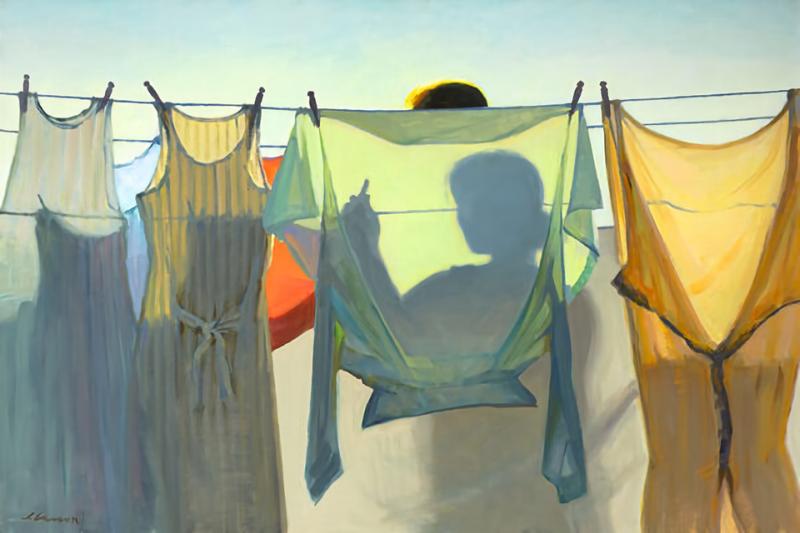
"Tendiendo la ropa / Hanging Laundry", óleo sobre lino / oil on linen, 30" x 48", 2009. facebook

"Patrones / Patterns", óleo sobre lienzo / oil on canvas, 50,8 x 61 cm., 2001. ARC

"Impresión de rosas / Rose Print", óleo sobre lienzo / oil on canvas, 61 x 76,2 cm., 2000. facebook

"Lavado matinal / Morning Wash", óleo sobre lino / oil on linen, 15" x 15". Collins Galleries

"Conversación en el tendedero - Colada / Clothesline Conversation – Laundry"
Óleo sobre lino / oil on linen, 91,4 x 116,8 cm., 2015

"Amarillo y azul / Yellow and Blue", óleo sobre lienzo / oil on canvas, 2005

"Sobre el tendedero / Over The Line", óleo sobre lienzo / oil on canvas, 32" x 84"

"Gracia y Caridad / Grace And Mercy"

"La sábana blanca / The White Sheet", óleo sobre lino / oil on linen, 30" x 30", 2006. facebook

"Notas de color / Color Notes", óleo sobre lino / oil on linen, 20" x 24", 1998. facebook
___________________________________________________________
Mian Situ
司徒綿
(开平市, 广州, 中国 / Kaiping, Provincia de Cantón [Guangdong] /
Guangdong Province, China, 1953-)

"Lavandería familiar china en 1880 / Chinese Family Laundry in 1880"
Óleo sobre lienzo / oil on canvas, 36" x 54", 2013
___________________________________________________________
John French Sloan
(Lock Haven, Pennsylvania, EE.UU./ PA, USA, 1871 -
Hanover, New Hampshire, 1951)

"Trabajo de mujeres / A Woman's Work", óleo sobre lienzo / oil on canvas, 80,3 x 65,4 cm., 1912
© Delaware Art Museum / Artists Rights Society (ARS), New York
The Cleveland Museum of Art (Cleveland, Ohio, EE.UU./ OH, USA)

"Sol y viento en la azotea / Sun and Wind on The Roof"
Óleo sobre lienzo / oil on canvas, 61,2 x 59,4 cm., 1915
Randolph College (Virginia, EE.UU./ VA, USA). Wikimedia Commons

"Tendiendo ropa / Hanging Laundry", aguafuerte / etching, 10,4 × 15,2 cm., 1912
Metropolitan Museum of Art (Nueva York, EE.UU./ NY, USA)

"Kimono rojo en la azotea / Red Kimono on the Roof"
Óleo sobre lienzo / oil on canvas, 60,9 x 50,8 cm., 1912
Indianapolis Museum of Art (Indiana, EE.UU./ IN, USA). Wikimedia Commons
___________________________________________________________
Jacob Abraham Camille Pissarro
(Carlota Amalia, Saint Thomas, Danmark / Dinamarca / Denmark, 1830 -
París, Francia / France, 1903)

"Femme étendant du linge / Mujer tendiendo la colada / Woman Hanging Laundry"
Óleo sobre lienzo / oil on canvas, 41 x 33 cm., 1887
Musée d'Orsay (París, Francia / France)
.jpg)
"Femme étendant du linge (étude) / Mujer tendiendo la colada (estudio) /
Woman Hanging Laundry (study)"
Óleo sobre lienzo montado sobre panel /
oil on canvas mounted on panel, 73,3 x 59,7 cm., c.1887. Wikimedia Commons / Hermitage Fine Art

"Les lavandières / Las lavanderas / The Washerwomen, Éragny-sur-Epte"
Óleo sobre lienzo / oil on canvas, 38 x 46 cm., 1895. Fine Art America

"Les laveuses à Éragny / Las lavanderas en Éragny / The Washerwomen at Eragny"
Óleo sobre lienzo / oil on canvas, 73,4 x 92,4 cm., 1901. Mutual Art
.jpg)
"Le Berger et les laveuses à / Pastor y lavanderas en / Shepherd and Washerwomen at Mountfoucault"
Óleo sobre lienzo / oil on canvas, 65 x 80 cm., 1881. Meisterdrucke

"Estudio de una lavandera arrodillada, vista desde atrás / Study of a Kneeling Washerwoman, Seen from Behind"
Carboncillo con tiza blanca y negra sobre papel azul-gris /
charcoal with white and blue chalk on blue-gray paper, 43,3 x 30,9 cm., 1881. Stephen Ongpin Fine Art
Este dibujo es un estudio preparatorio para una de las lavanderas arrodilladas del cuadro de Pissarro Pastor y lavanderas en Montfoucault, firmado y fechado en 1881, en el Museo Mohamed Mahmoud Khalil de Guiza, Egipto. El cuadro se expuso, como Le berger et les laveuses, en la séptima exposición impresionista de 1882, donde fue uno de los varios lienzos del artista en los que las campesinas ocupaban un lugar destacado. Como señaló un crítico en una reseña de la exposición, "Pissarro sitúa a sus campesinas frente al trabajo que están realizando: aquí están lavando a orillas de un curso de agua, con las mangas arremangadas, la parte baja de la espalda en tensión, las manos enrojecidas, están atrapadas trabajando".
This drawing is a preparatory study for one of the kneeling washerwomen in Pissarro’s painting Shepherd and Washerwomen at Montfoucault, signed and dated 1881, in the Mohamed Mahmoud Khalil Museum in Giza, Egypt. The painting was exhibited, as Le berger et les laveuses, at the seventh Impressionist exhibition in 1882, where it was one of several canvases by the artist in which peasant women were particularly prominent. As one critic noted of the painting in a review of the exhibition, ‘Pissarro places his peasant women in front of the actual work they are doing: here they are washing on the banks of a watercourse, their sleeves rolled up, the small of their back straining, their hands red, they are caught working.
Camille Pissarro en "El Hurgador" / in this blog: [Aniversarios (XXIV)]
________________________________________________________
Otros posts de esta serie / Other posts of this Series: [Sobre la vestimenta... / About Clothing... (I)]
________________________________________________________
Shirley Rebuffo es Licenciada en Bibliotecología y Archivología por la Escuela Universitaria de Bibliotecología y Ciencias Afines (Montevideo, Uruguay), Técnica en Museología por la Facultad de Humanidades y Ciencias (opción de Antropología), Objeto, símbolo y espacio en Curaduría. Museología Aplicada y Museología Social – Conceptos, técnicas y prácticas (Campo Grande, BR), Coaching (Campo Grande, BR), Planeamiento Estratégico (Campo Grande, BR) y estudiante de arte y pintura con el maestro Eduardo Espino.
Shirley Rebuffo has a Degree in Library Science and a Degree in Archivology by the Universitary School of Library and Related Sciences (Montevideo, Uruguay), Technician in Museology by the Faculty of Humanities and Sciences (Anthropology option), Object, Symbol and Spance in Curatorship Applied Museology and Social Museology - Concepts, Technics and Practice (Campo Grande, Brazil), Coaching (Campo Grande, Brazil), Strategic Planning (Campo Grande, Brazil), and Art and Painting student under Master Eduardo Espino.
________________________________________________________
Datos biográficos / Biographic information
Alice Ernestine Prin, apodada la Reina de Montparnasse y a menudo conocida como Kiki de Montparnasse, fue una modelo, cantante, actriz, escritora de memorias y pintora francesa de la Era del Jazz. Floreció y ayudó a definir la cultura liberada de París en los llamados Années folles ("años locos" en francés). Se convirtió en una de las modelos más famosas del siglo XX y de la historia del arte de vanguardia.
Adoptando un único nombre, "Kiki", Prin se convirtió en una fija de la escena social de Montparnasse y en una popular modelo, posando para decenas de artistas. En otoño de 1921, Prin conoció al artista visual estadounidense Man Ray, y pronto ambos iniciaron una tormentosa relación de ocho años. Vivió con Man Ray en su estudio de la rue Campagne-Première hasta 1929, durante el cual le hizo cientos de retratos.
Prin, pintora por derecho propio, expuso sus cuadros en la Galerie au Sacre du Printemps de París en 1927, con todas las entradas agotadas. Sus dibujos y pinturas, que firmaba con su nombre de soltera, Kiki, incluyen retratos, autorretratos, actividades sociales, animales de fantasía y paisajes de ensueño, compuestos en un estilo expresionista ligero y ligeramente irregular, reflejo de su despreocupación y optimismo sin límites.
Murió en 1953.
Alice Ernestine Prin, nicknamed the Queen of Montparnasse and often known as Kiki de Montparnasse, was a French model, chanteuse, actress, memoirist and painter during the Jazz Age. She flourished in, and helped define, the liberated culture of Paris in the so-called Années folles ("crazy years" in French). She became one of the most famous models of the 20th century and in the history of avant-garde art.
Adopting a single name, "Kiki", Prin became a fixture of the Montparnasse social scene and a popular model, posing for dozens of artists. In Autumn 1921, Prin met the American visual artist Man Ray, and the two soon entered into a stormy eight-year relationship. She lived with Man Ray in his studio on rue Campagne-Première until 1929 during which time he made hundreds of portraits of her.
A painter in her own right, Prin had a sold-out exhibition of her paintings in 1927 at the Galerie au Sacre du Printemps in Paris. Signing her work with her chosen single name, Kiki, her drawings and paintings comprise portraits, self-portraits, social activities, fanciful animals and dreamy landscapes composed in a light, slightly uneven, expressionist style that is a reflection of her carefree manner and boundless optimism.
She died in 1953.
Donald Saaf es un pintor estadounidense nacido en 1961. En su declaración artística, en su sitio web, podemos leer:
«Durante los últimos 20 años he estado explorando el lugar donde se cruzan las bellas artes y el arte popular. Mi temática se basa en la experiencia local de la comunidad, la familia y el entorno inmediato, así como en un lugar de ensueño interno. Aunque algunas de las imágenes son muy personales, siempre busco lo universal. Las figuras de los cuadros son a la vez "yo" y una especie de "Cada hombre".
Suelo empezar con una idea compositiva y, una vez establecida, dejo que las cosas crezcan orgánicamente. A veces enfoco la composición como una colcha, o incluso como una vidriera, descomponiéndola en formas y figuras luminosas. Intento ver los cuadros simultáneamente por su "historia" y como pura abstracción. A menudo hay diferentes capas en los cuadros. Algunas de las figuras tienen varias cabezas, una que parece más sólida y otras que parecen más transparentes y fantasmales, insinuando quizá el paso del tiempo o sugiriendo que la realidad es más flexible de lo que solemos pensar. Podrían ser una representación del alma o quizá sólo un símbolo de los muchos niveles de la conciencia personal.
Me interesa la memoria; la memoria del lugar y de la experiencia. El recuerdo de caminar por una calle imaginando el paisaje a vista de pájaro, al tiempo que se ve una casa a lo lejos, se perciben pequeños objetos en el suelo y se experimenta brevemente la vida de otras personas al pasar. Es el momento en que el mundo exterior se solapa con el interior.»
Donald Saaf is a American painter in 1961. In his artistic statement, on his website, we can read:
«For the past 20 years I have been exploring the place where fine art and folk art intersect. My subject matter draws from the local experience of community, family and immediate surroundings as well as an internal dream place. Although some of the imagery is very personal, I am always striving for the universal. The figures in the pictures are simultaneously ‘me’ and a sort of ‘Everyman’.
I usually begin with a compositional idea, and once that is established, I let things grow organically. At times I approach a composition like a quilt, or even a stained glass window; breaking down the composition into luminous forms and shapes. I try to see the pictures simultaneously both for their ‘story’ and as pure abstraction. Often there are different layers in the paintings. Some of the figures will have several heads; one that seems more solid and others that look more transparent and ghostly, hinting perhaps at the passage of time or suggesting that reality is more pliable than we usually think. They might be a representation of the soul or perhaps just a symbol for the many levels of personal consciousness.
I’m interested in memory; the memory of place and experience. The memory of walking down a street imagining the view from a birds eye view, while simultaneously seeing a house in the distance, noticing small objects on the ground and briefly experiencing other people’s lives as they pass by. It’s the moment that happens when the external world overlaps with the internal world.»
Ekua Holmes es una artista estadounidense nacida en 1955, residente de Roxbury de toda la vida y licenciada por el Massachusetts College of Art.
Pintora, diseñadora y artista del collage, los coloridos collages de Holmes responden a la necesidad de comunicar a las generaciones futuras cómo es la vida hoy: lo que sentimos y pensamos, nuestras luchas y victorias. "El arte visual", afirma, "contiene pistas importantes para comprender la historia de la humanidad. La artista guarda los detalles del cambiante paisaje humano del tiempo y el espacio, y así mantiene una conversación con la eternidad."
Ekua Holmes is an American artist born in 1955, is a lifelong resident of Roxbury and a graduate of the Massachusetts College of Art.
A painter, designer, and collage artist, Holmes’ colorful collages answer a need to communicate to future generations what life is like today--what we are feeling and thinking, our struggles and victories. "Visual art," she says, "holds important clues to understanding the history of humankind. The artist keeps the details of the changing human landscape of time and space, and in this way keeps a conversation with eternity."
José Francisco Domingo Laso de la Vega y de los Ríos fue un pintor y político peruano nacido en Tacna en 1823. En vida fue conocido sobre todo por sus retratos, pero actualmente se le conoce más por haber creado obras precursoras del indigenismo en el arte.
Nació en el seno de una familia aristocrática colonial. Cuando sólo tenía siete años, su madre murió y la familia se trasladó a Arequipa.
Asistió a las escuelas públicas, luego fue a Lima a estudiar Derecho, pero lo dejó al poco tiempo y se matriculó en la "Academia de Dibujo y Pintura".
En 1843 se trasladó a París, donde trabajó en los estudios del pintor suizo Charles Gleyre. Cuatro años más tarde viajó a Italia, donde visitó Roma, Florencia y Venecia. Le impresionaron especialmente las obras de Tiziano y Paolo Veronese. En 1849 regresó a Lima y abrió su propio estudio. También viajó por la sierra y la costa, pintando obras que retrataban la vida y las costumbres de la región. En 1851 pudo realizar un segundo viaje a Europa.
Esta vez, cuando regresó a Perú en 1855, se instaló en Arequipa y, a petición del obispo (más tarde arzobispo) José Sebastián de Goyeneche y Barreda, pintó varias obras religiosas. También realizó retratos. En 1863 contrajo matrimonio y realizó otro viaje a Europa que duró tres años.
Poco después de su regreso, participó en la batalla del Callao, donde sirvió como bombero. Al año siguiente, fue elegido diputado al Congreso Constituyente. Una vez en el cargo, fue atacado por críticos anónimos, que se quejaban de que se había lucrado con las diversas becas que le habían permitido estudiar en Europa. Para acallarlas, regaló al gobierno tres cuadros.
En 1868, una epidemia de fiebre amarilla asoló Lima, y colaboró estrechamente con la Cruz Roja en su campaña para erradicarla. Sin embargo, su salud no estaba a la altura y contrajo la enfermedad en 1869.
Murió en 1869.
José Francisco Domingo Laso de la Vega y de los Ríos was a Peruvian painter and politician, born in Tacna, in 1823. During his lifetime he was mostly known for his portraits, but is now better known for creating works that were precursors to indigenismo in art.
He was born to an aristocratic colonial family. When he was only seven, his mother died and the family moved to Arequipa.
He attended the public schools, then went to Lima to study law, but quit after only a short time and enrolled at the "Academy of Drawing and Painting".
He moved to Paris in 1843 and found a position in the studios of the Swiss painter Charles Gleyre. Four years later, he went to Italy, visiting Rome, Florence and Venice. He was especially impressed by the works of Titian and Paolo Veronese. In 1849, he returned to Lima and opened his own studio. He also travelled throughout the Sierra and along the coast, painting works that depicted the life and customs of the region. He was able to make a second trip to Europe in 1851.
This time, when he went back to Peru in 1855, he settled in Arequipa and, at the request of Bishop (later Archbishop) José Sebastián de Goyeneche y Barreda, he painted several religious works. He also did portraits. In 1863, he was married and made another trip to Europe which lasted for three years.
Shortly after his return, he was a participant in the Battle of Callao, where he served as a firefighter. The following year, he was elected a Deputy to the "Congreso Constituyente". Once in office, he was attacked by anonymous critics, complaining that he had made a profit from the various grants that had allowed him to study in Europe. In an effort to silence them, he presented the government with three paintings.
An epidemic of yellow fever struck Lima in 1868, and he worked closely with the Red Cross in their campaign to eradicate it. His health was not up to the effort, however, and he caught the disease in 1869.
He died in 1869.
Gary Bunt es un pintor británico autodidacta, nacido en 1957, que actualmente vive en Tonbridge, Reino Unido, con su esposa y sus dos hijos.
Fue un trabajador agrícola al principio de su carrera, y esto se refleja en sus pinturas con escenas de granjeros y paisajes rurales. Gracias a sus habilidades literarias, acompaña las pinturas con composiciones poéticas.
Leía libros sobre pintura mientras aprendía de las obras de otros artistas como William Scott y Christopher Wood. Comenzó a pintar profesionalmente a los 40 años, cuando descubrió que tenía cáncer, y lo hacía libremente, mostrando la vida de un granjero y su perro en la campiña inglesa. Gary ha declarado que el granjero es una representación de sí mismo en una vejez que nunca pensó que alcanzaría.
Gary Bunt is a self-taught British painter, born in 1957, who currently lives in Tonbridge, UK, with his wife and two children.
He was a farm worker at the beginning of his career, and this is reflected in his paintings with scenes of farmers and rural landscapes. Thanks to his literary skills, he accompanies the paintings with poetic compositions.
He read books on painting while learning from the works of other artists such as William Scott and Christopher Wood. He began painting professionally at the age of 40, when he discovered he had cancer, and did so freely, depicting the life of a farmer and his dog in the English countryside. Gary has stated that the farmer is a representation of himself in an old age he never thought he would reach.
Jeffrey T. Larson nació en 1962 en Two Harbors, Minnesota, y creció en las Ciudades Gemelas. A los diecisiete años comenzó sus estudios clásicos con una formación tradicional en el Atelier Lack de Minneapolis, bajo la tutela de Richard Lack. Tras su formación de cuatro años en el Atelier Lack (1980-1984), Larson estudió la obra de los maestros en Estados Unidos y en el extranjero. Estos ejercicios incluían la escultura, lo que proporcionó a Larson una comprensión superior del volumen y la forma que hoy es evidente en sus pinturas. Larson también fue director adjunto e instructor principal en el Atelier LeSeur de Minnesota (1984-1986).
Una marca distintiva de la obra de Larson es su capacidad para elevar el tema. A diferencia de su pintura al aire libre, en la que se centra en la impresión de la luz del sol, sus cuadros de estudio se centran en una luz más contemplativa y atmosférica creada por sutiles cambios de valor y delicadas pinceladas. Ya sea al aire libre o en el estudio, Larson toma algo que de otro modo el ojo categorizaría como anodino y lo presenta con tal autoridad que reevaluamos su integridad artística y, en última instancia, encontramos belleza y relevancia en la cosa misma.
Jeffrey T. Larson was born in 1962 in Two Harbors, Minnesota and grew up in the Twin Cities. At the age of seventeen he began his classical studies with traditional atelier training under Richard Lack at the Atelier Lack in Minneapolis, MN. Following his four- year training at Atelier Lack(1980-1984), Larson studied the work of the masters in the United States and abroad. These exercises included sculpting, which granted Larson a superior understanding of volume and form that is evident in his paintings today. Larson also served as the assistant Director and Head Instructor at Atelier LeSeur in Minnesota (1984-1986).
A Trademark of Larson’s work is his ability to elevate his subject matter. In contrast to his outdoor painting where his focus is on the impression of sunlight, his studio paintings focus on a more contemplative, atmospheric light created by subtle changes in value and delicate brushwork. Whether outdoors or in the studio, Larson takes something that the eye would otherwise categorize as unremarkable, and presents it with such authority that we re-evaluate its artistic integrity, and ultimately find beauty and relevance in the thing itself.
Nacido en el sur de China, Mian Situ (司徒綿) recibió su formación artística formal en su Guangdong natal, antiguo Cantón. Se licenció en Bellas Artes en el Instituto de Bellas Artes de Guangzhou, y unos años más tarde obtuvo un máster en Bellas Artes.
Los cuadros de Mian reflejan claramente su educación en el campo de su China natal. Sus cuadros impresionistas de tonos profundos se centran a menudo en la gente que vive su vida cotidiana en pequeños pueblos y comunidades agrícolas. La versatilidad artística de Mian también queda patente en sus exquisitos retratos, así como en sus obras más recientes inspiradas en temas históricos occidentales y paisajes americanos. Desde 1995 ha sido reconocido con numerosos premios nacionales de arte. Durante la exposición Masters of the American West de 2003 en el Gene Autry Museum, fue galardonado con tres importantes premios: el Thomas Moran Memorial Award (en reconocimiento a un mérito artístico excepcional), el Artists' Choice Award y el Patrons' Choice Award. También ha ganado el Premio a la Excelencia para Maestros Firmantes por su cuadro "Helpful Hand".
Born in Southern China, Mian Situ (司徒綿) received his formal art training in his native homeland of Guangdong, formerly Canton. He graduated with a Bachelor of Fine Arts from the Guangzhou Institute of Fine Art, and a few years later earned a Masters in Fine Art.
Mian’s paintings clearly reflect his upbringing in the rural countryside of his native China. His deep-toned impressionistic paintings of the backcountry often focus on people going about their daily lives in their small villages and farming communities. Mian’s artistic versatility is also evident in his exquisite portraiture, as well as his more recent works inspired by western historical themes and American landscapes. Since 1995, he has been recognized with many national art awards. During the 2003 Masters of the American West show at the Gene Autry Museum, he was honored with three major awards: the Thomas Moran Memorial Award (in recognition of exceptional artistic merit), Artists’ Choice Award and Patrons’ Choice Award. He has also won the Award for Excellence for Master Signature Members for his painting, “Helpful Hand”.
John French Sloan fue un pintor y grabador estadounidense nacido en 1871.
Se le considera uno de los fundadores de la escuela Ashcan de arte estadounidense. También fue miembro del grupo conocido como Los Ocho. Se le conoce sobre todo por sus escenas de género urbano y su habilidad para captar la esencia de la vida en los barrios de Nueva York, a menudo observada a través de la ventana de su estudio de Chelsea. Sloan ha sido considerado el principal artista de la Escuela Ashcan, y también un pintor realista que abrazó los principios del socialismo, aunque él mismo desvinculó su arte de su política.
Murió en 1951.
John French Sloan was an American painter and etcher born in 1871.
He is considered to be one of the founders of the Ashcan school of American art. He was also a member of the group known as The Eight. He is best known for his urban genre scenes and ability to capture the essence of neighborhood life in New York City, often observed through his Chelsea studio window. Sloan has been called the premier artist of the Ashcan School, and also a realist painter who embraced the principles of Socialism, though he himself disassociated his art from his politics.
He died in 1951.


.jpg)

.jpg)


.jpg)


%20The%20Horsemen%20of%20the%20Apocalypse,%201908.%20Art%20Institute%20of%20Chicago,%20USA-ok..jpg)
%20Red%20Horseman,%201913.%20Civiche%20raccolte%20d%E2%80%99arte,%20Milan-B2-OK.jpg)
%20Horseman,%201915.%20%D0%A1ollage.%20%D0%A1olecci%C3%B3n%20particular-Peggy%20G-800.jpg)
%20Western%20Horseman.%201917.%20Oil%20on%20canvas.%20Private%20Collection-BIG-OK-.jpg)
%20Red%20Horseman,%201974.%20Oil%20and%20Magna%20on%20canvas,%20213,4x284,5%20cm.%20Estate%20of%20Roy%20Lichtenstein..jpg)
.jpg)




%20The%20shell%20(Conus%20Marmoreus),%201650.%20Etching,%20OK..jpg)
%20Sea-shell,%201919%20or%201920.%20Woodcut..jpg)

.jpg)

%20Nautilus%20shell,%201927-BIG%20OK.jpg)


